-
John Williams: Helping People and Preserving Biodiversity Hotspots
›March 16, 2012 // By Schuyler Null“Both humans and the number of species in the world are not evenly distributed across the globe,” said John Williams of the University of California, Davis, who recently spoke at the Wilson Center about his contribution to Biodiversity Hotspots: Distribution and Protection of Conservation Priority Areas. “In particular we find that species diversity is concentrated in what’s called the biodiversity ‘hotspots.’”
Largely in the tropics, Mediterranean climates, and along mountain chains, biodiversity hotspots are “where there’s a real concentration in number of species and also unique species – plants and animals that exist nowhere else on Earth,” he said.
“It’s a very complex relationship between biodiversity and human population, because it’s not necessarily [true] that places of high human population are a threat to biodiversity,” said Williams. Many different factors play a role, “like education, like consumption, like economic development, different cultures – how people interface with the natural world – all these things create nuances as far as what that relationship is between biodiversity and where people live.”
“There are some basic things we can do that are going to be good for human welfare, as well as biodiversity,” he continued. A few are addressing lack of education, especially among girls, in areas of high biodiversity; providing basic health services, including family planning, where rural growth rates are highest; and improving physical access to rural areas to promote economic development.
“We see there’s a direct correlation between each additional year of schooling a girl has and their fertility during their lifetime,” Williams said. “As people climb out of poverty, they also choose to have smaller, healthier families.” -
The Middle East Program
Reflections on Women in the Arab Spring
›The Arab Spring has fascinating and powerful demographic and gender undercurrents. Last year, demographer Richard Cincotta counseled observers to pay close attention to the demonstrations: if they featured young women – as opposed to being dominated by young men and boys – it’s a sign that democracy may be on its way. To mark the occasion of International Women’s Day last week, the Wilson Center’s Middle East Program gathered observations from a cross-section of regional voices on how women have fared thus far.
Excerpted below is the entry from Moushira Khattab, former Egyptian ambassador to South Africa and the Czech and Slovak Republics, and former minister of family and population:As the global community celebrates International Women’s Day, we must hail the heroic and pivotal role Egyptian women played to make the January 25th Revolution an inspiration for the world. They joined men and took to Tahrir Square calling for freedom, dignity, and social justice. They rallied around the cause of pushing the train of political change. One year later, Egyptian women find that the train of change has not only left them behind, but has in fact turned against them. It is ironic that the revolution that empowered a country, and made every Egyptian realize the power of their voice, stopped short of women’s rights. Sadly, the only march that was kicked out of Tahrir Square was that of women celebrating 2011 International Women’s Day. Women were beaten, subjected to virginity tests, and stripped of their clothes in the very same Tahrir Square.
Download the full set of reflections from the Wilson Center’s Middle East Program.
Dormant conservative value systems are being manipulated by a religious discourse that denies women their rights. Calls for purging the sins of the old regime necessitate a reminder of the positive outcomes of laws that, although enacted under that old regime, have liberated and enhanced women’s status, including prohibiting female genital mutilation and child marriage. We also need a reminder that such gains are only a step towards these rights, and are the outcome of collective hard work along generations. Against the background of parliamentary elections, defenders of women’s rights have backed down, while young revolutionaries don’t have women’s rights on their agendas. The most telling indicator is the shameful and meager representation of women in Egypt’s post-revolution parliament. Among a handful of elected female MPs, one declared that her top priority is to repeal the law granting women the right to seek divorce.
With religious parties controlling it, the question becomes: Will this parliament be willing and able to produce a constitution that guarantees equal rights to all Egyptians regardless of gender or religion? Dare we dream that Egyptians in 2012 could have a constitution equal to that put in place by South Africans in 1996? -
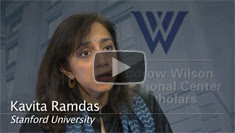
Kavita Ramdas: Why Educating Girls Is Not Enough
› “I’m a big proponent of girl’s education. I believe that it’s a very important and a very valuable human rights obligation that all countries should be meeting,” said Kavita Ramdas, executive director for programs on social entrepreneurship at Stanford University, at the Wilson Center. However, “in the past seven to eight years we have found ourselves in a situation where there’s kind of an enchantment with girl’s education, as though it were the new microenterprise magic bullet to solve everything from poverty, to malnourishment, to inequality.”
“The outcomes that we ascribe to girl’s education…are not anything that I would argue with,” she said, yet, this enchantment “has happened simultaneously with a significant drop in both funding and support for strategies that give girls and women access to reproductive health and choices, particularly family planning.”
This is a problem, said Ramdas, because we cannot rely on education alone to do all the heavy lifting required to empower women.
“I think it’s important for us to recognize that there are societies where girls and women have achieved significantly high levels of education in which gender inequality remains,” she said, “for example, places like Japan and Saudi Arabia, where you have high per capita income, high levels of education, and yet…where women and girls are still marginalized and on the edges in terms of decision making.”
“I don’t think we have to wait for one to be able to do the other,” she said. “As we support programs for girls’ education, we also need to demand that those programs be buttressed by strong programs in adolescent health, strong programs in sex education, strong programs that actually provide girls and women with access to family planning and contraception.” -
Africa’s Demographic Challenges, Genderizing Food Security and Climate Responses
›Gender and Climate Change Research in Agriculture and Food Security for Rural Development is a detailed training guide produced by the CGIAR Research Program on Climate Change, Agriculture and Food Security and the Food and Agricultural Organization of the United Nations (FAO). The guide’s purpose is to support “work to investigate the gender dimensions of responding to climate change in the agriculture and food sectors…to improve food production, livelihood security and gender equality.” The authors write that “the number of hungry people in the world could be reduced by more than 100 million if women in rural areas were given equal access to the same resources as men.” The guide focuses on sensitizing researchers and practitioners “to the links between socio-economic and gender issues” and provides a suite of tools for gathering data about the gender and climate change aspects of agricultural development. Along with concrete tools to understand and address gender inequities in agricultural development, the report adopts a nuanced social definition of gender in which “people are born female or male, but learn to be women and men,” keeping the focus squarely on the socio-economic and political barriers to full equality.A report from the Berlin Institute for Population and Development, Africa’s Demographic Challenges: How A Young Population Can Make Development Possible, argues that “if mortality and fertility decrease” across the African continent, there will be a “demographic bonus.” If nurtured through ample investment in human capital, this bonus may become a “demographic dividend,” as growing numbers of working-age people participate in the economy. The report argues that taking advantage of this demographic window, however, requires policy actions that both encourage fertility reductions and foster economic development throughout the continent, declaring boldly that “high birth rates and development are mutually exclusive.” Thus, according to the authors, the pathway to development is supporting the empowerment and education of women and girls, strengthening reproductive health services, and ensuring that both young women and young men are able to engage socio-economically within their societies. Though the report’s argument that demographic change can be critical for development is convincing, the form, strength, and causal direction of these linkages at times becomes confused. -
Women’s Health: Key to Climate Adaptation Strategies
›The discussion about family planning and reproductive rights “needs to be in a place where we can talk thoughtfully about the fact that yes, more people on this planet – and we’ve just crossed seven billion – does actually put pressure on the planet. And no, it is not just black women or brown women or Chinese women who create that problem,” said Kavita Ramdas, executive director for programs on social entrepreneurship at Stanford University. [Video Below]
-
More People, Less Biodiversity? The Complex Connections Between Population Dynamics and Species Loss
›March 8, 2012 // By Laurie Mazur“For if one link in nature’s chain might be lost, another and another might be lost, till this whole system of things should vanish by piece-meal.”
~ Thomas Jefferson, 1799This much is clear: As human numbers have grown, the number of species with whom we share the planet has declined dramatically. While it took about 200,000 years for humanity to reach one billion people around 1800, world population has grown sevenfold since then, surpassing seven billion last year.
-
Reaching Out to Environmentalists About Population Growth and Family Planning
›“Promoting women’s empowerment is an effective strategy for looking at climate and the environment but also is important in its own right,” said the Sierra Club’s Kim Lovell at the Wilson Center on February 22. “Increasing access to family planning for women around the world is a climate adaptation and climate mitigation solution.” [Video Below]Drawing on research by Brian O’Neill (National Center for Atmospheric Research) and others Lovell explained that meeting the unmet need for family planning around the world could provide up to 16 to 29 percent of the emissions reductions required by 2050 in order to avoid more than two degrees of warming (the target set by nations to prevent the most damaging effects of climate change).
For environmentalists and those concerned with climate change, “sometimes the idea has been that population is toxic, that we can’t talk about population growth,” said Nancy Belden of Belden Russonello and Stewart Consulting, but the results of a recent survey and several focus groups conducted in association with Americans for UNFPA demonstrate that there is great potential for engaging the environmental community in such a discussion.
Belden and Lovell were joined by Kate Sheppard from Mother Jones to discuss how the population and environment communities can come together in the lead-up to the Rio+20 UN sustainable development conference.
Besides providing a basic health commodity, empowering women through access to family planning also improves adaptation outcomes, said Lovell. “Climate change is already happening and women and families around the world are suffering from the effects of water scarcity [and] of erratic weather patterns,” she said. But “when women have the ability to plan their family size and have more choices about their families and about their reproductive health and rights, that makes it easier to adapt to those climate change effects that are already taking place.”
Resonating With Environmental Priorities
“The people who really care about the environment are generally the same people who care about access to contraception and birth control and family planning…they’re a ready audience to hear about these connections and they’re a ready audience to take action about them,” said Kate Sheppard. Reproductive rights issues are something that people can really connect with, she said; “most women, most men too…understand why it’s an important issue and they’ve understood it in their own life and they have [a] very strong response to it.”
When we approach the linkages between environment and population, said Sheppard, it is important to recognize the role of empowering language – language about access to services, education, and resources for women.
The aim of the Americans for UNFPA survey was to find out whether environmentalists can be engaged in discussions of population issues such as family planning and international voluntary contraception, and if so, how?
The results show that “environmentalists are ready to talk about population, they’re ready to listen – it’s not toxic,” said Belden. She outlined three key findings:
First, environmentalists prioritize the environment but they also give a high priority to empowering women, said Belden. “Population pressures are seen as an environmental problem…they don’t dismiss it,” yet the “strongest framework that we could come up with…for engaging people on the issues around voluntary family planning and contraception focuses on women.”
Second, the environmental community is relatively optimistic about the potential outcomes of family planning programs and of foreign aid in general. When queried, half of the environmentalists strongly supported the idea of U.S. contributions to UN programs that provide voluntary access to contraception in developing countries, said Belden.
When asked to mark their top priority among a list of possible outcomes of providing voluntary access to contraception, 47 percent of the environmentalists selected either “improving living conditions for women and their families” or “ensuring women have options and can make reproductive decisions” as their top priority. While a significant number are also concerned about stalling population growth, this integrative focus on improving the lives of women and their families is heartening, said Belden.
In the Run-Up to Rio+20, More Than Pop
One point that all three speakers stressed is the need to integrate consumption into the integrated population message. In her survey work, Belden found that “if you don’t talk about consumption in the same breath, [environmentalists] start wanting to put it in there because otherwise…this is someone blaming others.”
Lovell similarly highlighted that “if we’re working to ensure a sustainable planet for future generations to come, we have to think about consumption and population.” For instance, “the United States makes up five percent of the world’s population but consumes 25 percent of the world’s resources,” she said.
Said Sheppard: “It’s not simply a problem that the numbers of people here on the Earth are going up, it’s a problem of how people, especially here in the U.S., live.”
It is imperative – especially from a sustainable development standpoint – that while working towards integrating environment and population we remain focused on a message that includes “using less but still having a high quality of life” here at home, said Sheppard.
Event ResourcesSources: Proceedings of the National Academy of Sciences.
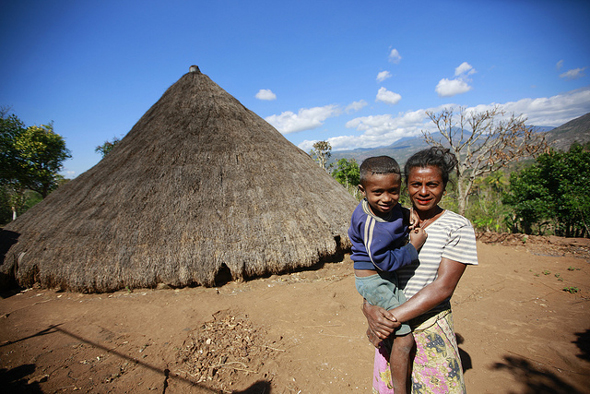
Photo Credit: “Timorese Traditional Home,” courtesy of United Nations Photo. -
Melanne Verveer and Others at Heinrich Böll Gender Equity and Sustainable Development Conference
›The Gender Equity and Sustainable Development conference, hosted last month by the Heinrich Böll Foundation, was a testament to the increasing importance of gender and sustainability within the international development community. Representatives from the U.S. government, UN, and countless international non-profits, aid organizations, and corporations demonstrated the vital need for collaboration and innovative action when working towards a more sustainable world.
The conference kicked off with an invigorating speech by the Honorable Melanne Verveer, U.S. Ambassador-at-Large for Global Women’s Issues, who called on the international community to acknowledge the “vital role that women can and must play in sustainable development.”
“Putting a spotlight on the critical role of women in stopping climate change will help to harness the immense human capacity of women worldwide,” said Verveer. By advocating for consideration of gender at every level – from grassroots organizing to policymaking – the ambassador painted a picture of a new era of sustainable development.
Step One: Recognize the Problem
A series of four panels followed the keynote address and focused on the intersections between gender inequity, the economy, trade, food and agriculture, and climate change.
There was clear consensus among all the participants that worldwide consciousness of gender inequity can lead to vast improvements in the status of women while also opening the door for new, innovative approaches to sustainable development. The 16 panel members represented numerous groups, from Oxfam America to Gender Action to the Stockholm Environment Institute, and all spoke to the importance of working for larger structural changes while simultaneously shifting more economic, social, and political power into the hands of women by any means possible.
The panelists described a world in which women represent a tremendous, untapped resource for change. Although women only own approximately one percent of titled land worldwide, they own close to 33 percent of business in the developing world and spend two-thirds of consumer dollars worldwide, which they tend to invest in sectors like health and education that benefit the larger community. Verveer said that data also shows women are more likely to pass environmental legislation and that forestry projects involving women have a higher rate of success.
Humanizing Climate Change
The big question of the conference seemed to be: in a world where women are disproportionately vulnerable to the effects of climate change, why aren’t women given more of a voice in the process of creating a more sustainable world?
Marie Brill, a senior policy analyst at Action Aid USA, pointed to the production of biofuels as a poignant example of a sustainable development plan that has had unintended negative consequences for women around the world. In the developing world, women are primarily responsible for food provisioning, yet many social and legal restrictions prevent women from owning land. If women had better access to land ownership and food insecurity would decrease, she said, and crops yields could increase by as much as 20 to 30 percent.
Foreign ownership of large tracts of land, common in the production of biofuels, makes land title even more difficult for women to acquire or maintain. The industry has also led to price spikes for staple crops like corn, said Brill, meaning poor women are sometimes unable to feed their families.
While biofuels provide an alternative fuel source, their production has been managed in a way that ignores the gender-specific implications of the process. By maintaining an awareness of gender, we can ensure that women do not become victims as we move towards a more sustainable world, Brill said.
Liane Schalatek, the associate director of the Heinrich Böll Foundation North America, suggested that a paradigm shift is needed regarding our approach to climate change.
Approaching climate change from a purely scientific and technological perspective is offensively simplistic, Schalatek said. “We need to humanize climate change and bring social equity into the discourse,” she said, emphasizing that “it is our obligation under international human rights objectives and vital to the success of sustainable development to take a rights-centered approach.”
Molly Shane was an intern for the Sierra Club’s Global Population and Environment Program.
Sources: Boston Consulting Group, Council on Foreign Relations, Food and Agriculture Organization of the United Nations, USAID, U.S. State Department, Women Deliver.
Photo Credit: “Climate Risk and Resilience: Securing the Region’s Future,” courtesy of the Asian Development Bank.
Showing posts from category gender.