Showing posts from category forests.
-
How Did We Arrive at 7 Billion – and Where Do We Go From Here? [Part Two]
›October 26, 2011 // By Elizabeth Leahy MadsenThe world’s women will determine whether the global population in 2050 is as low as 8 billion or as high as 11 billion through their choices (or lack thereof) about the number and timing of their children. Women in developing regions of the world will have the greatest effect on these potential population trajectories. Even if fertility rates remain constant at current levels (which is unlikely), developing regions would grow from 5.7 billion in 2010 to 9.7 billion in 2050, but the total population of developed countries would remain essentially unchanged. The UN estimates that the seven billionth person alive today will be born on October 31. Demographer Elizabeth Leahy Madsen explains how we got to that number, its significance, and where our demographic path might take us from here. Read part one here.
The world’s women will determine whether the global population in 2050 is as low as 8 billion or as high as 11 billion through their choices (or lack thereof) about the number and timing of their children. Women in developing regions of the world will have the greatest effect on these potential population trajectories. Even if fertility rates remain constant at current levels (which is unlikely), developing regions would grow from 5.7 billion in 2010 to 9.7 billion in 2050, but the total population of developed countries would remain essentially unchanged.
The way that people decide the timing and number of their children is not easily distilled into a simple formula with a single solution. Still, some basic and important facts are known. In the developing world, where more than 80 percent of the world’s population lives, women in rural areas, those who have little or no education, and those who are poor, have larger families. As demographers have shown in modeling the determinants of fertility, women tend to seek contraception once they are confident that their children will survive to adulthood and when socioeconomic development increases the “costs” of having children, for example by motivating parents to send them to school rather than to work.
One of the most direct reasons for past declines in fertility rates was the rapid expansion of family planning and reproductive health programs, supported by country governments and international donors, that enabled women and men to more effectively choose the size of their families. But today, about 215 million women across the developing world would like to delay or avoid pregnancy but are using ineffective contraception or none at all. Funding programs to meet the family planning needs of these women, which would cost about $3.6 billion annually, would both empower them and help fertility rates continue to decline.
Beyond Access: Gender Inequality Inhibits Contraceptive Use
While increasing support for family planning programs tops the list of demographers’ recommended policies, ensuring that contraceptives are available and accessible will not alone achieve the fertility declines projected in most of the UN’s range of possibilities. Many women who are having or planning to have large families know about family planning and where to find it, but are choosing not to use contraception for cultural reasons that are often deeply engrained.
In sub-Saharan Africa, the region with the highest global fertility rate, only 16 percent of married/partnered women of reproductive age are using effective contraception. In comparison, between 62 and 75 percent of their peers in Ireland, the United States, and Uruguay – countries whose fertility rates are almost exactly at replacement level – are using it.
Logically, sub-Saharan Africa needs similar levels of contraceptive use to bring its average fertility rate towards replacement level as the UN projects, so the region’s average prevalence rate for modern contraception would need to rise by at least 10 percentage points in each of the next four decades. However, contraceptive use in the region has grown by only 0.5 percentage points or less over the past 30 years.
What is inhibiting the use of contraception? Demographic and health surveys find in Nigeria, for example, that 10 percent of married women are using an effective contraceptive method, while twice as many have an unmet need for family planning. This low use of family planning demonstrates high potential for change in the country’s demographic future, which, as the most populous in Africa, will greatly influence global and regional trends. Yet among women who do not intend to use contraception, 39 percent report that they or their family members are opposed to family planning, and another 16 percent fear side effects or have other health-related concerns. If Nigeria’s fertility rate remains unchanged, the country will be home to 500 million people by 2050.
In Pakistan, where 24 percent of births are unintended, surveys show similar barriers. Ninety-six percent of married women know about effective contraceptive methods, but only 22 percent are using one. More than one-quarter of women who do not plan to use contraceptives report that their fertility is “up to God” and 23 percent report that they or their family members are opposed to family planning. Pakistan’s population would more than double from 174 million to 379 million by 2050 if current fertility trends hold constant.
Peak Planet? Population Growth and Consumption Strain Environmental Resources
Because Nigeria, Pakistan, and other countries’ demographic trajectories may not follow the path laid out in population projections, we can’t take a world of nine billion for granted. While human ingenuity and technological advancements have improved standards of living in many countries, scientists caution that the combination of rising human numbers and growing consumption has serious environmental implications. Already, the quantity and quality of fresh water supplies are under strain, and forests in many developing countries are being rapidly depleted.
Population projections are much more than wonkish speculation – they foreshadow the serious problems that lie ahead if health, environment, and development policies aren’t strengthened. If the UN projections of our demographic future are to bear any semblance of reality, we must move beyond the status quo. While improving physical access to family planning should remain a top priority, meeting unmet need will also require addressing the deep-seated challenges of women’s education and empowerment.
Elizabeth Leahy Madsen is a consultant on political demography for the Wilson Center’s Environmental Change and Security Program and former senior research associate at Population Action International.
Sources: Bongaarts and Sinding (2009), Bongaarts (2006), Futures Institute, Guttmacher Institute and UN Population Fund, Measure DHS, O’Neill, Dalton, Fuchs, Jiang, Shonali Pachauri, and Katarina Zigova (2010), UN Population Division, Washington Post.
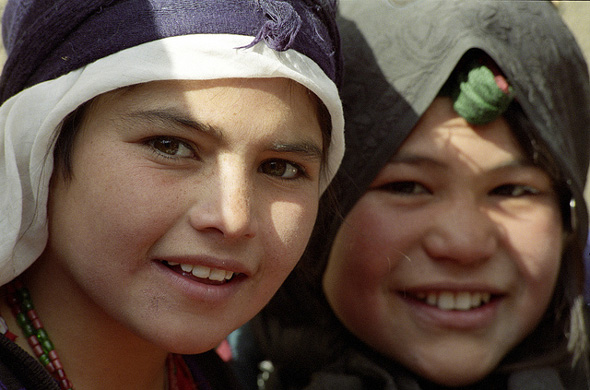
Photo Credit: “Afghan Internally Displaced Persons,” courtesy of flickr user United Nations Photo. -
Robert Draper, National Geographic
People and Wildlife Compete in East Africa’s Albertine Rift
›The original version of this article, by Robert Draper, appeared on National Geographic.
The mwami remembers when he was a king of sorts. His judgment was sovereign, his power unassailable. Since 1954 he, like his father and grandfather before him, has been the head of the Bashali chiefdom in the Masisi District, an undulating pastoral region in eastern Democratic Republic of the Congo (DRC). Though his name is Sylvestre Bashali Mokoto, the other chiefs address him as simply doyen – seniormost. For much of his adult life, the mwami received newcomers to his district. They brought him livestock or other gifts. He in turn parceled out land as he saw fit.
Today the chief sits on a dirty couch in a squalid hovel in Goma, a Congolese city several hours south of Masisi. His domain is now the epicenter of a humanitarian crisis that has lasted for more than a decade yet has largely eluded the world’s attention. Eastern Congo has been overtaken by thousands of Tutsi and Hutu and Hunde fighting over what they claim is their lawful property, by militias aiming to acquire land by force, by cattlemen searching for less cluttered pastures, by hordes of refugees from all over this fertile and dangerously overpopulated region of East Africa seeking somewhere, anywhere, to eke out a living. Some years ago a member of a rebel army seized the mwami’s 200-acre estate, forcing him, humiliated and fearing for his safety, to retreat to this shack in Goma.
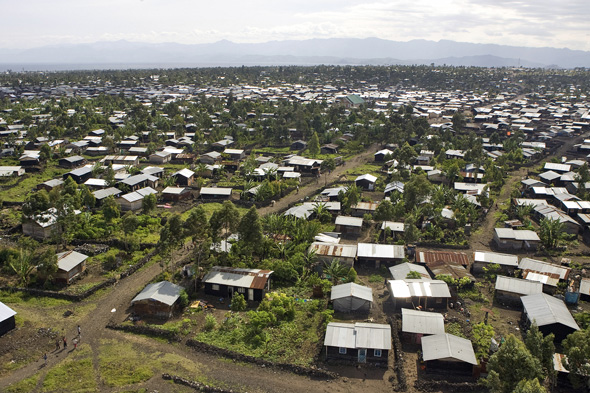
The city is a hornet’s nest. As recently as two decades ago Goma’s population was perhaps 50,000. Now it is at least 20 times that number. Armed males in uniform stalk its raggedy, unlit streets with no one to answer to. Streaming out of the outlying forests and into the city market is a 24/7 procession of people ferrying immense sacks of charcoal on bicycles or wooden, scooter-like chukudus. North of the city limits seethes Nyiragongo volcano, which last erupted in 2002, when its lava roared through town and wiped out Goma’s commercial district. At the city’s southern edge lies the silver cauldron of Lake Kivu – so choked with carbon dioxide and methane that some scientists predict a gas eruption in the lake could one day kill everyone in and around Goma.
The mwami, like so many far less privileged people, has run out of options. His stare is one of regal aloofness. Yet despite his cuff links and trimmed gray beard, he is not a chief here in Goma. He is only Sylvestre Mokoto, a man swept into the hornet’s nest, with no land left for him to parcel out. As his guest, a journalist from the West, I have brought no gifts, only demeaning questions. “Yes, of course my power has been affected greatly,” the mwami snaps at me. “When others back up their claims with guns, there is nothing I can do.”
Continue reading on National Geographic.
Photo Credit: “Aerial View of Goma,” courtesy of UN Photo/Marie Frechon. -
Watch: Scott Wallace on the Amazon’s Last Uncontacted Tribes and the Intersection Between Human Rights and Conservation
›October 19, 2011 // By Wilson Center StaffIn the far west of the Amazon, some of the last uncontacted indigenous tribes on Earth live untouched by modern society. Scott Wallace, frequent contributor to National Geographic and former public policy scholar at the Wilson Center, spoke to New Security Beat about his new book, The Unconquered: In Search of the Amazon’s Last Uncontacted Tribes, which chronicles his harrowing trip through the Javari Valley Indigenous Land. Wallace accompanies former sertanista (“agent of contact”)-turned-native rights advocate Sydney Possuelo as he attempts to map and protect the territory of the flecheiros, or Arrow People, named for the poison-tipped arrows they use.
The Brazilian government and activists are trying to protect the areas where these native groups live and allow them to choose for themselves if they want contact. “It’s not that hard to find us,” Wallace said. For the moment, however, “it’s clear that they do not want that contact.”
By protecting these people, the government is also protecting thousands, if not millions, of acres of virgin rainforest, said Wallace, creating a mutually beneficial intersection between human rights and environmental conservation.
“The assumption is that there is now a global village, everyone’s connected…no one of us is separated from anyone else on the planet by more than six degrees of separation,” said Wallace. But that assumption breaks down in the face of these people who live in complete isolation from the rest of the world.
We have to decide whether to leave them alone and let them live their lives or try to make lasting contact, said Wallace. Contact would open up the tribe’s land and resources to development but come at great risk to their society, their lives (due to vulnerability to disease), and the Amazonian ecosystem, as the example of India’s Adavasi tribes demonstrates. -
Health and Harmony: Population, Health, and Environment in Indonesia
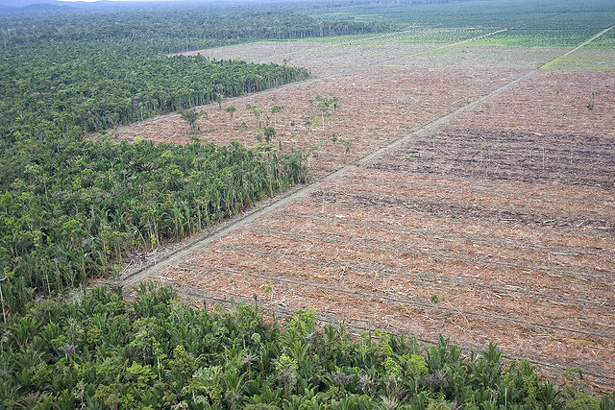
›Borneo’s Gunung Palung National Park is a microcosm of both the island’s ecological wealth and vulnerability. More than half of the park is undisturbed forest; the remainder, however, “is being torn down day after day” at an alarming rate, said Health in Harmony’s Nichol Simpson at an event on integrated approaches to population, health, and environment (PHE) programs in Indonesia. Alene Gelbard of the Public Health Institute’s Company-Community Partnerships for Health Indonesia (CCPHI) program joined Simpson on September 29 at the Wilson Center. Both speakers emphasized that no matter what issue a group works on, engaging local communities is essential for success.
The Destructive Cycle: Poor Health, Poor Environment
For Simpson, “the intersection between human and environmental health” is at the heart of Health in Harmony’s work. Health in Harmony opened Clinic ASRI in 2007, aiming to provide improved healthcare to villagers throughout Gunung Palung National Park while ending their dependence on illegal logging as a means of financial survival.
The area’s inhabitants were all too easily trapped in what Simpson called “the destructive cycle.” When faced by an unexpected medical emergency, families would go into debt to pay their medical bills. Health in Harmony found that of 232 local households surveyed, 13 percent had recently experienced a major medical emergency, at an average cost of $360. Most households in the area only hold around $260 in emergency savings, so to make up the difference, about a third turned to illegal logging to pay down their debt.
By deforesting the park, illegal logging worsens the health of nearby communities. For example, Simpson said that Clinic ASRI has seen a rise in cases of malaria and tuberculosis in the surrounding communities, in part because deforestation has increased the level of mosquito activity. The link between human and environmental health is clear, said Simpson: the people ASRI serves are “living it every day. They know the cause of this. And…they want it to stop.”
Protecting Natural Resources By Improving Health
The Health in Harmony clinic located in Sukadana, a small village sandwiched between Borneo’s coast and Gunung Palung Park, helps break the destructive cycle by treating patients regardless of their ability to pay. If patients do not have cash, they can barter for their care. In one case, a girl named Yani came to ASRI after her family incurred $500 over two months of visiting hospitals and traditional healers, none of whom could treat her condition. ASRI diagnosed and treated Yani for scabies. In exchange, her mother signed a pledge to protect Gunung Palung from logging and made the clinic a floor mat to cover the $1.50 bill.
By providing affordable, high-quality healthcare that is contingent upon pledging to protect the environment, Clinic ASRI improves human and environmental health in one fell swoop, said Simpson. “Because the infant mortality rate has decreased and you’re not overcompensating,” said Simpson, families can choose to have fewer children, using free birth control provided by ASRI.
“When you have fewer and healthier children, you’re investing in your education,” said Simpson. “When you’re investing in your education, you’re investing in your country and your community. This is the virtuous cycle. I didn’t invent it, but we are proving it in Sukadana.”
The communities around the clinic have embraced ASRI’s work, partnering with them to expand their services to address additional community needs, like training farmers in more productive organic methods and providing mated pairs of goats for widows, who pay ASRI back with kid goats and manure for fertilizer.
All but one of the 23 villages that ASRI services have been consistently free of illegal logging, according to monitors who visit them on a regular basis. “We’re proving the theory that we can protect natural resources by improving health,” Simpson said.
“Health Is Key to Sustainable Development”
Gelbard took a step back to talk about CCPHI’s experience establishing multi-sector partnerships among NGOs and corporations by building trust and enabling dialogue between the communities.
With corporate responsibility becoming more popular, “everyone’s talking about partnerships these days, and everybody’s partnering with everyone,” said Gelbard. “I don’t care what they call it – I care what they’re doing” and what results they achieve, she said. A successful partnership involves “all partners doing something more than just giving money.”
Gelbard said the 2004 tsunami reinforced the notion of corporate responsibility for a lot of companies operating in Indonesia. They saw that unless they branched out beyond their own walls and “did things to help strengthen communities,” efforts at corporate responsibility simply “would not benefit them in the long-run,” she said.
Through CCPHI, companies and NGOs have partnered on a wide range of efforts, including improving access to and funding for reproductive health services, improving sanitation by increasing access to water, and combating human trafficking by empowering girls and women.
Achieving the Millennium Development Goals will require increasing access to health care in a manner that reflects the needs of communities, she said. At its core, CCPHI’s work and the partnerships it facilitates are “based on the knowledge that health is key to sustainable development,” said Gelbard.
Event Resources
Sources: Alam Sehat Lestari, American Journal of Tropical Medicine and Hygiene, Company-Community Partnerships for Health Indonesia, ExxonMobil, The Guardian, Health in Harmony, National Geographic, PBS News Hour, Public Health Institute, Republic of Indonesia Ministry of Forestry, United Nations, World Wildlife Fund
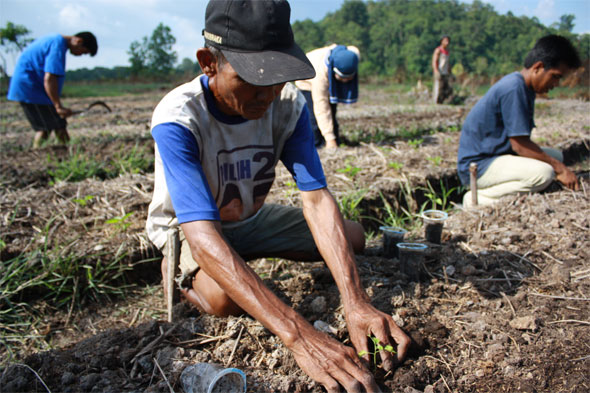
Photo Credit: Used with permission courtesy of ASRI and Nikki See, Under-told Stories. -
Watch: Dennis Taenzler on Four Key Steps for REDD+ to Avoid Becoming a Source of Conflict
›The UN Program on Reducing Emissions from Deforestation and Forest Degradation (REDD) provides financial incentives to developing countries to conserve their forests and invest in low-carbon pathways to sustainable development. However, it may also be a potential new source of conflict, says Dennis Taenzler, a senior project manager at adelphi in Berlin, who works on climate and energy policies as well as peace and conflict issues.
-
Remembrance: Wangari Maathai, Nobel Peace Prize Winner, Linked Environment and Conflict
›September 26, 2011 // By Schuyler NullSad news today as Wangari Maathai, the first African woman and the first environmentalist to win the Nobel Peace Prize, has passed away in Nairobi. The Green Belt Movement, which Maathai founded in 1977, has planted over 30 million trees and advocates for what Maathai called the three essential components of a stable society: sustainable environmental management, democratic governance, and a culture of peace. [Video Below]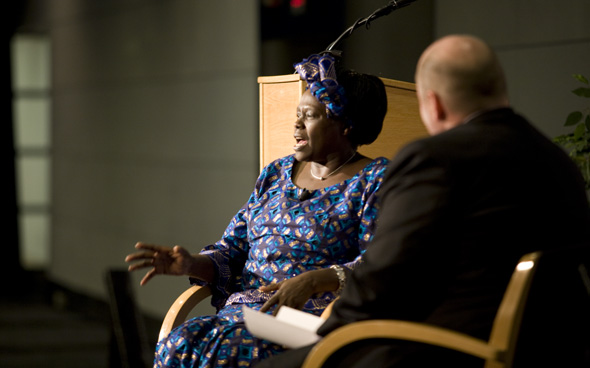
“Almost every conflict in Africa you can point at has something to do with competition over resources in an environment,” said Maathai during her visit to the Wilson Center in 2009:Unless you deal with the cause, you are wasting your time. You can use all the money you want for all the years you want; you will not solve the problem, because you are dealing with a symptom. So we need to go outside that box and deal with development in a holistic way.
Maathai’s message was molded from her experiences in Kenya and across sub-Saharan Africa in general. She was not shy about condemning African leaders and advocating for women in the political space. In ECSP Report 12, she wrote, “I come from a continent that has known many conflicts for a long time. Many of them are glaringly due to bad governance, unwillingness to share resources more equitably, selfishness, and a failure to promote cultures of peace.”
Importantly, though, Maathai advocated for addressing these issues in concert, not separately. She said at the Wilson Center:I can’t say, ‘Let us deal with governance this time, and don’t worry about the resources.’ Or, ‘Don’t worry about peace today, or conflicts that are going on; let us worry about management of resources.’ I saw that it was very, very important to use the tree-planting as an entry point.
A Message to the World
Some raised questions when Maathai won the Nobel Peace Prize in 2004 – the first awarded to someone from the environmental field – but the recognition was more than deserved, wrote Environmental Change and Security Program (ECSP) Director Geoff Dabelko on Grist:Maathai is on the front lines of the struggle over natural resources that fuels conflicts across the world. While there is no dramatic footage of tanks rumbling across borders or airplanes flying into buildings, the everyday fight for survival of those who depend directly on natural resources – forests, water, minerals – for their livelihoods is at the heart of the battle for peace and human security.
Maathai explained in Report 12 that she thought her winning of the prize was intended as a message to the world to “rethink peace and security.”
…
Elevating such a strong Southern voice – and one whose elephant’s skin bears the scars of the fight for peace – is a noble choice.
The Nobel Committee “wanted to challenge the world to discover the close linkage between good governance, sustainable management of resources, and peace,” she wrote. “In managing our resources, we need to realize that they are limited and need to be managed more sustainably, responsibly, and accountably.”
Sources: Grist, The New York Times.
Photo Credit: David Hawxhurst/Wilson Center. -
IRP and TIME Collaborate on Indonesia’s Palm Oil Dilemma
›“Everything the company does goes against my conscience. But the question remains, who should work from the inside to inform everyone? Who should be pushing that these things are right, these things are acceptable, and these things are not?” says Victor Terran, in this video by Jacob Templin for TIME and the International Reporting Project (IRP). Templin traveled to Indonesia as part of IRP’s Gatekeeper Editor program in May 2011.
Terran is a resident of a village west of Borneo in the Kalimatan province, where he works as a field supervisor for one of the largest palm oil companies in Indonesia. Although the industry has supplied his village with much-needed employment and economic development, he worries that the influx of jobs has come at the expense of the health of the forests, agriculture, and clean rivers that sustain his village. “It’s not just about the money,” he says. “Will they sincerely keep the regulations and be fair to our community?”
An Industry with a Checkered Past
Terran’s skepticism of the industry is justified – palm companies, such as Sinar Mas, have a nasty track record of “abusing local labor and pilfering forests” for what they call “liquid gold,” says Templin.
Greenpeace released a report, “How Sinar Mas is Pulping the Planet,” in 2010 that alleged that Sinar Mas cut down important wildlife preserves, illegally planted on peat lands, and that these actions resulted in the release of considerable amounts of carbon into the atmosphere and loss of critical wildlife habitat.
As a result, the company lost major contracts with Unilever, Kraft, and Nestle. Sinar Mas CEO Franky Widjaya tells Templin that the company is taking definitive steps to prevent such instances from happening again, but that change will not happen overnight.
Akhir bin Man, a manager for another palm oil company, PT Kal, says he does not want to experience a public relations nightmare similar to Sinar Mas, so his company is seeking certification from the internationally recognized Roundtable on Sustainable Palm Oil (RSPO). The RSPO certification requires PT Kal to conserve nearly half of its land, use safer pesticides, and negotiate profit-sharing agreements with villagers.
Global Benefits
“These are not only vast forest landscapes which are home to species such as orangutans, elephants, and rhinos, but they’re also some of the globally most important reservoirs of carbon,” Adam Tomasek, director of the WWF Heart of Borneo Initiative, tells Templin.
Due to the wide-scale implications of disrupting such a substantial carbon sink, Tomasek and his colleagues see the destruction of these habitats as not just a local problem: “Sustainably managing the forest and carbon stocks that they contain here in Indonesia is not only important locally, not only important regionally, but an extremely important critical in the global approach to dealing with climate change,” he says.
Resisting the Juggernaut
Recognizing the inherent value of their natural resources, some villages are fighting to keep palm companies off of their land. Pak Bastarian is the head of such a village: “In my opinion, [palm] plantations are only owned by certain groups of people, and they don’t necessarily bring prosperity,” he tells Templin.
Bastarian is a reformed environmentalist whose hesitance toward the palm industry is a by-product of his own experiences – in the 1990s he worked for years running a timber company that illegally cut down trees. “I don’t know how many trees I cut down…a countless number.” Now, he uses his elected power to preserve trees like the ones he once cut down.
However, keeping the companies out of his village is an uphill battle, Templin explains. Bastarian says he faces mounting pressure from governmental officials, who make threats, and many villagers, who would rather have the jobs. He tells Templin that he even received bribes from PT Kal (an accusation they deny).
Bastarian’s position may cost him though – with elections right around the corner, he said does not know how much longer he can keep the palm companies out.
“My worry is that if our forests are cleared, our children will not be able to see what protected wood looks like, or what protected animals look like,” he tells Templin. When the palm oil companies first came, he chose to wait and see how the other villages fared before allowing them to come in. “To this day,” he says, “I’ve never changed my mind.”
Video Credit: “Indonesia’s Palm Oil Dilemma: To Cash In or Fight for the Forests?,” courtesy of the International Reporting Project. -
Backdraft: Minimizing Conflict in Climate Change Responses
›“What are the conflicts or risks associated with response to climate change?” asked ECSP Director Geoff Dabelko at the Wilson Center on July 18. “How we respond to climate change may or may not contribute to conflict,” he said, but “at the end of the day, we need to do no harm.”