-
Michael Kugelman, World Politics Review
The Gathering Global Food Storm
›March 28, 2011 // By Wilson Center StaffThe original version of this article, by Michael Kugelman, appeared on World Politics Review.
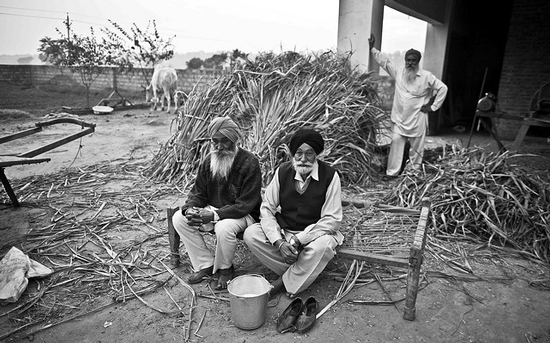
In India’s vibrant capital, food seems to be everywhere – from bustling fruit and vegetable markets and greasy kebab stalls, to sumptuous platters in rooftop restaurants and dilli ki chaat, Delhi’s ubiquitous street snacks. Poor street vendors and high-end chefs alike offer a multitude of culinary options to keep the city – and its array of visiting tourists, diplomats and business leaders – well-fed.
Yet behind this apparent culinary prosperity lies rampant food insecurity. Food-related inflation in India soared above 18 percent in December, sparking street protests over high onion prices. Today, food-related inflation remains high, at nearly 12 percent. In a nation where at least 250 million subsist on less than a dollar a day, even modest price rises have a devastating impact on incomes and livelihoods. Yet, when food prices fall, India’s small farmers suffer. Already crippled by debt and encumbered by water shortages, 200,000 of them have committed suicide over the past 13 years.
India is not alone in this story. Just a few years removed from the 2007-2008 global food crisis, the world is once again experiencing the telltale drivers of acute food insecurity: rising prices of both food and oil, low agricultural yields, destructive weather and unquenchable demand. Once again, nations are banning exports in an effort to keep prices down at home – even as such policies drive up food costs in global markets. The consequences can be seen from Bolivia, where top government officials are hoarding food in their homes, to the Middle East, where the rising cost of basic foodstuffs has become a rallying cry for revolution.
Continue reading on World Politics Review.
Michael Kugelman is a program associate for the Asia Program at the Wilson Center and lead editor of Hunger Pains: Pakistan’s Food Insecurity and Land Grab? The Race for the World’s Farmland.
Sources: The Economist, India’s Contemporary Security Challenges, CNN, The Washington Post.
Photo Credit: Adapted from “India’s Food Crisis,” courtesy of flickr user lecercle. -
Shannon Beebe, Los Angeles Times
Somali Piracy Shows How an Environmental Issue Can Evolve Into a Security Crisis
›March 14, 2011 // By Wilson Center Staff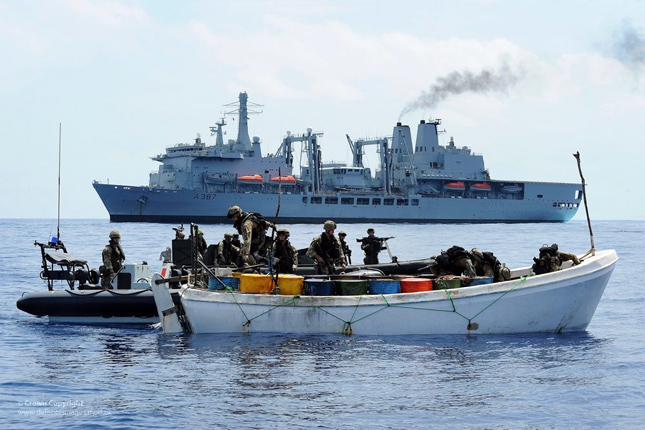
It has become apparent that real piracy is far different from the lighthearted subject sometimes portrayed in popular culture, and the problem is growing much worse. Besides the tragic cost in lives, the United States, many other nations, and NATO spent roughly $2 billion combined last year to safeguard the busy international sea lanes off the Horn of Africa from Somali pirates. According to the International Maritime Bureau, “hijackings off the coast of Somalia accounted for 92 percent of all ship seizures last year,” and the price tag does not include the costs of reallocating critical military resources.
-
Mapping the Hot Spots of the 2010/11 Food Crisis
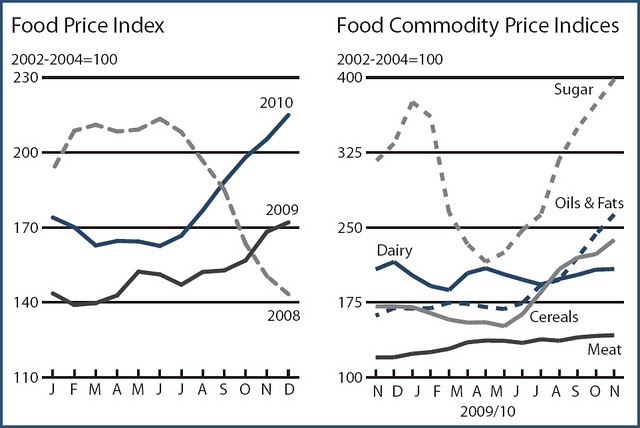
›If you’ve taken a trip to the supermarket lately or scanned the headlines you may have noticed something: Food prices are on the rise. Worldwide, food prices are on track to reach their highest point since their peak in 2008. Using data from the Food and Agriculture Organization (FAO), the International Food Policy Research Institute (IFPRI), and the World Bank, the Environmental Working Group (EWG) and ActionAid have collaborated to create an interactive world map called, “Hot Spots in the Emerging Global Food Crisis.”
The focus of the map is to highlight the 52 most at-risk countries where increases in staple food prices could tip the scales of stability. There are three variants of the map to choose from: countries at risk which depend on imported cereals, countries where prices are already increasing (featured above), and countries with vulnerable economies and high rates of hunger.Food prices have become a hot topic of conversation lately for their alleged role in the instability that is rocking the Middle East/North Africa region. But the Middle East is not the only area affected: Besides in Algeria, Tunisia, Morocco, Jordan, and Egypt, food-related riots and protests have also broken out in Mozambique, Bolivia, and India. As the map’s accompanying text puts it, these food riots “feed deeper discontent about economic inequalities and hunger and help give rise to revolutions that can topple governments, as in Tunisia and Egypt.”
Scrolling over a country reveals more information, like, for example, the specific percentage increases in the price of wheat or rice over the past year (wheat prices have risen 15.9 percent in China vs. 54 percent in Kyrgyzstan) or the amounts of corn, soybean, and wheat annually imported and exported (Afghanistan exported 908 million metric tons of wheat in 2010 while Egypt imported 4,978).
Users can also click on vulnerable countries to see how many people are malnourished and their per capita income per day. In the Democratic Republic of the Congo, for example, an estimated 42 million people were undernourished between 2005 and 2007, and the average person lives on $0.28 per day. According to EWG and ActionAid, the total number of people living in extreme poverty rose by 25 million in 2008 during the last global food crisis. Since June 2010, the start of the current upward trend in prices, the World Bank estimates that 44 million people have fallen into extreme poverty.
One recommendation from EWG and ActionAid for developed countries and the United States in particular: Stop looking to biofuels as an energy option. In their view, “spending scarce taxpayer dollars to shift crops from food to biofuels at the expense of hungry people and already stressed resources like soil, water, and air is unsustainable.”
Image Credit: Map courtesy of the Environmental Working Group and ActionAid, and Food Price Index and Food Commodity Indices, extracted from Global Food Price Monitor, January 2011, courtesy of the Food and Agriculture Organization.
Sources: ActionAid International, BBC News, CNN, the Environmental Working Group, The European Union Times, Time, Voice of America, World Bank. -
Rural Poverty: The Bottom One Billion
›March 10, 2011 // By Hannah MarquseeThere are currently 1.4 billion people in the world living in extreme poverty, and 70 percent of them – about one billion people – live in rural areas, according to the Rural Poverty Report 2011, published recently by the International Fund for Agricultural Development (IFAD). The two regions most affected by rural poverty are South Asia, home to half of the world’s rural poor, and sub-Saharan Africa, where, team leader Ted Heinemann points in the accompanying trailer, “the number of rural people living in extreme poverty is actually increasing and the proportion is a very high 62 percent.”
The State of Rural Poverty
While the number of rural poor in the world has actually declined sharply since the late 1980s, the decline is due almost entirely to gains made in East and Southeast Asia, particularly China. Despite these gains, rural poverty remains a stubborn challenge in South Asia, Southeast Asia, and sub-Saharan Africa: three-quarters of the poor in these areas are rural, and “the proportion is barely declining, despite urbanization,” says the report. In the Middle East, North Africa, Latin America, and the Caribbean, the majority of the extremely poor live in urban areas.
The number of undernourished people in the world has also declined slightly from its historic high of 2009, after a doubling of international food prices between 2006 and 2008 left a staggering one billion hungry. (However, food prices recently passed 2008’s historic high point, and some have argued they may have been a factor in the recent uprisings in the Middle East and North Africa.) From a high of one billion, the world’s hungry have since decreased to 925 million, a figure that the UN Food and Agriculture Organization nonetheless calls “unacceptably high.” The current rate of decline is far from meeting the MDG target of halving the number of people who suffer from hunger by 2015, says the IFAD report, and with continuing population growth and resource and energy scarcities, they predict little change in the number of hungry worldwide.
Meeting Rising Demand, Sustainably
“Feeding a global population of just over 9 billion in 2050 will require a 70 percent increase in global food production,” says the report. To do this, the report calls for more sustainable agricultural intensification driven by small-holder farmers. “Small-holder agriculture…can offer rural people a route out of poverty just as they can offer the world a solution to meeting its future food needs,” says IFAD President Kanayo Nwanze, in the trailer.
Increasing global agricultural production must be done “in the context of a weakened natural resource base, energy scarcities, and climate change,” says the report. This will require more efficient use of water, less waste, and a shift towards more resilient crops. It will also require linking scientific knowledge with local farmer knowledge in order to create a sustainable, context-specific approach. The report recommends a sustainable small-holder agriculture system that gives rural people incentives to protect their environment, while helping them adapt to climate change.
Providing Economic Opportunities
Since 80 percent of rural households “farm to some extent,” agricultural intensification will be “a primary engine of rural growth and poverty reduction,” says IFAD, especially in the poorest countries. In a statement to announce the launch of the report, Nwanze said, “rather than romanticizing the concept of lifting poor rural women, men, and children above the poverty line, like a plague that can be eradicated by charity and humanitarian gestures, we are advocating the proactive creation of vibrant rural economies.”
But lifting the one billion rural people out of poverty is not just about stimulating rural farm economies, says the report; it also means creating opportunities in the rural non-farm economy to minimize the risk of economic shocks that drive people into poverty in the first place. While agriculture remains central to rural economies, urbanization, globalization, improved information systems, and growing investments in renewable energy all offer opportunities for growth in rural, non-farm economies. Helping rural people take advantage of these opportunities will require multiple investments, says the report: in education to improve the capabilities of rural youth; in infrastructure and social services to make rural areas better places to live; and in governance mechanisms and collective organizing so that rural people can better represent their own interests.
“Robust action is required now to address the many factors that perpetuate the marginalization of rural economies,” says IFAD. “Above all, this action needs to turn rural areas from backwaters into places where the youth of today will want to live and will be able to fulfill their aspirations.”
Sources: AFP, FAO, IFAD, United Nations, The Washington Post.
Video Credit: “Rural Poverty Report 2011,” courtesy of YouTube user IFADTV. -
Engineering Solutions to the Infrastructure and Scarcity Challenges of Population Seven Billion (and Beyond)
›March 9, 2011 // By Hannah MarquseeA recent Institution of Mechanical Engineers (IME) report, Population: One Planet, Too Many People?, argues that “sustainable engineering solutions largely exist for many of the anticipated challenges” of a world population scheduled to top seven billion this year and projected to reach upwards of nine billion by 2050. “What is needed,” write the authors, “is political and social will, innovative financing mechanisms, and the transfer of best practice through localization to achieve a successful outcome.”City lights on the French-Italian border, from the International Space Station.
Since nearly all of the population growth in the next 40 years will occur in the developing world, the report recommends nations adopt five “Engineering Development Goals” (listed below), alongside the Millennium Development Goals, to meet the needs of the world’s growing poor. The report also recommends that developed countries provide technical engineering expertise to developing countries in the model of the UK Department for International Development’s Resource Centers. This assistance will help them implement these goals and “leapfrog” the “resource-hungry, dirty phase of industrialization.”
Population Growth a Threat?
While the report issues a clear call to action for engineers and governments, it does not address the issue of population growth per se, which has caused some to argue that population growth might not be the problem after all. The Independent, for example, initially headlined their article about the report, “Population Growth Not a Threat, Say Engineers,” but changed it after publication to “Population Growth a Threat, Say Engineers.”
The IME authors clearly state that “population increase is likely to be the defining challenge of the 21st century,” and the report provides practical steps governments can take given current population trends. But its focus on “engineering solutions” highlights the ongoing debate between those who argue that technological fixes alone can solve the world’s social and environmental problems, and those who advocate for contraception as a low-cost path to a sustainable world.
“I would love there to be technological solutions to all our problems,” said Nobel Laureate Sir John Sulston at a recent ECSP event on the UK Royal Society’s forthcoming People and the Planet study, but “we’ve got to make sure that population is recognized, while not the sole problem, as a multiplier of many others. We’ve got to make sure that population really does peak out when we hope it will.”
The projections on which the report is based will be difficult to hit without dramatic reductions in fertility, mainly in sub-Saharan Africa – a goal that is nigh impossible without increased investment in access to voluntary family planning. The UN high variant projection, which calculates a much less dramatic decrease in current fertility levels, has world population reaching 11 billion by 2050.
“There is no need to delay action while waiting for the next greatest technical discovery,” write the IME authors. “If action is not taken before a crisis point is reached there will be significant human hardship. Failure to act will place billions of people around the world at risk of hunger, thirst, and conflict as capacity tries to catch up with demand.”
Engineering Development Goals
1. “Energy: Use existing sustainable energy technologies and reduce energy waste.”
Currently, “over 1.5 billion people in the world do not have access to energy,” says the IME report. In addition, global demand for energy is expected to rise by 46 percent by 2030, and the world will need to invest $46 trillion over the next 40 years to shift towards renewable energy sources. The report points out that “there are no insurmountable technical issues in sourcing enough energy for an increasingly affluent larger global population.” Instead, “the difficulties lie in the areas of regulation, financing, politics, social ethics, and international relations.”
2. “Water: Replenish groundwater sources, improve storage of excess water and increase energy efficiencies of desalination.”
Global water consumption, write the IME authors, is predicted to rise 30 percent by 2030 due to population growth and increased energy and agricultural consumption. These numbers are troubling, considering that a recent study in Nature found that more than 1.7 billion people, almost entirely from the developing world, already face chronically high water scarcity.
However, this problem is not simply one of a shortage of water, rather “a case of supply not matching demand at a certain time and place where people are living,” says the IME report. Engineering solutions must involve the capturing and storage of rain water, more cost-effective desalination techniques, and aquifer storage and recovery techniques, says the report. But more importantly, “decision-makers need to become more aware of the issues of water scarcity and work more closely with the engineering profession in finding localized solutions.”
3. “Food: Reduce food waste and resolve the politics of hunger.”
The IME report cites the World Bank’s prediction that demand for agricultural production will double by 2050, due to a combination of population growth, more people turning to meat-heavy diets, and agricultural shortages from extreme weather events. Efficiencies can go a long way towards filling this supply-demand gap, says the IME report. In developed countries an average of 25 percent of edible food is thrown away in the home after purchase, while in developing countries, as much as half of crops are lost before ever reaching market due to lack of adequate transportation and storage infrastructure.
For example, the authors point out that in India, “between 35 percent and 40 percent of fruit and vegetable production is lost each year between the farm and the consumer” – an amount greater than the entire annual consumption of the UK. Americans are also big food wasters. A USDA study found that in one year, 27 percent of all edible food was thrown away in the United States after purchase. Developed countries can significantly increase efficiency “through behavioral change that recognizes the value of food,” says the report.
4. “Urbanization: Meet the challenge of slums and defending against sea-level rises.”
Urbanization “presents one of the greatest societal challenges of the coming decades,” write the IME authors, but cities also represent a “significant opportunity…to be very efficient places to live in terms of a person’s environmental impact.”
According to the World Bank, by 2050, three quarters of the world will live in cities, and nearly all of this growth will occur in the developing world. Already, one third of the world’s urban population live in “appalling slum conditions,” says the IME report. Challenges for the urban poor are especially severe in coastal areas – home to three quarters of the world’s large cities – where they are vulnerable to flooding and extreme weather events, which according to new studies, have increased as a result of climate change.
The report calls for nations to use an “integrated, holistic approach” that brings in engineering expertise early in the planning process to create infrastructure that is individualized to a city’s unique cultural, geographical, and economic needs.
5. “Finance: Empower communities and enable implementation.”
Implementation of the above four goals will require “innovative soft loans and micro-financing, ‘zero-cost’ transition packages, and new models of personal and community ownership, such as trusts,” write the IME authors. Furthermore, communities must play a central role in decision-making in order to find appropriate and local solutions.
In all five of these goals, “barriers to deploying solutions are not technological,” says the report. Instead, they are political and social. Better international cooperation, dialogue, and sharing of expertise between and amongst engineers, decision-makers, and the public, is crucial to implementation.
Sources: Department for International Development, Guardian, The Independent, Institution of Mechanical Engineers, Nature, The New York Times, UN Habitat, United Nations, USDA, World Bank.
Image Credit: “City Lights, France-Italy Border (NASA, International Space Station Science, 04/28/10),” courtesy of flickr user NASA’s Marshall Space Flight Center. -
USAID’s Role in National Security: Development Matters and It’s Cheaper Than You Think
›February 22, 2011 // By Ramona Godbole“Development is not and cannot be a sideshow,” said U.S. Agency for International Development (USAID) head Rajiv Shah, in a speech at the Center for Global Development on January 19. This year marks the 50th anniversary of USAID, and there are some promising changes in the works for the agency as it transforms itself into a “modern development enterprise.”
Over the past year, the Obama administration launched the Quadrennial Diplomacy and Development Review (the QDDR – see our full set of reviews on this first-of-its-kind document), Feed the Future, and the Global Health Initiative. In accordance with these new strategic initiatives, USAID has launched USAID Forward to implement a series of reforms to strengthen its capacity to meet the world’s development challenges effectively and efficiently. The agency has tried to foster a “spirit of innovation, science, technology, and smarter strategic thinking to each of [its] areas of core focus: gender, education, water, and climate,” said Shah. In his speech at CGD, he announced a new, re-worked evaluation policy and outlined a number of cost-saving actions, including graduating countries that no longer need aid, promoting procurement and contracting reform, and eliminating some costly senior positions in the agency.
Value to Shareholders
Moving forward, USAID is working to further reduce inefficiencies and increase transparency, said Shah, and is “focused on delivering the highest possible value for our shareholders – the American people and the congressional leaders who represent them.” He added that “like an enterprise, we’re relentlessly focused on delivering results and learning from success and failure.”
These are exciting changes for the development community. But, if Congress significantly cuts funding, by, for example, passing a plan similar to one endorsed by 165 Republican representatives a few weeks ago, these changes might not see the light of day – the plan proposed to save $1.39 billion by eliminating agency operating expenses. Putting that in perspective, the USAID operating budget for the past fiscal year was $1.69 billion. (Strangely, while the plan all but eliminates the agency that administers them, it does little to cut actual outgoing foreign assistance monies.)
The plan, however, may reflect the views of much of the American public. A World Public Opinion poll showed that Americans believe the government spends up to 25 percent of its budget on foreign aid and want to cut back to 10 percent, while in fact, aid represents just one percent of the federal budget (compared with more than 20 percent for defense).
What the proposed plan fails to take into account is development’s role in promoting peace, security, and prosperity globally. Said Shah at CGD, “as the President and the Secretaries of State, Treasury, and Defense have all made abundantly clear, development is as critical to our economic prospects and our national security as diplomacy and defense.”
A More Efficient Investment
Shah elaborated on this idea in an interview with Foreign Policy last month: “In the military they call us a high-value, low-density partner because we are of high value to the national security mission but there aren’t enough of us and we don’t have enough capability,” he said. “This is actually a much, much, much more efficient investment than sending in our troops, not even counting the tremendous risk to American lives when we have to do that.”
Chad Briggs, a professor for the USAF Air University, pointed out the multiple benefits to the military that increased State and USAID agency in the field could provide in his review of the QDDR:Considering the existing responsibilities of the United States overseas and the potential for future risks and crises that will need to be addressed, the QDDR’s recommendations to strengthen engagement abroad can only be a positive step for U.S. interests. If the various hurdles enumerated above and elsewhere can be addressed, the QDDR’s focus on emerging risks may also ease the burden on DOD resources and force deployments, recognizing that not every engagement abroad should be resolved by the military alone.
If done right, development can provide both economic growth and democratic governance and help stabilize countries before, during, and after conflict or crisis in a cost-effective way while simultaneously addressing transnational human and environmental security issues like hunger, poverty, disease, and climate change (see Yemen for an example where the application of soft power now could reduce the chance of deploying more hard power later).
Policymakers should support USAID’s current efforts to make smarter investments, “which over time will save hundreds of millions of dollars, as opposed to trying to save a little bit now by cutting our capacity to do oversight and monitoring,” said Shah in Foreign Policy.
Sources: Center for Global Development, The Economist, Foreign Policy, USAID, U.S. Department of State, World Public Opinion.
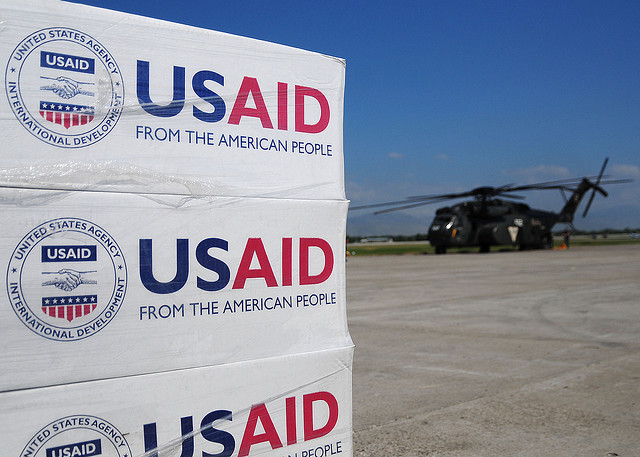
Photo Credit: “Pallets of food, water and supplies staged to be delivered,” courtesy of flickr user USAID_Images. -
A Dialogue on Managing the Planet
›“Collectively, the impact of humanity on the way the planet works is enormous and headed in disturbing directions,” said George Mason University professor Thomas Lovejoy in January at the first in a monthly series, “Managing the Planet,” led jointly by George Mason University and the Woodrow Wilson Center. The series will focus on how to take “environmental management to the scale of the entire planet,” as climate change, increasing energy consumption, and population growth place increasing stress on natural resources. We need to “chart a better course for the human future,” said Lovejoy.
Joining Lovejoy at the kickoff meeting were Dennis Dimick, executive environment editor at National Geographic, and Professor Molly Jahn of the University of Wisconsin-Madison. [Video Below]
Signs From Earth
“The entire human enterprise is based on the assumption of a stable climate,” said Lovejoy. The “most dramatic part of the story” in recent decades has been the melting of ice in the Arctic and in the mountain ranges of tropical zones. At current rates, tropical glaciers will completely disappear within the next 15 years. Though scientists predicted it would last until at least 2015, Bolivia’s Chacaltaya glacier – once renowned as the world’s highest elevation ski area – was reduced to a “few lumps of ice” in 2009, according to the BBC.
Glacial melt has raised water temperatures, altered species migrations, and threatened water supplies, coastal ecosystems, and the communities that depend on them, said Lovejoy. Higher ocean temperatures also cause the “fundamental partnership” between coral reefs and algae to break down, and “the Technicolor world essentially goes black and white,” he said.
Ocean acidification, fresh water shortages, melting glaciers, pollution, forest fires, and a “vast whipsaw” of temperature and weather extremes are just some of the effects human consumption has had on the planet, said Dimick. “It’s a sign from the Earth. It is telling us, ‘not all is well.’”
Finding Balance
As the world’s population nears seven billion this year, “we have one planet, yet we live like we live on four,” said Dimick. National Geographic’s new series “Population 7 Billion” seeks to answer the questions, he said, of “how do we find balance? How do we find ways to lower the intensity of our demands on an Earth that is telling us it is strained?”
Finding solutions to these challenges will require us to “look forward and confront the future,” said Dimick. “We need to rethink our whole global energy system,” he said, and “rethink our basic premise about what we need, as opposed to what we want.”
The global emissions limit of 450 parts per million (ppm) of carbon – the level needed to achieve the two-degree warming limit agreed upon at Cancun and Copenhagen – “is probably too high,” said Lovejoy. Most scientists agree that 350 ppm is a safer level; however, the world is already at “390 and climbing,” he noted, and global temperatures are projected to rise two degrees Celsius by 2035. If we want global warming to stop at two degrees, carbon emissions will need to stop growing by 2016, he said.
Figuring Out “Plan B”
“We have a problem that is presenting itself in a whole host of ways, with urgency that cannot be denied or dismissed,” said Jahn. “The way we do agriculture is a very significant contributor” to that problem, she said. Today, in the United States, “we waste 40 percent of the food we grow,” she said.
“Plan A…was about maximizing productivity at all costs,” said Jahn. “It looks like we may need another plan.” But figuring out “Plan B” will require steps by both policy and science communities. “We still have enormous gaps in our understanding towards even the basic science platform upon which these very important decisions about ways forward lie,” she said.
Managing the planet must begin with managing data so that we can “transition between data, information, and knowledge, and march this information out to…those making decisions that matter,” said Jahn. The information management structure that developed in the medical sciences and led to the creation of the National Library of Medicine is a useful model for managing the planet, she argued. “Personalized medicine” for the planet would allow people to use data to make better decisions about who should be doing what and where.
Using and expanding the knowledge base is a crucial step towards bringing together the science and policy communities on an international scale in search of solutions to managing the planet. “If we work together, we can change the world,” said Dimick.
Sources: 350 Science, BBC, Earth System Research Laboratory, United Nations Environment Program, United Nations Framework Convention on Climate Change.
Photo Credit: “Sun Over Earth (NASA, International Space Station, 07/21/03),” courtesy of flickr user NASA’s Marshall Space Flight Center. -
Food Price Shocks and Instability Highlight Weaknesses in Governance and Markets
›Unrest across the Middle East has been front-page news for weeks, with commentators searching for explanations to account for the shifting political winds. Many, such as Thomas Friedman and Kevin Hall, have drawn connections between food prices and instability. But, as they point out, high food prices do not deterministically lead to unrest. Instead, rising prices highlight the degree to which governments and governance processes provide and ensure sustainable livelihoods for their people. What these and other commentators point to is that recognizing the role of government in providing food and security is vital: high food prices, they argue, don’t directly cause unrest, but high food prices in poorly managed countries creates a dangerous environment in which unrest may be more likely.
Showing posts from category food security.