-
VIDEO: Family Planning in Conflict Areas
›“Displaced people are like every other human being, they want, they need the advantage of family planning. They are asking only for services to be available for them, affordable for them, and acceptable for them,” said Dr. Grace Kodindo in a recent interview with ECSP about the challenges of family planning in conflict regions. The OB/GYN from Chad calls for family planning services to be included in the provisions made for displaced and refugee communities.
Kodindo identified five key barriers to family planning for displaced people, including a lack of coherent policies for displaced people in host countries and a lack of awareness and attention by donors to family planning. Other barriers include the lack of access in remote areas, and a lack of knowledge and therefore demand.
However, in many cases family planning services are very much in demand. One refugee mother compared herself to a “hen being followed by many chicks,” said Kodindo, who “ask[s] the government and the donors to give and to make policy that can really facilitate the provision of services and to provide funding so that services can be available to all these people.”
Kodindo, who recently spoke at a Wilson Center panel on “Family Planning in Fragile States,” is also speaking in DC on Thursday, June 3 at a showing of the documentary about her work in the Democratic Republic of the Congo, Grace Under Fire. -
‘Frontlines’ Interviews John Sewell: “Promoting Development Is a Risky Business”
›May 31, 2010 // By Wilson Center Staff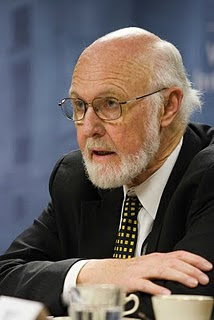 Q: Foreign assistance has had major achievements over the past 50 years. What are some examples?
SEWELL: There have been many but off the top of my head I can think of three. First, the Green Revolution where the combined efforts of American aid and private foundations revolutionized agriculture in Asia. As a result, many more people lived a much longer time. Second, the efforts put into improving education, particularly of women and girls. The third is population growth. When I started working on development, the best predictions said that global population would rise to over 20 billion at the end of the 20th century. Now we know it will not go much above 9 billion and perhaps lower. That wouldn’t have happened without American leadership and funding.
Q: What are the major failures of foreign assistance?
SEWELL: Failures have occurred either because countries were not committed to development, or because aid agencies designed ineffective programs. But most major failures came about because aid was provided for political reasons— for Cold War purposes in Southeast Asia or the Middle East, not for economic and social development. And we should remember that promoting development is a risky business. If there were no failures, development agencies were being too cautious.
But the more important failures are at the strategic level. Assistance really is only effective when governments and leaders want to speed economic growth, improve health and education, and address poverty. When the government isn’t committed to development, a lot of aid is wasted.
That’s why the choice of countries is so important. Korea is one example. Korean leaders knew how to use foreign aid effectively to build agriculture and industry. Part of that assistance funded investments in health and education. We all know the result.
Egypt, on the other hand, also has received large amounts of American assistance since 1979. But its growth rates are low and they still have one of the highest rates of adult illiteracy in the world.
Perhaps the largest failure has been in Africa. Except for a small number of countries, Africa lags far behind other regions. The blame lies not just with African leaders but also with aid donors who have continued to provide assistance in ways that hinder development.
Q: In what ways can global poverty be reduced quickly in the next three to four years?
SEWELL: In the short term, it won’t happen. The global financial crisis makes that a certainty.
The best estimates are that up to 90 million people will fall back into poverty because they will have lost jobs and livelihoods. The most important thing the U.S. can do in the near term is to continue to lead the reform of the international financial systems that are essential to restarting global economic growth, particularly in the developing world.
Q: That’s the way to reduce poverty?
SEWELL: In the short term, yes. But the U.S. can target aid to build poor peoples’ capacities and can make a great difference. That means aid for education, especially women, and to enable poor people to improve their health. And jobs are critical.
I think the right goal is to empower people to move into the middle class.
That means helping to provide technical assistance and in making low-cost credits for both farmers and small scale entrepreneurs. They will be the generators of jobs that enable men and women to move out of poverty.
Q: Why do you say in one of your papers that economic growth alone will not eliminate poverty?
SEWELL: Because it’s true. Growth does not automatically diminish poverty; it has to be complemented by government actions to share the gains from growth by investing in better health and education. For this you also need a competent state. That’s how the East Asian countries managed to develop so successfully. On the other hand, many Latin American countries have grown at decent rates but have lousy income distribution. But now countries like Brazil are starting to change. For instance, the Brazilian government now pays mothers to keep their children in school where they can get education and health care.
Q: USAID has restrictions that inhibit advertising. How can the public and Congress be informed about the successes and importance of development assistance?
SEWELL: USAID has been very timid about educating the public and Congress. I am not even sure that the earlier successful programs of development education exist anymore. Some steps are easy.
USAID staff knows a lot about development. Why not send them out to talk to public groups around the country? USAID staff doesn’t even participate actively in the yeasty dialogue on development that goes on in the Washington policy community and they should be encouraged to do so. Other changes may require funding and perhaps legislation and the administration should work with the Congress to get them.
Informing the public is particularly important now when there are two major processes underway to modernize U.S. development programs and Congress is rewriting the development assistance legislation.
Q: Since China and Vietnam have both developed without democracy, how important is it to push for democracy and good governance? Are they really necessary?
SEWELL: We need to separate democracy and governance. Very few of the successful developing countries have started out as democracies; India is the big exception. On the other hand, all of the successful countries have had effective governments to do what governments should do: provide security and public goods like health and education, establish the rule of law, and encourage entrepreneurship.
We need to face the fact that no outsider, including the U.S., can “democratize” a country. But it can play an important role in helping to improve governance in committed poor countries. And one of the important parts of successful development is what a Harvard economist calls “conflict mediating institutions” that allow people to deal with the inevitable conflicts that arise within successful development.
Q: You have said that we need to make markets work. How can we help poor people begin to trade when Europe, Japan, and the United States either block imports or subsidize exports?
SEWELL: If you are serious about development, you have to give high priority to trade policy. Unfortunately, USAID seems to have very little voice in trade decisions.
The U.S. needs to focus its development trade policy on the poorest countries. The highest priority should be dropping the remaining subsidies for U.S. production of highly subsidized agricultural products like cotton that can be produced very competitively in very poor countries.
But many of these countries have difficulty selling goods in the U.S., not only because of subsidies, but also because they are not equipped to export. Transport costs are high as are the costs of meeting U.S. health and quality standards, and knowledge of marketing in America is scarce.
Here’s where USAID can play an important complementary role. U.S. companies are already providing technical assistance, some with USAID support. But USAID can expand its trade capacity building programs and focus them on the poorer countries.
Q: What about microcredit?
SEWELL: Microcredit is a very important innovation, especially for empowering poor people, particularly poor women. It’s part of the solution to ending poverty.
But there are other needs. In most poor countries, there are large groups of poor entrepreneurs who are not poor enough to get microcredit but who can’t get commercial banks to lend to them. These are people who produce products for sale— handbags, for instance—that employ 10 to 20 people, but they need capital and advice in order to grow. In the U.S., small businessmen used to borrow money from local banks.That’s how America grew. But similar institutions don’t exist in many poor countries.
Q: We are involved in so many different programs—20 or 30 different federal agencies do some sort of foreign assistance— why not just invest in education and health and let each country figure out what their own development plan should be?
SEWELL: A very good idea. I have long advocated that the U.S. should focus its programs on a few major development issues but I would go beyond just health and education. I add climate change and dealing with global health threats. We dodged the bullet on SARS [severe acute respiratory syndrome] and avian flu but we may not be so lucky in the future. And strengthening governance and strengthening weak states is essential.
The real need now is for some mechanism that oversees and coordinates the multiplicity of agencies that have programs and expertise on these critical issues. Let’s hope that emerges from the current administration’s reviews of development policy
John Sewell a senior scholar at the Woodrow Wilson International Center for Scholars, was interviewed by FrontLines Editorial Director Ben Barber. Originally published in USAID FrontLines, April 2010.Urbanization, Climate Change, and Indigenous Populations: Finding USAID’s Comparative Advantage
›May 26, 2010 // By Kayly Ober “Part of the outflow of migrants from rural areas of many Latin American countries has settled in remote rural areas, pushing the agricultural frontier further into the forest,” writes David López-Carr in a recent article in Population & Environment, “The population, agriculture, and environment nexus in Latin America.” In a May 4 presentation at the LAC Economic Growth and Environment Strategic Planning Workshop in Panama City, Panama, he discussed how to integrate family planning and environmental services in rural Latin America.
Latin America is one of the most highly urbanized continents in the world, with an average of 75 percent of the population living in cities. However, “there are two Latin Americas,” said López-Carr at the workshop, which was sponsored by the Woodrow Wilson Center’s Environmental Change and Security Program and Brazil Institute, as well as the U.S. Agency for International Development. Largely developed countries like Chile, Argentina, and Uruguay are close to 90 percent urbanized, while Guatemala, Ecuador, and Bolivia are about 50 percent. In less urbanized countries, rural-rural migrants in search of agricultural land remain a major driving force behind forest conversion, he said.
Between 1961 and 2001, Central America’s rural population increased by 59 percent, said Lopez-Carr. The increasing density of the rural population had a negative impact on forest reserves: a 15 percent increase in deforestation totaling some 13 million hectares.
“Rural areas of Latin America still have high fertility rates but (unlike much of rural Africa, for example) also have a high unmet demand for contraception, meaning that improved contraceptive availability would likely result in a rapid and cost-effective means to reduce population pressures in priority conservation areas,” he said. Additionally, remote rural areas with high population growth rates tend to be associated with indigenous populations located in close proximity to protected forests.
For example, in Guatemala, communities surrounding Sierra de Lacandon National Park have, since 1990, grown by 10 percent each year, with birthrates averaging eight children per woman. Larger communities and larger households have led to agricultural expansion, which infringes on the park and accelerates deforestation in one of the most biologically diverse biospheres in the world, said López-Carr.
Based on these demographic and environmental trends, López-Carr suggested USAID’s work in the region should focus on rural maternal and child health, and education – especially for girls. Not only does USAID already invest in such programs, but they only cost pennies per capita and could reduce the number of rural poor living in Latin American cities by tens of millions.
Given the strong links between population density and deforestation in Latin America, expanding access to family planning would also be a smart investment in forest conservation and climate mitigation, López-Carr concluded.
Source: Population Reference Bureau.
Photo Credit: Dave Hawxhurst, Woodrow Wilson Center.Coffee and Contraception: Combining Agribusiness and Community Health Projects in Rwanda
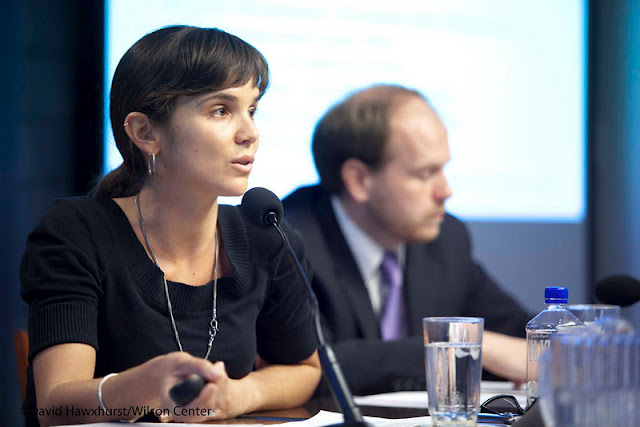
›“Population pressures and diminishing land holdings – due to high fertility rates, war and genocide, and subsequent migration – have caused a rapid decrease in the forested and protected areas and increased soil infertility and food insecurity” in Rwanda, USAID’s Irene Kitzantides told a Wilson Center audience.
Kitzantides, a population, health, and environment advisor and global health fellow, said “the population is projected to reach over 14 million by 2025” – nearly one-third more than today, due to the country’s high fertility rate of nearly 5.5 children per women–which could continue to negatively impact forests and food supplies.
In response to these challenges, USAID supported the Sustaining Partnerships to Enhance Rural Enterprise and Agribusiness Development (SPREAD) Project. SPREAD uses an integrated population-health-environment (PHE) approach to develop the coffee agribusiness and bring family planning, HIV/AIDS, and reproductive health services to coffee workers.
Combining income generation with health services was thought an effective way to “fulfill the overall SPREAD goal of improving lives and livelihoods,” said Kitzantides.
A SPREADing Mandate: Integrating Health and Agribusiness
SPREAD follows USAID’s PEARL I and II Projects, which focused exclusively on agricultural development. Coffee is still at the center of SPREAD’s activities, with $5 million of the project’s $6 million USAID budget earmarked for agricultural development.
However, a broader mandate to include health services emerged after recognition that greater income alone does not ensure greater quality of life. The additional health funding leverages SPREAD’s already established relationships with farming cooperatives to bring health services to traditionally underserved rural communities.
“We really tried to build on the existing assets of the cooperative,” said Kitzantides. “We also really tried to complement local and national public health policy and partners.”
The integration of health with agricultural goals, and the use of already established in-country health programs, has made SPREAD extremely cost-effective, with HIV/AIDS prevention education costing less than $2 per person.
Examples of SPREAD’s integrated work include:Combined health and agricultural lessons: Kitzantides and her colleagues trained nearly 400 animateurs de café, cooperative employees running the agricultural education programs, to incorporate public health objectives into their activities. Combining health and agricultural education into one session takes advantage of workers already trained during previous USAID programs. The combination also attracts more male participants, who traditionally shunned HIV/AIDS, family planning, and reproductive health campaigns and services.
Radio programming: SPREAD worked with the agricultural radio program Imbere Heza (“Bright Future”) to incorporate health messaging at the end of each program.
- Mobile clinics: SPREAD works with cooperatives and local health centers to bring convenient services to farmers when they gather at sales or processing stations during harvests.
Community theater: SPREAD hires local theater groups to perform skits on health. The farming communities “really love community theater and always ask for it,” said Kitzantides.
In its relatively short existence, SPREAD’s health activities have reached over 120,000 people with HIV/AIDS prevention messages; nearly 90,000 with messages discussing family planning/reproductive health; and almost 40,000 about maternal and child health. The project counts 347 women as new users of family planning services.
Lessons learned – which will be examined in more detail in an upcoming issue of Focus – include the importance of using community-based approaches to overcome perceived social barriers; the advantages of integrating cross-cutting activities at the outset of a program; and the need for strong monitoring and evaluation systems to measure the effort’s outcomes.Jason Bremner of the Population Research Bureau said PHE projects such as SPREAD go “beyond what the health sector itself can do and find new ways of reaching underserved remote populations.” He presented a soon-to-be-released PRB map plotting the location of more than 40 PHE projects in Africa.
The success of SPREAD and similar projects demonstrates the potential for PHE approaches to bring reproductive health and family planning services to rural areas, Bremner noted, but there is still much work to be done to scale up this integrated approach – and to document its successes.
Sustaining SPREAD
Kitzantides said it took several years to integrate health activities with the already established agricultural programs. Since USAID funding for the program is scheduled to end in 2011, she is uncertain that the time remaining will be enough for SPREAD’s health partners to develop the logistical and financial capacities to become self-sustaining. But SPREAD has changed attitudes and beliefs, two key objectives that do not require sustained funding.
“We used to talk about growing coffee, making money, buying material things like bikes – not about problems like malaria, HIV/AIDS, etc.,” said one SPREAD agricultural business manager during the program’s evaluation. “Someone could have 5 million Rwandan francs in the house but could suffer from malaria where medicine costs 500 Rwandan francs, due to ignorance. You have to teach people about production, you have to also think of their health to improve their lives.”
Photo Credits: Irene Kitzantides, courtesy David Hawxhurst; condom demonstration, courtesy Nick Fraser; community theater group, courtesy SPREAD Health Program; Jason Bremner, courtesy David Hawxhurst.New Research on Population and Climate: The Impact of Demographic Change on Carbon Emissions
›“Policies that have the effect…of leading to lower fertility and to slower population growth can be considered ‘win-win’ from the climate point of view,” said Brian O’Neill of the National Center for Atmospheric Research (NCAR) at a recent Wilson Center event on his latest research. Yet while the connection between demographic change and CO2 emissions is implicitly understood among both researchers and policymakers, it “has not really caught on,” he added.
In response to critiques of earlier studies looking at demographic change and CO2 emissions—which the climate research community has faulted for their lack of sophistication, use of unfamiliar analytic approaches, and failure to clearly demonstrate the magnitude of the connection—O’Neill is using a novel, more rigorous approach that he hopes will provide a clearer understanding of the links between demography and climate change.
The Population Factor
To generate CO2 emissions scenarios for the next 100 years, O’Neill’s team used the Population-Environment-Technology (PET) Model, originally created by Lawrence H. Goulder and Michael Dalton of Stanford. The PET Model takes its basic assumptions on regional economic growth, technological development, change in population characteristics, and other factors from the IPCC’s A2 and B2 scenarios, but replaces each scenario’s singular population growth curve with high and low alternatives from the United Nations Population Division.
Like other climate models, the PET Model divides the world into nine regions. “You don’t want to treat economies—or the demography, the consumption patterns, the energy system, and so on—of sub-Saharan Africa the same as you do for the U.S. or EU,” he said.What makes the O’Neill’s approach unique, however, is his attention to the sub-regional level. “Typically in these models…you break the world up into nine regions, but then you treat everyone in sub-Saharan Africa the same, everyone in China the same,” said O’Neill.
By drawing on data from detailed surveys of 800,000 households from 35 countries, O’Neill and his team demonstrated that the distinctions between urban and rural, older and younger, and smaller and larger households hold important implications for carbon emissions. This inclusion of demographic sub-factors allows a deeper degree of analysis than models that treat all households the same. They found that age structure, household size, and urbanization all altered emissions outputs.
Could Bending Population Growth Curves Reduce Emissions?
In the long run, the potential for demographic shifts to reduce CO2 emissions “is a big number,” said O’Neill. In the medium term, for example by the middle of the century, results are less clear. To compare population-related emissions reductions to other carbon-reduction opportunities, he evoked Socolow and Pacala’s “stabilization wedge” framework. The wedge framework posits 15 opportunities, or wedges, to eventually reduce CO2 emissions by 1 billion tons of carbon equivalent per year. They contend that implementing any 7 of the wedges could stabilize CO2 emissions by 2050 and, if followed by additional measures reducing emissions below today’s levels, would stabilize the atmospheric concentration of CO2 at 550 ppm and forestall the worst impacts of climate change.
Would reducing population growth equal a wedge? The full results, currently under review at a scientific journal, will seek to answer this question. “Slower population growth can’t solve the climate problem,” he concluded. “But it can certainly help.”The Food Security Debate: From Malthus to Seinfeld
›Charles Kenny’s latest article, “Bomb Scare: The World Has a Lot of Problems; an Exploding Population Isn’t One of Them” reminds me of a late-night episode of Seinfeld: a re-run played for those who missed the original broadcast. Kenny does a nice job of filling Julian Simon’s shoes. What’s next? Will Jeffrey Sachs do a Paul Ehrlich impersonation? Oh, Lord, help me; I hope not.
I’ve already seen the finale. Not the one where Jerry, George, and Kramer go to jail — the denouement of the original “Simon and Ehrlich” show. After the public figured out that each successive argument (they never met to debate) over Malthus’s worldview was simply a rehash of the first — a statement of ideology, rather than policy — they flipped the channel.
Foreign Policy could avoid recycling this weary and irrelevant 200-year-old debate by instead exploring food security from the state-centric perspective with which policymakers are accustomed. While economists might hope for a seamless global grain production and food distribution system, it exists only on their graphs.
Cropland, water, farms, and markets are still part and parcel of the political economy of the nations in which they reside. Therefore they are subject to each state’s strategic interests, political considerations, local and regional economic forces, and historical and institutional inefficiencies.
From this realistic perspective, it is much less important that world population will soon surpass 7 billion people, and more relevant that nearly two dozen countries have dropped below established benchmarks of agricultural resource scarcity (less than 0.07 hectares of cropland per person, and/or less than 1000 cubic meters of renewable fresh water per person).
Today, 21 countries—with some 600 million people—have lost, for the foreseeable future (and perhaps forever), the potential to sustainably nourish most of their citizens using their own agricultural resources and reasonably affordable technological and energy inputs. Instead, these states must rely on trade with–and food aid from–a dwindling handful of surplus grain producers.
By 2025, another 15 countries will have joined their ranks as a result of population growth alone (according to the UN medium variant projection). By then, about 1.4 billion people will live in those 36 states—with or without climate change.
For the foreseeable future, poor countries will be dependent on an international grain market that has recently experienced unprecedented swings in volume and speculation-driven price volatility; or the incentive-numbing effects of food aid. As demand rises, the poorest states spend down foreign currency reserves to import staples, instead of using it to import technology and expertise to support their own economic development.
Meanwhile, wealthier countries finding themselves short of water and land either heavily subsidize local agriculture (e.g., Japan, Israel, and much of Europe) or invest in cropland elsewhere (e.g., China, India, and Saudi Arabia). And some grain exporters—like Thailand—decided it might be safer to hold onto some of their own grain to shield themselves from a future downturn in their own harvest. All of this is quite a bit more complex than either Malthus could have imagined or Kenny cares to relate.
It hardly matters why food prices spiked and remained relatively high—whether it is failed harvests, growing demand for grain-fed meat, biofuels, profit-taking by speculators, or climate change. Like it or not, each has become an input into those wiggly lines called grain price trends, and neither individual states nor the international system appears able or willing to do much about any of them.
From the state-centric perspective, hunger is sustained by:1. The state’s inability or lack of desire to maintain a secure environment for production and commerce within its borders;
In some countries, aspects of population age structure or population density could possibly affect all three. In others, population may have little effect at all.
2. Its incapacity to provide an economic and trade policy environment that keeps farming profitable, food markets adequately stocked and prices reasonably affordable (whether produce comes from domestic or foreign sources); and
3. Its unwillingness or inability to supplement the diets of its poor.
What bugs me most about Kenny’s re-run is its disconnect with current state-centric food policy concerns, research, and debates (even as the U.S. administration and Congress are focusing on food security, with a specific emphasis on improving the lives of women.—Ed.).
Another critique of Malthus’s 200-year-old thesis hardly informs serious policy discussions. Isn’t Foreign Policy supposed to be about today’s foreign policy?
Richard Cincotta is a consultant with the Environmental Change and Security Program and the demographer-in-residence at the H.L. Stimson Center in Washington, DC.
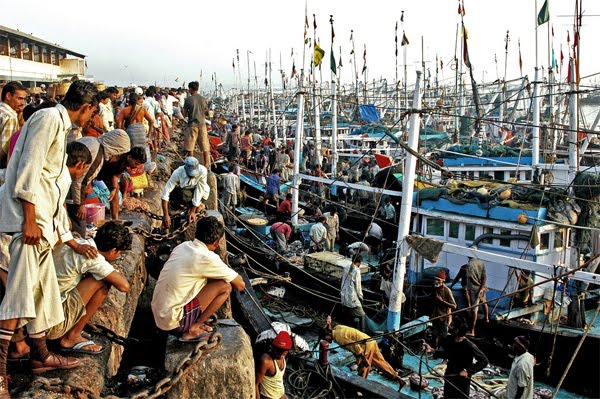
Photo Credit “The Bombay Armada” courtesy of Flickr user lecercle.Pop-Up Video: Cable News Covers PHE Connections
›It was a bit of a shock to hear population-environment connections being discussed on television, including the Most Trusted Name in News (aka Jon Stewart’s Daily Show), as well as CNN’s Amanpour, late last month.
Population and Sustainability
›“The MAHB, the Culture Gap, and Some Really Inconvenient Truths,” authored by Paul Ehrlich and appearing in the most recent edition of PLoS Biology, is a call for greater participation in the Millennium Assessment of Human Behavior (MAHB). MAHB was created, he writes, because societies understand the magnitude of environmental challenges, yet often still fail to act. “The urgent need now is clearly not for more natural science…but rather for better understanding of human behaviors and how they can be altered to direct Homo sapiens onto a course toward a sustainable society.” MAHB aims to create an inclusive global discussion of “the human predicament, what people desire, and what goals are possible to achieve in a sustainable society” in the hopes of encouraging a “rapid modification” in human behavior.The BALANCED Project, lead by the Coastal Resource Center at the University of Rhode Island, released its first “BALANCED Newsletter.” To be published biannually, the newsletter highlights recent PHE fieldwork, unpacks aspects of particular PHE projects, and shares best practices in an effort to advance the BALANCED Project’s goal: promoting PHE approaches to safeguard areas of high biodiversity threatened by population pressures. The current edition examines the integration of family planning and reproductive health projects into marine conservation projects in Kenya and Madagascar, a theater-based youth education program in the Philippines, and the combining of family planning services with gorilla conservation work in Uganda. The newsletter also profiles two “PHE Champions,” Gezahegh Guedta Shana of Ethiopia and Ramadhani Zuberi of Tanzania.“Human population growth is perhaps the most significant cause of the complex problems the world faces,” write authors Jason Collodi and Freida M’Cormack in “Population Growth, Environment and Food Security: What Does the Future Hold?,” the first issue of the Institute of Development Studies‘ Horizon series. The impacts of climate change, poverty, and resource scarcity, they write, are not far behind. Collodi and M’Cormack highlight trends in, and projections for, population growth, the environment, and food security, and offer bulleted policy recommendations for each. Offering greater access to family planning; levying global taxes on carbon; introducing selective water pricing; and removing subsidies for first-generation biofuels are each examples of suggestions advanced by the authors to meet the interrelated challenges.
Showing posts from category family planning.