• woodrow wilson center
  • ecsp

New Security Beat

Subscribe:
  • rss
  • mail-to
  • Who We Are
  • Topics
    • Population
    • Environment
    • Security
    • Health
    • Development
  • Columns
    • China Environment Forum
    • Choke Point
    • Dot-Mom
    • Friday Podcasts
    • Navigating the Poles
    • Reading Radar
  • Multimedia
    • Water Stories (Podcast Series)
    • Backdraft (Podcast Series)
    • Tracking the Energy Titans (Interactive)
  • Films
    • Water, Conflict, and Peacebuilding (Animated Short)
    • Paving the Way (Ethiopia)
    • Broken Landscape (India)
    • Scaling the Mountain (Nepal)
    • Healthy People, Healthy Environment (Tanzania)
  • Publications
  • Events
  • Contact Us

NewSecurityBeat

The blog of the Wilson Center's Environmental Change and Security Program
Showing posts from category family planning.
  • Women Leaders Urge Stronger Advocacy on Health and Public Policy

    ›
    Dot-Mom  //  From the Wilson Center  //  September 29, 2011  //  By Wilson Center Staff
    The original version of this article appeared on the Pan American Health Organization website.

    Women have made major strides toward greater equality in Latin America and the Caribbean, but stronger advocacy and leadership are needed to address problems they continue to face in health and other areas, said a group of top women health leaders at an event held at the Woodrow Wilson Center in Washington, D.C. on September 27.

    The event was part of a series of activities surrounding the 51st Directing Council meeting of the Pan American Health Organization/World Health Organization (PAHO/WHO), which is being held this week.

    Dr. Michelle Bachelet, Executive Director of UN Women, noted that Millennium Development Goal (MDG) five, reduce maternal mortality, “is the one MDG that has advanced the least in our region and around the world.” She said it is now widely accepted that investing in women is not only an issue of human rights, it is also “the intelligent thing to do economically, politically, and socially. So why doesn’t it happen?” She said making it happen is the major leadership challenge facing women in health and public policy today. “We have to empower women to make the strongest case possible that investing in women is the best thing governments can do, and we have to help ministers of health make this same case with their governments.”

    WHO Director-General Dr. Margaret Chan said that high levels of maternal mortality reflect “a failure of governments.” “We know how to prevent women from dying while giving birth. It’s a lack of political commitment, policies, and investments in the right areas. We need to get these issues out into the public, and we need to work with men who are enlightened to accomplish this,” she said.

    Rocío García Gaytán, President of the Inter-American Commission of Women, said maternal mortality continues to be a major problem in the hemisphere despite the fact that it is almost completely preventable. She said that contrary to common belief, most maternal deaths take place in hospitals and are the result of a lack of proper training of medical personnel. “This problem should not exist in the second decade of this millennium,” she said.

    PAHO Director Dr. Mirta Roses urged women to develop a leadership style that will effectively advocate for women’s top concerns, particularly social, economic, and political progress.

    “What is different when women lead?” Roses asked. “We need to support each other and identify what we should do that is different from male models. We must all work together – UN Women, the Council of Women World Leaders – to define feminine leadership and promote it.”

    Canada’s Minister of International Cooperation, Beverly Oda, said progress on public policies for women “took many years” to develop in Canada. Today, gender reviews of legislation are now mandatory for legislation, and promotion of gender equality is an integral part of Canadian technical cooperation programs.

    Vice-Minister of Health Dr. Silva Palma de Ruiz of Guatemala described a number of initiatives in her country that have been successful in improving women’s health and status. They include joint efforts involving the health ministry, the public prosecutor’s office, the national human rights ombudsman, and civil society organizations to reduce sexual violence by empowering women to report violence and by more aggressive prosecution of perpetrators. PAHO/WHO has supported these efforts with technical assistance in developing guides for care of victims of sexual violence. Other efforts include a new family planning law and education of men and women as well as healthcare workers about women’s rights to use contraception.

    Minister of Health Ann Peters of Grenada said that women of the Caribbean “are very vocal” and have had considerable success advocating for women’s health. In her own country, this has helped produce a highly effective comprehensive mother-child health program that includes strong community health services with well-trained midwives and good referral systems, breastfeeding-friendly hospitals, and universal voluntary testing of pregnant women for HIV. Thanks to these programs, Grenada has “no mother-to-child transmission of HIV and virtually no maternal mortality.”

    Minister of Health Marcella Liburd of Saint Kitts and Nevis noted the importance of addressing the social determinants of women’s health. For example, in her country as elsewhere, the majority of people living in poverty are women. “We need to consider other aspects of women’s well-being,” she said, “including financial, social, and mental health.”

    Paraguay’s Minister of Health, Dr. Esperanza Martinez, said it was important to address women’s concerns in an integral way. She described a new platform for discussing policies that affect women involving different government ministries, not just health. “Women need to participate as policymakers and also to influence policies from the outside,” she said.

    Dr. Carmen Barroso, Western Hemisphere Director for the International Planned Parenthood Federation, said, “Civil society is ready to partner with ministries of health to advocate for more resources, legislation, and promotion of women’s sexual and reproductive rights.”

    The event was organized by the Council on Women World Leaders, PAHO/WHO, the Wilson Center’s Environmental Change and Security Program, Global Health Initiative, and Latin America Program.

    Event Resources
    • Photo gallery
    Photo Credit: David Hawxhurst/Wilson Center.
    MORE
  • Carl Haub, Behind the Numbers

    Ethiopia’s 2011 Demographic and Health Survey: Remarkable Fertility Decline, Continued Rural Health Challenges

    ›
    September 28, 2011  //  By Wilson Center Staff
    The original version of this article, by Carl Haub, appeared on the Population Reference Bureau’s Behind the Numbers blog.

    Continuing my recent practice of posting a quick summary of results from new demographic surveys in developing countries, here is another new Demographic and Health Survey (DHS) preliminary report, this time from a sub-Saharan African country. This will help readers of this blog to stay right up-to-date with the latest developments.

    The Ethiopia 2011 DHS interviewed 16,515 women ages 15 to 49 and 14,110 men ages 15 to 59 from September 2010 to June 2011. The total fertility rate (TFR – the average number of children would bear in her lifetime if the birth rate of a particular year were to remain constant) obtained in the survey was 4.8 for the three-year period preceding the survey. For urban women, the TFR was 2.6 and for rural women, who were a little over 75 percent of the sample, 5.5. There appears to have been an acceleration of TFR decline from the 2005 to the 2011 survey compared with the 2000 DHS, which had a three-year TFR of 5.5. In 1990, a government survey had shown the TFR as 6.4. The desire to continue or cease childbearing provides one insight into possible future fertility trends. Of the women with five living children, 55.8 percent said that they did not wish to have any more children; among women with six or more living children, 68.6 percent said that they also wished to ceased childbearing.

    Continue reading on Behind the Numbers.

    Image Credit: Population Reference Bureau; data courtesy of Ethiopian Central Statistics Agency (CSA) and ICF Macro, Ethiopia Demographic and Health Survey (EDHS) 2011, Preliminary Report.
    MORE
  • John Donnelly, Global Post

    Reproductive Health’s Connection to Global Problems

    ›
    September 26, 2011  //  By Wilson Center Staff
    The original version of this article, by John Donnelly, appeared on Global Post.

    At a forum at the Rubin Art Museum earlier this week, a group of global leaders, including two top U.S. officials, talked about how reproductive health issues for women were wrongly cast as only a women’s issue.

    Instead, they said reproductive health was intimately connected to the world’s population boom, climate change, water and sanitation crises, economic downturns, educational rates, and development overall. And greater reproductive health rights would trigger a brighter future for the 600 million young women in the developing world, including the 10 million girls who are married before they reach the age 18, said the panelists, members of the Global Leaders Council for Reproductive Health of Aspen Global Health and Development.

    And yet, reproductive health and family planning is generally not a focus on the world stage. In fact, the topic is often avoided.

    “If you can help young women feel empowered, where they themselves want to delay pregnancy, they can become the actors in their own lives,” Maria Otero, U.S. Under Secretary of State for Democracy and Global Affairs said at the Rubin Museum of Art. “What this Council allows us to do is think about the issue of reproductive health, one that is interconnected to all other issues” related to development.

    Continue reading on Global Post.

    Image Credit: “Age at 1st marriage (women),” courtesy of ChartsBin; data courtesy of Gapminder.
    MORE
  • Carl Haub, Yale Environment 360

    What If Experts Are Wrong On World Population Growth?

    ›
    September 22, 2011  //  By Wilson Center Staff
    The original version of this article, by Carl Haub, appeared on Yale Environment 360.

    In a mere half-century, the number of people on the planet has soared from 3 billion to 7 billion, placing us squarely in the midst of the most rapid expansion of world population in our 50,000-year history – and placing ever-growing pressure on the Earth and its resources.

    But that is the past. What of the future? Leading demographers, including those at the United Nations and the U.S. Census Bureau, are projecting that world population will peak at 9.5 billion to 10 billion later this century and then gradually decline as poorer countries develop. But what if those projections are too optimistic? What if population continues to soar, as it has in recent decades, and the world becomes home to 12 billion or even 16 billion people by 2100, as a high-end UN estimate has projected? Such an outcome would clearly have enormous social and environmental implications, including placing enormous stress on the world’s food and water resources, spurring further loss of wild lands and biodiversity, and hastening the degradation of the natural systems that support life on Earth.

    It is customary in the popular media and in many journal articles to cite a projected population figure as if it were a given, a figure so certain that it could virtually be used for long-range planning purposes. But we must carefully examine the assumptions behind such projections. And forecasts that population is going to level off or decline this century have been based on the assumption that the developing world will necessarily follow the path of the industrialized world. That is far from a sure bet.

    Continue reading on Yale Environment 360.

    Image Credit: Data from UN Population Division, chart arranged by Schuyler Null.
    MORE
  • Perfect Storm? Population Pressures, Natural Resource Constraints, and Climate Change in Bangladesh

    ›
    From the Wilson Center  //  September 21, 2011  //  By Michael Kugelman
    Few nations are more at risk from climate change’s destructive effects than Bangladesh, a low-lying, lower-riparian, populous, impoverished, and natural disaster-prone nation. The UN Intergovernmental Panel on Climate Change estimates that by 2050, sea levels in Bangladesh will have risen by two to three feet, obliterating a fifth of the country’s landmass and displacing at least 20 million people. On September 19, the Wilson Center’s Asia Program, with assistance from ECSP and the Comparative Urban Studies Project, hosted a conference that examined Bangladesh’s imperiled environmental security.

    Climate Change and Population

    The first panel focused on manifestations, drivers, and risks. Ali Riaz addressed the threat of climate refugees. Environmental stress, he said, may produce two possible responses: fight (civil conflict or external aggression) or flight (migration). In Bangladesh, the latter is the more likely outcome. Coastal communities, overwhelmed by rising sea levels and flooding, could migrate to Bangladesh’s urban areas or into neighboring India. Both scenarios pose challenges for the state, which already struggles to provide services to its urban masses and has shaky relations with New Delhi.

    Mohamed Khalequzzaman examined Bangladesh’s geological vulnerability in the context of climate change. In a deltaic nation like Bangladesh, he explained, sedimentation levels must keep up with rates of sea level rise to prevent the nation from drowning. However, sediment levels now fall below 5 millimeters (mm) per year – short of the 6.5 mm Khalequzzaman calculates are necessary to keep pace with projected sea level rises. He lamented the nation’s tendency to construct large dams and embankments in the Bengal Delta, which “isolate coastal ecosystems from natural sedimentation,” he said, and result in lower land elevations relative to rising sea levels.

    Adnan Morshed declared that Bangladesh’s geographic center – not its southern, flood-prone coastal regions – constitutes the nation’s chief climate change threat. Here, Dhaka’s urbanization is “destroying” Bangladesh’s environment, he said. Impelled by immense population growth (2,200 people enter Dhaka each day) and the need for land, people are occupying “vital wetlands” and rivers on the city’s eastern and western peripheries. “Manhattan-style” urban grid patterns now dominate wetlands and several rivers have become converted into land. Exacerbating this urbanization-driven environmental stress are highly polluting wetlands-based brickfields (necessary to satisfy Dhaka’s construction needs) and city vehicular gas emissions.

    Adaptation Responses

    The second panel considered possible responses to Bangladesh’s environmental security challenges. Roger-Mark De Souza trumpeted the imperative of more gender-inclusive policies. Environmental insecurity affects women and girls disproportionately, he said. When Bangladesh is stricken by floods, females must work harder to secure drinking water and to tend to the ill; they must often take off from school; and they face a heightened risk of sexual exploitation – due, in great part, to the lack of separate facilities for women in cyclone shelters. He reported that such conditions have often led to early forced marriages after cyclones.

    Shamarukh Mohiuddin discussed possible U.S. responses. On the whole, American funding for global climate change adaptation programs has lagged and initiatives that are funded often focus more on short-term mitigation (such as emissions reductions) rather than adaptation. She recommended that Washington’s Bangladesh-based adaptation efforts be better coordinated with those of other donors.

    Mohiuddin also suggested that to convey a greater sense of urgency, Bangladesh’s climate change threats should be more explicitly linked to national security – and particularly to how America’s strategic ally, India, would be affected by climate refugees fleeing Bangladesh.

    The Sundarbans – click to view larger map.
    Philip J. DeCosse highlighted Bangladeshi government success stories in the famed Sundarbans – one of the world’s largest mangrove forests. Officials have banned commercial harvesting in some areas of the forests and shut down a highly polluting paper mill. He also praised civil society and the media for bringing attention to the Sundarban’s environmental vulnerability. As a result of efforts such as these, the Sundarbans are “coming back,” he said, with mangrove species growing anew. Thanks to a range of actors – from the forestry department to civil society – these forests are also now being “governed more than managed,” said DeCosse.

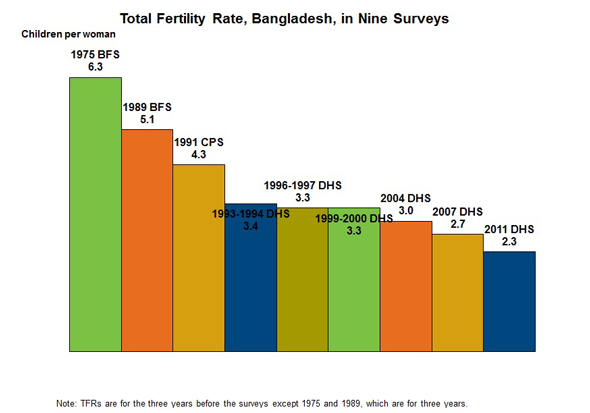
    DeCosse’s fellow panelists identified additional hopeful signs. Morshed shared a photograph of a green, pristine park in Dhaka. De Souza underscored how family planning programs have worked in Bangladesh in the past, with fertility rates declining considerably in recent years, and several speakers spotlighted efforts by civil society and the media to bring greater attention to Bangladesh’s environmental security imperatives.

    Nonetheless, major challenges remain, and panelists offered a panoply of recommendations. Khalequzzaman called for a major geological study of soil loss and siltation. De Souza implored Bangladesh to ensure that women’s roles and family planning considerations are featured in climate change negotiations and adaptation policies. Morshed advocated for imposing urban growth boundaries and enhancing public transport in cities. And several speakers spoke of the need to pursue more effective natural-resource-sharing arrangements with India. Ultimately, in the words of De Souza, it may not be possible to eliminate Bangladesh’s “perfect storm” – but much can be done to calm it.

    Event Resources
    • Agenda
    • Photo gallery
    • Speaker bios
    • Video
    Michael Kugelman is a program associate with the Wilson Center’s Asia Program.

    Sources: UN.

    Photo/Image Credit: “Precarious Living, Dhaka,” courtesy of flickr user Michael Foley Photography; “Impact of Sea Level Rise in Bangladesh,” courtesy of UNEP; and the Sundarbans courtesy of Google Maps.
    MORE
  • John Donnelly, Global Post

    Family Planning and Seven Billion at the Aspen Institute

    ›
    September 9, 2011  //  By Wilson Center Staff

    The original version of this article, by John Donnelly, appeared on Global Post.

    Sometime this fall, the world’s population will reach 7 billion people. Experts now forecast that by 2050, the population could be 10 billion.

    Those numbers, said the former presidents of Chile and Latvia at an event in Washington D.C., Wednesday night, should force policy makers to focus more intently on making family planning much more widely available in the developing world.

    “When we are 9, 10 billion people, what are we going to do? Go to Mars? Go to the moon?” said Michelle Bachelet, the former president of Chile and now the Under Secretary-General and Executive Director of UN Women, the latest agency created by the United Nations. “We are really going to have huge problems. Family planning is a huge issue.”

    Her comments came during a series of discussions organized by Aspen Global Health and Development called “7 Billion: Conversations that Matter.” The talks, funded in part by the U.S. Agency for International Development, have often centered on global health issues, and Wednesday’s event was no different.

    Continue reading on Global Post.

    Video Credit: The Aspen Institute.
    MORE
  • Jennifer Dabbs Sciubba, The Philadelphia Inquirer

    Family Planning Can Help in Afghanistan

    ›
    September 6, 2011  //  By Wilson Center Staff
    The original version of this op-ed, by Jennifer Dabbs Sciubba, appeared in The Philadelphia Inquirer.

    Most experts agree that the mark of long-term success in Afghanistan will be stable governance that allows the economy, democracy, and the people to flourish. Many factors will determine that, but a major one that seems to be left out of most high-level conversations is population.

    Afghanistan is a country of 31 million people, but that number will double by 2035, according to the most recent UN projections, and could reach 126 million by midcentury. That’s 95 million more Afghans to govern, clothe, feed, and employ.

    Without attention to population, countries like Afghanistan and Pakistan stand a good chance of staying mired in poverty, conflict, and corrupt, repressive government. That is why sustained investment in family planning by the United States and other countries would do more to stabilize the political climate there than any other foreign policy initiative. Though efforts by the Afghan government to provide contraceptives have met some resistance by conservative Muslim groups, the success of family planning in other Muslim states demonstrates that it can be effective.

    Continue reading on The Philadelphia Inquirer.

    Sources: UN Population Division.

    Photo Credit: “100430-F-2616H-050,” courtesy of flickr user Kenny Holston 21 (Kenny Holston).
    MORE
  • Population and Development, Scarcity and Fairness

    ›
    Reading Radar  //  August 31, 2011  //  By Schuyler Null
    Monica Das Gupta, John Bongaarts, and John Cleland’s World Bank working paper, “Population, Poverty, and Sustainable Development: A Review of the Evidence,” analyzes the evidence so far on three questions: 1) Does high fertility affect low-income countries’ prospects for economic growth and poverty reduction?; 2) Does population growth exacerbate pressure on natural resources?; and 3) Are family planning programs effective at lowering fertility, and should they be publicly funded? They find the answers to these questions mainly to be “yes,” but more so in low-income countries with “poor policy environments,” where reducing fertility can lessen the pressure on natural resources – the management of which frequently faces “deep challenges” – and allow economic growth. Gupta et al. highlight sub-Saharan Africa in particular as a region that could gain from these policy levers.

    Resource Scarcity, Fair Shares and Development, a discussion paper by Alex Evans of the Center on International Cooperation at New York University, published in cooperation with WWF and Oxfam, tackles what Evans writes is an oft-ignored issue in relation to resource scarcity: the notion of fairness in a world of environmental limits. The need to advocate for “fair shares” will become a major issue for poor people and poor countries, and is therefore an important part of the development agenda, he writes. “Scarcity isn’t just relevant to specialists in environment, climate and rural livelihoods,” writes Evans. “On the contrary, resource scarcity will become increasingly central to governance, economics, social development and conflict advisers, and should be incorporated into training and professional development across these areas.”
    MORE
Newer Posts   Older Posts
View full site

Join the Conversation

  • RSS
  • subscribe
  • facebook
  • G+
  • twitter
  • iTunes
  • podomatic
  • youtube
Tweets by NewSecurityBeat

Trending Stories

  • unfccclogo1
  • Pop at COP: Population and Family Planning at the UN Climate Negotiations

Featured Media

Backdraft Podcast

play Backdraft
Podcasts

More »

What You're Saying

  • Volunteers,At,The,Lagos,Food,Bank,Initiative,Outreach,To,Ikotun, Pan-African Response to COVID-19: New Forms of Environmental Peacebuilding Emerge
    Rashida Salifu: Great piece 👍🏾 Africa as a continent has suffered this unfortunate pandemic.But it has also...
  • A desert road near Kuqa An Unholy Trinity: Xinjiang’s Unhealthy Relationship With Coal, Water, and the Quest for Development
    Ismail: It is more historically accurate to refer to Xinjiang as East Turkistan.
  • shutterstock_1779654803 Leverage COVID-19 Data Collection Networks for Environmental Peacebuilding
    Carsten Pran: Thanks for reading! It will be interesting to see how society adapts to droves of new information in...

What We’re Reading

  • Rising rates of food instability in Latin America threaten women and Venezuelan migrants
  • Treetop sensors help Indonesia eavesdrop on forests to cut logging
  • 'Seat at the table': Women's land rights seen as key to climate fight
  • A Surprise in Africa: Air Pollution Falls as Economies Rise
  • Himalayan glacier disaster highlights climate change risks
More »
  • woodrow
  • ecsp
  • RSS Feed
  • YouTube
  • Twitter
  • Facebook
  • Home
  • Who We Are
  • Publications
  • Events
  • Wilson Center
  • Contact Us
  • Print Friendly Page

© Copyright 2007-2021. Environmental Change and Security Program.

Woodrow Wilson International Center for Scholars. All rights reserved.

Developed by Vico Rock Media

Environmental Change and Security Program

Woodrow Wilson International Center for Scholars

Ronald Reagan Building and International Trade Center

  • One Woodrow Wilson Plaza
  • 1300 Pennsylvania Ave., NW
  • Washington, DC 20004-3027

T 202-691-4000