-
Updates to African Conflict Database Give Researchers Access to Comprehensive, Near Real-Time Information
›Despite the end of Cold War-era civil wars, political violence rates in Africa remain remarkably high. However, this broad statement hides an important qualification: the types of violence that have persisted in recent years have changed significantly, shifting from rebel and government activity towards violence against civilians, riots, protests, and battles by armed groups other than rebels.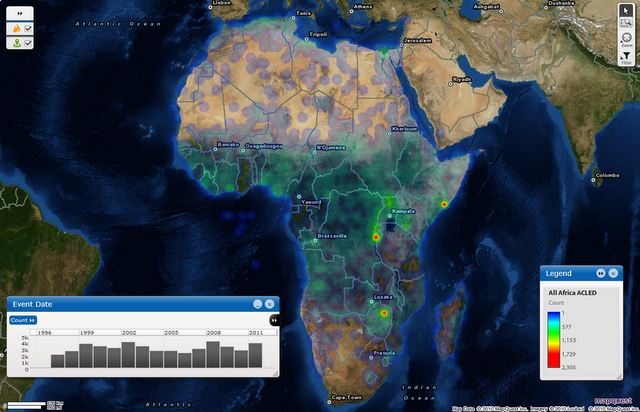
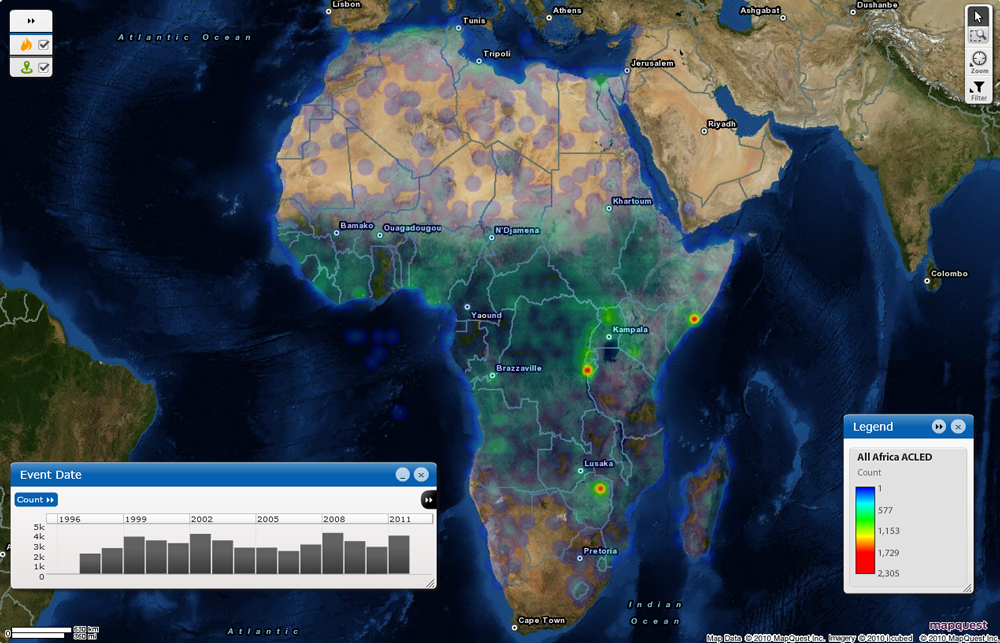
The only way researchers can track this activity is through political violence data disaggregated by type, location, and time. The Armed Conflict Location and Event Dataset (ACLED) project aims to provide that service. We recently released updated information on political violence across Africa from January 1997 to December 2011 (see above for a hotspot map and timeline of violence over this period).
New to the ACLED project are real time data and trend reports on monthly conflict patterns throughout the continent. It is now perhaps the comprehensive and representative depiction of political violence as it occurs throughout Africa.
The data captures an array of actions including battles, looting, rioting, protesting, violence against civilians, and non-violent activity (such as arrests, recruitment drives, troop movements) by a variety of actors such as governments, rebels, militias, rioters and protestors.
Each event is geo-referenced by location and time-stamped by day. In our recently released version, we also included fatalities by event; distinguished conflict groups by their type (government, rebel, political militia, communal militia, rioters, protesters, civilians etc.); and specified the type of interaction between actors (e.g. government-rebel battle; rebel-civilian attack). These changes make ACLED data flexible for multiple uses.
Several new findings on conflict patterns are found using ACLED data:- Violence against civilians accounts for approximately half of all conflict events.
- Generally, where they occur, civil wars intensely affect 19 percent of a state’s territory, yet rebel actions have drastically decreased since 2005.
- Militia activity has significantly increased since 2005 and is especially high during election periods in new democracies.
- Communal violence patterns are more widespread but affect fewer people than civil war violence.
- Civil war patterns are not strongly affected by climate changes, but communal conflict decreases during periods of local scarcity and increases on the cusp of rainy seasons.
- Political violence increases in the period from peace talk announcements to negotiations. This violence is directed towards overtaking territory and civilians are frequently the main victims.
Fine-grained data on the range of political violence in the developing world is important as it provides the opportunity to ask and potentially answer certain questions about a range of issues related to governance, economic development, and conflict dynamics themselves.
For example, ACLED data shows that violence is increasingly occurring in villages, towns, and cities across Africa. In other words, political violence may be “urbanizing.” This has important implications for how we understand the practice of politics, the geography of marginalization, and the role of trigger patterns in explaining conflict. But there are many competing theories that could explain this trend.
Using data that disaggregates by violence type allows us to probe deeper: If the environmental security framework is correct, political violence in towns may be a response to high in-migration from rural areas to cities. Violence therefore is due to competition between urban people and migrant populations.
An alternative explanation is that the poor conditions of African urban life, high rates of informal employment, and under-representation of urban communities in government might explain an increase in violence. In this case, violence is a populist response, in that civilians riot and protest in favor of government reform.
Finally, the advantages of densely populated urban areas – easier access to resources, recruits, infrastructure, and power – may attract more organized groups to contest these spaces. If this explanation were correct, we would expect higher rates of rebel activity against government forces in cities, with a clear drive to overtaking the capital.
We have not been able to address these questions before with credible and comprehensive data, but now we can. Indeed, such data is crucial for interrogating the climate-security debate.
For example, Clionadh recently co-authored an article in the Journal of Peace Research’s special issue on climate and conflict, which used ACLED data for East Africa. In that piece, she and her co-author argued that different conflict groups use their environment in accordance with their overall goals. While much of the conflict activity studied had an environmental signal, the climate signal was much weaker.
We hope that these studies and other work with disaggregated data spur more theories and explanations of conflict patterns in developing states, and that the breadth and form of the data allows for new directions within conflict research.
Clionadh Raleigh is an assistant professor in the Department of Geography at Trinity College, Dublin, external researcher at the Peace Research Institute Oslo (PRIO), and director of the ACLED project. Caitriona Dowd of Trinity College and Andrew Linke of the University of Colorado are senior researchers for ACLED.
Image Credit: ACLED. -
Richard Matthew: Responsive Peacebuilding Includes the Environment and Natural Resources
›April 30, 2012 // By Stuart Kent“After 20 years of peacebuilding experimentation, one of the good signs is that the countries receiving this [peacebuilding] attention…more and more are shaping the process,” said Professor Richard Matthew, director of the Center for Unconventional Security Affairs at the University of California, Irvine.
Peacebuilding is shifting, he said, from internationals going in with pre-existing conceptions of “what you need for stability and development, what will make you attractive to investors, what will make your people secure,” to instead sitting down and talking with stakeholders about “what types of capacity do you need, and how can we support you in acquiring those.”
Along with the shift towards more responsive peacebuilding has come an elevated interested in the environment and natural resources. For people living in the peacebuilding countries themselves, “there was never any doubt that water and forest and access to minerals and so on were critical to their future,” said Matthew, but Western and Northern countries often thought of it as a “second tier issue that you might get to once people were safe, and the government was functioning, and the economy was up and running again.”
Matthew co-authored the 2009 UNEP report, From Conflict to Peacebuilding: The Role of Natural Resources and the Environment, which examined environmental factors all along the conflict continuum – from inception to peacebuilding. Successful peacebuilding, the report argues, requires that “environmental drivers are managed, that tensions are defused, and that natural assets are used sustainably to support stability and development in the long term.” -
Uganda’s Demographic and Health Challenges Put Into Perspective With Newfound Oil Discoveries [Part Two]
›April 26, 2012 // By Kate Diamond
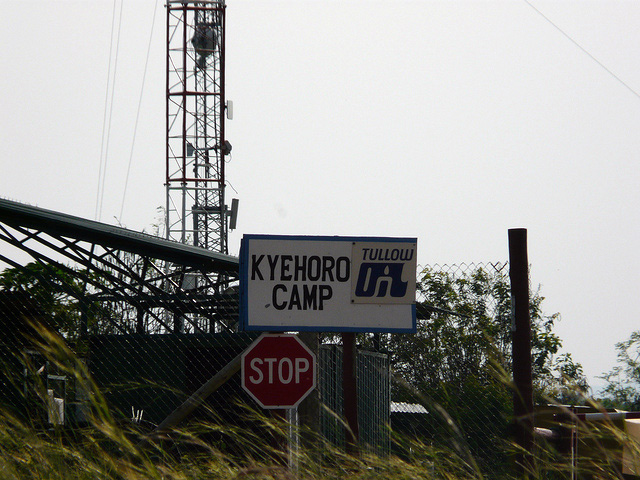
“We never thought we would end up having the same problems here as the people in the Niger Delta. But now I’m worried,” Henry Ford Mirima, a spokesman for Uganda’s Bunyoro kingdom, said last fall in Le Monde Diplomatique. The kingdom – which calls itself East Africa’s oldest – sits along Lake Albert, where over the past seven years British oil company Tullow Oil has discovered oil reserves big enough to produce an estimated 2.5 billion barrels.
-
Richard Cronin, World Politics Review
China and the Geopolitics of the Mekong River Basin
›April 25, 2012 // By Wilson Center StaffThe original version of this article, by Richard Cronin, appeared in World Politics Review.
Two decades after the Paris Peace Accord that ended the proxy war in Cambodia, the Mekong Basin has re-emerged as a region of global significance. The rapid infrastructure-led integration of a region some call “Asia’s last frontier” has created tensions between and among China and its five southern neighbors – Cambodia, Laos, Myanmar, Thailand, and Vietnam. Both expanded regional cooperation as well as increased competition for access to the rich resources of the once war-torn region have created serious environmental degradation while endangering food security and other dimensions of human security and even regional stability.
China’s seemingly insatiable demand for raw materials and tropical commodities has made it a fast-growing market for several Mekong countries and an increasingly important regional investor. Economic integration has been boosted by a multibillion dollar network of all-weather roads, bridges, dams, and power lines largely financed by the Asian Development Bank (ADB) that is linking the countries of the Lower Mekong to each other and to China. To date, the ADB’s Greater Mekong Subregion (GMS) cooperative development program has primarily benefited large population centers outside the basin proper in China, Thailand, and Vietnam. Unfortunately, the same infrastructure that speeds the flow of people and goods to urban centers also facilitates the environmentally unsustainable exploitation of the forests, minerals, water resources, and fisheries that are still the primary source of food and livelihoods to millions of the Mekong’s poorest inhabitants.
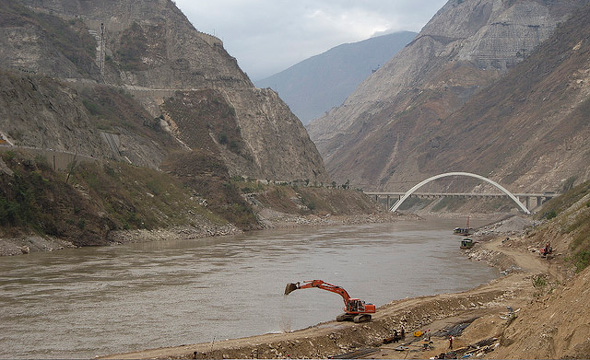
No aspect of China’s fast-growing role and influence in the Mekong region is more evident and more problematic than its drive to harness the huge hydroelectric potential of the Upper Mekong through the construction of a massive cascade of eight large- to mega-sized dams on the mainstream of the river in Yunnan Province. The recently completed Xiaowan dam, the fourth in the series, will mainly be used to send electricity to the factories and cities of Guangdong Province, its coastal export manufacturing base some 1,400 kilometers away. China’s Yunnan cascade will have enough operational storage capacity to augment the dry season flow at the border with Myanmar and Laos by 40-70 percent, both to maintain maximum electricity output and facilitate navigation on the river downstream as far as northern Laos for boats of up to 500 tons.
Continue reading in World Politics Review.
Photo Credit: “Xiaowan Dam Site,” courtesy of International Rivers. -
Andrew Freedman, Climate Central
Senate Hearing Focuses on Threat of Sea Level Rise
›April 21, 2012 // By Wilson Center StaffThe original version of this article, by Andrew Freedman, appeared on Climate Central.
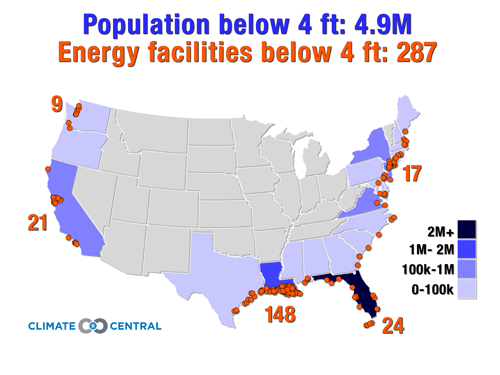
Sea level rise poses an increasingly grave threat to coastal energy facilities and communities during the course of the next several decades, with some impacts already evident, according to testimony delivered Thursday before a rare Senate hearing on climate science.
The hearing, held by the Senate Energy and Natural Resources Committee, focused on the challenges posed by sea level rise, which is one of the most visible manifestations of a warming planet.
“Sea level rise takes the current level of vulnerability and multiplies it,” said Committee Chairman Jeff Bingaman (D-N.M.). “When sea levels rise, the storm surge associated with extreme storms gets even worse, and even an average storm can have above-average consequences.”
Although Chairman Bingaman said he hoped the hearing would help restart “a national conversation” on climate change, the hearing instead may have served to highlight the continuing partisan divide on global climate change. While there were five Democrats in attendance, just one Republican – ranking member Lisa Murkowski (R-AK) – participated in the hearing, a fact not lost on Minnesota Democrat Al Franken, who called climate change the proverbial “elephant in the room.”
Continue reading on Climate Central.
Sources: U.S. Senate Energy and Natural Resources Committee.
Image Credit: Climate Central. -
‘Green Prophet’ Interviews Geoff Dabelko on Water Security in the Middle East
›April 18, 2012 // By Schuyler NullTafline Laylin, managing editor of the Green Prophet blog, recently interviewed ECSP Director Geoff Dabelko about the just-released U.S. intelligence assessment on global water security and what it says about the Middle East.
The conversation touched on regional water scarcity, Palestinian-Israeli water tensions, and the role of the international community.
“We put a lot of faith in the past helping us understand the future and it rests at the center of much of the way we analyze things,” said Dabelko. “But at the same time, we also, especially in the natural world, have established patterns of thresholds and tipping points and sudden changes.”
We’ve excerpted the first few questions below; read the full interview on Green Prophet:Green Prophet: So, for context, can you say a little bit about the National Intelligence report and why it was compiled?
Continue reading on Green Prophet.
Geoff Dabelko: The water and security assessment from the National Intelligence Council was done at the request of Secretary of State Hillary Clinton. The National Intelligence Council has a strong history of looking at long term trends in the environmental, technological, demographic realms and working to understand how trends in these areas are and could be part of larger economic, political, and social dynamics that may pose national security issues for the United States.
Green Prophet: There were seven river basins of particular concern, of which four are located in the MENA region: the Euphrates, Jordan, Nile, and the Tigris. Why do you think these are of particular importance?
Geoff Dabelko: I do not explicitly know the criteria for their selection of the seven basins. But I think these four, like the other three, have some common characteristics. They are basins where the rivers are shared by two or more countries/territories that are heavily dependent on the waters; that have relations among the states that include uncertain, tense, or even overtly hostile relationships; that are now and/or likely to experience big growth in demand for the water resource based on both population growth and consumption growth, that at the same time there is concern that climate change will at least increase variability, timing, and or quantity of that water (both scarcity and abundance i.e. floods).
And then the report focuses on the institutional river basin arrangements and differentiates among their assessed capacities for addressing these current and future stresses. That diversity aside, it is fair to say that the transboundary water institutions remain a priority yet a challenge for addressing the multiple dimensions of the water relationship. I say “multiple” given all the different uses water performs in most of these settings (transport, irrigation, hydropower, culture, industrial, household, etc).
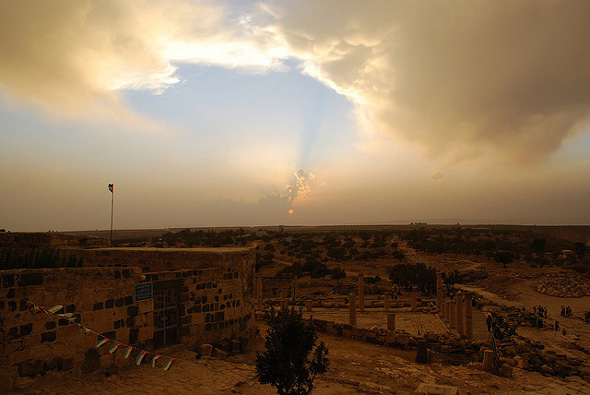
Photo Credit: “Umm Qais – Sunset,” courtesy of flickr user Magh. -
Geoff Dabelko On ‘The Diane Rehm Show’ Discussing Global Water Security
›April 13, 2012 // By Wilson Center StaffECSP Director Geoff Dabelko was recently a guest on The Diane Rehm Show to discuss the just-released U.S. intelligence community assessment of world water security. He was joined by co-panelists retired Maj. Gen. Richard Engel (USAF) of the National Intelligence Council’s Environment and Natural Resources Program (a key figure in preparing the report), Jessica Troell of the International Water Program at the Environmental Law Institute, and Steve Fleischli of the Natural Resources Defense Council.
The Department of State-requested assessment (outlined in more detail, here and here) is a very positive contribution, said Dabelko. It “moves away from the arm-waving, headline-grabbing, water wars frame – the kind of sky-is-falling frame that is intuitively appealing and certainly appealing for politicians and headline writers, but doesn’t really reflect the reality.” He continued:What this report instead does, is recognize that there’s been an awful lot of cooperation around water even in the face of scarcity and that that cooperation in part helps us avoid conflicts, whether they’re violent or political, and that we should invest in those institutions that help us get to cooperation.
Visit the show’s program page to listen to the full segment, or read the transcript here.
It also suggests that it’s inadequate and incorrect to think of water as just a single-sector issue. The report is quite clear in connecting it to energy, connecting it to food, connecting it to health, economic development, agriculture obviously, and so that recognition [in] analysis sounds in some way straightforward, but unfortunately, when we organize our responses, we often respond in sector, and there’s not nearly enough communication and cooperation.
And finally, the report does say that the future may not look like the past, and so while we don’t have evidence of states fighting one another over water – and the judgment of the report is in the next 10 years, we won’t see that – it does hold out the prospect for as we go farther down the line, in terms of higher levels of consumption and higher levels of population, that we need to pay special attention because there’s some particular river basins in parts of the world where, as I said, the future may not look like the past and we have greater concerns for higher levels of conflict.
Sources/Image Credit: The Diane Rehm Show. -
Responses to JPR Climate and Conflict Special Issue: John O’Loughlin, Andrew M. Linke, Frank Witmer (University of Colorado, Boulder)
›Complexity, in terms of economic, cultural, institutional, and ecological characteristics, weighs heavily on contemporary attempts to unravel the climate change/variability and conflict nexus. The view that local-level complexity can be “controlled away” by technical fixes or adding variables in quantitative analysis does not sit well with many geographers (though some do try to adopt a middle ground position).
Showing posts from category environmental security.