-
Ingrid Schulze, Mongabay
Local Experts Needed to Protect Congo Basin Rainforests Amid Conflict, Development Challenges
›July 13, 2012 // By Wilson Center StaffThe original version of this article, by Ingrid Schulze, appeared on Mongabay.
This summer, the Democratic Republic of Congo (DRC) is expected to approve a new higher education strategy which the country has developed with the World Bank and other international donors. The shape of this educational reform initiative will be critical to Congo’s future in many ways. It could finally offer Congo’s long-suffering people a route into the 21st century. It will also help determine the future of the DRC’s forests.
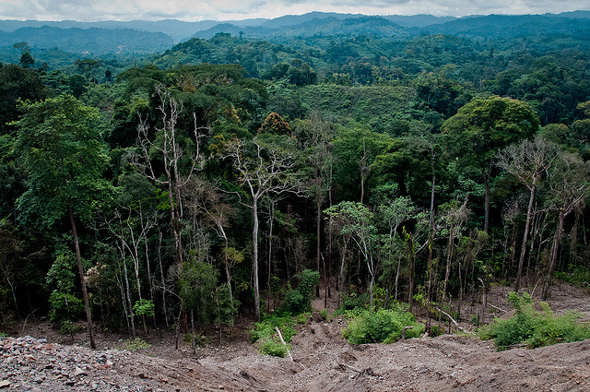
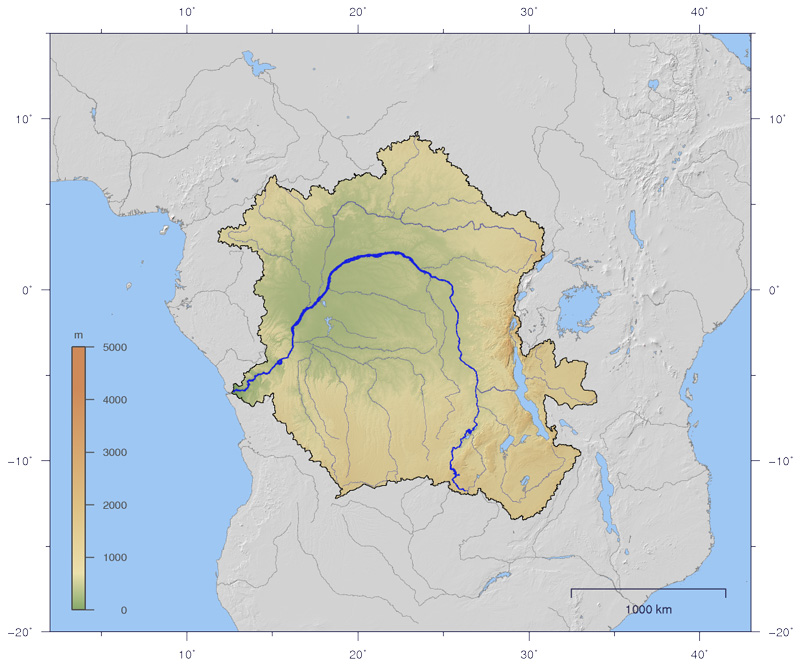
Nearly half of the Congo Basin’s remaining rainforest is in the DRC – yet the critical role of Congolese experts in forestry, agricultural science, wildlife management and other rural sciences in protecting this forest is not widely recognized.As one Congolese graduate student observed, the DRC has a “void” in agricultural and forestry research. Due to years of war and decades of economic crisis and mismanagement, most of Congo’s colleges and universities are severely underfunded and in disrepair. The country is short of experts who can investigate the ecology and economic potential of Congo’s forests and their biota, and provide an objective basis for setting priorities for protection and use of forest resources. While universities in Kinshasa and Kisangani do have some internationally funded programs to increase the number of biologists and other specialists, the number of graduates is nowhere near what is needed. Foreign scientists and consultants are not a substitute for Congolese experts.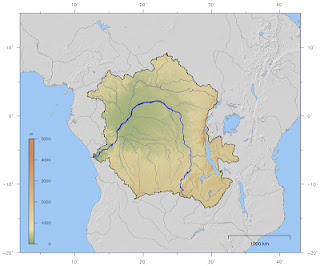
Moreover, competent rural science graduates who can advise local farmers, communities and administrators on forestry, sustainable agriculture, wildlife management, and rural development issues are also desperately needed. The DRC’s national agricultural extension service, which should be integral to this process, has been broken for decades. A 1990 USAID report described it as underfunded, without the means to provide farmers with proven crop varieties and advice on agricultural practices, and tasked more with imposing particular crops on farmers and collecting taxes than helping them. There is little evidence that this has changed significantly since the end of the Congo war in 2003.
Continue reading on Mongabay.
Image Credit: Depths of Forest, courtesy of flickr user Bobulix. Congo Basin map, courtesy of Wikimedia Commons user Imagico. -
Kirk Talbott, State of the Planet
Burma at a Crossroads for Peacebuilding and Natural Resource Governance
›June 18, 2012 // By Wilson Center StaffThe original version of this article, by Kirk Talbott, appeared on the Columbia University Earth Institute’s State of the Planet blog.
After a half-century of authoritarian rule, armed conflict against millions of ethnic minorities, and natural resource plunder, Burma, also known as Myanmar, now stands at a crossroads. As conditions for peace coalesce and civil society begins to blossom, there is hope once more for Burma’s people.
Burma’s quasi-civilian government, led by reformist Thein Sein, has initiated a series of surprising political openings and continues to engage actively with Nobel laureate Aung San Suu Kyi, now a member of parliament. Civil society and international relations are flourishing in contrast to conditions just one year ago. In May, the United States suspended economic sanctions and President Obama appointed a U.S. Ambassador for the first time in decades.
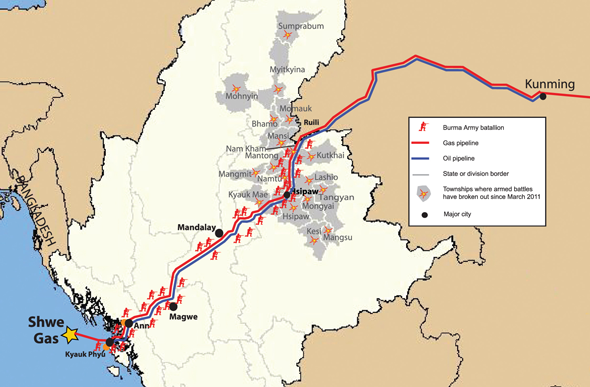
A new set of challenges emerge, however, around sharing the benefits and responsibilities of governing the country’s diverse wealth of natural resources. Nestled strategically between China and India, Burma has been isolated from the world’s attention since a coup in 1962. Its military government has consolidated a brutal grip on power through the sale of its rich timber, mineral, natural gas, and other resources, primarily to China and Thailand. This practice expanded after 1995, when the regime brokered a series of cease fire agreements with several ethnic armies along mountainous border areas. (For the first time in 60 years the Karen National Union joined almost all other major ethnic armies in agreeing to a cease fire, with the notable exception of the Kachin Independence Army.)
Oil and gas revenues fund the Tatmadaw, Burma’s half-million-strong army, one of Asia’s largest. Currently the huge offshore Shwe and Yadana natural gas reserves provide more than 90 percent of the nation’s foreign exchange. Chinese and Thai companies fund extensive pipeline, hydro-power, and transport networks as Burma becomes a potential regional economic corridor and natural resources production hub. China looms large in the geo-political equation investing over $12 billion in Burma in 2011.
Continue reading on State of the Planet.
Image Credit: Shwe gas line map, courtesy of Shwe Gas Movement. -
Gidon Bromberg at TEDx on Peacebuilding Through Water in the Middle East
›“Cooperation over water is not a privilege, it’s a necessity,” said Gidon Bromberg, co-director of Friends of the Earth Middle East, in a TEDx talk at Yale. He sees the shortage of water in Jordan, Israel, and Palestine as an opportunity to bring these contentious communities together – even more so during this period of upheaval in the region.
Water woes have long contributed to regional tensions, said Bromberg. Water rights between Israel and Palestine were supposed to be settled during the Oslo accords in 1993, but negotiations were unsuccessful and water discussions were consequently left unfinished. The lack of formal negotiations caused each side to seize whatever resources they could Although Jordan was not part of the negotiations, it does share water resources with Israel and the West Bank and thus has been impacted by the lack of formal allocation processes. Both Jordan and Israel have diverted flow of the Jordan River into dams and irrigation projects. As a result, the Jordan River has lost 98 percent of its historic flow and the Dead Sea has lost one-third of its surface area.
Today, Israel has restricted Palestinian water use such that Palestinians have access to water only once a week in winter and once every three weeks in the summer, leading them to store water in containers on their roofs, Bromberg said. Though mismanagement is as much to blame as conflict, he notes, Palestinians chafe under the limitations.
Yet Friends of the Earth Middle East has used this difficult situation to educate the public, propose reforms, and build trust between Palestinian, Jordanian, and Israeli communities. Bromberg highlighted “fear of a small but vocal minority on both sides” as a key factor in preventing dialogue between the communities, but insists that water can bring people together. Neighboring communities have to work together, he said, “not because they’re best friends,” but to improve their own water situations.
Friends of the Earth provides that opportunity with their Good Water Neighbors project and hopes the trust built between communities extends beyond water issues as well. Since communities have strong motives to solve these problems, they work together more effectively than high-level politicians who may not be as apt to collaborate.
A positive update on the state of the Jordan River given in an interview with ECSP in October suggests that Bromberg may be on to something.
Sources: Amnesty International, Friends of the Earth.
Video Credit: TEDx. -
Environment, Natural Resource Guidelines for Peacekeepers Moves UN Closer to ‘Greening the Blue Helmets’
›May 30, 2012 // By Stuart KentUN peacekeepers not only operate in conflicts where land and natural resources are a component of the fighting but their own bases and operations can also impact the local environment. As well as documenting practical steps to minimize the footprint of field missions, a new report from the United Nations Environment Program (UNEP) reviews the relationship between natural resources and conflict and what it means for peacekeeping.
While there’s been talk about “greening” UN peacekeeping for years, the details about the economic, environmental, and mission benefits contained in Greening the Blue Helmets: Environment, Natural Resources and UN Peacekeeping Operations suggest that this talk is getting closer to reality.
As of December 2011, the UN’s Department of Peacekeeping Operations was responsible for 121,591 personnel, 17,000 vehicles, and 257 aircraft across 16 different operations worldwide. These forces account for more than half of the entire UN system’s carbon emissions and can significantly strain the resources of fragile host communities, according to the report.
Building on the 2009 Environmental Policy for UN Field Missions, the UNEP report provides a dozen best practice examples from ongoing missions.
Field cases serve as evidence of how increasing water and energy efficiency, safely discarding solid and hazardous wastes, protecting cultural and historical sites, and ensuring a limited footprint after the closing down of camps, can save environmental and financial resources. These measures, the report claims, also reduce the risk of tension with host communities, such as occurred in Haiti when an outbreak of Cholera was traced to unsanitary water management practices at a UN camp.
Technologies recommended include better waste management systems, improved water systems, energy efficient buildings, and green energy capacities. However, some improvements can be made by simply encouraging behavioral changes; the UN mission in Timor-Leste reduced energy consumption by 15 percent over 12 months using a “CarLog” system to encourage fuel efficiency. With a 2009 global fuel bill of $638 million, even a 15 percent margin relates to a significant figure (much like the logic behind similar efficiency efforts within the U.S. military).
However, uncertain mission lengths are a major barrier to the adoption of more efficient technologies. Despite UN operations lasting an average of seven years and evidence indicating that capital investments could be recovered within one to five years in some cases, year-to-year mandates complicate long-term planning.
Natural Resource Nexus
Conceptually, the nexus of natural resources, conflict, and peacebuilding must be a central concern of peacekeeping operations, asserts the report.
In Africa alone, 13 operations have been conducted in response to conflicts associated with natural resources, at a cost of around $32 billion. Exploitation of natural resources such as diamonds, timber, and oil has financed and fueled conflicts in Sierra Leone, the Democratic Republic of the Congo, and Liberia. Communal tensions over access to scarce land and water resources are also considered an exacerbating influence on conflict dynamics in much of Sudan and now South Sudan, according to the report.
Addressing this nexus can also provide opportunities to reduce and redress conflict. In Darfur, firewood collection is a dangerous task for women and girls. By making “firewood patrols” a regular feature of the UN forces’ protection, the prevalence of sexual violence has been limited.
The UN Assistance Mission in Afghanistan is cited in the report for its efforts to hire ex-combatant and vulnerable populations to aid in the reforestation of extensively degraded pistachio woodlands from 2003 to 2009.
“Natural resources can provide opportunities for emergency employment and…sustainable livelihoods for former combatants,” write the authors.
Countries recovering from episodes of violence tend to have a low capacity to effectively and equitably manage a natural resource base that itself may have been degraded by conflict. Recent attention, however, is being paid to the peacebuilding potential of managing shared resources.
According to the report, “while only 54 percent of peace agreements reached between 1989 and 2004 contained provisions on natural resources, all of the major agreements concluded between 2005 and 2010 included such provisions.” This includes the renovation of land tenure systems, management of valuable extractive industries, and reallocation of resource rents.
Preventing Predatory Extraction
As peace begins to take hold, “access to land may be a key determining factor affecting the successful reintegration of a former combatant into a community.”
According to interview data from Northern Uganda, 93 percent of male LRA ex-combatants were unable to access land after demobilization. Often due to the death of an elder relative, sale of land by a family member, or land grabs by other members of the community.
While shared resources can build trust between communities, spoiler groups that use aggressive means to secure resource rents in the aftermath of conflict can endanger a fragile peace. The report identifies a role here for peacekeeping forces – and in particular for their civilian contingent – to identify these potential risks and opportunities for action.
In particular, the report recommends a higher level of clarity about the relationship between peacekeeping forces and so called “expert panels” – groups of civilian specialists called upon by the Security Council to provide advice on an official basis about natural resources in the aftermath of conflict.
The UN mission in the Democratic Republic of Congo, for instance, was given a direct mandate in 2008 to work with the DRC expert panel and to “use its monitoring and inspection capacities to curtail the provision of support to illegal armed groups derived from illicit trade in natural resources.”
UNEP Program Officer Matti Lehtonen, in an email interview, called the panels a “tremendous asset that is not yet used up to its full potential.” However, he noted, “expert panels and peacekeeping missions are different tools with different objectives so there is also a need to maintain a degree of independence.”
The report identifies a set of key recommendations for the UN moving forward:- Ensure that pre-deployment and in-mission training includes instruction on environment and natural resource management
- Aid and encourage disarmament, demobilization, and reintegration programs to look closely at emergency employment and sustainable livelihoods related to natural resources and the environment
- Support and encourage civil affairs personnel to seek ways to capitalize on peacebuilding opportunities around natural resources and the environment
- Systematically inform the Security Council of linkages between natural resources and conflict in states where the Council may be considering action
- Where natural resources have fueled or financed conflict, provide peacekeepers with a more systemic mandate to act on these issues
- Effectively implement best practices identified in the 2009 environmental policy
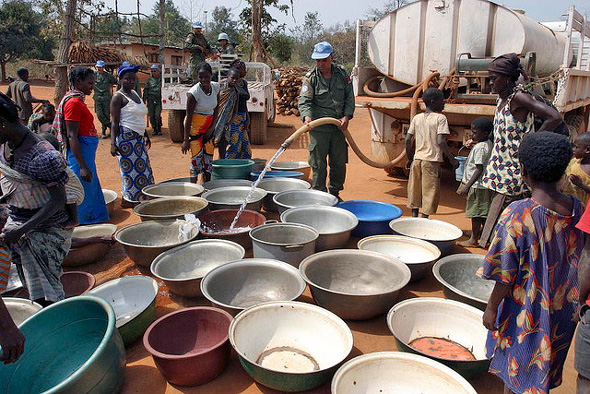
Photo Credit: UN peacekeepers in Côte d’Ivoire distribute water during a 2007 mission, courtesy of United Nations Photo. -
Full Extent of Africa’s Groundwater Resources Visualized for the First Time
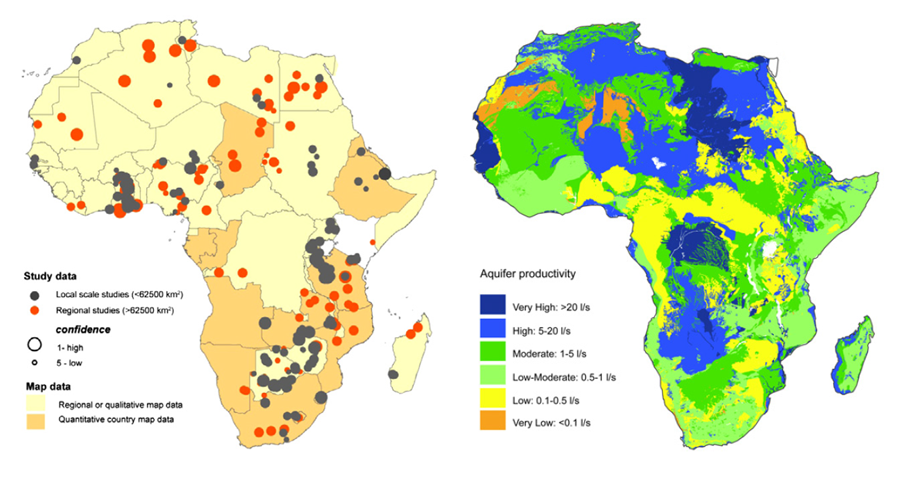
›“In Africa, groundwater is the major source of drinking water and its use for irrigation is forecast to increase substantially to combat growing food insecurity,” yet, a lack of quantitative data has meant that “groundwater storage is consequently omitted from assessments of freshwater availability,” according Alan Macdonald, Helen Bonsor, and Brighid Dochartaigh of the British Geological Survey, and Richard Taylor of University College London, writing in Environmental Research Letters.
The authors hope to remedy this with new research presented in “Quantitative Maps of Groundwater Resources in Africa.” They used estimates compiled from geologic data and 283 aquifer summaries from 152 different publications to quantitatively visualize, for the first time, the full extent of Africa’s groundwater resources.
Tapping a Hidden Resource
The study estimates the scale of the continent’s groundwater resources at around 0.66 million km3. This volume, the authors explain, is “more than 100 times the annual renewable freshwater resources, and 20 times the freshwater stored in African lakes.”
Tapping into this massive resource is not always straightforward, however. The largest aquifers, and those most able to support high yielding bores, are concentrated in the arid regions of North Africa. The depth of these aquifers and their distance from major populations creates substantial economic challenges for extraction.
The geographic distribution of aquifers across sub-Saharan Africa is also quite variable, and local geology can determine not just the availability and accessibility of water but also its quality. For instance, geologic specificities can result in elevated levels of arsenic and other undesirable chemicals. Furthermore, “contamination…is common in urban areas from widespread and dispersed faecal effluent from on-site sanitation and leaking sewers.”
Tempering Expectations
Throughout Africa, “groundwater provides an important buffer to climate variability and change,” say the authors. But these buffers are not a singular solution to the threat of future water scarcity.
As the analysis shows, most aquifers, especially south of the Sahara, are unlikely to sustain boreholes of a higher capacity than that required by community-level hand pumps (one liter per second of flow at minimum). Yet, commercial irrigations schemes and urban towns typically demand boreholes greater than five liters per second, according to the study.
So, groundwater extraction may help communities and some small-scale farmers maintain access to water, particularly because many aquifers are found to possess the storage capacity required “to sustain abstraction through inter-annual variations in recharge,” however, “strategies for increasing irrigation or supplying water to rapidly urbanizing cities that are predicted on the widespread drilling of high yielding boreholes are likely to be unsuccessful.” Especially, the authors assert, where drilling precedes detailed local scale mapping of the available resources.
Sources: Environmental Research Letters.
Image Credit: Figures 1 and 3, courtesy of Environmental Research Letters. -
Poor Land Tenure: A Key Component to Why Nations Fail
›The murder of five land rights campaigners during the last two months – one in Colombia, three in Brazil, and one in Cambodia – have not captured many headlines, but they are a reminder of the central role land tenure plays not just in rural economic development but also in sparking broadly distributed economic gains throughout a society.
-
The Global Water Security Assessment and U.S. National Security Implications
›“Water security is about much more than access to H2O,” said Jane Harman, director, president, and CEO of the Wilson Center at the May 9 meeting, “Global Water Security: The Intelligence Community Assessment.” The event – part of the Wilson Center’s National Conversation Series – brought together a number of experts to discuss a recently released intelligence community assessment of global water security. [Video Below]
-
Michael Kugelman, AfPak Channel
Pakistan’s Climate Change Challenge
›May 11, 2012 // By Wilson Center StaffLast month, an avalanche on the Siachen glacier in Kashmir killed 124 Pakistani soldiers and 11 civilians. The tragedy has intensified debate about the logic of stationing Pakistani and Indian troops on such inhospitable terrain. And it has also brought attention to Pakistan’s environmental insecurity.
Siachen is rife with glacial melt; one study concludes the icy peak has retreated nearly two kilometers in less than 20 years. It has also been described as “the world’s highest waste dump.” Much of this waste-generated from soldiers’ food, fuel, and equipment-eventually finds its way to the Indus River Basin, Pakistan’s chief water source.
Siachen, in fact, serves as a microcosm of Pakistan’s environmental troubles. The nation experiences record-breaking temperatures, torrential rains (nearly 60 percent of Pakistan’s annual rainfall comes from monsoons), drought, and glacial melt (Pakistan’s United Nations representative, Hussain Haroon, contends that glacial recession on Pakistani mountains has increased by 23 percent over the past decade). Experts estimate that about a quarter of Pakistan’s land area and half of its population are vulnerable to climate change-related disasters, and several weeks ago Sindh’s environment minister said that millions of people across the province face “acute environmental threats.”
Continue reading on the AfPak Channel.
Sources: Daily Times, Dawn.com, Environment News Service, The Express Tribune, The New York Times, Remote Sensing Technology Center of Japan.
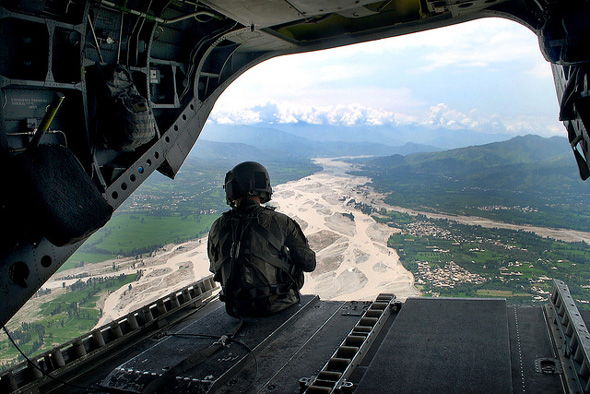
Photo Credit: “Surveying damage in Pakistan,” courtesy of the U.S. Army.
Showing posts from category environmental security.