

Showing posts from category environmental security.
-
VIDEO: Geoff Dabelko on the Global Environmental Change and Human Security Conference
›June 23, 2009 // By Wilson Center StaffMore than 150 experts from around the world are assembled this week in Oslo, Norway, for the capstone conference of the Global Environmental Change and Human Security (GECHS) Project. The conference features a mix of researchers and policymakers, who are debating the practical impacts of bringing a focus on people more firmly into discussions of global environmental change.
The Wilson Center’s Geoff Dabelko, director of the Environmental Change and Security Program, is attending the conference, and in this video, he comments on three themes prominently discussed in the opening day of the conference: human security versus national security; climate change and migration; and practical avenues for incorporating human security research into the fifth assessment of the Intergovernmental Panel on Climate Change. -
At Heavy-Hitting Conference, CNAS Launches Natural Security Program, Blog
›June 11, 2009 // By Rachel WeisshaarToday’s Center for a New American Security (CNAS) annual conference was replete with heavy hitters like General David Petraeus discussing the world’s top security challenges, including Iraq, Afghanistan, Pakistan, and North Korea. But at an afternoon panel, CNAS’s Sharon Burke argued that although environmental and natural-resource issues may not get their own section in the Presidential Daily Briefing, they are intimately intertwined with many of the high-profile security issues that do.
President Obama recently called for a stronger focus on agricultural development in Afghanistan, said Burke, as part of a broader approach to increasing stability and improving Afghans’ quality of life. But decades of war have contributed to severe deforestation and land degradation, and farmers “can’t plant their seeds if the land is barren, and that’s where we are right now,” she said.
The panel also served as the launch for CNAS’s new Natural Security program (see working paper) and blog, which aim to study the “national-security implications of natural resources use,” said Burke. The program grows out of CNAS’s investigation of the security impacts of climate change and energy over the past several years. Burke explained that it was difficult to discuss energy and climate change without also talking about water, land, biodiversity, and a host of other related issues, so CNAS decided to create a program that would not attempt to separate these interconnected issues.
Burke was joined by former U.S. Senator John Warner, Peter Gleick of the Pacific Institute, Roderick Eggert of the Colorado School of Mines, and Commander E. J. McClure of the Office of the Secretary of Defense. -
Climate-Security Links Recognized by UN General Assembly
›June 4, 2009 // By Geoffrey D. Dabelko The security threat of sea level rise to small island states appears to have proven so obvious as to overcome the common objections of many countries (notably P5 members China and Russia) to framing climate change as a threat to security. Just yesterday, the UN General Assembly passed by consensus a non-binding resolution linking climate and security. The final version of the resolution (GA/10830) is not yet online, but the May 18 draft resolution gives you an idea of the final language.
Symbolic, yes, but perhaps this will make it easier for climate security questions to come before the UN Security Council again. The April 2007 Security Council session on climate change and security, at the behest of the British chair at the time, was, shall we say, met with a mixed reception, but 2009 is already different than 2007 in so many ways. It will be interesting to watch where the discussion goes from here at the UN and in national capitals.
Graphic: Symbol of the Alliance of Small Island States (AOSIS). -
VIDEO: Environment Key to Resolving Conflicts, Building Peace, Says UN Environment Programme Director Achim Steiner
›June 2, 2009 // By Rachel Weisshaar“Addressing the issue of the environment in the context of conflict resolution, conflict prevention, peacekeeping, [and] peacebuilding becomes ever more important because we know from everything we have learned—and are learning every day—about climate change that one thing is for certain: The world is going to be under more stress,” says UN Environment Programme (UNEP) Director Achim Steiner in a short expert interview on YouTube.
Yet in another original Environmental Change and Security Program (ECSP) video, Steiner emphasizes that environmental issues do not lead inexorably to conflict. “History shows that human societies are not prone to looking for conflict but rather for conflict resolution, particularly when it comes to fundamental elements of life support systems, be it water, or be it clean air or other issues—we have seen the model of cooperation emerge.”
Steiner was at the Wilson Center in March 2009 for the launch of From Conflict to Peacebuilding: The Role of Natural Resources and the Environment, a new report by UNEP’s Disasters and Conflicts Programme. According to From Conflict to Peacebuilding:- Forty percent of intrastate conflicts within the past 60 years have been strongly linked to natural resources.
- Such conflicts are twice as likely to relapse within the first five years of peace.
- Less than a quarter of peace agreements for these conflicts address natural-resource issues.
- Forty percent of intrastate conflicts within the past 60 years have been strongly linked to natural resources.
-
The Challenge for Africa: A Conversation With Wangari Maathai
›May 5, 2009 // By Rachel Weisshaar“Almost every conflict in Africa you can point at has something to do with competition over resources in an environment which has bad governance,” said Wangari Maathai, founder of the Green Belt Movement and recipient of the 2004 Nobel Peace Prize, at an April 13, 2009, event co-sponsored by the Wilson Center’s Environmental Change and Security Program and Africa Program and the International Gateway at the Ronald Reagan Building & International Trade Center. Maathai discussed her new book, The Challenge for Africa, with Environmental Change and Security Program Director Geoff Dabelko.
“This is why I wrote this book: Because I really was challenging us as Africans to think outside the box and to begin to see why when we seem to move forward, we make two steps forward, and we make one step backward, and so we look like we are not moving,” said Maathai. “Some of these issues are complex, they are difficult—but they have a lot to do with the way we have decided to manage our resources and to manage our politics and economics.”
The Three Legs of Stability
Maathai used the traditional African three-legged stool as a metaphor for what she views as the three essential components of a stable society: sustainable environmental management, democratic governance, and a culture of peace. “Those legs are chiseled by a craftsman…[who] chisels all the three legs at the same time, in order to create a balance,” she said. “If we don’t have these three legs, no matter who comes, and with whatever [loans or aid], we shall never develop.”
Land, Politics, and Ethnicity: An Explosive Combination
Maathai explained that in the absence of democratic governance and sustainable environmental management, natural resources have repeatedly ignited conflict in her native Kenya. For instance, the advent of private land ownership during colonialism pitted Maasai herders, who need large tracts of land to graze their cattle, against Kikuyu farmers, who for the first time obtained deeds to their land and began to erect fences to mark the boundaries.
In addition, Maathai noted that politicians often use Kenya’s ethnic divisions and land scarcity to whip up animosity toward internal migrants and bolster their own re-election prospects. “If you don’t, then, therefore, ensure that the resources within the country are equitably distributed, and you encourage these prejudgments that communities have against each other, you’re going to have conflict,” she said.
Holistic Approach Is Key to Successful Development
The Green Belt Movement began as a small, grassroots project that envisioned tree-planting as a way to address rural women’s needs, including firewood, food, clean water, and soil erosion. “Even though that’s how we started, it very quickly became clear to me that these are symptoms, and therefore we needed to get to the causes. And it is in search of the causes that eventually led me into understanding how interconnected these issues were,” said Maathai, who urged governments, development agencies, and nonprofits to adopt an integrated approach to development.
“Unless you deal with the cause, you are wasting your time. You can use all the money you want for all the years you want; you will not solve the problem, because you are dealing with a symptom. So we need to go outside that box and deal with development in a holistic way.”
“I can’t say, ‘Let us deal with governance this time, and don’t worry about the resources.’ Or, ‘Don’t worry about peace today, or conflicts that are going on; let us worry about management of resources.’ I saw that it was very, very important to use the tree-planting as an entry point,” explained Maathai.
“Even though it is the women who provide the drive for planting trees—partly because it is they who suffer when the environment is destroyed, it is also they who work in the field—once we are in the community, we will have to deal with the women, deal with the men, deal with the children, deal with the livestock, deal with everything,” said Maathai.
Climate Change, Forests, and Environmental Justice
According to Maathai, 20 percent of greenhouse gas emissions are due to deforestation and forest degradation—more than the percentage due to transportation. She is working with Avoided Deforestation Partners to make avoiding deforestation part of the Copenhagen agreements—a step that would not only slow global climate change, but also help those who are directly dependent on natural resources like forests for their livelihoods, and therefore most vulnerable to climate change. “This is the one issue which really comes to tell us that indeed, the planet is a small village, and all of us are in this little village together.” -
Pakistan’s Daunting—and Deteriorating—Demographic Challenge
›Every day it seems the headlines bring new worries about the future of Pakistan. But among the many challenges confronting the nation—including a growing Taliban insurgency—one significant problem remains largely undiscussed: its rapidly expanding population.
Consider this: Pakistan’s population nearly quadrupled from 50 million in 1960 to 180 million today. It’s expected to add another 66 million people—nearly the entire population of Iran—in the next 15 years. UN projections predict that by the late 2030s, Pakistan will become the fourth most populous country in the world, behind India, China, and the United States.
And believe it or not, the demographic outlook for Pakistan got bleaker in recent weeks. The new medium-range UN projections for Pakistan’s total population have been raised to 335 million for 2050—45 million higher than the UN projection just two years ago. Why the change? Because birth rates aren’t falling as had been predicted—women in Pakistan have an average of four children—and unmet need for family planning remains high.
The case of education provides a snapshot of how these demographics affect Pakistan, from basic quality-of-life issues to the country’s overall stability. Even though the official literacy rate in Pakistan has increased from about 18 percent to 50 percent since 1970, the number of illiterate people has simultaneously jumped from 28 million to 48 million. The literacy rate for women stands at a shockingly low 35 percent.
As public schools have become increasingly overcrowded, more parents have turned to madrasas in an attempt to educate their children—or at least their sons. It’s no secret that some of Pakistan’s madrasas have ties to radical religious and terrorist-affiliated organizations.
So what does this portend for the future?
Even assuming large infusions of assistance from the United States, Pakistan’s public school system will become even more overwhelmed in the years ahead. Building enough schools and hiring enough teachers would be daunting in any country, let alone one facing as many challenges as Pakistan. It seems likely that enrollments in madrasas will swell, and more children will face a future with no schooling whatsoever. Clearly, this is not a recipe for a more stable and peaceful Pakistan.
Pakistan’s rapid population growth is not inevitable, however. A key driver is lack of access to family planning, which is symptomatic of the overall poor status of women and girls. More than 25 percent of Pakistani women have an unmet need for family planning—meaning the demand is clearly there—and nothing in the Koran prohibits its usage. In other majority-Muslim nations, such as Algeria, Bangladesh, and Iran, family planning has been prioritized and is widely used.
Unfortunately, family planning programs in Pakistan and many developing countries have suffered from both inattention and funding cuts in recent years. Traditionally, the United States has been a major source of funding and technical assistance, but since 1995, U.S. international family planning assistance has fallen 35 percent (adjusted for inflation), even as demand has increased.
Today, more than 200 million women—many of them in the most impoverished parts of the world—have an unmet need for family planning. In countries like Pakistan, the resulting rapid population growth makes it increasingly difficult to provide sufficient education, health care, housing, and employment—and depletes land, water, fisheries, and other vital natural resources.
The Obama administration recently proposed a new U.S. assistance strategy for Pakistan—and a key component is a significant increase in development and economic assistance. Let’s hope it will include an increase for family planning. It would be a wise investment in a brighter, more stable future—for Pakistan and for the world.
Tod Preston is vice president for U.S. government relations at Population Action International.
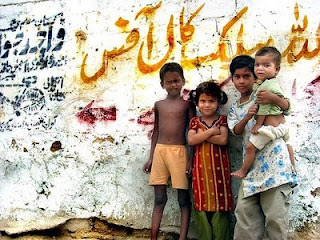
Photo: Children in Jinnah Colony, Karachi, Pakistan. Courtesy of Flickr user NB77. -
Environmental Cooperation Could Boost U.S.-Chinese Military Engagement, Says ECSP Director Dabelko
›April 23, 2009 // By Wilson Center Staff“Recently, the Defense Department warned that lack of Chinese transparency and dialogue between the Chinese and US militaries could lead to dangerous miscalculations on both sides. The tense confrontation between a US Naval survey vessel and five Chinese ships in the South China Sea in March echoed the rather serious 2001 Hainan Island incident, which was characterized by mutual suspicion and public acrimony. That event affected US-China relations for years.
To avoid further incidents, the Defense Department desires ‘deeper, broader, more high-level contacts with the Chinese,’ said Pentagon Press Secretary Geoff Morrell. The White House issued a statement stressing the ‘importance of raising the level and frequency of the US-China military-to-military dialogue,’ and President Obama quickly laid the groundwork by meeting with Chinese President Hu Jintao in London and agreeing to work to improve military-to-military relations.
One such way to begin military dialogue between the United States and China is by using environmental issues.
Environmental collaboration is unlikely to hit politically sensitive buttons, and thus offers great potential to deepen dialogue and cooperation. Military-to-military dialogue can facilitate the sharing of best practices on a range of environmental security issues.”
To read the rest of this op-ed, co-authored by ECSP Director Geoff Dabelko and Kent Hughes Butts, director of the National Security Issues Branch of the Center for Strategic Leadership at the U.S. Army War College, please visit the Christian Science Monitor. -
Climate Change and “Developed-Country Complacency Syndrome”
›While it is now widely acknowledged that environmental change, including climate change, could severely undermine security in the developing world, the implications for the developed world are just starting to be discussed. A sort of “developed-country complacency syndrome” has led many to assume that the main security problems for a country like the United States, such as waves of refugees or the need to intervene when other nations face disasters or conflicts, would be imported from abroad. Unfortunately, the United States is likely to face some fairly severe “Made in the USA” problems, as well.
For instance, as the economic stimulus package is rolled out, the United States is entering a historic period of new infrastructure construction. From a security perspective, this could help maintain stability, or it could be a disaster. What might make the difference is assessing how potential sites could be affected by environmental change. Transportation systems, defensive capabilities, agriculture, power generation, water supply, and more are all designed for the specific parameters of their physical environments—or, more often, the physical environments of the Victorian, Depression-era, or post-WWII periods in which they were originally built. That is why unplanned environmental change almost always has negative impacts.
In the case of a change in precipitation patterns, for example, drainage systems, reservoirs, and hydrological installations can all fail not because they were poorly engineered, but because they were engineered for different conditions. We are literally not designed for environmental change.
Current environmental impact assessments look almost exclusively at a structure’s impact on the environment. These assessments must now be expanded to include the other half of the equation: the impact of a changing environment on the structure. These sorts of “dual” assessments are essential. To put it bluntly, there is no point in building a zero-emissions house in a current or soon-to-be flood zone. However, this is exactly the sort of thing that is being proposed in areas of the U.S. Gulf Coast. We can avoid this by requiring these “dual” assessments when applying for insurance, planning permission, and/or government support.
Just as physical infrastructure is poorly prepared to deal with environmental change, so, too, is legal infrastructure. Very few regulations, international laws, and subsidies incorporate the effects of environmental change. At best, this renders them inadequate; at worst, it can create new vulnerabilities.
For instance, the U.S. government’s National Flood Insurance Program (NFIP) can inadvertently contribute to putting people and infrastructure in harm’s way. When private insurers deem areas too risky to be eligible for coverage, the NFIP can step in and insure them, making it possible to build in areas that are current flood zones, as well as areas that may become ones as climate change causes sea levels to rise and storm surges to increase. Already in some areas the same homes have had to be rebuilt multiple times, in part with cash infusions from the NFIP.
There are other examples of developed-world agreements that may cause more damage than they prevent:- Water-sharing agreements, especially those based on a set amount of water, rather than percentage of actual flow, will become problematic as water levels alter dramatically.
- Fisheries-sharing agreements will be thrown into chaos as fish shift to other regions due to climate change and overfishing.
- Hydropower-sharing agreements will be a major problem, both for precipitation-fed systems and glacier regions, where there will be above-average flows as the glaciers melt, followed by droughts once the glaciers disappear.
Two of the things the developed world prides itself on—its physical and legal infrastructures—are both highly vulnerable to environmental change. However, the stimulus packages and the reassessment of global, regional, and national agreements caused by the financial crisis offer a valuable opportunity to ensure that the structures and mechanisms we are counting on to maintain our security do not end up undermining it.
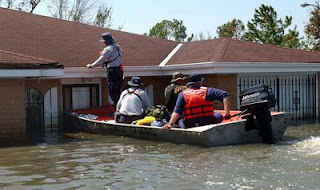
Photo: Members of the Coast Guard Sector Ohio Valley Disaster Response Team and the Miami-Dade Urban Search and Rescue Team mark a house to show it has been searched for survivors of Hurricane Katrina. Hurricane Katrina, which devastated the U.S. Gulf Coast in 2005, revealed the vulnerability of U.S. infrastructure to natural disasters. Climate change could make hurricanes and other natural disasters more frequent and severe. Photo courtesy of Flickr user Tidewater Muse and Petty Officer Robert M. Reed.
Cleo Paskal is an associate fellow in Chatham House’s Energy, Environment, and Development Programme. She is the author of UK National Security and Environmental Change.
 The security threat of sea level rise to small island states appears to have proven so obvious as to overcome the common objections of many countries (notably P5 members China and Russia) to framing climate change as a threat to security. Just
 Every day it seems the headlines bring new worries about the future of Pakistan. But among the many challenges confronting the nation—including a
  While it is now

