

-
ECSP Weekly Watch | February 17 – 21
›
A window into what we’re reading at the Wilson Center’s Environmental Change and Security Program
Africa Energy Bank Aims to Boost Energy Supply (Al Jazeera)
Nearly 43% of the African continent lacks consistent access to electricity, which is the lowest level of modern energy usage in the world. A newly established Africa Energy Bank aims to boost the energy supply on the continent through investments in energy infrastructure projects.
-
ECSP Weekly Watch | December 16 – 20
›
A window into what we’re reading at the Wilson Center’s Environmental Change and Security Program
Humanitarians Highlight the Climate-Conflict Nexus (The New Humanitarian)
Climate change’s disproportionate impacts on vulnerable populations exacerbate socioeconomic inequalities and conflict, particularly during natural disasters. This vexed connection has led humanitarians and peacebuilders increasingly to address climate and conflict challenges together in order to provide integrated relief, recovery, and aid.
-
The Arc | Indigenous and Community Power: Localizing Climate Action
›In today’s episode of The Arc, we are featuring a panel discussion on climate action through Indigenous and community power from the Forum on Advancing Inclusive Climate Action in Foreign Policy and Development, hosted by the Wilson Center in collaboration with the White House and USAID’s Bureau for Humanitarian Assistance, with support from the USAID Climate Adaptation Support Activity. -
New Tool Offers Key Insights for Tackling Climate and Conflict Challenges
›When the White House released the US Framework for Climate Resilience and Security in September 2024, it was an important opportunity to highlight the significant impacts of climate change on US national security, economic, and strategic interests. The Framework also emphasized the need for tailored approaches in fragile, conflict-affected, and vulnerable (FCV) contexts, particularly in managing and allocating resources, as well as ensuring that climate finance addresses conflict drivers.
-
ECSP Weekly Watch | October 7 – 11
›A window into what we’re reading at the Wilson Center’s Environmental Change and Security ProgramEscalations in Middle East Spur Oil Security Concerns (Reuters)
One year on from the brutal reignition of the Israeli-Palestinian Conflict on October 7, 2023, the situation in the Middle East has escalated drastically. Hamas’ attack on Israel has been followed by Israeli strikes across the region, which have killed tens of thousands of civilians, displacing millions in Gaza and in Lebanon. Now, tit for tat attacks between Israel and Iran have made Gulf states, particularly Saudi Arabia, Qatar, and the United Arab Emirates (UAE), worry about oil security in the region.
-
ECSP Weekly Watch | September 16 – 20
›A window into what we’re reading at the Wilson Center’s Environmental Change and Security Program
COP29-Host Azerbaijan Accused of Hypocrisy (The Guardian)
Azerbaijan holds the presidency for the upcoming COP29 in November 2024, and it is using that platform to call for all member states to cease any ongoing conflict they are involved in during the two-week conference. The Central Asian country will also host a “peace day” on November 15, and is putting forth a COP29 Climate and Peace Initiative to support vulnerable countries and advance action in the climate and peace nexus.
-
ECSP Weekly Watch | September 3 – 6
›A window into what we’re reading at the Wilson Center’s Environmental Change and Security Program
Proliferation of Icebreakers in the Arctic (Foreign Policy)
As climate change-induced melting of ice sheets clears new pathways, the fast-melting Arctic now has a new strategic race: icebreakers. Russia covers over half of what is defined as “Arctic” territory, and it has the largest number of icebreakers in the region. Russia’s attempt to consolidate and expand has led the US and its NATO allies to redefine their own Arctic security strategy.
-
Climate Security in South Sudan: A Conversation with Ratia Tekenet
›In today’s episode of New Security Broadcast, ECSP Director Lauren Risi interviews Ratia Tekenet, a Climate Security Expert with the UN Mission in South Sudan (UNMISS) and a former ECSP staff member. In their conversation, Ratia explores how climate change is intensifying South Sudan’s security challenges, creating an immense humanitarian crisis. She also discusses the efforts of UN agencies, the South Sudanese government, and local communities to build resilience and respond to ongoing climate disasters, as well as the need for greater integration of the humanitarian-development-peace (HDP) nexus. Select quotes from the interview are featured below.
Showing posts from category environmental peacemaking.
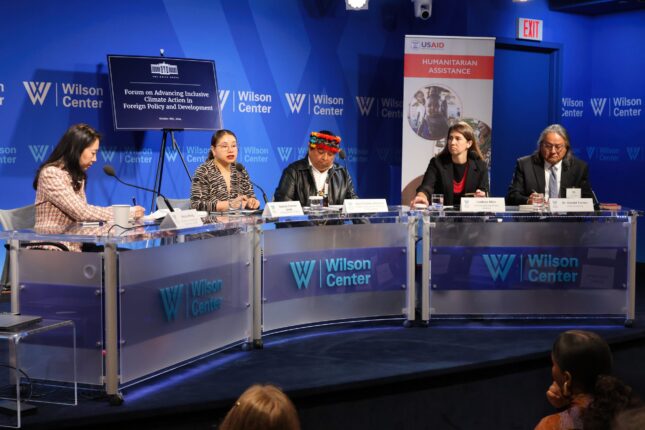 In today’s episode of The Arc, we are featuring a panel discussion on climate action through Indigenous and community power from the Forum on Advancing Inclusive Climate Action in Foreign Policy and Development, hosted by the Wilson Center in collaboration with the White House and USAID’s Bureau for Humanitarian Assistance, with support from the USAID Climate Adaptation Support Activity.
 In today’s episode of New Security Broadcast, ECSP Director Lauren Risi interviews Ratia Tekenet, a Climate Security Expert with the UN Mission in South Sudan (UNMISS) and a former ECSP staff member. In their conversation, Ratia explores how climate change is intensifying South Sudan’s security challenges, creating an immense humanitarian crisis. She also discusses the efforts of UN agencies, the South Sudanese government, and local communities to build resilience and respond to ongoing climate disasters, as well as the need for greater integration of the humanitarian-development-peace (HDP) nexus. Select quotes from the interview are featured below.

