-
What’s Next in Climate Security Studies? Exploiting Synergies Between Practice and Research
›
The increase in global temperatures by over 1 degree Celsius since preindustrial times is already having broad and significant impacts. An ongoing multi-year drought in Eastern Africa, for instance, has been attributed to global warming. Hunger crises, displacement, and exacerbated conflict between pastoralist groups are some of the reported dire consequences.
-
China’s Climate Security Vulnerabilities
›
Climate change’s ripples reach every corner of the globe, but nowhere is their geopolitical impact more pronounced than in China’s relations with the United States. This is especially the case as the undisputed security risks posed to both nations by climate change become intertwined with broader arcs of political, economic, and military competition on both sides.
-
Addressing Climate Security Risks in Central America (Report Launch)
›Northern Central America is experiencing a confluence of insecurity and migration challenges that are increasingly intertwined with climate change. What are the contours of this emergent convergence—and how can responses be developed and implemented more effectively?
-
USAID’s Revised Water and Conflict Toolkit
›Links between water and conflict seem to crop up everywhere one looks these days. The Horn of Africa will soon face a sixth consecutive failed rainy season in 2023—its worst drought on record. Not only is this drought a consequence of global climate change, but it has also led to widespread food shortages and local civil conflicts. And over the past year in Ukraine, Russian troops have directly damaged that nation’s already vulnerable water systems, including pipelines, pumping stations, and treatment facilities. These repeated attacks on water infrastructure have not only undermined local livelihoods in Ukraine, but they have also polluted surface waters and threatened biodiversity.
-
The UN Water Conference and Latin American Transboundary Waters: A Case for Better Governance
›In recent decades, the international system has undergone profound changes—especially in terms of the types of threats that destabilize international peace and security. As new threats emerge, a focus on new dimensions of the concept of security is now reaching the top of the international agenda. In this context, the global freshwater crisis is beginning to be perceived as an existential threat to states requiring extraordinary measures to alleviate or solve the problem.
-
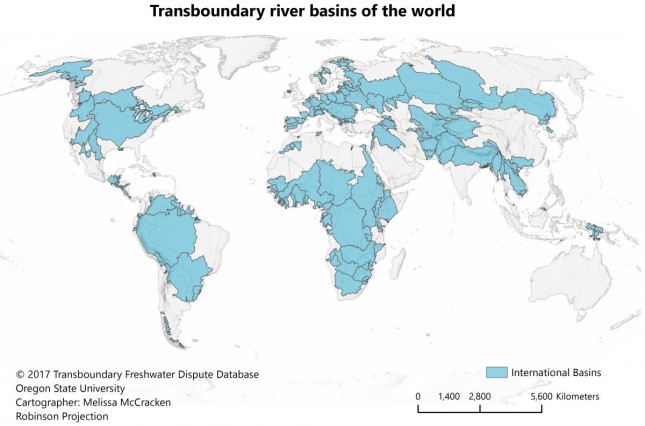
Tracking Conflict and Cooperation Over the World’s International Freshwater Resources
›Guest Contributor // March 20, 2023 // By Alexandra Caplan, Melissa McCracken, Susanne Schmeier, Zoe Rosenblum & Aaron WolfWaters that cross international political borders can drive the countries that share them to conflict—or encourage cooperation between them. Indeed, since the 1940s, overall trends point to a tendency for countries to cooperate over shared water resources, which stands in stark contrast to media portrayals of “water wars.”
Yet instances of conflict over water have increased slightly since 2000. Why? Most of them are fueled by water quantity disputes or the unilateral development of dams or other infrastructure. Institutions often play a key role in facilitating cooperation (and reducing conflict) over shared waters, but their growth and adoption have slowed over the last two to three decades.
-
Gravity and Hope in Environmental Peacebuilding: Two Young Leaders Share Their Stories
›In today’s episode of the New Security Broadcast, ECSP’s Claire Doyle partnered with Elsa Barron at the Center for Climate and Security for a conversation with two young leaders who are working to tackle climate change and build peace: Christianne Zakour and Hassan Mowlid Yasin. Christianne is a volunteer with UNEP’s Major Group for Children and Youth and Hassan is co-founder of the Somali Greenpeace Association. On the episode, Christianne and Hassan share about the climate, equity, and conflict issues that motivate their work and describe how they think we can make progress towards a livable future for all. -
Climate Security in The Horn: Crafting a Broader Role for Non-State Actors in IGAD
›The Horn of Africa now faces an unprecedented drought, with conditions not seen in the last 40 years. The implications of this looming catastrophe reach beyond the most recent severe drought periods in the region, which occurred in 2010 and 2011 and again in 2016 and 2017.
As of November 2022, over 36 million people in the Horn were affected by drought, including 24.1 million in Ethiopia, 7.8 million in Somalia, and 4.2 million in Kenya. More than 20 million children in Djibouti, Ethiopia, Kenya, and Somalia need immediate water and food assistance. In addition, nearly 1 million pregnant and lactating women are acutely malnourished. Since mid-2021, more than 9.5 million livestock have perished in the region due to a lack of water, starvation, and disease.
Showing posts from category environmental peacemaking.