-
Integrated Approach Helps “Model Farmers” Increase Productivity in Ethiopia
›March 24, 2011 // By Schuyler Null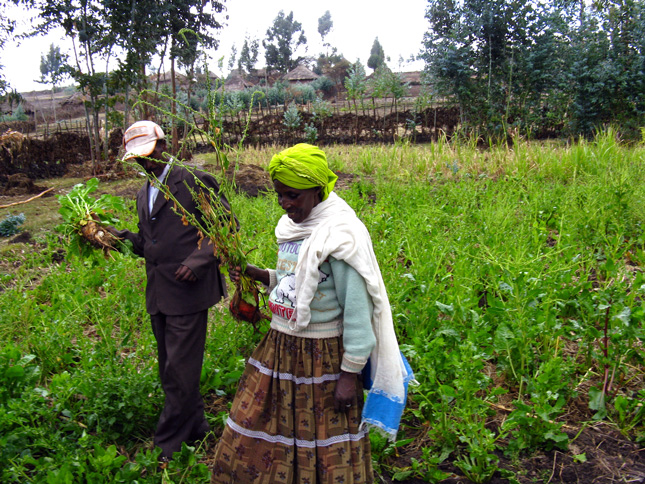
To reach the village of Grar Gaber from Addis Ababa, you drive up over the Entoto Mountains overlooking the capital then motor down two hours of new Japanese-built highway to the town of Fiche. From there it’s 20 minutes on a broken dirt road across rocky hills. I was joined there by about 20 others from the PHE Ethiopia Consortium’s general assembly (see day one and day two coverage here) and Population Action International, to visit an integrated population, health, and environment (PHE) development program run by LEM Ethiopia.
-
The Youth of North Africa
Surging on a Knife’s Edge
›March 23, 2011 // By Christina DaggettThe Middle East/North Africa region is experiencing a “youth surge,” said Jack Goldstone, director of the George Mason University’s Center for Global Policy, at a recent GMU event. “In the last two decades the number of people in their late teens and twenties has increased… It’s doubled in Egypt; it’s grown by half in Tunisia; and nearly doubled in Libya,” he told Warren Olney on KCRW’s To the Point. Such youth surges are problematic because, Goldstone wrote in ECSP Report 13, “population distortions – in which populations grow too young, or too fast, or too urbanized – make it difficult for prevailing economic and administrative institutions to maintain stable socialization and labor-force absorption.”
In the case of Egypt, the youth surge put enormous pressure on a government system that could no longer guarantee jobs to every college graduate, said Goldstone. When government guarantees dried up, graduates found that their poor-quality degrees were of little use, especially in a system that prioritized connections and bribery. The result was an unemployment rate of 25 percent among Egyptian youth and a mounting sense of frustration with the economic system and the government.
This frustration found a symbol when Mohammed Bouazizi, a 26-year-old Tunisian, set himself – and an entire region – on fire after his third run-in with the police cut off his only source of income. Youth across North Africa and the Middle East, Goldstone said, could identify with Bouazizi’s desperation and frustration after years of dealing with a closed economic system and a corrupt government.
While overall economic growth has been strong in the region – a fact which had misled many observers (including himself, Goldstone admits) into thinking the region was more stable – these economic gains were apparently being captured by the ruling elite to a far greater degree than previously thought, said Goldstone. For example, it is estimated that ousted Egyptian president Hosni Mubarak and his family are worth between $40 and $70 billion.
Meanwhile, a burgeoning surge of young people were struggling to get by. Goldstone pointed to a Gallup poll conducted in 2010 in which only 12 percent of Egyptians and 14 percent of Tunisians would classify themselves as “thriving” – down from 25 and 24 percent, respectively, in 2007 and 2008.
While the Ben Ali and Mubarak regimes have fallen, these revolutions do not ensure the youth in these countries will have a prosperous future. They need not only access to capital, said Goldstone, but also access to information and social networks so that they can identify market opportunities and stay connected.
Immigration to more developed countries could also be an important avenue for economic growth and education. In a Foreign Affairs article, “The New Population Bomb,” Goldstone writes, “Given the dangers of young, underemployed, and unstable populations in developing countries, immigration to developed countries can provide economic opportunities for the ambitious and serve as a safety valve for all.”
The future of Middle Eastern youth, and that of the region at large, depends on the quality of their education and their ability to be productive, said Goldstone. They stand on “a knife edge,” he said, and the transition to democracy will not be smooth or easy.
Image Credit: “Protest Face Paint,” courtesy of flickr user Ahmad Hammoud.
Sources: The Economist, ECSP Report 13, Foreign Affairs, Gallup, International Monetary Fund, KCRW, Voice of America. -
Hu Angang and Liang Jiaochen, ChinaDialogue
China’s Green Five-Year Plan: Making “Ecological Security” a National Strategy
›March 16, 2011 // By Wilson Center StaffThe original version of this article, by Hu Angang and Liang Jiaochen, appeared on ChinaDialogue.
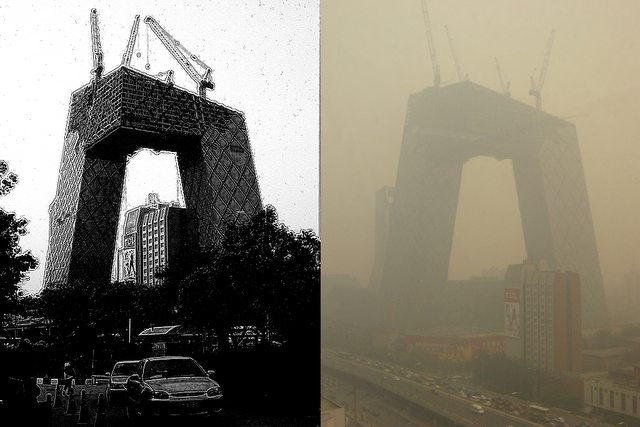
Five-year plans (FYPs), which set down and clarify national strategy, are one of China’s most important policy tools. Just as they have helped to drive China’s economic success over recent decades, so they will play a pivotal role in putting the country on a green development path. The 12th Five-Year Plan, now under consideration by the National People’s Congress, marks the beginning of that process in earnest (Editor’s note: Since this was originally published, the National People’s Congress voted in favor of the plan).
FYPs embody the concept of progressing by degrees, or developing step by step. This approach has been one of the driving forces behind China’s economic progress in recent decades and will now provide the platform for its green development. It is the methodology underpinning China’s socialist modernization: to reach a new step in development every five years. Unstinting efforts over a number of FYPs have driven China’s transformation.
Climate change presents a long-term and all-encompassing challenge for China. It demands a long-term development strategy and broad goals, as well as near-term action plans and concrete policies. Combining these is precisely the idea behind FYPs.
At the global climate change summit in Copenhagen in 2009, China demonstrated it has the long-term political will to respond to climate change; to work with the world to limit global temperatures to no more than two degrees Celsius above pre-industrial temperatures (the goal set out in the Copenhagen Accord). In November that year, the Chinese government formally put forward its medium-term targets on climate change: a reduction in energy intensity of 40 percent to 45 percent on 2005 levels by 2020, and generation of 15 percent of energy from non-fossil fuel sources by the same date.
Continue reading on ChinaDialogue.
Hu Angang is a professor at the Chinese Academy of Sciences and Tsinghua University and the director of the Centre for China Study. He has worked as the chief editor for China Studies Report, a circulated reference for senior officials. Liang Jiaochen is a PhD student at Tsinghua University’s School of Public Policy and Management.
Sources: Business Green, UN Framework Convention on Climate Change, World Resources Institute.
Photo Credit: Adapted from “China: CREME,” courtesy of flickr user IFC Infrastructure (Alejandro Perez/IFC). -
Engineering Solutions to the Infrastructure and Scarcity Challenges of Population Seven Billion (and Beyond)
›March 9, 2011 // By Hannah MarquseeA recent Institution of Mechanical Engineers (IME) report, Population: One Planet, Too Many People?, argues that “sustainable engineering solutions largely exist for many of the anticipated challenges” of a world population scheduled to top seven billion this year and projected to reach upwards of nine billion by 2050. “What is needed,” write the authors, “is political and social will, innovative financing mechanisms, and the transfer of best practice through localization to achieve a successful outcome.”City lights on the French-Italian border, from the International Space Station.
Since nearly all of the population growth in the next 40 years will occur in the developing world, the report recommends nations adopt five “Engineering Development Goals” (listed below), alongside the Millennium Development Goals, to meet the needs of the world’s growing poor. The report also recommends that developed countries provide technical engineering expertise to developing countries in the model of the UK Department for International Development’s Resource Centers. This assistance will help them implement these goals and “leapfrog” the “resource-hungry, dirty phase of industrialization.”
Population Growth a Threat?
While the report issues a clear call to action for engineers and governments, it does not address the issue of population growth per se, which has caused some to argue that population growth might not be the problem after all. The Independent, for example, initially headlined their article about the report, “Population Growth Not a Threat, Say Engineers,” but changed it after publication to “Population Growth a Threat, Say Engineers.”
The IME authors clearly state that “population increase is likely to be the defining challenge of the 21st century,” and the report provides practical steps governments can take given current population trends. But its focus on “engineering solutions” highlights the ongoing debate between those who argue that technological fixes alone can solve the world’s social and environmental problems, and those who advocate for contraception as a low-cost path to a sustainable world.
“I would love there to be technological solutions to all our problems,” said Nobel Laureate Sir John Sulston at a recent ECSP event on the UK Royal Society’s forthcoming People and the Planet study, but “we’ve got to make sure that population is recognized, while not the sole problem, as a multiplier of many others. We’ve got to make sure that population really does peak out when we hope it will.”
The projections on which the report is based will be difficult to hit without dramatic reductions in fertility, mainly in sub-Saharan Africa – a goal that is nigh impossible without increased investment in access to voluntary family planning. The UN high variant projection, which calculates a much less dramatic decrease in current fertility levels, has world population reaching 11 billion by 2050.
“There is no need to delay action while waiting for the next greatest technical discovery,” write the IME authors. “If action is not taken before a crisis point is reached there will be significant human hardship. Failure to act will place billions of people around the world at risk of hunger, thirst, and conflict as capacity tries to catch up with demand.”
Engineering Development Goals
1. “Energy: Use existing sustainable energy technologies and reduce energy waste.”
Currently, “over 1.5 billion people in the world do not have access to energy,” says the IME report. In addition, global demand for energy is expected to rise by 46 percent by 2030, and the world will need to invest $46 trillion over the next 40 years to shift towards renewable energy sources. The report points out that “there are no insurmountable technical issues in sourcing enough energy for an increasingly affluent larger global population.” Instead, “the difficulties lie in the areas of regulation, financing, politics, social ethics, and international relations.”
2. “Water: Replenish groundwater sources, improve storage of excess water and increase energy efficiencies of desalination.”
Global water consumption, write the IME authors, is predicted to rise 30 percent by 2030 due to population growth and increased energy and agricultural consumption. These numbers are troubling, considering that a recent study in Nature found that more than 1.7 billion people, almost entirely from the developing world, already face chronically high water scarcity.
However, this problem is not simply one of a shortage of water, rather “a case of supply not matching demand at a certain time and place where people are living,” says the IME report. Engineering solutions must involve the capturing and storage of rain water, more cost-effective desalination techniques, and aquifer storage and recovery techniques, says the report. But more importantly, “decision-makers need to become more aware of the issues of water scarcity and work more closely with the engineering profession in finding localized solutions.”
3. “Food: Reduce food waste and resolve the politics of hunger.”
The IME report cites the World Bank’s prediction that demand for agricultural production will double by 2050, due to a combination of population growth, more people turning to meat-heavy diets, and agricultural shortages from extreme weather events. Efficiencies can go a long way towards filling this supply-demand gap, says the IME report. In developed countries an average of 25 percent of edible food is thrown away in the home after purchase, while in developing countries, as much as half of crops are lost before ever reaching market due to lack of adequate transportation and storage infrastructure.
For example, the authors point out that in India, “between 35 percent and 40 percent of fruit and vegetable production is lost each year between the farm and the consumer” – an amount greater than the entire annual consumption of the UK. Americans are also big food wasters. A USDA study found that in one year, 27 percent of all edible food was thrown away in the United States after purchase. Developed countries can significantly increase efficiency “through behavioral change that recognizes the value of food,” says the report.
4. “Urbanization: Meet the challenge of slums and defending against sea-level rises.”
Urbanization “presents one of the greatest societal challenges of the coming decades,” write the IME authors, but cities also represent a “significant opportunity…to be very efficient places to live in terms of a person’s environmental impact.”
According to the World Bank, by 2050, three quarters of the world will live in cities, and nearly all of this growth will occur in the developing world. Already, one third of the world’s urban population live in “appalling slum conditions,” says the IME report. Challenges for the urban poor are especially severe in coastal areas – home to three quarters of the world’s large cities – where they are vulnerable to flooding and extreme weather events, which according to new studies, have increased as a result of climate change.
The report calls for nations to use an “integrated, holistic approach” that brings in engineering expertise early in the planning process to create infrastructure that is individualized to a city’s unique cultural, geographical, and economic needs.
5. “Finance: Empower communities and enable implementation.”
Implementation of the above four goals will require “innovative soft loans and micro-financing, ‘zero-cost’ transition packages, and new models of personal and community ownership, such as trusts,” write the IME authors. Furthermore, communities must play a central role in decision-making in order to find appropriate and local solutions.
In all five of these goals, “barriers to deploying solutions are not technological,” says the report. Instead, they are political and social. Better international cooperation, dialogue, and sharing of expertise between and amongst engineers, decision-makers, and the public, is crucial to implementation.
Sources: Department for International Development, Guardian, The Independent, Institution of Mechanical Engineers, Nature, The New York Times, UN Habitat, United Nations, USDA, World Bank.
Image Credit: “City Lights, France-Italy Border (NASA, International Space Station Science, 04/28/10),” courtesy of flickr user NASA’s Marshall Space Flight Center. -
World Bank Pipeline Project in Chad Reveals Development Challenges
›This scholar spotlight was originally featured in the Wilson Center’s Centerpoint, February 2011.
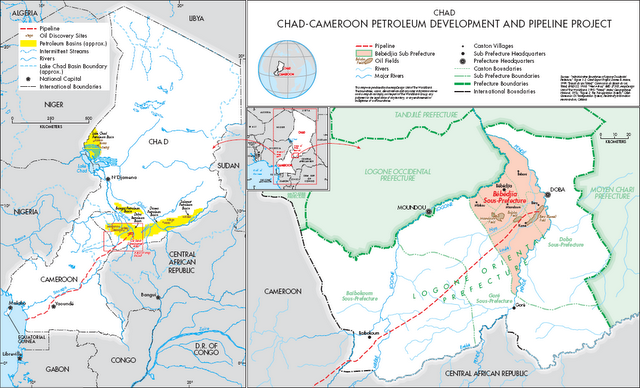
In 2000, the governments of Chad and Cameroon teamed up with a three-company oil consortium, with the help of a World Bank loan, to begin building an oil pipeline. By 2003, oil revenues were flowing. This multi-billion dollar pipeline project, which transports oil from Chad through a 640-mile underground pipeline in neighboring Cameroon, is one of Africa’s largest public-private development projects.“Unfortunately, the project fell short on its social and development-oriented objectives,” said Wilson Center Fellow Lori Leonard.
One of the World Bank’s conditions on granting the loan was compensation for the involuntary resettlement this project would cause. However, Leonard said, the World Bank failed to understand, or take into account, social norms around land use and property relations.
“The compensation plan introduced the idea of private property but there was no institutional or legal framework for it,” she said. “This led to a flood of disputes over land and created breaks in the social safety net and societal fabric in Chad.” Uprooting people led to unprecedented problems, from the loss of land and livelihoods to disputes over compensation payments.
The reality was that in Chad, one of the world’s poorest countries, about a quarter-million people were affected. “People in the oilfield region, like people everywhere, are deeply attached to the place where they live – tied to their land,” Leonard said. Suddenly, their property became monetized. “They were asked to think differently about crops, trees, kitchen gardens, everyday objects,” as everything was given a monetary value.
But all the land was populated so there was nowhere to move to and no other trade or skill to easily adopt. “The pipeline project did not create a local economy, that could absorb people who became land poor,” she said.
The World Bank, which withdrew from the project in 2008 when Chad paid off the loan, accused Chad of misspending oil revenues, but that is just part of the story, said Leonard. The problem is not purely economic. “The economy is not outside of society,” Leonard said. “[This project] put a market value on everyday objects and that reshapes societal relations. And it raises the ethical question: ‘How do I live now?’”
In Chad, a largely agrarian economy, large parcels of land became oil fields, wells, and pumping and collection stations.
“Fields were taken or divided up into small fragments and the people wonder what to do next,” said Leonard. “Fertility rates are high and each successive generation will have to divide up [smaller and smaller amounts of] land. And there is already incredible pressure on the land now. The soil is poor but there is not enough [viable land] to leave land fallow.”
Leonard, who teaches at the Bloomberg School of Public Health at Johns Hopkins University, first came to Chad as a Peace Corps volunteer during the post-civil war reconstruction period in the late 1980s.
“From the time of independence, oil was the promise of the future,” she said. “The lessons the World Bank learned do not inspire confidence that it would be different the next time around. We need a fundamental shift in this development model.”
Dana Steinberg is the editor of the Wilson Center’s Centerpoint.
Photo Credit: “Chad-Cameroon Petroleum Pipeline Development Project,” courtesy of the World Bank. -
Of Revolutions, Regime Change, and State Collapse in the Arab World
›The original version of this article, by David Ottaway and Marina Ottaway, was published by the Wilson Center’s Middle East Program.
With breath-taking speed, massive popular protests across the Arab world have swept away two Arab strongmen and shaken half a dozen monarchies and republics to their core. But the Arab world has yet to witness any fundamental change in ruling elites and even less in the nature of governance.
Libya now seems poised to be the first country to see a true change in governance, thanks to Muammar Qaddafi’s megalomania and his amorphous jamahiriya (state of the masses). But such change may not have a happy ending. The damage Qaddafi has inflicted on his country is likely to extend well past his demise because he leaves behind a weak state without functioning institutions.
The uprisings sweeping across the Middle East have similar causes and share certain conditions: authoritarian and ossified regimes, economic hardship, growing contrast between great wealth and dire poverty, all worsened by the extraordinarily large number of young people who demand a better future. But the consequences will not be the same everywhere.
Tunisia and Egypt: A System Still in Place
Pro-democracy protesters in Tunisia and Egypt have been quick to use the word “revolution” to describe their astounding achievement in forcing Presidents Zine el Abidine Ben Ali and Hosni Mubarak from power after decades of rule. Tunisia’s “Jasmine Revolution” and Egypt’s “January 25 Revolution” have certainly injected the long-silenced voice of the people into the autocratic politics of the region. But they have not brought to the fore a new ruling class, system of governance, or the profound social and economic changes associated with the classical meaning of revolution. And it remains to be seen whether they will succeed in doing so.
Continue reading at the Wilson Center’s Middle East Program.
Photo Credit: Adapted from “Libya-protests_025,” courtesy of flickr user Crethi Plethi. -
Carrying Capacity: Should We Be Aiming to Survive or Flourish?
›“In the eyes of many governments, population has, as we all know, been a rather uncomfortable topic for a number of years,” said Nobel Laureate Sir John Sulston, FRS, chair of the Institute for Science, Ethics, and Innovation at the University of Manchester and chair of the Royal Society’s People and the Planet working group. At an event at the Wilson Center on February 22, Sulston and his co-panelists, Martha Campbell, president of Venture Strategies for Health and Development, and Professor Parfait Eloundou-Enyegue of Cornell University, encouraged active debate on a range of population dynamics and their connections to economic, environmental, and political futures. [Video Below]
The Nexus of Population and Consumption
The dialogue between population and environmental communities has been pushed aside for many years but has lately been climbing its way back onto national agendas, said Sulston. However, the debate remains polarized. Scientists need to “sort out the facts as best we can” to help bring the communities together, he said. The Royal Society’s People and the Planet study, which will be completed by early 2012, will “provide policy guidance to decision-makers as far as possible” and “play our part in engendering constructive dialogue,” he said.
“What we should be aiming to do is to ensure that every individual on the planet can come to enjoy the same high quality of life whilst living within the Earth’s natural limits,” said Sulston. Instead of talking about the maximum number of people the Earth can hold, we should also focus on “the quality of life of those people,” he said. People are happier, healthier, and wealthier than ever before, according to human development indexes. But, Sulston said, 200 million women worldwide have an unmet need for family planning, ecosystems are degraded, biodiversity has decreased, and there are widespread shortages of food and water.
For centuries humanity has pursued a policy of “competitive growth,” both in population and consumption. But in preparation for the UN “Rio+20” summit on sustainable development in 2012, policymakers should be discussing “pathways to sustainability within the context of population,” said Sulston.
“Humanity needs to learn to act collectively and constructively in the face of these long-term and therefore rather elusive threats, just as we do rather well when we’re faced with immediate and tangible ones,” Sulston said. “So we need the best technology, but we need it in the context of a thoughtful society, and then we can both survive and happily flourish.”
A Demographic Crossroads
“No longer is population growth or population size the only issue of the day,” said Parfait Eloundou-Enyegue. “You have to worry about both population growth and population decline, you have to worry about immigration, you have to worry about aging, you have to worry about HIV and adult mortality, et cetera.”
Some people, Eloundou-Enyegue said, take this diversity of demographic issues as “grounds for complacency” by thinking they do not share in others’ problems. Yet, he said, population and ecology are areas where the risks are shared by all.
These challenges demand a “more comprehensive framework” that details the interactions between population, affluence, environment, technology, and inequality, said Eloundou-Enyegue. Tensions persist between these different areas, and breaking them will require “call[ing] on other qualities of the human spirit,” he said. The world is, Eloundou-Enyegue concluded, at a “demographic crossroads.”
The Timing of Declining Fertility
The key to ending the sensitivity to the issue of population growth is to “understand that this is about options: options for women and options for families,” said Martha Campbell. Strong attention and funding support can meet needs and lead to declining birth rates, as in the case of Kenya before the mid-1990s. But with the broader emphasis on reproductive health and concerns about coercion that followed the 1994 United Nations International Conference on Population and Development (ICPD) in Cairo, funding for family planning declined. As a result, Kenya’s fertility rates leveled off instead of continuing to decline, said Campbell, contributing to an upward revision of global population projections.Campbell illustrated the impact of delays in achieving replacement-level fertility on the overall population size of individual states. In the case of Pakistan, for example, analysis by Venture Strategies for Health and Development and the African Institute for Development Policy projects that the country will have a total population of 350 million if replacement-level fertility is reached by 2020, and a population of almost 600 million if that same mark is reached by 2060.
Looking ahead to the “Rio+20” summit in 2012, Campbell emphasized the need for continued discussion about population growth and family planning. The silence on these issues after Cairo in 1994 and the subsequent global impact should serve as a warning for future generations, she said: “It is important for this next generation and the current generation to understand what happened so that it will never, ever happen again. The silence on population must not occur.”
Photo Credit: “Rush hour,” courtesy of flickr user Jekkone, and Pakistan fertility chart, courtesy of Martha Campbell and Venture Strategies. -
Youth Revolt in Egypt: A Country at the Turning Point
›March 2, 2011 // By Wilson Center StaffThe original version of this article, by Farzaneh Roudi-Fahimi, Shereen El Feki, and Tyjen Tsai, appeared at the Population Reference Bureau.
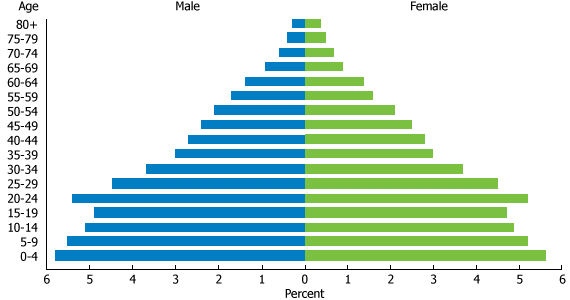
Egyptians know some dates by heart: July 26, 1952, marks the overthrow of Egypt’s last monarch; October 6, 1973, is the date of the country’s attack to reclaim the Sinai Peninsula. Now another date can be added to that list: January 25, 2011, the first day of anti-government protests that led to President Hosni Mubarak’s resignation 18 days later. Mubarak ruled Egypt for nearly 30 years, during which the country’s population grew by 90 percent – from 45 million to 85 million according to UN estimates, despite concerted government campaigns to slow population growth. The demographic strength of Egypt is undeniable, not just in absolute numbers but in its age distribution. Egypt is experiencing a “youth bulge:” One in five Egyptians is between ages 15 and 24, and one-half of the population is below age 25 (see figure above), a powerful engine of renewal for the country.
Youth as the Drivers of Change
Egyptians of all ages and walks of life participated in the protests, unified in aspirations and demands including political freedom, better wages, and better working conditions. But it was the astonishing numbers of young people participating in demonstrations that gave the uprising its momentum, and were key to sustaining it, as hundreds of thousands gathered in Tahrir (Liberation) Square in Cairo and other cities across the country. Egypt’s youth are the faces behind this leaderless revolution; the revolt, in large part, was spurred by their finesse in using social media to organize and make their voices heard.
Young people arguably have the most at stake in the outcome of this revolution. The results have immediate impact and future implications in how they construct their lives. Recent studies show the frustrations young Egyptians feel at the stagnancy of their lives. They are a generation waiting for better access to quality education, secure employment, and the financial stability necessary to get married and start their own families.
Continue reading at the Population Reference Bureau.
Sources: UN Population Division.
Image Credit: Population pyramid from PRB, data from the UN Population Division.
Showing posts from category economics.