Showing posts from category economics.
-
How Does Organic Farming in the U.S. Affect Global Food Security?
›The feature story for last month’s Wilson Center newsletter, Centerpoint, was on the popular full-day conference “Rebuilding the U.S. Economy – One Heirloom Tomato at a Time,” hosted by the Program on America and the Global Economy in March. The conference focused on organic, local farming and the idea of creating “sustainable” food production that was healthier but also better for the economy than relying on imports from afar.
ECSP was asked to provide some international context for the discussion with a brief “Point of View.” I tried to paint a little bit of the big picture 21st century supply and demand story and give a sense of how today, globalization has helped linked everyone in this food security discussion:Dramatic events over the last year have shone a spotlight on the problem of global food security: massive fires in Russia, which reduced wheat supplies; famine and drought in Niger and Chad; and food price riots in the Middle East and elsewhere. These stresses come amid price spikes that echo the food crises of 2008 and reveal the linked nature of food security today and some of the fundamental challenges facing poor countries’ efforts to feed their growing populations.
What do you think: What’s the best way to inject the urgency that people looking at demographics and consumption rates around the world are feeling about global food security into a discussion about organic agriculture in the United States? Is there a tension between quality and quantity of food in the organic vs. agrobusiness debate that needs to be addressed in a global context? And what’s the role of policy in determining that balance?
In most countries, food insecurity is a symptom of poverty, poor governance, and/or poor infrastructure. For example, developed countries can often rebound from natural disasters relatively quickly. However, in drought-prone countries like Niger and Chad or flood victims like Pakistan and North Korea, such structural weaknesses leave them unable to bounce back as quickly from extreme events. This makes development efforts more difficult and can cause vulnerable countries to quickly become a burden on their neighbors or more prone to internal instability.
In the long term, reducing vulnerability in developing countries will be one of the most critical factors to ensuring global food security. But to meet the projected demand from increased consumption and continuing population growth, global yields must also increase.
The Green Revolution of the 1960-70s saved millions of lives by introducing heartier strains of rice and improving other staple crops in South and Southeast Asia, and most agree that a “Second Green Revolution” (whether or not it looks like the first) will likely be necessary. If so, the current tensions in the West over organic or sustainable practices versus agribusiness models will need to be reconciled in a way that can provide the most immediate help for the world’s hungry.
An important requirement, however, is that in a more resource-constrained world, these yields must be increased without destroying our future capacity. How we go about this, whether through traditional industry, organic techniques, or a mixture of both, will be one of the defining challenges of the 21st century. -
Watch: Addressing the National Security Implications of U.S. Oil Dependency
›April 27, 2011 // By Schuyler NullBoth the civilian and military sectors have key roles to play in achieving energy security as the United States addresses the national security implications of its oil dependency. Yesterday, the White House hosted a forum with senior officials from both the public and private sector to highlight avenues toward achieving that security. Co-hosts Deputy Energy Secretary Daniel Poneman and Deputy Defense Secretary William Lynn were joined by Woodrow Wilson Center President Jane Harman, John Podesta of the Center for American Progress, and John Deutch of the Massachusetts Institute of Technology.
The panelists discussed ongoing cooperation between the Department of Energy and Department of Defense, and Harman in particular highlighted the power of the military to drive innovation and more efficient production of energy-efficient technologies.
“‘Energy security’…reminds us that important domestic energy developments have international consequences, and important international events have domestic consequences,” said Deutch, pointing out the linked, global nature of energy markets and climate change.
Deputy Secretary Lynn highlighted the tactical tactical benefits of reduced petroleum dependence with the example of a solar panel pilot program being conducted by the Marine Corps in Afghanistan:The regiment selected to try out the solar panels deployed to one of the most violent districts in Helmand province. The operational gains were immediate: Marines ran two patrol bases completely on solar power and cut diesel fuel consumption at a third base by over 90 percent. On one three-week foot patrol, flexible solar panels eliminated battery resupply needs entirely, ending supply drops that previously were required every 48 hours.
Watch the full forum above, and see also the recent National Conversation at the Woodrow Wilson Center that focused on “A New National Security Narrative.” -
Overcoming Pakistan’s Demographic Challenges
›Download Reaping the Divided: Overcoming Pakistan’s Demographic Challenges from the Wilson Center. Excerpted below is the introductory essay, “Pakistan’s Demographics: Possibilities, Perils, and Prescriptions,” by Michael Kugelman.
On July 11, 2010, Pakistani Prime Minister Yousaf Raza Gilani delivered a speech in Islamabad to commemorate World Population Day. He announced that in order to highlight the crucial connection between demographics and economic growth, 2011 would be designated “Population Year” in Pakistan. “All hopes of development and economic prosperity would flounder if we as a nation lose the focus and do not keep [the] population issue in the spotlight,” he declared.
Hopefully that spotlight comes with a long shelf life. Pakistan faces acute population challenges. If they are to be overcome, they will need to be illuminated for far more than a year.
Yet, there are exciting opportunities here as well. A long-term approach to managing the challenges presented by Pakistan’s burgeoning population, if accompanied by effective policies and sustained implementation, could spark a monumental transformation: one that enables the country to harness the great promise of a large population that has usually been viewed as a hindrance to prosperity. Indeed, demographers contend that Pakistan’s young, growing, and rapidly urbanizing population can potentially bring great benefits to the country. If birth rates fall substantially, and if young Pakistanis are properly educated and successfully absorbed into the labor force, then the nation could reap a “demographic dividend” that sparks economic growth, boosts social well-being, and promotes the rejuvenation of Pakistan.
The Young and the Rising
Because Pakistan has not conducted a census since 1998, estimating the country’s total population size is a highly inexact science. The Pakistani government lists the current figure at about 175 million people, while the United Nations believes the number is closer to 185 million. However, while the precise figure may be in doubt, the population’s rapid rise is not. Though no longer increasing at the 3 percent-plus rate seen in the 1980s, Pakistan’s population is still growing at a 2 percent pace. According to the UN Population Division’s latest mid-range demographic projections, released in 2009, the population will rise to 335 million by 2050. More than 60 million people are expected to be added in just the next 15 years.
This explosive increase, however, merely represents the best-case scenario, and will prevail only if the country’s fertility rates drop from the current average of about four children per woman to two. Should fertility rates remain constant, the UN estimates the population could exceed 450 million by 2050, with a total population of nearly 300 million as early as 2030.
Pakistan’s population is not only large and growing, but also very young, with a median age of 21. Currently, two-thirds of Pakistanis are less than 30 years old. As a percentage of total population, only Yemen has more people under the age of 24. Additionally, given that more than a third of Pakistanis are now 14 years old or younger, the country’s population promises to remain youthful over the next few decades. In the 2020s, the 15-to-24 age bracket is expected to swell by 20 percent. Pakistan’s under-24 population will still be in the majority come 2030. And as late as 2050, the median age is expected to be only 33.
Pakistan’s demographic profile contrasts with what is happening in much of the rest of the world. Sub-replacement level fertility rates (about two births per woman) prevail not only throughout the developed world, but also across much of Southeast Asia, the Middle East, and Latin America. As one commentator has noted, “the twenty-first century’s hallmark [demographic] trend appears to be a fertility implosion.” South Asia, along with sub-Saharan Africa, is one of the last regional bastions of youthful, rapidly proliferating populations. Yet even within South Asia, Pakistan stands out. Excluding Afghanistan, of all the member states of the South Asian Association for Regional Cooperation – Bangladesh, Bhutan, India, Maldives, Nepal, and Sri Lanka – Pakistan has the highest population growth, birth, and fertility rates; the youngest median age (tied with Nepal); and the largest percentage of people 14 years old or younger.
Continue reading “Pakistan’s Demographics: Possibilities, Perils, and Prescriptions,” or download the full report from the Wilson Center.
Michael Kugelman is a program associate with the Asia Program. -
Dividend or Deficit? The Economic Effects of Population Age Structure
›According to the latest projections, the global population will hit the seven billion mark later this year and perhaps nine billion by 2050. Yet, while the global population is growing, it is also aging, due to falling fertility rates and longer life expectancies. By 2050 the number of people aged 60 and over will reach two billion. At an event at the Wilson Center on April 1, Andrew Mason of the University of Hawaii at Manoa and the East-West Center and Ronald Lee of the University of California, Berkeley, discussed their research on the economic effects of an aging world with discussant Dalmer Hoskins of the Social Security Administration. [Video Below]
Changing Age Structures and Economic LifecyclesThere are three phases of age transition, Mason explained: during the first phase, high fertility rates and declining infant and child mortality rates increase the share of children in the population. In the second phase, the proportion of the working age population (those aged 15-64) increases, potentially providing a boost to production and consumption, and in the third phase, the elderly proportion increases due to lower fertility rates, decreasing production and increasing the burden on state support systems.
From 2010-2015, 85 countries are projected to witness the largest absolute increase in history of their populations aged 60 and over. This increase in elder populations is significant, Mason said, because it may mean slower economic growth.
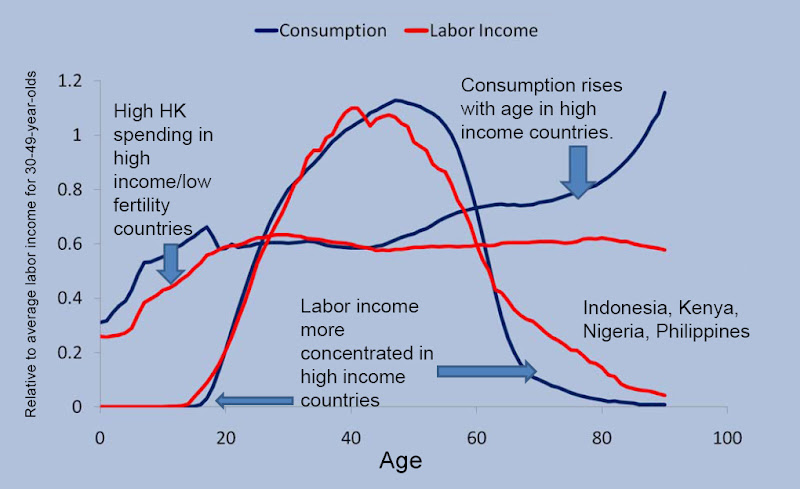
Based on data collected through National Transfer Accounts, Mason and Lee’s economic lifecycle tracks the labor income and consumption rates of a population at a given age. In high income countries, consumption increases around the teen years as a result of investments in education, then dips slightly, and, finally, sharply rises around the age of 80 due to high health care expenditures. The consumption rate remains relatively flat in low income countries, with consumption differing the most in the older ages.
The support ratio measures the number of workers relative to the number of consumers, while taking into account age-specific variances in number of hours worked and level of consumption. Mason explained that China, after four decades of rapid growth, has reached the peak of its support ratio, with many workers relative to the number of consumers. However, China is rapidly aging, like much of Northeast Asia, and also because of its one-child policy. The resulting decline in its support ratio will likely limit its economic growth; however, Mason cautioned that it would be “rash” to say that its growth will bottom out completely.
The United States has an age structure that is “quite a bit more favorable” than other industrial countries, Mason said. Higher fertility, lower life expectancy, and a higher rate of immigration mean that aging is coming more slowly to the United States than other developed countries.
The Second Demographic Dividend: An Investment OpportunityDuring the first demographic dividend, the labor force grows more rapidly than the dependent population, thus allowing more resources to be spent on economic growth. But what happens after that? As populations age, there is a “semi-automatic” increase in investment in human, physical, or financial capital, Lee explained; for example, as fertility falls, the amount invested per child increases. This second demographic dividend, said Lee, can help somewhat offset the decline in support ratio that comes in the third phase of the age transition – aging.
One response to the increased costs of an aging population, said Lee, is to reduce consumption in proportion to the decline in the support ratio. Another option would be adding more hours to the work day or pushing the retirement age back. In the United States, Lee said that to offset the declining support ratio entirely by postponing retirement would require postponement by eight years up to 2050, and 10 years by 2085.
Brazil, Lee said, is the “world champion” of pension generosity, where pensions make up 12 percent of the GDP. The United States, by contrast, relies on asset income from physical or financial investments for about two-thirds of its retirement income. Brazil’s challenge, when it begins to feel the effects of aging (it is still relatively young), will therefore be much greater than in the United States.
A “New Lens” on Aging
Aging, Hoskins said, is not the “catastrophe” that it has been portrayed to be in the media. Supporting an aging population is “something we can plan for and handle,” he said. It is possible “to do the right thing to make sure citizens have a decent life.” The problems come when a country waits too long or does not plan at all, such as in Nigeria and the Philippines where, Hoskins said, they have very underdeveloped social protection systems and the elderly have little to no income. Mason and Lee’s analysis of the work/consumption ratio, said Hoskins, offers a “new lens” into how the world will deal with aging.
Sources: Los Angeles Times, National Transfer Accounts, UNFPA, World Bank.
Image Credits: “Elderly couple – Meiji-jingu,” courtesy of flickr user Tom Spender. Chart courtesy of Ronald Lee and Andrew Mason, National Transfer Accounts. -
Biofuels: Food, Fuel, and Future?
›The Wilson Center’s Program on America and the Global Economy (PAGE) together with the Brazil Institute, have held a series of conferences focused on the field of biofuels and its impact both internationally and domestically. As part of the series, PAGE has published the results of a conference held last July on the current “state-of-play” for the biofuels industry in the United States.
In the brief, Biofuels: Food, Fuel, and Future?, C. Ford Runge and Robbin S. Johnson, of the University of Minnesota, and Calestous Juma, of Harvard University, provide context on the various federal mandates, subsidies, and policies that affect the U.S. biofuels market. They also present recommendations to improve what is now a not-so-new market, with the aim of reducing damaging effects on food prices and creating more international competition. The brief was edited by PAGE Director Kent H. Hughes and Elizabeth A. Byers.
Read more from PAGE on their blog, America and the Global Economy, and download the full brief and other PAGE publications from their website at the Wilson Center. -
Forest Conservation Method a Fit for Canada’s Oil Sands?
›In Wednesday’s speech on U.S. energy security, President Obama stated clearly that the United States would continue to rely on oil imports from Canada and other stable nations. But serious environmental concerns continue to dog the Canadian oil sands industry. Could an agreement reached by Canada’s Forest Products Association provide a model for a way forward?
In May 2010, the Canadian Boreal Forest Agreement (CBFA) was signed by 21 members of the Forest Products Association of Canada (FPAC) and nine major environmental groups, including Greenpeace, the Nature Conservancy, and the Pew Charitable Trusts, without government involvement. The three-year agreement represents the largest forest conservation plan in history and protects more than 72 million hectares of Canada’s Boreal Forest. It also ended a long “do not buy” campaign of FPAC products, previously spearheaded by environmental organizations.
The CBFA essentially commits FPAC to the highest environmental standards of forest management and conservation, as well as the suspension of logging in environmentally sensitive areas, in part to protect endangered caribou populations. In return, environmental organizations agreed to support FPAC members.
The oil sands industry faces a similar challenge. In both cases, industry and environmental NGOs have clashed in a long and bitter battle over industry practices and their impact on the environment. The difference is that FPAC realized that directly engaging environmental groups in reasoned discussion might be a more intelligent approach to resolving environmental challenges than shouting back and forth at one another. FPAC also believes that buyers will be attracted to their newfound reputation for sustainable practices and higher ethical standards.
Model Agreements
Oil sands producers have much to gain by engaging the environmental community in new and innovative ways Should the CBFA model be followed, the oil sands industry may be able to negotiate an agreement with environmental organizations and voluntarily agree to higher environmental standards in return for recognition and support of their efforts from key environmental organizations.This wouldn’t be the first initiative where creative engagement between environmental organizations and industry served to mutually benefit both sides. For instance, in 1999, WWF and Unilever created the Marine Stewardship Council (MSC), a program that rewards fisheries employing environmentally sustainable practices by recognizing their efforts through MSC certification and eco-labeling. Member fisheries maintain that MSC labeling has helped them retain existing markets, expand into others, and in some cases obtain a price premium for their product.
Such an initiative would go a long way to allow oil sands producers to shed their damaging reputation for producing “dirty oil.” Even if an agreement could not be reached, the oil sands industry would be viewed at the very least as willing to listen to the concerns of environmental organizations and take such issues seriously.
Not Perfect, But It’s a Start
The CBFA model may not be a perfect fit for the oil sands but it demonstrates that environmental groups and industry can find common ground on extremely contentious issues.
Finding this common ground must begin with accepting that the oil sands will never be “green.” According to a study by the Royal Society of Canada, in 2008, oil sands mining and development operations covered an area roughly the size of the state of Illinois and was responsible for emitting nearly 37 million tons of CO2. The study also found that there are legitimate concerns regarding the impact of oil sands development on the quality and quantity of regional freshwater supplies.
Nevertheless, the oil sands also represent a critical source of stable energy supplies for Canada and the United States, and calls by some environmental NGOs to halt oil sands production are unrealistic. More than 20 percent of U.S. oil is sourced from Canada, making it the United States’ leading supplier, and roughly half of that comes from the oil sands.
A CBFA-style agreement could help oil sands producers secure the U.S. market, which currently takes 99 percent of Canada’s oil exports, by quelling campaigns in the United States to stop imports from the oil sands. And under an agreement similar to the CBFA, the environmental community could have a larger say in how it is developed and extracted
As it stands, both industry and the environmental community remain engaged in a heated war of words, with neither side really listening to the other. Until they are willing to sit down and engage each other in new ways, both groups are likely to continue to talk over one another and make little progress on striking an environmental and economic balance that could ultimately benefit both sides.
Ken Crist is a program associate with the Canada Institute at the Woodrow Wilson International Center for Scholars.
Sources: Sources: The Canadian Boreal Forest Agreement, National Resources Defense Council, The New York Times, Royal Society of Canada, Vancouver Sun.
Photo Credit: “Athabasca oil sands digger,” courtesy of flickr user . Shell, and “Boreal forest 2009,” courtesy of flickr user Gord McKenna. -
Book Launch: ‘The Future Faces of War: Population and National Security,’ by Jennifer Dabbs Sciubba
›“Demographic trends by themselves are neither inherently good nor bad. It’s really a state’s ability to address these issues that can determine the outcome,” said Jennifer Dabbs Sciubba, the Mellon Environmental Fellow with the Department of International Studies at Rhodes College. At a book launch event at the Wilson Center on March 14 for The Future Faces of War: Population and National Security, Sciubba, along with Deputy Under Secretary Kathleen Hicks of the Department of Defense, discussed the national security implications of demography and its important role in understanding and managing conflicts around the world. [Video Below]
Demography as an Indicator, Multiplier, and Resource
Demography can be thought of in three ways, explained Sciubba: as “an indicator of challenge and opportunity; a multiplier of conflict and progress; and a resource for power and prosperity.”
A country’s age structure can pose a challenge, said Sciubba, because countries with a large percentage of their population under the age of 30 “are about two and a half times more likely to experience civil conflict than states with more mature age structures.” Tunisia’s recent revolution, she said, could be understood as a “story about demography.”
The 26-year-old fruit vendor Mohammed Bouazizi, who set himself on fire on December 17 after being hassled by police, was part of one of the largest age cohorts in Tunisia, those aged 25-29. There are some 64 million young men across the Middle East-North Africa region between the ages of 15 and 30, according to UN estimates. “If his death was the spark” for the unrest in the region, Sciubba said, “it’s the underlying demographic trends that were the fodder.”
Yet, Sciubba sees opportunity within this challenge. Citing the work of Richard Cincotta, she said that “states have half a chance – literally 50 percent – of becoming a democracy once their proportion of youth declines to less than 40 percent.” Tunisia has the best chance in the region of becoming a free democracy based on its demography, followed by Libya, where youth aged 15-29 are 43 percent of the adult population.
At the other end of the age structure, some of the world’s most powerful countries, such as Japan, Germany, Italy, France, Russia, and China, are rapidly aging. This aging will “somewhat decrease the ability of these states to project political, economic, and military power” due to a shortage of labor and a smaller pool of funding, said Sciubba.
Countries with transitional age structures, such as India, Brazil, and South Africa, face different security challenges. With a majority of their populations between 15 and 60 years old, there are more people contributing to the economy than are taking away, which could bolster these countries economically and politically (the “demographic dividend”). Global institutions will have to reform and include these countries, she advised, “or else become irrelevant.”
But the defining trend of the 21st century, said Sciubba, is urbanization. While great sources of economic growth, cities are also quite vulnerable to natural disasters and terrorism because of their concentrations of people, wealth, infrastructure, and bureaucracy.
In looking to the future, Sciubba called for continued support for family planning initiatives. “At least 90 percent of future world population growth will take place in less developed countries,” which are least equipped to handle the demands of that growth, she said. In addition, Sciubba recommended that the United States seek out partnerships with countries that have transitional age structures, particularly India, which could be a stabilizing force in a tumultuous region. She also called on the United States to partner with states in the Western Hemisphere and remain open to migration.
Defense and Demography
“Understanding population is critical to our success in being able to prevent conflict, and also managing conflict and crises once we’re involved,” said Hicks, describing the Department of Defense’s (DOD) interest in demography. However, the DOD does not “treat demographics as destiny,” she said, but instead as “one of several key trends, the complex interplay of which may spark or exacerbate future conflicts.”
Recent world events, such as those in the Middle East and North Africa, “have demonstrated how critical our understanding of population is for security practitioners,” said Hicks. Similarly, the recent earthquake and tsunami in Japan dramatically illustrate the vulnerability of large urban areas. Echoing Sciubba’s comments on population aging, she cited “incredible divestments in defense” in Europe, which, she said, “puts us, as a key partner in NATO, at a thinking stage.”
Under Secretary of Defense for Policy Michèle Flournoy is “deeply interested” in demographic issues, said Hicks. She identified other demographic areas of great interest for her office: the youth bulge in Pakistan, urbanization in Afghanistan, the role of highly educated women in Saudi Arabia, the Chinese diaspora in the Americas, Russia’s shrinking population, and various trends in China, including aging, gender imbalance, urbanization, and migration.
Image credit: “Iraq,” courtesy of flickr user The U.S. Army.
Sources: ECSP Report 12, Financial Times, The New York Times, Population Reference Bureau, UN Population Division. -
Michael Kugelman, World Politics Review
The Gathering Global Food Storm
›March 28, 2011 // By Wilson Center StaffThe original version of this article, by Michael Kugelman, appeared on World Politics Review.
In India’s vibrant capital, food seems to be everywhere – from bustling fruit and vegetable markets and greasy kebab stalls, to sumptuous platters in rooftop restaurants and dilli ki chaat, Delhi’s ubiquitous street snacks. Poor street vendors and high-end chefs alike offer a multitude of culinary options to keep the city – and its array of visiting tourists, diplomats and business leaders – well-fed.
Yet behind this apparent culinary prosperity lies rampant food insecurity. Food-related inflation in India soared above 18 percent in December, sparking street protests over high onion prices. Today, food-related inflation remains high, at nearly 12 percent. In a nation where at least 250 million subsist on less than a dollar a day, even modest price rises have a devastating impact on incomes and livelihoods. Yet, when food prices fall, India’s small farmers suffer. Already crippled by debt and encumbered by water shortages, 200,000 of them have committed suicide over the past 13 years.
India is not alone in this story. Just a few years removed from the 2007-2008 global food crisis, the world is once again experiencing the telltale drivers of acute food insecurity: rising prices of both food and oil, low agricultural yields, destructive weather and unquenchable demand. Once again, nations are banning exports in an effort to keep prices down at home – even as such policies drive up food costs in global markets. The consequences can be seen from Bolivia, where top government officials are hoarding food in their homes, to the Middle East, where the rising cost of basic foodstuffs has become a rallying cry for revolution.
Continue reading on World Politics Review.
Michael Kugelman is a program associate for the Asia Program at the Wilson Center and lead editor of Hunger Pains: Pakistan’s Food Insecurity and Land Grab? The Race for the World’s Farmland.
Sources: The Economist, India’s Contemporary Security Challenges, CNN, The Washington Post.
Photo Credit: Adapted from “India’s Food Crisis,” courtesy of flickr user lecercle.