Showing posts from category economics.
-
Fiona Harvey, The Guardian
Re|Source 2012 Conference: Global Fight for Natural Resources “Has Only Just Begun”
›July 18, 2012 // By Wilson Center StaffThe original version of this article, by Fiona Harvey, appeared in The Guardian.
The global battle for natural resources – from food and water to energy and precious metals – is only beginning, and will intensify to proportions that could mean enormous upheavals for every country, leading academics and business figures told a conference in Oxford on Thursday.
Sir David King, former chief scientific adviser to the UK government, who convened the two-day Re|Source 2012 conference, told The Guardian: “We are nowhere near realizing the full impact of this yet. We have seen the first indications – rising food prices, pressure on water supplies, a land grab by some countries for mining rights and fertile agricultural land, and rising prices for energy and for key resources [such as] metals. But we need to do far more to deal with these problems before they become even more acute, and we are not doing enough yet.”
Countries that are not prepared for this rapid change will soon – perhaps irrevocably – lose out, with serious damage to their economies and way of life, the conference was told.
Amartya Sen, a Nobel prize-winning economist, said that the free market would not necessarily provide the best solution to sharing out the world’s resources. Governments would need to step in, he said, to ensure that people had access to the basics of life, and that the interests of businesses and the financial markets did not win out over more fundamental human needs.
Continue reading on The Guardian.
Photo Credit: “Aerial view of the Jonah natural gas field, upper Green River valley, Wyoming, 2001,” courtesy of flickr user SkyTruth and Peter Aengst/The Wilderness Society. -
Nine Strategies to Stop Short of Nine Billion
›Although most analysts assume that the world’s population will rise from today’s seven billion to nine billion by 2050, it is quite possible that humanity will never reach this population size.
My chapter in this year’s State of the World 2012: Moving Toward Sustainable Prosperity, “Nine Population Strategies to Stop Short of 9 Billion,” outlines a series of strategies that would prompt significant declines in birth rates. Based purely on the intention of women around the world to have small families or no children at all, these initiatives, policies, and changes in attitude could end population growth before mid-century at fewer than nine billion people.
Examples from around the world demonstrate effective policies that not only reduce birth rates, but also respect the reproductive aspirations of parents and support an educated and economically active society that promotes the health of women and girls. Most of these reproduction policies are relatively inexpensive to implement, yet in many places they are opposed on the basis of cultural resistance and political infeasibility.
In creating this list, I sought to eschew the language and approaches of “population control” or the idea that anyone should pressure women and their partner on reproduction. Instead, I hoped to highlight strategies that could put human population on an environmentally sustainable path:- Provide universal access to safe and effective contraceptive options for both sexes. With two in five pregnancies reported as mistimed or never wanted, lack of access to good family planning services is among the biggest gaps in assuring that each baby will be wanted and welcomed in advance by its parents.
- Guarantee education through secondary school for all, especially girls. In every culture surveyed to date, women who have completed at least some secondary school have fewer children on average, and have children later in life, than do women who have less education.
- Eradicate gender bias from law, economic opportunity, health, and culture. Women who can own, inherit, and manage property; divorce; obtain credit; and participate in civic and political affairs on equal terms with men are more likely to postpone childbearing and to have fewer children compared to women who are deprived of these rights.
- Offer age-appropriate sexuality education for all students. Data from the United States indicates that exposure to comprehensive programs that detail puberty, intercourse, options of abstinence and birth control, and respecting the sexual rights and decisions of individuals can help prevent unwanted pregnancies and hence reduce birth rates.
- End all policies that reward parents financially based on the number of children they have. Governments can preserve and even increase tax and other financial benefits aimed at helping parents by linking these not to the number of children they have, but to parenthood status itself.
- Integrate lessons on population, environment, and development into school curricula at multiple levels. Refraining from advocacy or propaganda, schools should educate students to make well-informed choices about the impacts of their behavior, including childbearing, on the environment.
- Put prices on environmental costs and impacts. In quantifying the cost of an additional family member by calculating taxes and increased food costs, couples may decide that the cost of having an additional child is too high. Such decisions, freely made by women and couples, can decrease birth rates without any involvement by non-parents in reproduction.
- Adjust to an aging population instead of boosting childbearing through government incentives and programs. Population aging must be met with the needed societal adjustments, such as increased labor participation, rather than by offering incentives to women to have more children.
- Convince leaders to commit to stabilizing population through the exercise of human rights and human development. By educating themselves on rights-based population policies, policymakers can ethically and effectively address population-related challenges by empowering women to make their own reproductive choices.
Kathleen Mogelgaard assisted with research for this piece.
Robert Engelman is the president of the Worldwatch Institute and contributing author to State of the World 2012: Moving Toward Sustainable Prosperity.
Sources: Bloom et al. (2011), Guttmacher Institute, Kohler et al. (2008), Population Reference Bureau, UN, UNFPA, The Wall Street Journal, Yadava and Yadava (1999).
Image Credit: Worldwatch Institute, State of the World 2012: Moving Toward Sustainable Prosperity. -
Pop at Rio+20: Despite Failure Narrative, Progress Made at Rio on Gender, Health, Environment Links
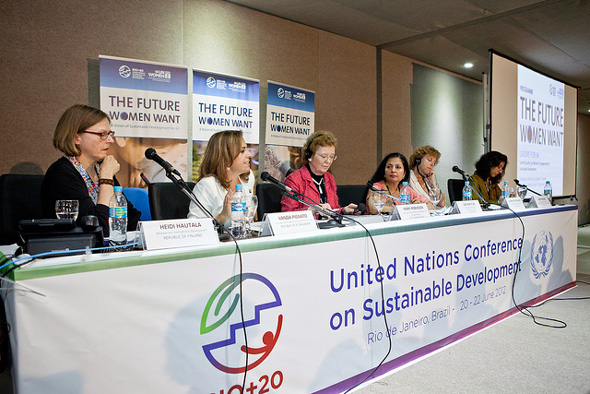
›July 13, 2012 // By Sandeep BathalaA month ago this weekend I boarded a plane to Rio de Janeiro for the UN Conference on Sustainable Development. Over the past few weeks, I have had some time to reflect on the amazing (and exhausting) experience afforded to me. Unfortunately, the final Rio+20 outcome document (considered by some to be misnamed as “The Future We Want”) failed to recognize the connections between reproductive rights and sustainability. However, since I returned I’ve also found myself in conversations with colleagues eager to celebrate the successes of the conference.
Jason Bremner, program director at Population Reference Bureau, reminds me that the initial “zero draft document” that was circulated prior to Rio had absolutely no mention of reproductive health, family planning, or population. “Though the ultimate conference document wasn’t a success by many measures, I commend the efforts of the many advocacy organizations that resulted in the inclusion of reproductive health and family planning as a key aspect of sustainable development,” he said.
Other wins were recognized at Rio as well. On a panel organized by the International Planned Parenthood Federation, Brazilian Minister of Policies for Women Eleonora Menicucci de Oliveira pointed out that the presence of women this year was much stronger than at the 1992 conference. And she stressed that the overall importance placed on the reduction of poverty will have a big impact for women.
Though the official language was weakened in the final outcome document, there was much more support expressed at side events and off the record conversations. Speaking at the same event as Oliveira, Christian Friis Bach, Minister for Development Cooperation in Denmark, said that “one leader after another has stood up for reproductive rights, and we’ve started a campaign which will go on until ICPD+20.”
In fact, as the Wilson Center’s Brazil Institute Director Paulo Sotero points out, there was a great deal of progress made by non-government representatives alongside the main conference:I left Rio more hopeful about the future than the official part of Rio+20 would allow. As governments clearly fumbled in the face of the complex challenges of imagining and building a more equitable and sustainable economic growth model in the decades ahead, I saw senior business executives and leaders of civil society engaged in intelligent and productive dialogue about difficult issues at hundreds of thematic panels held at the Corporate Sustainability Forum and other sessions held in Rio.
I felt the same energy. And many groups there seemed to already be planning for next steps.
On the first day of side events I attended, members of the Population and Climate Change Alliance discussed strategies to ensure that in the post-2015 (i.e. post-Millennium Development Goals) international development agenda sexual and reproductive health and rights are explicitly recognized as core to sustainable development. The panel included Mialy Andriamahefazafy of Blue Ventures Madagascar, Joan Castro of PATH Foundation Philippines, Inc., and Negash Teklu of PHE Ethiopia Consortium, who all shared examples of efforts in their countries to integrate reproductive health with other sustainable development programs.Joan Castro on PATH Foundation’s work in the Philippines
The Rio+20 conference was, at the very least, a re-affirmation of the tenets set down by the ‘92 Earth Summit – that is, that there is middle ground between full-tilt economic development and uncompromising environmentalism, called “sustainable development,” and we ought to be moving towards it. It was also a fantastic gathering place for disparate groups of people to come together on to similar issues and to build momentum and networks on their issues.
For those hoping to see a stronger link recognized between reproductive rights, population, and the environment, the good news is that elsewhere, awareness and momentum seems to be growing. Just this week, The Bill and Melinda Gates Foundation joined the United Kingdom, United States, France, Germany, the Netherlands, South Korea, Norway, Sweden, and Australia to pledge more than $2.6 billion towards meeting global unmet for contraceptives. And the connection to development was explicit: “Contraceptives are one of the best investments a country can make in its future,” reads the summit website.
Coincidence to have followed so closely behind a “disappointing” Rio outcome? Perhaps not.
Sources: The Bill and Melinda Gates Foundation, Estado, UN Conference on Sustainable Development.
Photo Credit: “UN Women Leaders Forum at Rio+20,” courtesy of UN Women. -
World Population Day 2012: Looking Beyond Reproductive Health
›How should the seven billion or so of us on Earth mark World Population Day? Today, major global players are focusing on increasing access to family planning around the world. But there are other important aspects to population that also deserve our sustained attention.
The links between demography and development have come into the limelight over the last few months, first as advocates decried the last minute removal of reproductive rights language from the Rio+20 outcome document and now as the Bill and Melinda Gates Foundation prepares a massive funding push for reproductive health (starting today, not coincidentally).
“Multiple crises – food, fuel, and financial – have caused significant suffering and served as a wake-up call about the need to pay far more attention to the building blocks of sustainable development,” UN Secretary-General Ban Ki-moon says in an address for today. “Reproductive health is an indispensable part of the sustainable development equation.”
The sustainable development connection is fairly obvious. Environmental destruction in some of the most biodiversity-rich parts of the world has complex but significant population drivers, as Wilson Center consultant Laurie Mazur explains:Human impact on the environment is mediated by a host of factors, including culture, technology, institutions, and market forces. And inequitable socioeconomic systems mean that some human beings have far greater impact than others.
“Often, the value of biodiversity becomes apparent only when it is lost,” Mazur continues. “For example, with the global decline of honeybee populations, growers can now calculate the monetary value of pollination services that were once provided for free by nature. ‘Bee pollination is worth $190 billion,’ said Pavan Sukhdev, a Yale environmental economist, in an interview with Bloomberg. ‘But when did a bee ever send you an invoice?’”
But some generalizations can be made. We live on a planet dominated and transformed by human activity. As we have become more numerous, we have also become more adept at altering ecosystems for human use, replacing species-rich natural landscapes with simpler monocultures.
In other areas, population drivers threaten more basic scarcities: food and water, which in turn impede development and cost human lives. Some of the most successful efforts to address these relationships have combined women’s empowerment, family planning, and basic health interventions with site-based conservation and livelihood efforts.
But besides reproductive rights, there are other important aspects of population that deserve attention on this day.
The demographic dividend – a concept that marries population dynamics and development economics – requires more than just fertility decline to take effect in countries. Economic and social policies that prepare and enable young people to enter the workforce are just as important.
And the Arab Spring helps illustrate the complex relationship between population and democracy. “Among the five countries where revolt took root, those with the earliest success in ousting autocratic leaders also had the most mature age structures and the least youthful populations,” writes Wilson Center consultant and demographer Elizabeth Leahy Madsen. The work of fellow Wilson Center consulting demographer Richard Cincotta shows that countries with very young age structures are prone both to higher incidence of civil conflict and undemocratic governance. What happens next in Egypt, Libya, Yemen, and Syria will further test the connection between youth and democracy.
In South Asia, Madsen finds that as Afghanistan and Pakistan’s political circumstances have become more entwined, their demographic paths are more closely parallel than expected. “For Afghanistan, given its myriad socioeconomic, political, cultural, and geographic challenges, this is good news. But for Pakistan, where efforts to meet family planning needs have fallen short of capacity, it is not,” she writes in the first issue of the newly re-launched ECSP Report, “Afghanistan, Against the Odds: A Demographic Surprise.”
In more developed countries, population aging is a concern. At the Wilson Center last year, economists Andrew Mason and Ronald Lee explained the challenges that those on the other side of the “demographic divide” will face in the near future. From 2010 to 2015, 85 countries are projected to witness the largest absolute increase in history of their populations aged 60 and over, straining public welfare systems and reducing labor forces. It’s not the “catastrophe” that it has been portrayed to be in the media, they said, but like many demographic issues, it is a challenge that will require planning for.
These connections demonstrate the wide importance of population dynamics to understanding how the world works today. Demography is the study of us – all seven billion of us. Demography affects – and is affected by – economics, political stability, health, the environment, food security, foreign policy, development, and conflict. Let’s not overlook that breadth on this World Population Day 2012.
For more, be sure to read some of our additional resources from the recent archives:- Food Security in a Climate-Altered Future: More Than a Supply Problem
- Taming Hunger in Ethiopia: The Role of Population Dynamics
- Uganda’s Demographic and Health Challenges Put Into Perspective With Newfound Oil
- New Surveys Generate Mixed Demographic Signals for East and Southern Africa
- In Building Resilience for a Changing World, Reproductive Health Is Key
- Demographic Security 101 (video)
- Yemen: Revisiting Demography After the Arab Spring
- Hania Zlotnik Discusses Latest Changes to UN Population Projections (audio)
- Book Review: ‘World Population Policies’
- Tunisia’s Shot at Democracy: What Demographics and Recent History Tell Us
- Joel E. Cohen on Solving the Resource-Population Equation in the Developing World (video)
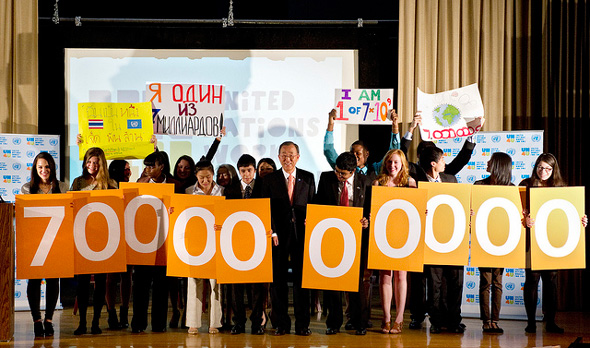
Photo Credit: UN Day Secretary-General Ban Ki-moon with students in October celebrating the seven billion mark, courtesy of Eskinder Debebe/UN Photo. -
Guttmacher Updates Unmet Need Estimates, and West Africa’s Demographic Dividend Examined
›The Guttmacher Institute has updated their estimates for global contraceptive services, putting the number of women around the world who have an unmet need for modern family planning at 222 million (up from 215 million). Authors Susheela Singh and Jacqueline E. Darroch, in Adding It Up: Costs and Benefits of Contraceptive Services Estimates for 2012, also examine the estimated current costs of contraception, cost of meeting the current unmet need, and the money saved from having fewer unintended pregnancies. An estimated four billion dollars is currently spent on contraception in the developing world, and “the total cost of fully meeting the contraceptive needs of all women in the developing world with appropriate services would…be $8.1 billion per year.” Singh and Darroch note that there are substantial benefits to increasing access to contraception, including reduced infant and maternal mortality and lower education and health costs as smaller populations put less strain on existing systems. They conclude that “the gains that derive from meeting the contraceptive needs of all women in the developing world more than outweigh the financial costs.”How Can We Capitalize on the Demographic Dividend?, by Jean-Pierre Guengant of the Institute of Development Research, explores the connection between population age structure and economic growth in 12 West African countries (the West African Economic and Monetary Union plus Ghana, Guinea, Mauritania, and Nigeria). While much of Africa has recently experienced economic growth between four and six percent, Guengant notes it has been “too low to allow for any substantial increase in per capita income levels” due to continued population growth. And he suggests that projections of declining fertility in much of Africa are overly optimistic. “Contrary to popular belief,” he writes, “the demographic future of sub-Saharan Africa has not been written.” Guengant extrapolates his own fertility projection using data beginning in 1960. If fertility declines rapidly, he writes, the larger proportion of people in the labor force could increase the GDP per capita and drive up the standard of living. -
Book Review: ‘World Population Policies’ Offers Sweeping Overview of a Complex Field
›July 2, 2012 // By Elizabeth Leahy MadsenWith much attention in the international family planning community directed to the impending anniversary of the 1994 International Conference on Population and Development and the closing date of the Millennium Development Goals, the fact that 2012 is the 60th anniversary of two other milestones in population programming may have escaped notice. In 1952, the International Planned Parenthood Federation was created, and India became the first country to formulate a national policy to reduce population growth.
These and many other landmarks are highlighted in World Population Policies: Their Origin, Evolution and Impact, a new book by demographer John May that reviews several decades of policies, advocacy, and program interventions addressing the full range of diverse demographic trends seen globally.May, who spent more than two decades working on population issues at the World Bank and other international institutions before recently assuming a fellowship at the Center for Global Development, is well-positioned to provide such an ambitious overview. Although the breadth of material included in the book means that some topics receive less coverage than a specialist might wish, it serves as a sound introduction to this diverse field, and offers some particularly interesting case studies.
The book’s main chapters begin with a summary of current population trends, including a comprehensive array of figures and statistics about population size, distribution, and projections. Some important concepts, such as the demographic transition and dividend, are perhaps covered too quickly, and in such cases the book would have benefited from more than a handful of figures, charts, and graphs. May classifies regions and countries as demographic “hotspots,” where the number of people outstrips available resources, and “coldspots,” which have too few residents. He makes an ambitious suggestion that high-density countries facing resource challenges, such as Bangladesh, should consider promoting rapid fertility decline below replacement level to stop population growth, then reverse course and increase to a rate that promotes a stable population – but such a reversal from low fertility is a feat that has stymied several countries in Europe and East Asia.
Evolution of the “Population Movement”
In addition to summarizing the ways that demographic issues have been framed in the past several decades, May briefly describes the long-running debate between demographers and economists about the ways in which population is theorized to affect economic development.
Three points in this chapter were particularly striking: First, the concept of family planning as a human right dates from well before the 1994 International Conference on Population and Development. In 1968, the Tehran International Conference on Human Rights defined the ability to choose family size and spacing as a fundamental right; still, some programs, such as India’s under the Emergency-era government of the late 1970s, adopted coercive practices. Second, population policies are not limited to official initiatives targeting fertility, mortality, and migration, but also encompass implicit or “passive” policy measures that arise without advance planning or that have an unintended effect on demographic trends. Related to this, May suggests that “contextual variables” such as education, health, gender, culture, and religion can have a greater impact on population policies’ effectiveness and demographic outcomes than government structures or funding.
Although population policies are most often designed at the national level, May’s discussion of the “population movement” highlights the influence of international networks and donors on such policies. By the late 1960s, the U.S. Agency for International Development had begun funding family planning programs overseas, and the United Nations Population Fund (UNFPA) was active. Although the United States has become less dominant over time, population programming remains a Northern-driven movement.
Beginning with a meeting in Belgrade in 1965, a series of international population conferences successfully raised the prominence of population issues on the global development agenda and built consensus around international goals, while also becoming increasingly political.
May’s cautions about such conferences are timely given this month’s London Family Planning Summit: “Consensus-building through international conferences and their preparatory meetings is often inefficient as a process, whereas such events could be used to promote learning among policymakers and experts…The gap between the conferences’ resolutions and the actual policies implemented at country level is important to remember” (110).
Growth and Aging Distinguish the Demographic Divide
In his chapter focusing on the developing world, May notes that population policies have become broader in the nearly 20 years since the Cairo conference, incorporating a reproductive rights framework while also addressing new issues such as the environment, HIV/AIDS, and poverty. But under this more holistic approach, national policies are susceptible to becoming overly diffuse, with an ambitious agenda not matched by concrete action plans.
The challenges expand to policy implementation as well. Kenya is profiled as emblematic of the difficulties facing population programs in fast-growing sub-Saharan Africa, particularly political disinterest, mismanagement, opposition from some religious groups, and commodity shortages. But when implemented well, such policies can be very successful. The book offers a thorough summary of research findings on the common features of effective family planning programs (such as leadership, monitoring performance data, and opening access to contraceptive methods at lower levels of the health system), as well as their demographic impact. Several country examples are cited to show that family planning programs reduce lifetime fertility rates by 0.5 to 1.5 children per woman, while also benefiting individual and social health, income, and well-being.
While population policies have been often effective at shaping demographic trends in high-fertility settings, even in changing cultural norms about family size, May notes that their impact has been notably weaker in reversing the trajectory of declining fertility in developed countries. While countries such as France have maintained a fertility rate close to, albeit still below, replacement level thanks to generous paid parental leave, housing initiatives and public child care facilities, policies that try to boost low fertility through financial compensation have been particularly ineffective.
Developed countries are less likely to have formal population policies and tend to address demographic issues through incentives and disincentives implemented by multiple agencies. Aging and immigration are receiving greater attention in such countries, along with low fertility rates. Population aging raises policy concerns that are both economic and social, and May focuses largely on the benefit of reducing incentives for early retirement. He notes that thanks to improvements in health and life expectancy, “today’s 65-year-old persons are young compared to their counterparts” of previous generations (180). Despite their economic soundness, government efforts to raise retirement ages are widely unpopular, and France’s newly elected president has promised to cut the retirement age from 62 to 60 for some workers.
What Comes Next
Some observations are intriguing and could have been further detailed. For example, May notes a recent “fragmentation” of organizations working on population issues, and suggests that “too many institutions and NGOs appear to support their own limited mandates as they also struggle for resources that are less abundant” (5). Decentralization and integration within health systems is a growing trend that could have been discussed in more detail, along with the legacy of pronatalist laws and attitudes by colonial powers in Africa, the effect of recent European efforts to tighten immigration policies, and the achievements of forums designed for collaboration on population policy issues (for example, the United Nations Commission on Population and Development or the Reproductive Health Supplies Coalition).
Looking towards the future, May foresees continued integration of demography with related development issues, such as poverty reduction and equitable growth, gender and youth perspectives, environmental issues, and conflict prevention. He notes a few challenges, including sub-Saharan Africa’s lag in fertility decline and the overall ineffectiveness of policies aimed at addressing the pressures of urbanization on infrastructure and resources.
In high-fertility settings, May recommends that instead of framing reproductive health writ large, policies should more specifically target family planning and women’s empowerment, including education and income-generation opportunities as well as legal rights. Bangladesh is presented as a model for other countries, as a setting where cultural change and economic development laid the groundwork for successful family planning outreach efforts. Most of all, May entreats government leaders to maintain a policy focus on population issues, regardless of where they stand in the demographic divide.
Elizabeth Leahy Madsen is a consultant on political demography for the Wilson Center’s Environmental Change and Security Program and senior technical advisor at Futures Group.
Photo Credit: “Crowded Shopping District,” courtesy of flickr user EnvironmentBlog. -
Alexandra Cousteau on the Global Water Crisis and Choosing Between the Environment and the Economy
›Above is a short discussion filmed after a full dialogue TV episode last week; for the full interview, please visit the Wilson Center.
“We have serious issues that we need to address, yet we’re largely unaware of them because water seems so abundant,” said Alexandra Cousteau in an interview at the Wilson Center. “That myth of abundance is finally reaching an age of limits.”
Cousteau spoke with John Milewski of the Wilson Center’s dialogue TV program, after an event on the recent global water security assessment by the U.S. intelligence community. She discussed the work of her organization, Blue Legacy, which seeks to raise awareness of the ‘global water crisis’ – from degrading quality to growing scarcity and the proliferation of water refugees.
Global Water Crisis
“Traditionally our understanding of the global water crisis has been very narrow,” said Cousteau. “We have talked about it mostly in terms of the very real water and sanitation crisis that is happening in the developing world.” Without minimizing the severity of the situation in developing countries or oversimplifying the tangled nature of their problems, she characterized these water and sanitation struggles as fundamentally “solvable.”
Cousteau argued that there are also substantial water problems in the United States. Pollution due to runoff and over-utilization of major riverways are threats that are much different from those in the past.
“In Nixon’s time, when he signed the Clean Water Act, it was because rivers like the Potomac were in such bad shape, and they could see it from their office windows,” she said. “But the threats to our water are different today…before, it was industrial effluent, and what we were putting in the water that we could see. The Hudson River would change color daily based on the paper mills and what color paper they were printing that day.”
Today, chemicals may impact water quality without changing the appearance of water: “You don’t see it, the water can be perfectly transparent.”
Blue Legacy Expeditions
Cousteau has taken two expeditions with Blue Legacy to highlight water issues around the world. The first in 2009 was global; Cousteau and her team traveled from India to Botswana and beyond. Throughout the voyage, she worked to make her travels accessible to the general public and was surprised at her success.
“It was an experiment, but it worked. And when we came back to the United States, we got a lot of feedback, and one of the things people said was, ‘Gosh, that was an incredible adventure, thanks for taking us along for the ride! Clearly, there is a global water crisis, now I understand that. I’m just so relieved it’s not happening in America.’ And I thought, ‘Oh my Lord, I guess we have an expedition to do in America!’”
Her 2010 North America expedition focused on issues ranging from the over-exploited Colorado River to the polluted Mississippi, and sought to make water problems personal “at a time when our demand on water is at a tipping point.”
The Environment and the Economy
Cousteau’s interview was particularly timely in light of global economic troubles which have led some to say the environment should take a backseat. Cousteau said this doesn’t have to be the case. She emphasized the interconnected nature of the environment and the economy, saying that policymakers don’t have to choose to focus on one or the other.
“We feel like we have to make a choice between the economy and the environment, and that’s a false dilemma. A healthier environment is a more prosperous economy. And when we fail to realize that we don’t have to sacrifice one to have the other, then I think we wind up sacrificing a lot of the quality of life and the opportunity that we take for granted.”
Video Credit: Dialogue/Wilson Center and Alexandra Cousteau. -
Population Projections: Breaking Down the Assumptions
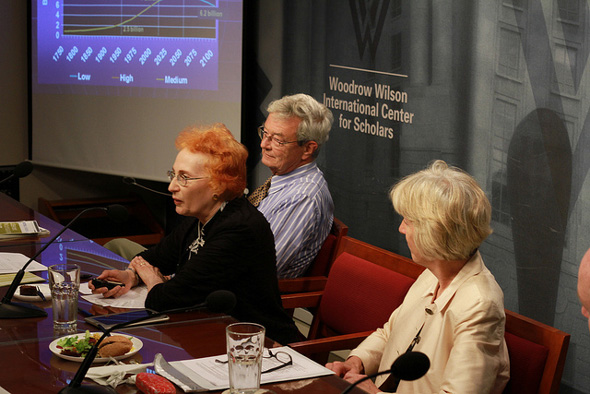
›“The seventh billion [person] was added in 12 years, and that could be the story for the eighth billion – and that gets people who think that growth has stopped,” said Carl Haub, senior demographer at the Population Reference Bureau. Haub was joined by Hania Zlotnik, former director of the UN Population Division, and Rachel Nugent of the University of Washington’s Department of Global Health on June 5 to speak about the assumptions behind the UN population projections. While each of the panelists noted the utility of projections, they also cautioned against seeing them as inevitable. [Video Below]
Meeting the Projections
As a former top official in the UN’s Population Division, Zlotnik spoke about how much is riding on the projections. “The experts tell me that to feed nine billion people, living better than the standards of living that we have today, one needs to increase agricultural production or all the production of food by about 70 percent and that is a challenge, but it might be feasible. But if the numbers go higher…I think it’s impossible,” she said.
The medium variant projection by the UN that gets the world to that nine billion figure is not a given – it builds in expected action on and improvement of many demographic indicators. Zlotnik pointed to the global unmet need for family planning, for example, which “is especially high in the high fertility countries,” and suggested that the current rate of increase in contraceptive use is insufficient.
She calculated the number of years it would take many of these countries to meet their unmet need at their current rate of uptake and found “the number of years for a lot of these poorer countries that have high fertility would be very long – 40 years, some of them, 80 years, 100 years – because the increased contraceptive prevalence has been so small.” At that rate, population growth in these countries will far surpass the UN medium variant.
The perception that population growth is no longer an issue contributes to the problem, Zlotnik said. People see that only 18 percent of the world population lives in countries with high population growth and assume “there’s no longer a population problem.” But she emphasized the power of exponential growth, arguing that even a small proportion growing at a rapid rate can have a large impact.
Questioning Assumptions
Haub pointed out several instances where assumptions in the methodology behind the projections create uncertainty.
For example, there is a lack of data in many low-income countries. “A date, let’s say 2000, 2005 – it’s the past, but it may be a projection. It may be based on a census in 1990,” he said. If it’s wrong, that error may not be corrected until another census, but it will still be relied on for country-level projections.
He also noted that certain assumptions about desired family size sometimes do not bear out on the ground. One of the key methods to slowing population growth is to provide women and couples with the means to choose how many children they wish to bear. But in many fast-growing countries, women wish to have large numbers of children. In Niger, for example, women say their ideal family size is over nine children. Such women are less likely to use contraception, no matter how accessible it is, as they value larger families.
“It has been – I guess conventional is a good word – to assume that birth rates are going to come down the way they did in the rich countries,” Haub noted. But there has been a “stall” for many developing countries, which he suggests is caused by fast initial uptake from urban women followed by much slower uptake by rural women. These dynamics, however, are relatively new and therefore are not always well incorporated into current projections.
The Economic Impact of Population Changes
While Haub and Zlotnik looked at the assumptions made before the projections are made and the importance and means to reach these projections, Nugent focused on the economic implications of lower fertility and the demographic transition.
She suggested that increased control over fertility can positively impact a country’s economy. Women are given the opportunity to “invest their time in acquiring skills and investing time in the labor market and that affects their earnings…[and] their ability to control resources and make decisions within the household” as they spend less time caring for children, she said.
The labor market changes as well, as fewer children are born into a given generation. This can reduce “demand on economic resources [and] demand on environmental resources,” and the increased investment in human capital allowed by smaller family sizes can lead to a healthier population.
Nugent concluded by pointing out key areas of intervention most likely to decrease both fertility and mortality and allow countries to reap the positive economic benefits of fertility decline. She suggested a focus on “complementary investments in education and health,” especially with regard to “poor and marginalized populations,” which can in fact impact the country as a whole. Finally, she recommended focusing on proven “evidence-based programs [and] service-delivery programs.”
Educating Policymakers
Each of the panelists cautioned against relying on population projections without taking action to make them come true.
“Maybe the best thing to do if you’re giving a presentation is to show the UN’s constant fertility variant first and scare people half to death and then say, ‘but if 117,000 things go right, [the medium variant projection] is what will happen,” said Haub, addressing the common tendency to view the UN projections as destiny.
Similarly, Nugent warned against viewing the demographic transition as inevitable. “There’s a certain sense…that [the demographic dividend] is kind of an automatic thing that happens, and that really has to be addressed,” she said, adding that “it’d be quite interesting to show some scenarios of what would need to be done…in order to get some benefits from that dividend.” (See also Elizabeth Leahy Madsen’s recent article on achieving the dividend.)
Zlotnik reiterated that the UN does not in fact know what the future will bring. “It’s not that we know what the world is going to do, but we hope that [the projections] will get the message out – if this doesn’t happen, you’re in trouble.”
Event ResourcesPhoto Credit: Sean Peoples/Wilson Center.