• woodrow wilson center
  • ecsp

New Security Beat

Subscribe:
  • rss
  • mail-to
  • Who We Are
  • Topics
    • Population
    • Environment
    • Security
    • Health
    • Development
  • Columns
    • China Environment Forum
    • Choke Point
    • Dot-Mom
    • Friday Podcasts
    • Navigating the Poles
    • Reading Radar
  • Multimedia
    • Water Stories (Podcast Series)
    • Backdraft (Podcast Series)
    • Tracking the Energy Titans (Interactive)
  • Films
    • Water, Conflict, and Peacebuilding (Animated Short)
    • Paving the Way (Ethiopia)
    • Broken Landscape (India)
    • Scaling the Mountain (Nepal)
    • Healthy People, Healthy Environment (Tanzania)
  • Publications
  • Events
  • Contact Us

NewSecurityBeat

The blog of the Wilson Center's Environmental Change and Security Program
Showing posts from category eco-tourism.
  • Gorillas and Family Planning: At the Crossroads of Community Development and Conservation in Uganda

    ›
    From the Wilson Center  //  November 13, 2013  //  By Donald Borenstein
    gorillaweb

    “Gorillas are very good at family planning; if we were like them, we’d be much better off,” said wildlife veterinarian Dr. Gladys Kalema-Zikusoka at the Wilson Center on September 26. The Conservation Through Public Health (CTPH) CEO and founder is celebrating 10 years of population, health, and environment (PHE) work in Uganda and the Democratic Republic of Congo, bringing health and livelihood interventions to people while protecting mountain gorillas around Virunga and Bwindi Impenetrable National Parks. [Video Below]

    MORE
  • Gladys Kalema-Zikusoka on Gorilla Conservation and Community Health in Uganda and DRC

    ›
    Friday Podcasts  //  October 11, 2013  //  By Donald Borenstein
    gladys-podcast

    Dr. Gladys Kalema-Zikusoka never expected to be so deeply involved in family planning when she started Conservation Through Public Health (CTPH) 10 years ago. CTPH began with a simple mission: to help preserve endangered mountain gorillas in Virunga National Park in the Democratic Republic of the Congo, and Bwindi Impenetrable National Park in Uganda. But, as Kalema-Zikusoka explains in this week’s podcast, they quickly found that to help the gorillas, they had to help the people living around them.

    MORE
  • From Octopus Conservation to Disaster Relief: Vik Mohan on PHE in Madagascar

    ›
    Friday Podcasts  //  September 27, 2013  //  By Laura Henson
    vik-mohan

    When Tropical Cyclone Haruna struck in February 2013, leaving thousands without shelter and tens of thousands without water, it was a test for Blue Ventures’ integrated approach to development in southwest Madagascar. According to Dr. Vik Mohan, they passed.

    “By the time the first aid organization arrived just to collect information, we had distributed to 17 villages already,” Mohan says in this week’s podcast. “We were the mouthpiece of the community, and because of our infrastructure on the ground, because of our good relationships with the community, we were able to procure and disseminate supplies that the community needed.”

    MORE
  • Coastal Resource Management, Family Planning Integration Build Resilience in Madagascar and The Gambia

    ›
    From the Wilson Center  //  August 26, 2013  //  By Jacob Glass
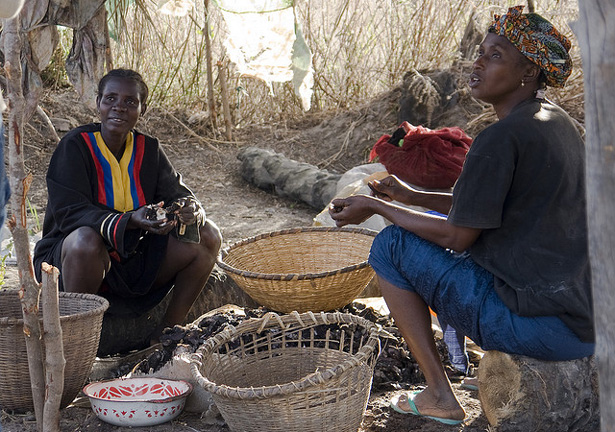
    Oyster Harvesters in The Gambia

    Growing awareness of the connected challenges of natural resource management, economic growth, and human health has encouraged more integrated models of international development. The experience of two organizations – TRY Oyster Women’s Association, based in The Gambia, and Blue Ventures, based in Madagascar – demonstrates the success of a community-based approach to building resilience, enabling communities to bounce back from adversity and establish a long-term basis for development. [Video Below]

    MORE
  • Wilson Center Premieres ‘Healthy People, Healthy Environment’ and ‘Transcending Boundaries’ at Environmental Film Festival

    ›
    From the Wilson Center  //  April 17, 2013  //  By Maria Prebble

    Environmental security and international development aren’t typical movie-going fare, but at the 2013 DC Environmental Film Festival, ECSP premiered two short documentaries with unique environmental stories: Healthy People, Healthy Environment: Integrated Development in Tanzania shows how improving health services and environmental conservation can empower coastal communities in Africa; and Transcending Boundaries: Perspectives from the Central Albertine Rift Transfrontier Protected Area Network explores the opportunities for “peace parks” along the shared borders of Uganda, Rwanda, and the Democratic Republic of Congo.

    MORE
  • Environmental Cooperation for Peacebuilding in Sierra Leone

    ›
    From the Wilson Center  //  August 10, 2011  //  By Jimmy Brousseau
    Sierra Leone’s decade-long civil war led to a complete collapse of environmental management in the country, according to Oli Brown, an environmental affairs officer with the UN Environment Programme (UNEP). Speaking at the Wilson Center last month, Brown highlighted the country’s current environmental conditions and how they have evolved since the war ended in 2002, while also outlining UNEP’s support for rebuilding the country’s natural resource governance.

    Despite its wealth of natural resources, Sierra Leone is plagued by high unemployment, a massive gap between the poor and wealthy, and extreme poverty – 70 percent of the population lives on $1.00 a day. The country is still “very fragile,” said Brown; the poor distribution of resources is partly responsible for the current problems facing the country.

    Sierra Leone’s environmental future and prospects for improving its natural resource governance depend on the answers to three key questions, said Brown:
    • How can the countries bountiful natural resources be shared more equitably?
    • How can the countries natural resources improve local livelihoods and provide jobs?
    • How can the war’s legacies be properly addressed while minimizing their negative impact?
    The first 5 to 10 years after a civil war are a critical time for peacebuilding efforts, Brown emphasized. Natural resources can help in this peace building process, but countries must recognize the value of their natural resources, and establish policies that are sustainable – environmentally, economically, and socially.

    Potential in Abundance: Agriculture, Minerals, Fisheries, and Tourism

    Today, agriculture – including rice, palm oil, and sugar cane – accounts for 50 percent of Sierra Leone’s GDP, but current production methods are extremely inefficient, said Brown. Farmers use slash-and-burn clearing techniques to grow crops with zero consideration for the environmental effects, a practice which has led to a high level of deforestation. Only four percent of the country’s original forest cover remains, he said.

    As part of its plan, Sierra Leone’s government is actively seeking large-scale investment in agricultural products for export. However, access to land development is complicated by the fact that more than 100 different chiefs control land and leasing rights around the country.

    Additionally, some fear that companies investing in Sierra Leone may be exploiting the situation to achieve maximum profit without providing local development benefits, such as employment.

    Water is also crucial to agriculture development, but Sierra Leone’s government does not know how much they have, said Brown, so they cannot properly plan for addressing the needs of their people. Reforming the sector is critical, as palm oil and sugar cane in particular have great potential for increasing the country’s GDP.

    Sierra Leone also has an abundant supply of minerals: Diamonds, iron, rutile, gold, and oil currently account for about 20 percent of GDP and approximately 250,000 jobs, said Brown.

    The planned Tonkolili iron mine will be the largest of its type built over the past 20 years anywhere in the world. If successful, the mine could double Sierra Leone’s GDP, he said. But the government must monitor these mining operations to ensure that the environmental damage does not undermine the economic benefits, said Brown. For example, rutile mining without proper safety precautions has produced acid lakes, he said, some of which have been measure with a PH level of 3.7 or greater.

    While fishing operations in Sierra Leone make up only 10 percent of GDP, fish provide 80 percent of the animal protein consumed in the country’s households. However, lack of regulation and enforcement has left the door open for rampant illegal and unregulated fishing, said Brown, which has depleted local fish stocks and reduced the size of fish that are caught threatening the country’s food security.

    On a more positive note, environmental tourism could be a potential source of sustainable revenue. The large chimpanzee population and the national parks could be strong tourist draws. However, the country must overcome its “blood diamonds” stigma in order to take advantage of its potential.

    UNEP is seeking to help Sierra Leone’s government develop its environmental regulations and planning, said Brown, such as ways to measure and regulate water usage. The regulation of agriculture, minerals, fisheries, and tourism industries will be vital steps toward helping Sierra Leone build a sustainable economy and a sustainable peace.

    Sources: Awoko Newspaper, Delegation of the European Union to Sierra Leone, Infinity Business Media, The Oakland Institute, UNDP, USAID.

    Photo Credit: “mining57,” courtesy of flickr user thehunter1184.
    MORE
  • Ecological Tourism and Development in Chi Phat, Cambodia

    ›
    Beat on the Ground  //  June 29, 2011  //  By Hannah Marqusee
    Chi Phat is a single-dirt-road town nestled in the Cardamom Mountains of Southwestern Cambodia, one of the largest intact forests in Southeast Asia. The town is only accessible by two routes: a three-hour river boat trip up the Phipot River or, if the road isn’t flooded by the rainy season, an exhilarating 30-minute motorbike ride from Andoung Tuek, a blip on the one paved road that runs along Cambodia’s southwestern border. Since 2007, Wildlife Alliance has been running an ecotourism project in Chi Phat (full disclosure: I used to work for Wildlife Alliance in Washington, DC).

    The project has been featured in The New York Times and since its inclusion in the Lonely Planet travel guide, has become a destination for backpackers looking to leave the beaten path. I recently visited the project after spending time in neighboring Vietnam and was struck by the contrast between the densely populated and urbanized Mekong Delta and the visibility of rural poverty in Cambodia.

    “Cambodia’s contemporary poverty is largely a legacy of over twenty years of political conflict,” reads a 2006 World Bank Poverty Assessment. The Pol Pot regime’s agrarian collectivization forced millions into the countryside and as a result, even in today’s predominantly-urban world, Cambodia remains 78 percent rural. Today 93 percent of Cambodia’s poor live in rural areas, two thirds of rural people face food shortages, and maternal and reproductive health outcomes in the country lag far behind those in the cities. Chi Phat and the sparsely populated northeast have over ten or twenty times the rate of maternal deaths of Phnom Penh.

    A Town Transformed

    Before Wildlife Alliance began the Community-Based Ecotourism (CBET) project in Chi Phat, most villagers made a living by slash-and-burn farming, illegal logging, and poaching endangered wildlife. Wildlife Alliance Founder and CEO Suwanna Gauntlett described the ecological zone around the town as “a circle of death,” in an audio interview with New Security Beat last year.

    Now, Chi Phat is a rapidly growing tourism destination offering treks and bike tours. In 2010 they brought in 1,228 tourists – not huge by any means, but over twice the number from 2009. The town now boasts a micro-credit association, a school, and a health clinic that offers maternal and reproductive health services. The village is also visited by the Kouprey Express, an environmental education-mobile that provides children and teachers with lessons, trainings, and materials on habitat and wildlife protection, pollution prevention, sustainable livelihoods, water quality, waste and sanitation, energy use, climate change, and adaptation.

    One villager, Moa Sarun, described to me how he went from poacher and slash-and-burn farmer, to tour guide, and finally, chief accountant:
    Since I have started working with CBET, I realize that the wildlife and forest can attract a lot of tourists and bring a lot of income to villagers in Chi Phat commune. I feel very regretful for what I have done in the past as the poacher…I know clearly the aim of CBET is to alleviate the poverty of local people in Chi Phat, so I am very happy to see people in Chi Phat have jobs and better livelihoods since the project has established.
    It’s hard to imagine what the town would have looked like before Wildlife Alliance arrived. The visitor center, restaurant, and “pub” (really, a concrete patio with plastic chairs and a cooler filled with beer), together make up nearly half of the town’s establishments. For two dollars a night, I stayed in a homestay and lived as the locals do on a thin mattress under mosquito netting, with a bucket of cold water by the outhouse for a shower, and a car battery if I wanted to use the fan or light (but not both). These amenities place Chi Phat above average for rural Cambodia. According to 2008 World Bank data, only 18 percent of rural areas had access to improved sanitation and only 56 percent had access to an improved water source.

    Poaching Persists

    Real change has certainly hit Chi Phat, but illegal activities persist, as a Wall Street Journal review of the project noted. In one Wildlife Alliance survey, 95 percent of members participating in the project made less than 80 percent of their previous income and 12 percent of people made less than 50 percent. “That, to me, is a red flag,” Director of U.S. Operations Michael Zwirn acknowledged to me. Nevertheless, he said “it is well documented that it’s the most lucrative community-based ecotourism project in Cambodia. That doesn’t mean that everyone is making money, or that they’re making enough money, but the community is clearly benefiting.”

    Harold de Martimprey, Wildlife Alliance’s community-based ecotourism project manager, told me in an email interview:
    We monitor closely the impact of the CBET project on the diminution of poaching and deforestation. We estimate that since the beginning of the project, the illegal activities have decreased by almost 70 percent.
    As Chi Phat ecotourism continues to scale up, de Martimprey expressed hope that more and more villagers would participate in the project and stop destructive livelihoods.

    After four years, Chi Phat has already developed enough to operate financially on its own. Wildlife Alliance will stop funding the project later this year and transition it towards total self-sustainability. The plan is to then ramp up efforts at a neighboring project in Trapeang Ruong, due to open to the public next month.


    A Land of Opportunity

    So far Chi Phat lacks much of what do-gooder tourists are hoping to find when they come in search of ecotourism. There is little to no information about the work of Wildlife Alliance and how ecotourism benefits the town, or the health, education, and economic benefits the villagers have received. A little more obvious justification for ecotourism’s inflated prices might appease the average backpacker used to exploitatively lower prices elsewhere in the country. The guides, staff, and host families for the most part speak little English, which does not bode well for its tourism potential. “This is a work in progress,” said de Martimprey.

    Most of my time in Chi Phat, I felt like the only foreigner to ever set foot in the town – refreshing after witnessing much of the rest of Southeast Asia’s crowded backpacker scene. As Chi Phat continues to grow, hopefully it will “bring in enough people to support the community without the adverse effects of tourism,” said Zwirn. “They don’t want it to turn into the Galapagos.” Thankfully, de Martimprey told me, “Chi Phat is far from reaching this limit and can be scaled up to much bigger operation,” without negatively impacting the environment.

    Luckily, plans to build a highly destructive titanium mine near the town were recently nixed by Prime Minister Hun Sen in what was an unexpected victory over industrial interests. However, soon after, the town was again under threat – this time by a proposed banana plantation nearby.

    “The Cardamom Mountains are still seen as a land of opportunity for economic land concessions for some not-so-green investors looking at buying land for different purposes, and often disregarding the interest of the local people,” said de Martimprey.

    Eventually Zwirn hopes that as more tourists come to the Cardamoms, they will become “a constituency for conservation,” he said. “We need to build a worldwide awareness of the Cardamoms as a destination, and as a place worth saving.”

    Sources: BBC, IFAD, Phnom Penh Post, New York Times, United Nations, Wall Street Journal, Wildlife Alliance, World Bank, World Wildlife Fund.

    Photo Credit: Hannah Marqusee.
    MORE
  • Minister Izabella Teixeira at the Wilson Center

    A Review of Brazil’s Environmental Policies and Challenges Ahead

    ›
    From the Wilson Center  //  December 29, 2010  //  By J.C. Hodges
    Stressing the need for concrete, tangible institutional policies, Izabella Teixeira, Brazil’s Minister of the Environment, discussed the challenges and goals of her ministry at the Wilson Center on October 20. Sustainable development, not just conservation, must be the focus, and that requires bringing lots of different players to the table, taking into account not only environmental but also social and economic agendas. To do this, she argued, one must take the rather ephemeral and hypothetical notions of environmental stewardship and put them into the realm of a practicable, institutionalized framework, built on a social pact that engages all sectors of society.

    The foundation of sustainable development and environmental policy must be biodiversity, according to Teixeira. Central concerns, such as food and energy security and combating climate change, all rely on a diverse array of natural resources. These need to be conserved, but they must also be developed in a responsible, sustainable way. A legal international framework toward this end, covering access to biodiversity and genetic resources, has yet to be implemented. Developing and developed countries need to find a middle ground on allocating the benefits that accrue from the use of genetic resources found in areas such as the Amazon, and this agreement must then be linked into existing political institutions.

    Teixeira noted the strides Brazil has made toward protecting its environment – including having set aside the equivalent of 70 percent of all protected areas in the world in 2009 and the establishment of the Amazon Fund. Nevertheless, Brazil must continue to protect and maintain these nature preserves, not just establish them. Creating a program that pragmatically implements international goals in a national context is an ongoing process, and countries like Brazil now need to focus on the “how” of implementing these goals, rather than just the “what.”

    Teixeira also highlighted the complexity of formulating environmental policy that integrates all the various points of view that must be taken into consideration. At recent meetings to discuss transitioning to a low-carbon economy, 17 different cabinet ministers had to be present to coordinate government positions and policies. The complexity is due in part to the need to create alternatives, not just to prevent certain activities. For example, one must not only use legal enforcement to stop illicit deforestation, but also create paths to legal, sustainable logging. Once again, attempting to balance environmental, social, and economic concerns is difficult, to say the least, but crucial for long-term effectiveness.

    Also a unique challenge for Brazil is the natural diversity that exists within such a large country. While much of the attention paid to the environment goes (rightly so) to the Amazon, there are many other biomes and local environments that must be taken into consideration, Teixeira observed.

    The cerrado, Brazil’s enormous savanna, requires a different strategy than the Amazon, which is different than the coastal Atlantic forest. Furthermore, urban areas need their own environmental policies that can take into account issues of human development and population density.

    To illustrate the need for an inclusive, well-thought-out policy, Teixeira discussed–rather frankly–the controversy surrounding the recent proposed amendments to the Forest Code. She argued that the proposal makes blanket changes that do not take into consideration differences in biomes, differences between large agribusinesses and family farms, and between historic, settled communities and recent developments. The implications of this proposal, according to the minister, could have enormous social costs. Teixeira said she believes that it would be virtually impossible to enforce the amended Forest Code if it was approved by Congress. She used this example to underscore her role in offering legislative alternatives that seek to provide a more nuanced, and ultimately more effective, institutional framework that can use Brazil’s many natural resources to help its population to the greatest extent possible.

    J.C. Hodges is an intern with the Brazil Institute at the Wilson Center; Paulo Sotero is the director of the Brazil Institute.

    Photo Credit: “Rio Jurua, Brazil (NASA, International Space Station Science, 05/29/07),” courtesy of flickr user NASA’s Marshall Space Flight Center, and David Hawxhurst/Wilson Center.
    MORE
Newer Posts   Older Posts
View full site

Join the Conversation

  • RSS
  • subscribe
  • facebook
  • G+
  • twitter
  • iTunes
  • podomatic
  • youtube
Tweets by NewSecurityBeat

Trending Stories

  • unfccclogo1
  • Pop at COP: Population and Family Planning at the UN Climate Negotiations

Featured Media

Backdraft Podcast

play Backdraft
Podcasts

More »

What You're Saying

  • Volunteers,At,The,Lagos,Food,Bank,Initiative,Outreach,To,Ikotun, Pan-African Response to COVID-19: New Forms of Environmental Peacebuilding Emerge
    Rashida Salifu: Great piece 👍🏾 Africa as a continent has suffered this unfortunate pandemic.But it has also...
  • A desert road near Kuqa An Unholy Trinity: Xinjiang’s Unhealthy Relationship With Coal, Water, and the Quest for Development
    Ismail: It is more historically accurate to refer to Xinjiang as East Turkistan.
  • shutterstock_1779654803 Leverage COVID-19 Data Collection Networks for Environmental Peacebuilding
    Carsten Pran: Thanks for reading! It will be interesting to see how society adapts to droves of new information in...

What We’re Reading

  • Rising rates of food instability in Latin America threaten women and Venezuelan migrants
  • Treetop sensors help Indonesia eavesdrop on forests to cut logging
  • 'Seat at the table': Women's land rights seen as key to climate fight
  • A Surprise in Africa: Air Pollution Falls as Economies Rise
  • Himalayan glacier disaster highlights climate change risks
More »
  • woodrow
  • ecsp
  • RSS Feed
  • YouTube
  • Twitter
  • Facebook
  • Home
  • Who We Are
  • Publications
  • Events
  • Wilson Center
  • Contact Us
  • Print Friendly Page

© Copyright 2007-2021. Environmental Change and Security Program.

Woodrow Wilson International Center for Scholars. All rights reserved.

Developed by Vico Rock Media

Environmental Change and Security Program

Woodrow Wilson International Center for Scholars

Ronald Reagan Building and International Trade Center

  • One Woodrow Wilson Plaza
  • 1300 Pennsylvania Ave., NW
  • Washington, DC 20004-3027

T 202-691-4000