-
Re-Thinking Price Shocks and Conflict?
›“Conflict, Food Price Shocks, and Food Insecurity: The Experience of Afghan Households,” a paper prepared for presentation at the Agricultural and Applied Economics Association’s annual meeting, examines the relationship between conflict and food prices, using Afghanistan during the 2008 global food crisis as a case study. By examining per capita food intake, numbers of fatalities and injuries, and the number of violent incidents in a given area, authors Anna D’Souza and Dean Jolliffe, of the U.S. Department of Agriculture and World Bank, respectively, determine that “at least in the case of Afghanistan, conflict does not seem to be the predominant driver of food insecurity.” Instead, inhabitants of conflict-prone regions, namely southern Afghanistan, consume more food, on the whole, than their northern compatriots. Residents of conflict areas do seem to be more affected by major food price increases, however these are fairly uncommon. D’Souza and Jolliffe speculate that this may be due to “interruptions in market access, inability to trade and barter, and worse food production and distribution systems.” These findings may be somewhat counterintuitive, but are an important resource for those seeking to reduce food insecurity in both conflict-prone and peaceful regions. In a working paper for the Center of Global Development, Samuel Bazzi and Christopher Blattman upend much of the established thinking on the relationship between commodity prices and conflict onset. Past researchers have found that lower prices of agricultural commodities lead to conflict as civilians have less to lose by rebelling against the government, and higher prices of resources like oil and minerals can lead to conflict as rebel groups have greater incentive to seize control. Contrary to these explanations, however, Bazzi and Blattman find “no evidence of a consistent, robust relationship between commodity price shocks and political instability.” Even when examining states with higher risks of conflict, like those which are particularly fragile, ethnically polarized, economically unequal, especially poor, and/or located in sub-Saharan Africa, they find no correlation between price shocks and conflict. The only evidence of a relationship they find is that rising prices lead to rising incomes, which can hasten the end of a conflict, but even this correlation is weak and varies from state to state. Though currently only a working paper, Bazzi and Blattman’s research provides an intriguing counter-narrative: “We argue that errors and publication bias have likely distorted the theoretical and empirical literature on political instability,” they write.
 -
Environment, Natural Resource Guidelines for Peacekeepers Moves UN Closer to ‘Greening the Blue Helmets’
›May 30, 2012 // By Stuart KentUN peacekeepers not only operate in conflicts where land and natural resources are a component of the fighting but their own bases and operations can also impact the local environment. As well as documenting practical steps to minimize the footprint of field missions, a new report from the United Nations Environment Program (UNEP) reviews the relationship between natural resources and conflict and what it means for peacekeeping.
While there’s been talk about “greening” UN peacekeeping for years, the details about the economic, environmental, and mission benefits contained in Greening the Blue Helmets: Environment, Natural Resources and UN Peacekeeping Operations suggest that this talk is getting closer to reality.
As of December 2011, the UN’s Department of Peacekeeping Operations was responsible for 121,591 personnel, 17,000 vehicles, and 257 aircraft across 16 different operations worldwide. These forces account for more than half of the entire UN system’s carbon emissions and can significantly strain the resources of fragile host communities, according to the report.
Building on the 2009 Environmental Policy for UN Field Missions, the UNEP report provides a dozen best practice examples from ongoing missions.
Field cases serve as evidence of how increasing water and energy efficiency, safely discarding solid and hazardous wastes, protecting cultural and historical sites, and ensuring a limited footprint after the closing down of camps, can save environmental and financial resources. These measures, the report claims, also reduce the risk of tension with host communities, such as occurred in Haiti when an outbreak of Cholera was traced to unsanitary water management practices at a UN camp.
Technologies recommended include better waste management systems, improved water systems, energy efficient buildings, and green energy capacities. However, some improvements can be made by simply encouraging behavioral changes; the UN mission in Timor-Leste reduced energy consumption by 15 percent over 12 months using a “CarLog” system to encourage fuel efficiency. With a 2009 global fuel bill of $638 million, even a 15 percent margin relates to a significant figure (much like the logic behind similar efficiency efforts within the U.S. military).
However, uncertain mission lengths are a major barrier to the adoption of more efficient technologies. Despite UN operations lasting an average of seven years and evidence indicating that capital investments could be recovered within one to five years in some cases, year-to-year mandates complicate long-term planning.
Natural Resource Nexus
Conceptually, the nexus of natural resources, conflict, and peacebuilding must be a central concern of peacekeeping operations, asserts the report.
In Africa alone, 13 operations have been conducted in response to conflicts associated with natural resources, at a cost of around $32 billion. Exploitation of natural resources such as diamonds, timber, and oil has financed and fueled conflicts in Sierra Leone, the Democratic Republic of the Congo, and Liberia. Communal tensions over access to scarce land and water resources are also considered an exacerbating influence on conflict dynamics in much of Sudan and now South Sudan, according to the report.
Addressing this nexus can also provide opportunities to reduce and redress conflict. In Darfur, firewood collection is a dangerous task for women and girls. By making “firewood patrols” a regular feature of the UN forces’ protection, the prevalence of sexual violence has been limited.
The UN Assistance Mission in Afghanistan is cited in the report for its efforts to hire ex-combatant and vulnerable populations to aid in the reforestation of extensively degraded pistachio woodlands from 2003 to 2009.
“Natural resources can provide opportunities for emergency employment and…sustainable livelihoods for former combatants,” write the authors.
Countries recovering from episodes of violence tend to have a low capacity to effectively and equitably manage a natural resource base that itself may have been degraded by conflict. Recent attention, however, is being paid to the peacebuilding potential of managing shared resources.
According to the report, “while only 54 percent of peace agreements reached between 1989 and 2004 contained provisions on natural resources, all of the major agreements concluded between 2005 and 2010 included such provisions.” This includes the renovation of land tenure systems, management of valuable extractive industries, and reallocation of resource rents.
Preventing Predatory Extraction
As peace begins to take hold, “access to land may be a key determining factor affecting the successful reintegration of a former combatant into a community.”
According to interview data from Northern Uganda, 93 percent of male LRA ex-combatants were unable to access land after demobilization. Often due to the death of an elder relative, sale of land by a family member, or land grabs by other members of the community.
While shared resources can build trust between communities, spoiler groups that use aggressive means to secure resource rents in the aftermath of conflict can endanger a fragile peace. The report identifies a role here for peacekeeping forces – and in particular for their civilian contingent – to identify these potential risks and opportunities for action.
In particular, the report recommends a higher level of clarity about the relationship between peacekeeping forces and so called “expert panels” – groups of civilian specialists called upon by the Security Council to provide advice on an official basis about natural resources in the aftermath of conflict.
The UN mission in the Democratic Republic of Congo, for instance, was given a direct mandate in 2008 to work with the DRC expert panel and to “use its monitoring and inspection capacities to curtail the provision of support to illegal armed groups derived from illicit trade in natural resources.”
UNEP Program Officer Matti Lehtonen, in an email interview, called the panels a “tremendous asset that is not yet used up to its full potential.” However, he noted, “expert panels and peacekeeping missions are different tools with different objectives so there is also a need to maintain a degree of independence.”
The report identifies a set of key recommendations for the UN moving forward:- Ensure that pre-deployment and in-mission training includes instruction on environment and natural resource management
- Aid and encourage disarmament, demobilization, and reintegration programs to look closely at emergency employment and sustainable livelihoods related to natural resources and the environment
- Support and encourage civil affairs personnel to seek ways to capitalize on peacebuilding opportunities around natural resources and the environment
- Systematically inform the Security Council of linkages between natural resources and conflict in states where the Council may be considering action
- Where natural resources have fueled or financed conflict, provide peacekeepers with a more systemic mandate to act on these issues
- Effectively implement best practices identified in the 2009 environmental policy
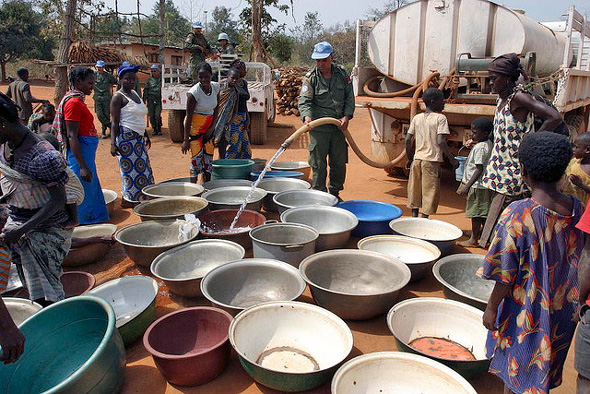
Photo Credit: UN peacekeepers in Côte d’Ivoire distribute water during a 2007 mission, courtesy of United Nations Photo. -
Poor Land Tenure: A Key Component to Why Nations Fail
›The murder of five land rights campaigners during the last two months – one in Colombia, three in Brazil, and one in Cambodia – have not captured many headlines, but they are a reminder of the central role land tenure plays not just in rural economic development but also in sparking broadly distributed economic gains throughout a society.
-
Valerie Hudson and Chad Emmett: Women’s Well-Being Is the Best Predictor of State Stability
›May 22, 2012 // By Kate Diamond“The best predictor of a state’s stability and security is the level of violence against women in society,” said Texas A&M University’s Valerie Hudson in this interview with ECSP. That link is “based on rigorous empirical analysis,” she said. “There’s something to it. It’s not just political correctness.”
-
Improving Food Security Through Land Rights and Access to Family Planning
›“In a future world affected by climate change, population growth is one lever that can be addressed to ameliorate the impacts of climate change, particularly in the area of food security,” write Scott Moreland and Ellen Smith in “Modeling Climate Change, Food Security, and Population,” a recent study for MEASURE Evaluation and USAID. Moreland and Smith combine demographic changes, food needs, and economic capacity into a single aggregate model to assess how family planning and climate change might affect food security from now until 2050. Using Ethiopia as an example, the model finds that if access to family planning services were increased to meet existing needs, the subsequent decrease in demand for food would reduce child malnutrition and effectively counteract a projected 25 percent shortfall in caloric availability from climate change’s impact on agriculture. Programs designed to increase access to family planning should therefore be incorporated into national adaptation and food security strategies, they conclude. “Family planning, especially in countries with high unmet need, provides a potential solution not only for women’s reproductive health, but also for adapting to the effects of climate change.”The Food and Agriculture Organization’s Committee on World Food Security recently endorsed a set of voluntary guidelines for land tenure governance in the context of food security that aims to strike a balance between encouraging productive investment and ensuring equitable and sustainable development. Population growth, climate change, and environmental degradation are putting pressure on the legal and cultural systems that govern land rights, resulting in “inadequate and insecure tenure rights” which can “increase vulnerability, hunger and poverty, and can lead to conflict and environmental degradation when competing users fight for control of these resources.” The guidelines, drawn from consultations with hundreds of people from both the private and public spheres and representing more than 130 countries, emphasize the need to safeguard access to land, fisheries, and forests – as well as the resources they provide – in a way that respects customary tenure systems, which are not always reflected in official tenure policies or records. They also emphasize strengthening the ownership rights of women and other traditionally marginalized groups in order to enhance food security and minimize the risk of instability and conflict in the future. -
The Global Water Security Assessment and U.S. National Security Implications
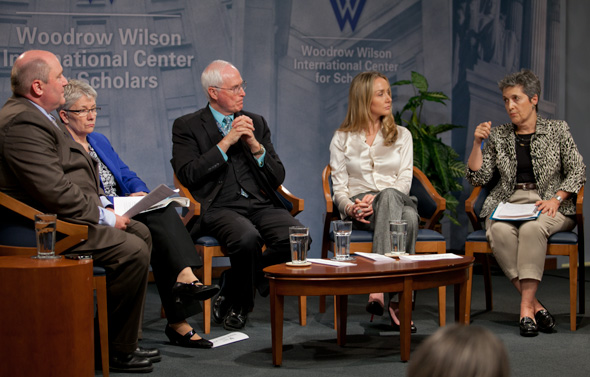
›“Water security is about much more than access to H2O,” said Jane Harman, director, president, and CEO of the Wilson Center at the May 9 meeting, “Global Water Security: The Intelligence Community Assessment.” The event – part of the Wilson Center’s National Conversation Series – brought together a number of experts to discuss a recently released intelligence community assessment of global water security. [Video Below]
-
Sex and World Peace: How the Treatment of Women Affects Development and Security
›“What we have discovered is that the very best predictor of how insecure and unstable a nation is not its level of democracy, it’s not its level of wealth, it’s not what ‘Huntington civilization’ it belongs to, but is in fact best predicted by the level of violence against women in the society,” said Valerie Hudson, co-author of Sex and World Peace, at an April 26 book launch at the Wilson Center. [Video Below]
-
Nigeria Beyond the Headlines: Environment and Security [Part Two]
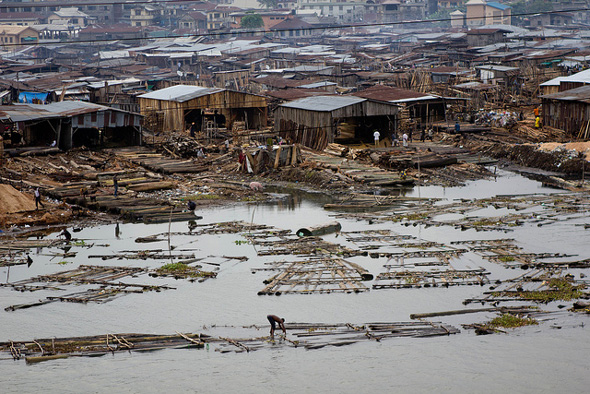
›In the coming years, Nigeria’s cohort of unemployed youth has equal potential to “be converted into either a religious or a regional clash, as certain youths get opportunities and other youths do not,” said Pauline Baker, President Emeritus of the Fund for Peace, during the day-long “Nigeria Behind the Headlines” event at the Wilson Center on the April 25 (read part one here). [Video Below]
Showing posts from category conflict.