Showing posts from category conflict.
-
Nancy Lindborg, The Huffington Post
Chronic Crisis in the Sahel Calls for a New Approach
›July 10, 2012 // By Wilson Center StaffThe original version of this article, by Nancy Lindborg, appeared on The Huffington Post.
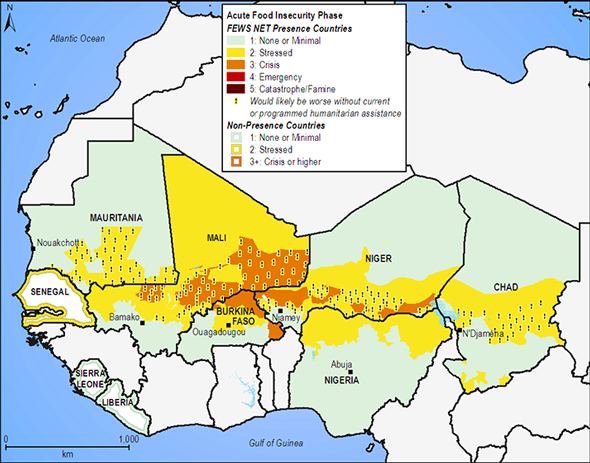
It is the lean season in the Sahel, a spine of arid and dry lands that runs from Senegal to Chad in western Africa, and once again we are seeing the devastating images of children gaunt with hunger. This is a region that faces high childhood malnutrition and underdevelopment even under the best of circumstances so one poor harvest can push millions of the most vulnerable into severe risk. In the aftermath of poor rains, and with food prices stubbornly stuck on high since the food crisis of 2008, some 18.7 million people across eight affected countries in the Sahel are at risk of food insecurity this year alone. At least eight million people are already in need of emergency assistance.
At USAID, we are determined to get ahead of these kinds of chronic crises. We know that millions of Africans living in the dry lands of the Horn and Sahel regions need new solutions. Last year, the worst drought in 60 years ravaged the Horn of Africa, driving 13.3 million people into crisis. And this summer, families in the Sahel are feeling the peril of depleting food supplies, high food prices, and rising malnutrition.
We can’t prevent what appears to be increasing cycles of drought, but we can and are working to create better solutions and build greater resilience among the most vulnerable.
Every crisis is complex, and the Sahel is no exception. A regional drought has been overlaid with instability stemming from the coup in Mali and conflict in the northern part of that country where armed militant groups have forced the suspension of critical relief operations. More than 184,000 refugees have fled to communities in neighboring countries that are already deeply stressed from drought. Though still functioning, local and regional markets have been disrupted, driving food prices even higher. And as of mid-June, swarms of locusts from southern Algeria and Libya had arrived in northern Mali and Niger; now expected to move southward, these infestations could result in crop destruction exacerbating an already worsening situation.
Continue reading on The Huffington Post.
Image Credit: West African medium-term food security outlook, courtesy of the Famine Early Warning Systems Network.
Nancy Lindborg is the assistant administrator of the Bureau for Democracy, Conflict, and Humanitarian Assistance at the U.S. Agency for International Development. -
Geoff Dabelko at the Aspen Environment Forum: “We Have to Find Ways to Do Things Differently”
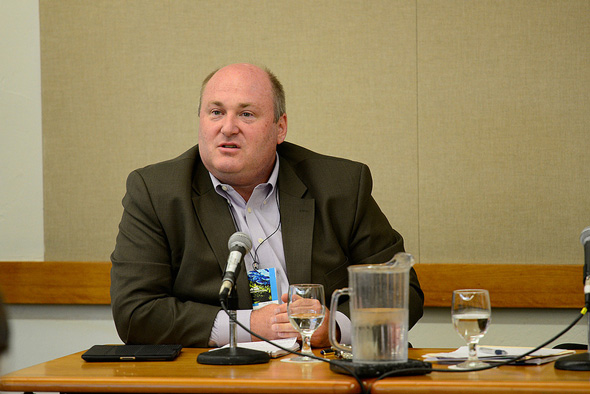
›July 9, 2012 // By Graham NorwoodECSP Director Geoff Dabelko was in Colorado last month to participate in the fifth annual Aspen Environment Forum, a three-day series of discussions about some of the world’s most vexing environmental concerns, hosted jointly by the Aspen Institute and National Geographic. Dabelko took part in two panel discussions, considering recent efforts to “green” the U.S. military in one and addressing the nexus of climate change and conflict in the other.
The U.S. Department of Defense is currently pursuing an ambitious strategy to minimize its dependence on oil, aiming to produce 25 percent of its power from renewable energy sources by 2025. During the 75-minute “Is the Military a Model?” panel, Dabelko joined Sharon Burke of the Department of Defense, Sherri Goodman of CNA, and U.S. Army Major General Joseph Anderson to discuss the extent to which the military’s embrace of more efficient and alternative technologies can spur wider innovation and adoption. Many have previously cited the military’s role in developing technologies like the Global Positioning System and the internet as a reason for optimism in this regard.
The “Climate and Conflict” panel, meanwhile, addressed how and to what degree climate change might affect future conflicts. According to Scientific American, “the consensus was that climate change per se will not cause conflict, armed or otherwise, but will exacerbate existing conflicts and instabilities.”
This was Dabelko’s third trip to the Aspen Environment Forum, and he spoke enthusiastically about the event in a brief interview with genConnect, which was covering the event. “The experience has been excellent,” he remarked, highlighting the diversity of participants as one of the forum’s greatest strengths.Dabelko acknowledged that much work remains to be done to achieve environmental and energy-related goals, but praised the realistic and grounded approach of attendees: “We have a tremendous set of challenges, and we’re not yet really succeeding in addressing them. So there’s a self-reflection that what we’ve been doing isn’t necessarily getting us where we want to get, and so we have to find ways to do things differently.”
One way to improve, according to Dabelko, is to work on communications. “[We need to have] conversations about complex issues, [and we] need to understand how to make them more accessible and more simple. But ‘simple’ does not mean ‘dumb’ or ‘incorrect’…we need to get smarter about how to have these conversations with wider and [more] diverse audiences.”
Photo Credit: Geoff Dabelko, courtesy of the Aspen Institute. Video: genConnect. -
UNHCR Report on East African Environmental Migrants: Long on Anecdotes, Short on Data
›July 6, 2012 // By Graham NorwoodAs part of the recently-concluded Rio+20 Conference on Sustainable Development, the UN High Commissioner for Refugees (UNHCR) presented a new report last week, titled Climate Change, Vulnerability, and Human Mobility: Perspectives of Refugees From the East and Horn of Africa. The report was created in order to “understand the extent to which refugees and IDPs (internally displaced persons) in the East and Horn of Africa have perceived, experienced, and responded to climatic events and trends in recent years.”
In order to achieve this goal, UNHCR and its collaborators (including the United Nations University Institute for Environment and Human Security, the London School of Economics, and the University of Bonn) interviewed approximately 150 refugees and IDPs in parts of Ethiopia and Uganda.
While the narrative is more anecdotal than data-driven, it nevertheless identifies several apparent trends in climate-related migration:Overwhelmingly, stories of mobility associated with moving away from worsening impacts associated with climate variability followed a specific pattern. That is, where movement related to climatic stressors did occur, such movement was taken as a last resort (only after all efforts to remain and adopt other methods of adaptation had been exhausted), particularly where the land being left was self-owned and only after all efforts to remain and try a number of alternative forms of adaptation had failed. Where movement occurred, in most cases it was likely to be internal, circular, and temporary rather than cross-border and permanent.
Stories of international migration were rare, and generally occurred either because migrants already lived near a border and were familiar with the area, or because they had encountered violent conflict (often of a political nature) during an earlier intra-state relocation.
The report also mentions that a majority of those interviewed claimed to have noticed significant changes in weather patterns over a 10- to 15-year period. In fact, many interviewees frequently claimed to be able to distinguish “normal” climate variability from more “permanent” changes.
Significantly, Climate Change, Vulnerability, and Human Mobility highlights several ongoing sources of debate and controversy regarding the issue of climate-induced migration as well.
The links between climate change, migration, and violent conflict are not well understood. And the question of whether climate change precipitates conflict or merely exacerbates it is still unresolved, though research on the subject is ongoing.
The terminology used to describe climate migrants remains a hotly-contested issue as well. While terms like “environmental refugee” and the especially popular “climate refugee” can make for good headlines, the UNHCR report strongly disapproves of such terms, given that the word “refugee” has a very specific legal definition.
Indeed, there is still much debate over how to classify climate migrants. It has been pointed out, for instance, that it is virtually impossible to separate out the various factors that induce migration, and questions as to whether migration is forced or voluntary also persist. For the most part, the UNHCR report shies away from such contentious questions, aiming instead to present a general and “human” narrative designed to call attention to the plight of climate migrants.
Definitional debates aside, the issue of climate-induced migration has been in headlines recently. The Asian Development Bank reported in March that 42 million people were displaced in the region during the last two years due to storms, floods, and other extreme weather events. And Israel signaled a tougher stance on immigration by deporting South Sudanese refugees in the wake of a major Israeli Ministry of Environmental Protection report warning of future climate-induced migration.
The particular vulnerability of women too is drawing increased interest. An article in Environmental Research Letters points out that “women tend to be poorer, less educated, have a lower health status, and have limited direct access to or ownership of natural resources,” and will therefore be disproportionately affected by climate change. Gender disparities must be accounted for in policymaking then, to ensure that future climate migration policies are equitable and inclusive, the author, Namrata Chindarkar, argues.
The challenges of defining and measuring the phenomenon remain – the UN Environment Program’s 2006 prediction of 50 million climate migrants by 2010 has not come true, and has even been a source of some embarrassment for the organization – but the recent UNHCR report is a timely reminder that climate-induced migration remains a major issue with tremendous long-term implications.
Sources: Asian Development Bank, Environmental Research Letters, Human Rights Education Association (HREA), The Jerusalem Post, The New Republic, National Geographic, OECD, Scientific American, Der Spiegel, UNHCR, The Washington Post.
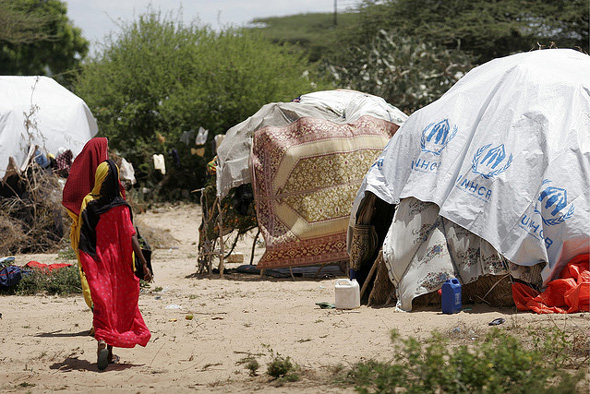
Photo Credit: Displaced Somalis, courtesy of UNHCR. -
Jennifer Dabbs Sciubba, The Huffington Post
Global Threats Exist, But Also Many Global Demographic Opportunities for the United States
›July 3, 2012 // By Wilson Center StaffThe original version of this article, by Jennifer Dabbs Sciubba, appeared on The Huffington Post.
Events like the Arab Spring gave birth to a generation of demographic converts in the national security community. Many are now convinced that demography matters because demographers today can clearly show how youthful population profiles in the developing world could lead to conflicts over the next 20 years – a major concern for policymakers.
Too much focus on demography and conflict, though, means policymakers miss opportunities for cooperation.
We are used to thinking of the wealthy and stable “Global North” and the poor and tumultuous “Global South,” but a demographic divide within the developing world is emerging, a third category of states that are growing older, more urban, more prosperous, more peaceful, and active in international affairs. These states – particularly India, Brazil, and South Africa – represent opportunities for building U.S. and world security.
Even as it maintains its longstanding relationships in Europe and elsewhere in the developed world, the U.S. should be more assertive in seeking partnerships with India as both a counterbalance to China and as a global security partner in addressing piracy and terrorism and in distributing international aid.
Continue reading on The Huffington Post.
Photo Credit: Tahrir 2011, courtesy of flickr user Denis Bocquet. -
What Are the Most Important Factors in the Failed States Index?
›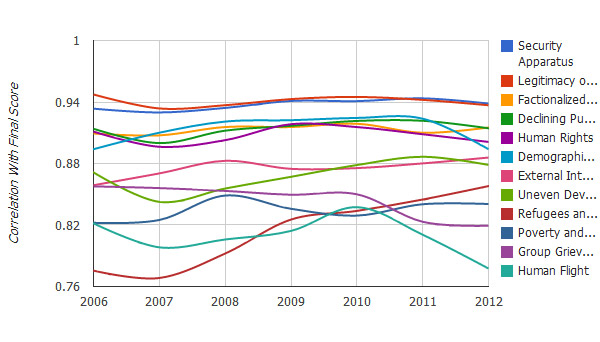
Last week, the Fund for Peace issued its eighth annual Failed States Index (FSI). The index gives 177 countries a score between 1.0 and 10.0 for 12 indicators, ranging from the legitimacy of the state and the security apparatus to demographic pressure and uneven development (high being bad, low being good – see full descriptions of the indicators here). But which of these indicators has the biggest impact? We did a quick analysis of the Failed States Indexes published from 2006 to 2012 to show which of the indicators correlate most with a high score. (We skipped 2005 since the roster of analyzed countries was significantly smaller.)
-
Climate-Conflict Thresholds and Water as a Casualty of Conflict
›While numerous studies have examined the perils faced by businesses operating in conflict-affected or high-risk locations, Water as a Casualty of Conflict: Threats to Business and Society in High-Risk Areas, written by Kristina Donnelly, Mai-Lan Ha, Heather Cooley, and Jason Morrison, is the first such report to focus specifically on water. The report – a collaborative effort between the UN Global Compact and the Pacific Institute – aims to provide a framework for understanding the conflict-water-business nexus by first tracing the ways in which conflict and high-risk areas can adversely impact local and regional water systems and then illustrating the challenges such impacts can pose to businesses in conflict-affected or high-risk areas. Water as a Casualty of Conflict was published online this week and was introduced at a Rio+20 Corporate Sustainability Forum panel session.In an article titled “Climate Change and Violent Conflict,” appearing in the May 18th edition of Science, authors Jürgen Scheffran, Michael Brzoska, Jasmin Kominek, Michael Link, and Janpeter Schilling attempt to sort out some of the controversy surrounding the intersection of climate change and violent conflict. They urge greater interdisciplinary research to identify and provide solutions for possible “tipping points” where the impacts of climate change may prove too great for human adaptive capacity. Such research has been scarce due to difficulties in collecting sufficient data. Moreover, the authors note that many of the extant studies on climate change and conflict are flawed because of how they define violent conflict. The commonly-used Uppsala Conflict Data Program and Peace Research Institute Oslo (UCDP-PRIO) Armed Conflict dataset, for instance, excludes by definition many riots, protests, incidences of livestock theft, and other violent or potentially violent behaviors. This is problematic because, as the authors point out, “in recent decades, climate variability may have been more associated with low-level violence and internal civil war – which fall below the UCDP-PRIO definition cutoff – than with armed conflict or war between countries.” -
Kirk Talbott, State of the Planet
Burma at a Crossroads for Peacebuilding and Natural Resource Governance
›June 18, 2012 // By Wilson Center StaffThe original version of this article, by Kirk Talbott, appeared on the Columbia University Earth Institute’s State of the Planet blog.
After a half-century of authoritarian rule, armed conflict against millions of ethnic minorities, and natural resource plunder, Burma, also known as Myanmar, now stands at a crossroads. As conditions for peace coalesce and civil society begins to blossom, there is hope once more for Burma’s people.
Burma’s quasi-civilian government, led by reformist Thein Sein, has initiated a series of surprising political openings and continues to engage actively with Nobel laureate Aung San Suu Kyi, now a member of parliament. Civil society and international relations are flourishing in contrast to conditions just one year ago. In May, the United States suspended economic sanctions and President Obama appointed a U.S. Ambassador for the first time in decades.
A new set of challenges emerge, however, around sharing the benefits and responsibilities of governing the country’s diverse wealth of natural resources. Nestled strategically between China and India, Burma has been isolated from the world’s attention since a coup in 1962. Its military government has consolidated a brutal grip on power through the sale of its rich timber, mineral, natural gas, and other resources, primarily to China and Thailand. This practice expanded after 1995, when the regime brokered a series of cease fire agreements with several ethnic armies along mountainous border areas. (For the first time in 60 years the Karen National Union joined almost all other major ethnic armies in agreeing to a cease fire, with the notable exception of the Kachin Independence Army.)
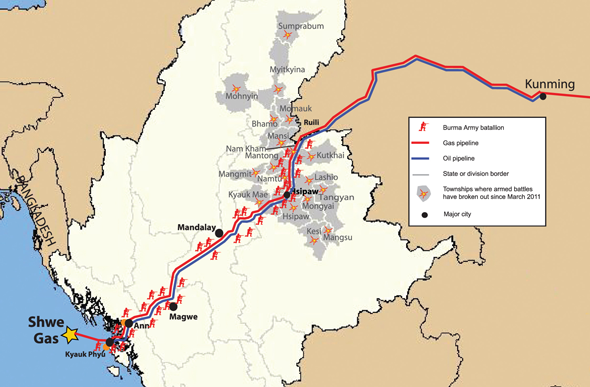
Oil and gas revenues fund the Tatmadaw, Burma’s half-million-strong army, one of Asia’s largest. Currently the huge offshore Shwe and Yadana natural gas reserves provide more than 90 percent of the nation’s foreign exchange. Chinese and Thai companies fund extensive pipeline, hydro-power, and transport networks as Burma becomes a potential regional economic corridor and natural resources production hub. China looms large in the geo-political equation investing over $12 billion in Burma in 2011.
Continue reading on State of the Planet.
Image Credit: Shwe gas line map, courtesy of Shwe Gas Movement. -
Gidon Bromberg at TEDx on Peacebuilding Through Water in the Middle East
›“Cooperation over water is not a privilege, it’s a necessity,” said Gidon Bromberg, co-director of Friends of the Earth Middle East, in a TEDx talk at Yale. He sees the shortage of water in Jordan, Israel, and Palestine as an opportunity to bring these contentious communities together – even more so during this period of upheaval in the region.
Water woes have long contributed to regional tensions, said Bromberg. Water rights between Israel and Palestine were supposed to be settled during the Oslo accords in 1993, but negotiations were unsuccessful and water discussions were consequently left unfinished. The lack of formal negotiations caused each side to seize whatever resources they could Although Jordan was not part of the negotiations, it does share water resources with Israel and the West Bank and thus has been impacted by the lack of formal allocation processes. Both Jordan and Israel have diverted flow of the Jordan River into dams and irrigation projects. As a result, the Jordan River has lost 98 percent of its historic flow and the Dead Sea has lost one-third of its surface area.
Today, Israel has restricted Palestinian water use such that Palestinians have access to water only once a week in winter and once every three weeks in the summer, leading them to store water in containers on their roofs, Bromberg said. Though mismanagement is as much to blame as conflict, he notes, Palestinians chafe under the limitations.
Yet Friends of the Earth Middle East has used this difficult situation to educate the public, propose reforms, and build trust between Palestinian, Jordanian, and Israeli communities. Bromberg highlighted “fear of a small but vocal minority on both sides” as a key factor in preventing dialogue between the communities, but insists that water can bring people together. Neighboring communities have to work together, he said, “not because they’re best friends,” but to improve their own water situations.
Friends of the Earth provides that opportunity with their Good Water Neighbors project and hopes the trust built between communities extends beyond water issues as well. Since communities have strong motives to solve these problems, they work together more effectively than high-level politicians who may not be as apt to collaborate.
A positive update on the state of the Jordan River given in an interview with ECSP in October suggests that Bromberg may be on to something.
Sources: Amnesty International, Friends of the Earth.
Video Credit: TEDx.