• woodrow wilson center
  • ecsp

New Security Beat

Subscribe:
  • rss
  • mail-to
  • Who We Are
  • Topics
    • Population
    • Environment
    • Security
    • Health
    • Development
  • Columns
    • China Environment Forum
    • Choke Point
    • Dot-Mom
    • Friday Podcasts
    • Navigating the Poles
    • Reading Radar
  • Multimedia
    • Water Stories (Podcast Series)
    • Backdraft (Podcast Series)
    • Tracking the Energy Titans (Interactive)
  • Films
    • Water, Conflict, and Peacebuilding (Animated Short)
    • Paving the Way (Ethiopia)
    • Broken Landscape (India)
    • Scaling the Mountain (Nepal)
    • Healthy People, Healthy Environment (Tanzania)
  • Publications
  • Events
  • Contact Us

NewSecurityBeat

The blog of the Wilson Center's Environmental Change and Security Program
Showing posts from category climate engineering.
  • Backdraft: The Conflict Potential of Climate Change Adaptation and Mitigation (ECSP Report 14)

    ›
    From the Wilson Center  //  May 16, 2013  //  By Geoffrey D. Dabelko

    Excerpted below is the introduction to ECSP Report 14, Issue Two.

    Amid the growing number of reports warning that climate change could threaten national security, another potentially dangerous – but counterintuitive – dimension has been largely ignored. Could efforts to reduce our carbon footprint and lower our vulnerability to climate change inadvertently exacerbate existing conflicts – or create new ones?

    MORE
  • Breaking Out of the Green House: Indian Leadership in Times of Environmental Change (Book Preview)

    ›
    Guest Contributor  //  March 7, 2013  //  By Dhanasree Jayaram

    The 2009 Copenhagen summit was a watershed moment in the history of climate change negotiations, especially from an Indian perspective. Brazil, South Africa, India, and China – the “BASIC” group – asserted their position, which led to a virtual collapse in talks, ostensibly marking the ascent of the global “south” and relative descent of the “north.”

    MORE
  • Considering “Soft Geoengineering”

    ›
    From the Wilson Center  //  November 29, 2012  //  By Aaron Lovell

    Even as the climate debate has been paralyzed by politics, the concept of geoengineering has been in the news lately, most notably in October when Russ George dumped 120 tons of iron particles into the Pacific Ocean in a scheme to try and score carbon credits. Earlier this month, the Wilson Center’s Science and Technology Innovation Program hosted an event taking a look at “soft geoengineering” – techniques that might have low or minimal environmental side effects but still address or reverse climate change.

    MORE
  • Michael D. Lemonick, Climate Central

    Surprise Geoengineering Test Goes Forward Off Coast of Canada

    ›
    November 2, 2012  //  By Wilson Center Staff

    The original version of this article, by Michael D. Lemonick, appeared on Climate Central.

    Harvard’s David Keith calls it the “goofy Goldfinger scenario” – a rogue nation, or even an individual, would conduct an unsupervised geoengineering experiment – and he confidently predicted in a story I wrote last month that it would never happen.

    MORE
  • Michael D. Lemonick, Climate Central

    Geoengineering Faces Dilemma: Experiment or Not?

    ›
    September 18, 2012  //  By Wilson Center Staff

    The original version of this article, by Michael D. Lemonick, appeared on Climate Central.

     In May, a team of British scientists abruptly canceled an experiment they had been planning for nearly two years. The Stratospheric Particle Experiment for Climate Engineering, or SPICE, was intended to test ways of injecting tiny particles of sulfur dioxide into the upper atmosphere, with the eventual goal of filtering out sunlight to cool the Earth in the face of global warming. The main reason given for the cancellation was a potential patent dispute over some of the technology involved.

    MORE
  • Georgina Mace on Planetary Stewardship in a Globalized Age: Risks, Obstacles, and Opportunities

    ›
    April 18, 2012  //  By Stuart Kent
    “The goal, ultimately, is just to manage our world better,” to have an “integrated system for the environment that is driven by what local communities want and need,” said Professor Georgina Mace, director of the NERC Centre for Population Biology at Imperial College London. Mace spoke to ECSP on the sidelines of the 2012 Planet Under Pressure conference.

    The environmental challenges of humanity are “really twofold,” she said. First, “human societies have grown up at what we now call the local scale…traditionally using the area in which they live.” Communities have always exerted pressures on their local environment but population growth “means those pressures on local landscapes are much greater than they use to be,” said Mace. “We can’t do everything all in the same place,” without the needs of different groups sometimes conflicting.

    Second, “there are connections between societies that are sometimes good but quite often they’re damaging.” For example, the increasingly globalized nature of how we utilize natural resources means that “overuse by one community may affect local people in ways that they have no way of responding to.”

    Taking apart the first of these challenges, Mace explained that “the population growth issue is really a population growth and demographic change [issue].” In places with mature age structures, such as North America, Europe, Russia, South Korea, and Japan, “the concern is about the number of old people dependent on a reducing number of producers in their society,” while in many poorer regions of the globe the concern is about the “many young people who still have to go through their reproductive years.”

    This latter case “looks a horrible problem from the environment point of view,” said Mace, because the areas growing fastest are areas that are “already overused in many ways.” If countries “don’t worry too much about international migration [and] we’re able to accommodate that,” this “demographic divide” could actually be helpful, as countries with growing populations could provide a young, energetic workforce to those that are aging.

    Mace made policy recommendations on different scales, from the local to the planetary. At the local level she encouraged making sure that climate interventions “are actually in concert with what’s going on in the environment.” “Let’s take advantage of ecological resilience, biological adaptation – all the things that nature has provided us with that give us mechanisms for coping,” she said.

    On a broader scale, she recommended intervening to counteract the “damaging drivers of environmental change,” by using geoengineering and better land use planning, “which is essentially gardening the planet.”

    “Both of those offer solutions that are actually incredibly efficient. They also have costs, risks, and obstacles to do with governance, to do with different people being winners and losers, and to do with the fact that we tend to organize our world around nation states and these solutions mostly transcend international boundaries.”

    “That’s a major obstacle,” Mace said, but in the end we need “to have a fully integrated planning system that is not top down but has an overall strategy that seeks to optimize all the things that people want and allows a way for local communities to connect.”

    “I think that’s the big challenge for us – how to get there.”
    MORE
  • Robert Olson for the Science and Technology Innovation Program

    Geoengineering for Decision Makers

    ›
    From the Wilson Center  //  November 16, 2011  //  By Wilson Center Staff
    Download Geoengineering for Decision Makers, by Robert Olson, from the Wilson Center. Excerpted below is the executive summary.

    Geoengineering involves intentional, large-scale interventions in the Earth’s atmosphere, oceans, soils or living systems to influence the planet’s climate. Geoengineering is not a new idea. Speculation about it dates at least to 1908, when Swedish scientist Svente Arrhenius suggested that the carbon dioxide released from burning fossil fuels might help prevent the next ice age. Until recently, proposals for using geoengineering to counteract global warming have been viewed with extreme skepticism, but as projections concerning the impact of climate change have become more dire, a growing number of scientists have begun to argue that geoengineering deserves a second look.

    Below are 10 of the major concerns about geoengineering that policymakers need to be aware of and give due consideration. These concerns apply mainly to solar radiation management (SRM), the form of geoengineering that attempts to cool the climate by reflecting a small amount of solar radiation back into space. SRM involves significantly higher risks than the other form of geoengineering, carbon dioxide removal (CDR) which involves removing carbon dioxide from the atmosphere and storing it in the ocean, plants, soil, or geological formations.
    • Unintended Negative Consequences: We may know too little about the Earth’s geophysical and ecological systems to be confident we can engineer the climate on a planetary scale without making an already bad situation even worse;
    • Potential Ineffectiveness: Some proposed CDR methods are so weak that they would produce useful results only if sustained on a millennial timescale;
    • Risk of Undermining Emissions-Mitigation Efforts: If politicians come to believe that geoengineering can provide a low-cost “tech fix” for climate change, it could provide a perfect excuse for backing off from efforts to shift away from fossil fuels;
    • Risk of Sudden Catastrophic Warming: If geoengineering is used as a substitute for emissions reduction, allowing high concentrations of CO2 to build up in the atmosphere, it would create a situation where if the geoengineering ever faltered because of wars, economic depressions, terrorism or any other reasons during the millennium ahead, a catastrophic warming would occur too quickly for human society and vast numbers of plant and animal species to adapt;
    • Equity Issues: Geoengineering efforts might succeed in countering the warming trend on a global scale, but at the same time cause droughts and famines in some regions;
    • Difficulty of Reaching Agreement: It could be harder to reach global agreements on doing geoengineering than it is to reach agreements on reducing carbon emissions;
    • Potential for Weaponization: Geoengineering research could lead to major advances in knowledge relevant for developing weather control as a military tool;
    • Reduced Efficiency of Solar Energy: For every one percent reduction in solar radiation caused by the use of SRM geoengineering, the average output of concentrator solar systems that rely on direct sunlight will drop by four to five percent;
    • Danger of Corporate Interests Overriding the Public Interest: Dangers include a lack of transparency in SRM technology development and the possibility that the drive for corporate profits could lead to inappropriate geoengineering deployments;
    • Danger of Research Driving Inappropriate Deployment: Research programs have often created a community of researchers that functions as an interest group promoting the development of the technology that they are investigating.
    As problematic as geoengineering is, a growing number of scientists now view global climate change as such a serious threat that they feel no option for dealing with it, including geoengineering, can be taken off the table. There is no longer any doubt that the average temperature of the Earth’s atmosphere and oceans is rising. There is an overwhelming consensus in the scientific community that human activities are significant contributors to this temperature increase, even if other dynamics are also at work. There are still uncertainties about how fast the climate will change and even larger uncertainties about the impacts climate change could have in different parts of the world. But there is substantial agreement that the impacts could become dangerous over the decades ahead. The greatest danger is that we could pass “tipping points” of self-amplifying, irreversible change into a much hotter world.

    Several of the best climate studies suggest that stabilizing the amount of carbon dioxide and other greenhouse gases below the level that risks dangerous climate change will require a social mobilization and technological transformation at a speed and scale that has few if any peacetime precedents. If correct, and the needed mobilization does not occur in the years immediately ahead, then decision makers later in the century could find themselves in a situation where geoengineering is the only recourse to truly dangerous climate change. The most fundamental argument for R&D; on geoengineering is that those decision makers should not be put in a position of either letting dangerous climate change occur or deploying poorly evaluated, untested technologies at scale. At the very least, we need to learn what approaches to avoid even if desperate.

    Continue reading by downloading the full report from the Wilson Center.

    Robert Olson is a Senior Fellow at the Institute for Alternative Futures.
    MORE
  • Backdraft: Minimizing Conflict in Climate Change Responses

    ›
    From the Wilson Center  //  August 5, 2011  //  By Jason Steimel

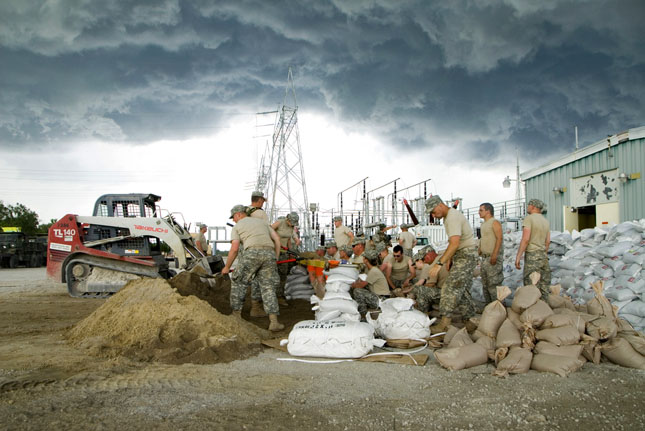
    “What are the conflicts or risks associated with response to climate change?” asked ECSP Director Geoff Dabelko at the Wilson Center on July 18. “How we respond to climate change may or may not contribute to conflict,” he said, but “at the end of the day, we need to do no harm.”

    MORE
Newer Posts   Older Posts
View full site

Join the Conversation

  • RSS
  • subscribe
  • facebook
  • G+
  • twitter
  • iTunes
  • podomatic
  • youtube
Tweets by NewSecurityBeat

Trending Stories

  • unfccclogo1
  • Pop at COP: Population and Family Planning at the UN Climate Negotiations

Featured Media

Backdraft Podcast

play Backdraft
Podcasts

More »

What You're Saying

  • Volunteers,At,The,Lagos,Food,Bank,Initiative,Outreach,To,Ikotun, Pan-African Response to COVID-19: New Forms of Environmental Peacebuilding Emerge
    Rashida Salifu: Great piece 👍🏾 Africa as a continent has suffered this unfortunate pandemic.But it has also...
  • A desert road near Kuqa An Unholy Trinity: Xinjiang’s Unhealthy Relationship With Coal, Water, and the Quest for Development
    Ismail: It is more historically accurate to refer to Xinjiang as East Turkistan.
  • shutterstock_1779654803 Leverage COVID-19 Data Collection Networks for Environmental Peacebuilding
    Carsten Pran: Thanks for reading! It will be interesting to see how society adapts to droves of new information in...

What We’re Reading

  • Rising rates of food instability in Latin America threaten women and Venezuelan migrants
  • Treetop sensors help Indonesia eavesdrop on forests to cut logging
  • 'Seat at the table': Women's land rights seen as key to climate fight
  • A Surprise in Africa: Air Pollution Falls as Economies Rise
  • Himalayan glacier disaster highlights climate change risks
More »
  • woodrow
  • ecsp
  • RSS Feed
  • YouTube
  • Twitter
  • Facebook
  • Home
  • Who We Are
  • Publications
  • Events
  • Wilson Center
  • Contact Us
  • Print Friendly Page

© Copyright 2007-2021. Environmental Change and Security Program.

Woodrow Wilson International Center for Scholars. All rights reserved.

Developed by Vico Rock Media

Environmental Change and Security Program

Woodrow Wilson International Center for Scholars

Ronald Reagan Building and International Trade Center

  • One Woodrow Wilson Plaza
  • 1300 Pennsylvania Ave., NW
  • Washington, DC 20004-3027

T 202-691-4000