-
From Readiness to Resilience: Strengthening Institutions for Climate Action
›November 12, 2025 // By Stephanie Speck
This article was adapted from Stephanie Speck’s remarks at the 2025 Berlin Climate Security Conference.
When I arrived in Mogadishu in 2013 to set up and lead the Office of the President’s communication and media department, I had the privilege of being invited to breakfast with the President. As I made my way through the layers of security leading to the presidential residence, I noticed an older woman walking behind me—cradling a chicken under each arm. She followed closely, undeterred by the checkpoints that stopped others.
-
Closing the Climate Finance Gap in Fragile States
›November 11, 2025 // By Madelyn MacMurray
A massive flood in Somalia killed hundreds of people, and displaced tens of thousands more. Yet the survivors faced a vexing prospect when they tried to return home: Al-Shabab had moved in.
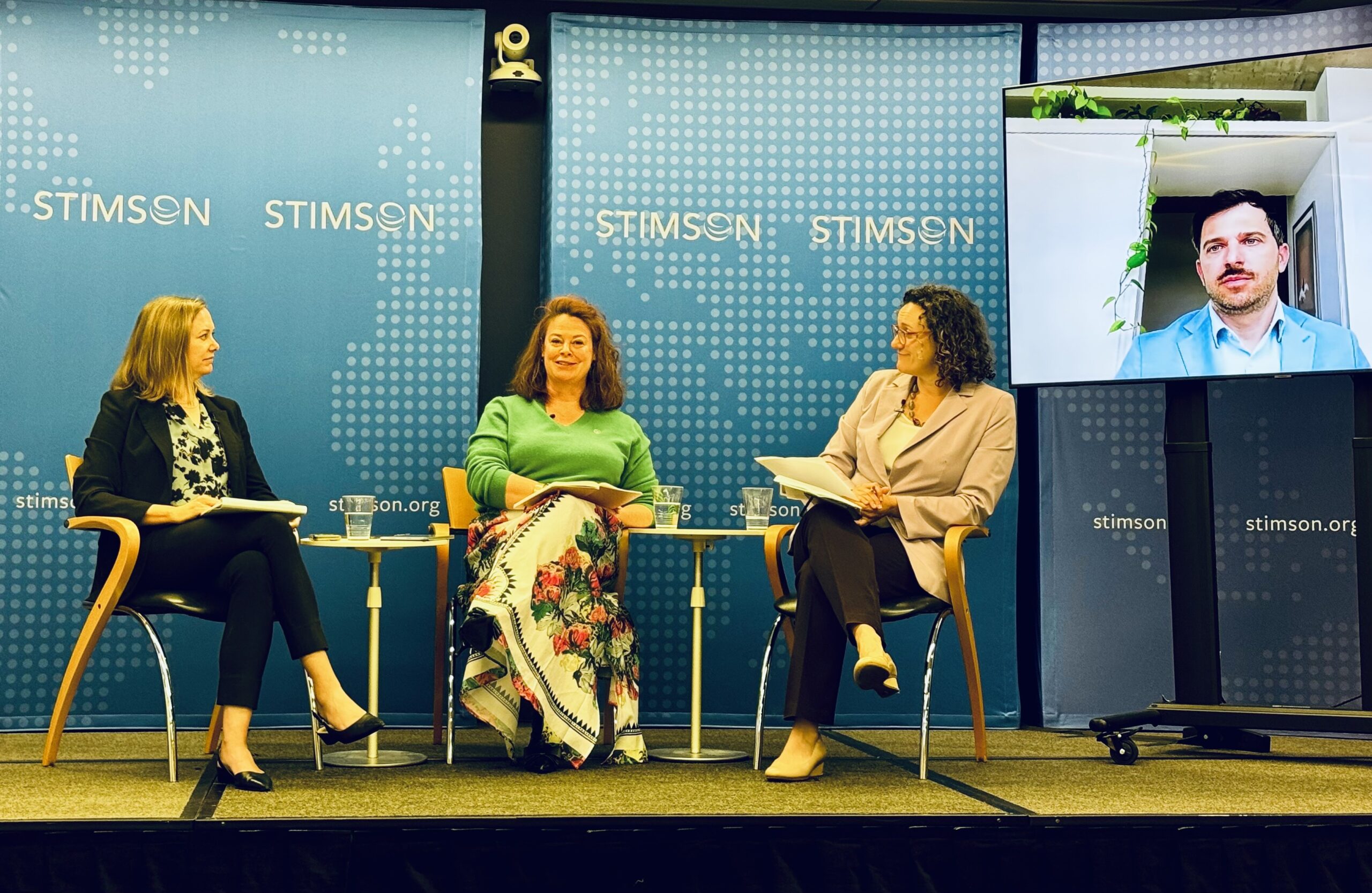
Stephanie Speck, Head of Special Initiatives at the Green Climate Fund, observed at a recent Stimson Center event that Shabab’s new levies meant that residents could not to move back to farm their land.
-
The Global Energy Transition Is About Securing the Future, Not Managing Decline
›November 5, 2025 // By Lauren Herzer RisiThe global energy transition is often framed as a balancing act between climate commitments on one hand, and sufficient energy and economic security on the other. That framing assumes the transition will mean less: less energy, less growth, and a steady decline in fossil fuel use. But this rhetoric is, as Ambassador Anthony Agotha put it at last month’s Berlin Climate Security Conference a “false choice.”
-
Zambian Women Take the Lead in Adapting Food Systems to Climate Change
›Women play vital roles as actors and innovators in food systems worldwide. In many societies, they are the primary food producers, accounting for between 60% and 80% of the national food stock. Women are also deeply engaged in other stages of the food value chain, from processing to consumption. Their multiple roles provide them with specific abilities that strengthen food systems during times of crisis.
-
Climate Insecurity Comes for Europe
›October 30, 2025 // By Peter SchwartzsteinWhen we look at climate-related insecurity, it’s usually in the context of poorer parts of the planet. And there’s generally good reason for that focus. Regions such as the Sahel and the Middle East are where the most––and worst––conflict of this nature plays out. And, for the most part, poorer countries are also the places least equipped to manage climate impacts and their effects on stability.
-
Environmental Security Weekly Watch: October 20-24, 2025
›US Resistance Delays Vote on Shipping Decarbonization Rules (Mongabay)
The International Maritime Organization (IMO) has voted 57-49 to postpone the adoption of the “net-zero framework” until October 2026. As the shipping sector’s first binding deal on global greenhouse gas emissions, the agreement would have established progressively stricter intensity limits starting in 2028. The framework also imposed substantial fees for noncompliance, with high emitters facing up to $1.5 million in additional annual fees by 2035 that could raise fuel costs by roughly 20%. Low-emission vessels would be rewarded with tradable carbon allowances.
-
Environmental Security Weekly Watch: October 13-17, 2025
›A window into what we’re reading in the Stimson Center’s Environmental Security Program
Assessment of UNESCO Sites Reveals Climate Impacts (Mongabay)
Initial data from the first ever global biodiversity and climate assessment indicates that 98% of UNESCO’s 2,200+ World Heritage Sites, Biosphere Reserves, and Geoparks have experienced at least one climate-related extreme event since 2000, including massive wildfires, droughts, and retreating glaciers. The effort to track such effects will now be augmented by UNESCO’s new Sites Navigator, a geospatial platform that integrates over 40 datasets to track climate impacts, biodiversity loss, and socioeconomic conditions in real time.
-
Environmental Security Weekly Watch: October 6-10, 2025
›A window into what we’re reading at the Stimson Center’s Environmental Security Program
“Intractable” systemic problems mean carbon offsets fail to cut global heating (The Guardian)
A recent review of 25 years of evidence found that carbon credit quality issues stem from deep-seated structural flaws, and not isolated cases of fraud. Researchers point to four major flaws that undermine most carbon offset projects. The worst problems include issuing credits for already-planned projects, impermanent solutions (forests that later burn), incidences of leakage (such as protecting one forest area while pushing logging elsewhere), and double-counting which allows both seller and buyer to claim the same emission reduction.
Showing posts from category climate change.