Showing posts from category climate change.
-
Michael D. Lemonick, Climate Central
Challenge of Making Climate Change News Sound Newsy
›The original version of this article, by Michael D. Lemonick, appeared on Climate Central.
Dog bites man: news or not? If you’re a journalist, you don’t even need to think about it. The phrase is our professional shorthand for an idea that hardly qualifies as news, that it’s not out of the ordinary. Man bites dog (goes the second half of the cliché), now that’s news!
It’s not an ironclad rule, though: if the dog bites the man after winning first place at the Westminster Dog Show, or if a marauding dog is biting its way through a terrified neighborhood, or if First Dog Bo bites Sasha or Malia – that’s news, too.
So when January 2012 was officially declared America’s fourth warmest January on record by the National Oceanic and Atmospheric Administration (NOAA), was that news or not? Here at Climate Central, we thought it was. But then, we would. Do a Google News search, and you’ll find that a whopping eight news outlets agreed with us, and one of them was the Weather Channel, so it hardly counts. (Extra points to msnbc.com, which came up with a clever angle: It feels like it must be the warmest January ever, but surprise! It’s only fourth!) But for most media, it was kind of ho-hum, because, really, haven’t we heard it all before? It’s always the warmest this, or the second-warmest that.
For scientists who think about climate, though, that’s the point. Especially in the past decade – a time when climate skeptics argue, bizarrely, that global warming has stopped – these records or near-records are being set all the time, and extreme weather events, including droughts, heat waves, and torrential storms, have been more frequent and more severe.
Continue reading on Climate Central.
Sources: National Oceanic and Atmospheric Administration.
Image Credit: “India – climate change canvas,” courtesy of Piotr Fajfer/Oxfam International. -
Kim Lovell, Sierra Club
Pop at COP: Population and Family Planning at the UN Climate Negotiations
›February 8, 2012 // By Wilson Center StaffThe original version of this article, by Kim Lovell, appeared on the Sierra Club’s activist network.
“Population, development, and climate should be a single discussion,” explained Jacques van Zuydam of South Africa’s National Population Unit. Van Zuydam, speaking to a sparsely filled room at the United Nations Framework Convention on Climate Change (UNFCCC) in Durban last month, centers his work around the concept that climate matters because people matter.
Given the focus on the Green Climate Fund, climate change adaptation, and the effects of sea-level rise and changing weather patterns on some of the world’s most vulnerable populations, it would have made sense for discussions about population to play a central role at the 17th Conference of Parties (COP-17). Yet despite these obvious links – and lead negotiator Jonathan Pershing’s admission to the U.S. youth delegation that population plays a central role when discussing climate impacts – the issue gained little traction in the formal negotiations.
Pershing said he considers population “too controversial” to play a role in the international climate talks, and recommended raising the issue elsewhere. But where better to talk about the need for increased access to voluntary family planning services than among a group of world leaders considering solutions to mitigate and adapt to climate change?
As Brian O’Neill and his colleagues at the National Center for Atmospheric Research explained in a 2010 paper, meeting the unmet need for contraceptive services worldwide could reduce emissions in 2050 by 1.4 to 2.5 billion tons of carbon per year, or 16 to 29 percent of the emissions reductions necessary to avoid dangerous changes to our climate. And beyond the potential effects on carbon, increasing access to education and family planning resources will have a huge impact on the ability of women and families to adapt to the effects of climate change that are already altering weather patterns, water availability, and agricultural production around the globe.
Continue reading at Sierra Club.
Sources: Amplify.
Image Credit: UNFCCC/Climate Change Information Center of Armenia. -
Ryan Britton: Addressing Population in Science Media for ‘EarthSky’
›“What we do is educate the general public and advocate on behalf of science to the general public,” said EarthSky Managing Partner Ryan Britton in this interview with ECSP. “Ultimately we try to bring science to people who don’t normally get science information.”
Part of that effort is addressing population dynamics – growth, aging, youth, food security, etc. – which is often a challenging subject. EarthSky’s coverage over the last year included a series of radio shows on global food security and the “year of seven billion,” which won them a second Global Media Award from the Population Institute in January (alongside New Security Beat!).
EarthSky productions appear on television, radio, online, and in multiple languages. “For us, it’s about getting science out to the general public as best we can,” said Britton.
In terms of population-related issues, he said, allocation of resources, how growing population is affecting ecology and biodiversity, and the effects of climate change are all topics on their radar. “But we do it within the lens of talking about humanity and our continued prosperity,” Britton said. “That’s important for people to hear – what are the solutions, how are we going to get through this, how are we going to be OK? And so those are the questions we’ll keep asking.” -
Richard Black: Future Climate-Migration Interactions Will Stress Cities, “Trap” Vulnerable Populations
›“In a 50-year time span, climate change, in particular, is likely to have a quite a strong impact on the drivers of migration,” said Richard Black, professor of human geography at University of Sussex and lead author of Migration and Global Environmental Change: Future Challenges and Opportunities. “But in a way that is different to what has been understood until now.”
-
Call for Papers: Reducing Urban Poverty
›The Woodrow Wilson Center’s Comparative Urban Studies Project, USAID, the International Housing Coalition, the World Bank, and Cities Alliance are teaming up a third time to co-sponsor an academic paper competition for graduate- and PhD-level students focused on challenges facing urban centers in the developing world.
The themes of this year’s competition are land markets, global climate change, and youth.
Land Markets: The absence of efficient land and housing markets and lack of secure tenure for both renters and owners are impediments to urban and economic development in developing cities. Papers on this topic should explore strategies and approaches that would enable property markets to function better and would provide increased security of tenure and strengthened property ownership rights.
Global Climate Change: Papers should examine how urban populations, especially the poor, are coping with the impacts of climate change, and provide strategic policy analysis to better understand how cities can become more resilient to climate change impacts.
Youth: Most of the youth of the developing world are now or will soon be living in urban areas. Unfortunately, they are often growing up in the poorest urban areas – informal settlements and slum communities where their opportunities for advancement are limited by a variety of negative factors. Papers focused on youth should explore ways to build capacity so that you can develop knowledge and skills, find gainful employment, and participate more fully in society to advance economic growth and social development.
Winning papers from each category will be published and the authors invited to Washington, D.C. in the fall of 2012 for a policy workshop with subject matter experts. Additionally, one grand prize winner will be asked to present his or her work at the World Urban Forum (WUF). WUF was established by the United Nations to examine rapid urbanization and its impact on communities, cities, economies, climate change, and policies. The sixth WUF will be held from September 1-7, 2012 in Naples, Italy and will be focused on “The Urban Future.” In addition to the Washington conference and publication of his or her paper, the grand-prize winner will be invited to present his or her winning paper on a panel at the World Urban Youth Assembly at WUF on September 1st and 2nd.
The deadline for the submission of abstracts is February 20, 2012.
For detailed competition guidelines and requirements, and further information on the sub-topics, please see the full call for papers.
Image Credit: “Split by yelowcap,” courtesy of flickr user yelowcap (Vladimir Kaštier). -
Move Beyond “Water Wars” to Fulfill Water’s Peacebuilding Potential, Says NCSE Panel
›January 26, 2012 // By Schuyler Null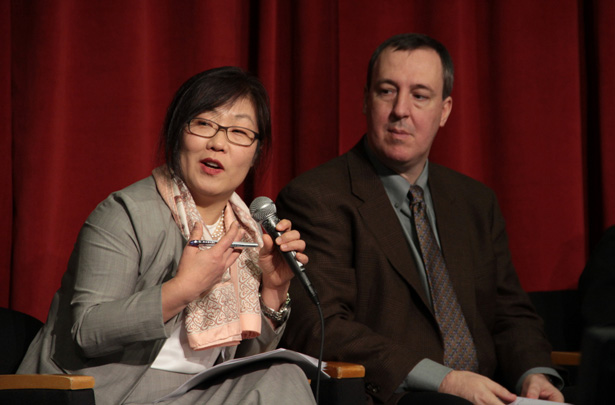
One of the best talks of last week’s NCSE Environment and Security Conference was thewater security plenary on Friday. Moderator Aaron Salzberg, who is the special coordinator for water resources at the Department of State, led with a provocative question: how many in attendance think there will be war over water in the future?
-
UNEP Maps Conflict, Migration, Environmental Vulnerability in the Sahel
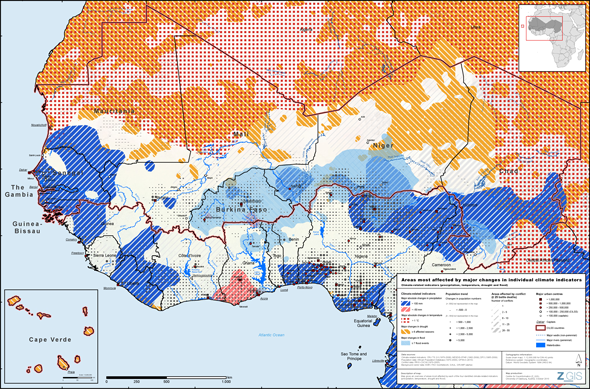
›A new set of maps from the United Nations Environment Programme (UNEP) identifies “climate hotspots” – areas vulnerable to instability exacerbated by climate change – in 17 sub-Saharan countries in and bordering the Sahel region. The maps reflect the fact that, more often than not, the impact of climate change on local populations is compounded by changes in migration, conflict, or both. According to Livelihood Security: Climate Change, Migration and Conflict in the Sahel, the UNEP report accompanying the maps, understanding “the exacerbating effect of changes in climate on population dynamics and conflict in the region” will be essential to developing successful adaptation strategies throughout the region.
UNEP’s maps analyze 40 years of data to pinpoint where the region’s most at-risk populations are located based on environmental, population, and conflict trends dating back to 1970. In a single map pinpointing the Sahel’s 19 hotspots, UNEP synthesizes subnational data from four environmental indicators over time – rainfall (from 1970 to 2006), temperature changes (1970 to 2006), drought (1982 to 2009), and flooding (1985 to 2009) – which are then layered on top of population trends (1970 to 2010) and conflict data (1970 to 2005) in order to identify the region’s most insecure areas.
Composite Vulnerability
At first glance, the map can appear hard to decipher; it is flooded with different colors and symbols, each indicating something different about the extent of climate change, migration, and conflict in the region. A Google Earth version of the map (available for download here) makes all this information easier to process by allowing users to select which indicators they want to see mapped out, cutting back on the number of lines, dots, colors, and pie charts the user has to decode.
Given the vast amount of the information being condensed into these maps, the report is a helpful and worthwhile read. For instance, eight hotspots are in places with growing populations and another seven are located in places that have experienced conflict; altogether, 4 of the 19 hotspots have both past conflict and growing populations. The report digs deeper into the confluence of climate, conflict, and migration by discussing case studies that highlight how the three intersect in local communities (at the same time, the report is careful to avoid suggesting that there is a causal relationship between the three issues.). In Niger, Nigeria, and Chad, for example, tensions have been mounting between northern pastoralists and southern farmers as each group has moved further and further afield in search of water and arable land to sustain their livelihoods.
Holes In the Data
While the hotspot maps include a wealth of information, the report makes clear that it is by no means exhaustive. Rising sea levels are, for instance, a major impending threat to coastal populations in the Sahel, but only the downloadable Google Earth map – not the hotspot map in the report or the Google Earth map as presented online – incorporates this factor. Compounded with a skyrocketing population in the coastal areas – the coast between Accra and the Niger delta is expected to be “an urban megalopolis of 50 million people” by 2020, according to the report – an increase in sea levels could have a huge impact on the region’s stability.
The report also readily admits that the datasets for population trends and conflict have shortcomings. Population data is largely based on censuses, which both the report and its data sources (UNEP’s African Population Database and the Gridded Population of the World, version 3) acknowledge can be inconsistent in their accuracy. Additionally, after 2000, population data is based on projections rather than estimates, which, as last year’s update from the UN Population Division showed, have often proven inaccurate, particularly in sub-Saharan Africa.
Regarding conflict, the UNEP report is straightforward in admitting its limits. The report lacks data on small-scale conflict (fewer than 25 battle deaths, following the Uppsala Conflict Data Program’s threshold that separates conflicts from lower-level violence), even as it acknowledges that such conflict is “often the first to occur” when climate change threatens communities’ access to resources and livelihoods.
Ultimately, however, these maps give valuable data on specific locations that are uniquely vulnerable to trends in population, climate, migration, and conflict. They add focus to the conventional wisdom that climate change will impact the region’s stability, and, taken together, the maps and the report provide a valuable resource for scholars and policymakers attempting to craft adaptation policies that take into consideration these complex links.
Sources: Socioeconomic Data and Applications Center at Columbia University’s Earth Institute, UNEP, Uppsala Conflict Data Program.
Image Credit: UNEP. -
Ethan Goffman, SSPP Blog
Securing a Sustainable Future: The Military Takes On a New Mission
›January 25, 2012 // By Wilson Center StaffThe original version of this article, by Ethan Goffman, appeared on the Sustainability: Science, Practice, and Policy blog.
In a time of polarized politics in the United States, over the environment and just about everything else, an overlooked development is how much the military, as well as the national security apparatus, has taken on climate change and other environmental challenges. “Environment and Security” was thus a profoundly important choice of theme for the 2012 National Conference on Science, Policy, and the Environment, held last week in Washington, DC. With the early effects of climate change apparently already occurring, notably in an increase in natural disasters and in a new northwest passage through the Arctic, those responsible for our security can’t afford to sit around and engage in speculation that climate change is caused by sunspots or isn’t really occurring. It is the military’s job, after all, to take action against potential threats rather than getting immersed in domestic politics.
The concern with climate change is the next step in a widening of the concept of security from strict military matters, to include such interrelated strands as food and water access, public health, and the environment. Much of the military has already acknowledged that armed force alone won’t make us safe. “Energy security, economic security, environmental security, and national security are all inextricably linked. Address one and you need to think of the others,” explained Vice-Admiral Dennis McGinn at the conference.
One obvious linkage is the connection of our oil dependency with security risks that can easily draw us into conflict in politically unstable parts of the world. Just how much the recent wars in the Middle East are about oil, and how much about a clash of civilizations, is a matter of considerable debate, although undoubtedly both factors play a part. The Iranian threat to close the Strait of Hormuz, choking outgoing oil deliveries, underscores vulnerability on the energy issue. From another angle, in Afghanistan, the military experienced the fragility of supply lines for a force strongly dependent on large quantities of oil. The Air Force, in particular, is working on algal jet fuel to free us from such reliance. And the Navy’s need for more icebreakers and other capacity shows concern regarding shipping and resource exploitation enabled by the melting of Arctic ice and the new passage.
Continue reading on the SSPP blog.
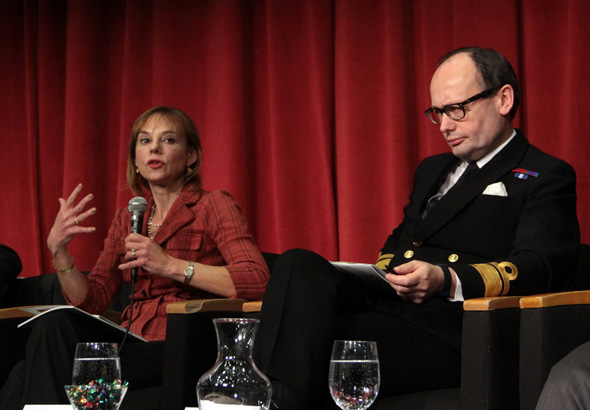
Photo Credit: Sherri Goodman and Rear Admiral Neil Morisetti, courtesy of Sean Peoples/Wilson Center.