-
John Donnelly, Global Post
A Call for Young People to “Get Angry” About Global Warming
›January 18, 2012 // By Wilson Center StaffThe original version of this article, by John Donnelly, appeared on Global Post.
The elder called on the younger generation to speak up.
At a session on climate change and family planning Thursday, Mary Robinson, the former president of Ireland, said that she keeps hoping that more young people will demand action on global warming.
“Maybe there’s a need to link the more thoughtful aspects of the Occupy movement with this, to get some of that more radical thinking,” she said. “As younger people increasingly understand the issues, I would say, ‘get angry’ so that we feel the need to do something more urgent. Let us know this is your future and for goodness sake it is absolutely urgent.”
She spoke at a session called “The Road to Rio: Climate Change, Population and Sustainability,” part of the Aspen Institute’s “7 Billion: Conversations that Matter” roundtable series (watch above). The discussion, organized by Aspen Global Health and Development, focused on strategies leading up to the Rio+20 United Nations Conference on Sustainable Development Summit in June – as well as what should be happening beyond Rio.
Continue reading on Global Post.
Video Credit: The Aspen Institute. -
Jon Barnett: Should Climate Change Be Addressed by the UN Security Council?
›For a small island state like Tuvalu, climate change is an enormous security issue and they have told the UN Security Council as much, said Jon Barnett, professor of resource management and geography at the University of Melbourne, in an interview with ECSP. But, despite debate in 2007 and 2011, the Council has been unable to reach agreement on whether climate change is an international security issue or not.
-
Jon Barnett: Climate Adaptation Not Just Building Infrastructure, But Expanding Options
›“I think it’s appropriate to think about [climate change] adaptation or investments in adaptation as investments to open up the range of choices available to people to deal with an uncertain future,” said Jon Barnett, associate professor of geography at the University of Melbourne, in an interview with ECSP. “In some circumstances it might be appropriate to build infrastructure and hard options where we’re very certain about the nature of the risk…but in other cases, expanding the range of choices and freedoms and opportunities that people have to deal with climate change in the future is perhaps the better strategy.”
-
Migration and Environmental Change, Minority Land Rights and Livelihoods
›Migration and Global Environmental Change: Future Challenges and Opportunities, from the UK Government Office for Science’s Foresight Programme, looks at how environmental change, including climate change, land degradation, and the degradation of coastal and marine ecosystems, over the next 50 years will affect migration trends. The report emphasizes that migration is a complex and multi-causal phenomenon, which makes it difficult to differentiate environmental migrants as a distinct group. Nevertheless, research suggests that global environmental changes will affect the drivers of migration, particularly economic forces, such as rural wages and agricultural productivity.
Though Foresight finds that many will use migration as an adaptation strategy that improves resilience to environmental change, they also point out that some affected individuals may become “trapped” in vulnerable situations, lacking the financial capacity to respond to environmental changes, while others may be able to move but will inadvertently enter more exposed areas, particularly, at risk urban centers. For recommendations, they stress the importance of strategic, long-term urban planning, and recognition within adaptation and development policies that migration can be part of the solution.A study, released on December 5 by Minority Rights Group International, finds that minority communities in Kenya, Uganda, and South Sudan face significant challenges around access to and control of critical natural resources. The report, Land, Livelihoods, and Identities: Inter-Community Conflicts in East Africa, shows how rapid population growth, climate change, and globalization are increasing competition for land, water, and forest and mineral resources in territories traditionally occupied by minority groups. These pressures can undermine livelihoods and trigger multiple and overlapping conflicts, especially where ownership has not been formalized in law. The study also notes that women are doubly vulnerable as their access to land and resources is frequently mediated through customary law, which depends on their communities retaining control over traditional territory. Although the report makes national-level legal and policy recommendations, the authors note that some of the most effective resource management and conflict resolution strategies adapt traditional cultural practices to the current circumstances of communities. -
Managing the Planet: The Road to Rio+20
›“We still see people thinking about the environment as if it is something apart. The idea of a synergy, a balance of development still, I think, eludes us both in theoretical, but especially in practical terms. And that is what Rio+20 is about,” said Ambassador Luiz Alberto Figueiredo Machado, under-secretary for environment, energy, science, and technology at the Brazilian Ministry of Foreign Affairs.
The Rio+20 conference next year, marks the 20th anniversary of the 1992 UN Earth Summit. It will be an opportunity to generate new answers to the question of how to collectively develop in a more sustainable and balanced way, said Figueiredo. Jacob Scherr, director of strategy and advocacy at the Natural Resources Defense Council, Richenda Van Leeuwen, senior director for energy and climate at the UN Foundation, and Thomas Lovejoy, biodiversity chair at the Heinz Center for Science and professor of environmental science and policy at George Mason University, joined the ambassador at the Wilson Center on November 16 for a discussion about preparations for the upcoming conference. The event was part of the Managing the Planet seminar series, coordinated jointly by George Mason University and the Wilson Center.
Sustainable Development Goals
Rio+20 should reaffirm the sustainable development vision of the first Earth Summit, said Scherr, “of our ability to deal with all of these issues at once: to move forward on economics, and dealing with poverty, of being equitable, and protecting and preserving the environment for future generations.”
Figueiredo said he sees the concept of a “green economy” as an “instrument to promote sustainable development and eradicate poverty. And in that sense, it seems clear that we will not find one green economy as such, but probably as many green economies as countries in the world, because each country will find its way of using that kind of tool.”
One proposal for the conference, supported by Brazil, is to devise a set of sustainable development goals, which would “embrace the Millennium Development Goals and instill a certain sustainability viewpoint to all of them,” Ambassador Figueiredo said. Furthermore, they would be global in nature, rather than geared towards developing countries, providing a vision for collective development.
“The Millennium Development Goals were good in some ways [but] they were fairly weak on the environmental side,” said Thomas Lovejoy. “This is a chance to actually improve on that, to really bring these elements together.”
Action and Accountability
Through “sustainable development dialogues,” Brazil is working to provide a new mechanism for civil society input at the conference. According to Figueiredo, Brazil hopes to “create a bridge between those who understand the issues, those who have a deep knowledge of the issues, and those who have the power again to do something about it.”
“We have been talking about these issues for 40 years, what we really need is a meeting that, as the Secretary General recently said, is a conference about implementation…to really start moving us down the path towards a sustainable future,” said Scherr.
“You might argue that everything that happened 20 years ago was an absolute failure, but of course it was not, because an awful lot has happened in the interim, it’s just that it hasn’t happened on a big enough scale or fast enough,” Lovejoy said.
“What gives me a lot of reason for hope going into Rio+20 is there are a lot of very practical, very pragmatic efforts involved,” he said.
Richenda Van Leeuwen pointed to the UN Secretary General’s Sustainable Energy for All initiative as a potential agenda to follow. The initiative has three objectives: ensuring universal access to modern energy services; doubling the rate of improvement in energy efficiency; and doubling the share of renewable energy in the global energy mix.
“We are using Rio, and the seminal opportunity that it represents, as a mechanism to be able to bring these new commitments together…to show that there is an opportunity for concrete actions,” Van Leeuwen said.
A robust accountability framework is vital to that effort, Van Leeuwen said. “It’s easy to make a pledge at a pledging conference, but really what we are looking at is a whole new way of doing business, a whole new action agenda,” she said. “So we are very optimistic and very excited about the opportunity for Rio, but Rio not as an end really, but as a beginning and as an opportunity to be a springboard to get much further global action.”
Photo credit: “Brazil!,” courtesy of Flickr user sparktography.
Event Resources -
Climate Diplomacy in Perspective
›December 20, 2011 // By Lukas RüttingerClimate policy on the international level often seems to be largely limited to negotiations within the United Nations Framework Convention on Climate Change (UNFCCC). However, in the shadow of these negotiations, a new approach merging climate and foreign policy is developing. Calling it “climate diplomacy,” proponents of this approach argue that tackling climate change is inherently a political struggle and one in which classic diplomatic instruments should play a role. This is especially true, since the challenges posed by climate change are so huge and the solutions so far reaching that the climate conversation also has to be a diplomatic one. Yet negotiations and treaties are just one instrument of foreign policy and they are only as successful and strong as the political foundation upon which they are built.
The German Federal Foreign Office, supported by adelphi, invited representatives from the European Union, the Organization for Security and Cooperation in Europe, and the United Nations, as well as over 30 countries for a two-day conference in Berlin this October, “Climate Diplomacy in Perspective – From Early Warning to Early Action,” to discuss what climate diplomacy looks like in practice, what its added value is, and what challenges it is best suited to address.
In working groups on water diplomacy, food security, and coastal stability, common themes and questions quickly emerged. In particular, the value and danger of securitizing the climate change discourse was a prominent issue.
On the one hand, the securitization of issues such as transnational water sharing can raise threat perception to a level that makes it very hard to tackle and may even foster conflict. On the other hand, participants noted that framing climate change as a security challenge might help to finally create the political leverage needed for far-reaching action.
Confronting Complexity
Another common theme was the complexity and linked nature of the climate challenges faced. Although covering different aspects, each working group quickly recognized systems with multiple feedback loops, such as the water-food-energy nexus. The same point was underlined in discussions around complex emergencies and crises, such as the 2010 floods in Pakistan.
However, the discussion did not stop at an analysis of challenges, the working groups also developed many suggestions of what climate diplomacy could and should look like.
One shared recommendation was that the complexity of and links between issues require sectoral policies and institutions to reach beyond their traditional, thematic, and even geographic focus. In regards to cross-border water cooperation, for example, this means that regional political institutions are often better suited than water institutions because of their broader mandate and focus. Where classic diplomacy and regional cooperation do not work, for example because national governments are blocking these efforts, participants proposed that informal diplomacy, track two initiatives, and cooperation on lower administrative levels such as municipalities can provide alternatives.
The complexity of the challenges is daunting but when asked to summarize why diplomats should tackle climate change, John Ashton, the special representative for climate change for the British Commonwealth Foreign Office, summed up his understanding in a simple but to-the-point answer: “Because it is our job.”
Lukas Rüttinger is a project manager for adelphi, mainly focusing on the fields of conflict analysis and peacebuilding as well as resources and governance.
Photo Credit: German Federal Foreign Office. -
Ruth Greenspan Bell and Barry Blechman for Foreign Affairs
How Much Did the Climate Talks in Durban Accomplish?
›December 16, 2011 // By Wilson Center StaffThe original version of this article, by Ruth Greenspan Bell and Barry Blechman, appeared on Foreign Affairs.
The outcome of the recent Durban climate conference represents a victory, of sorts, for a particular vision of how the community of nations might eventually gain control over greenhouse gases. But that vision is flawed, perpetuating an approach that, after more than 20 years of negotiations, has not reversed warming trends. Of particular concern is the continued insistence on a comprehensive deal negotiated by all nations through a UN process. The degree to which the meme of a “legally-binding” agreement has dominated thinking is likewise troubling.
Our October article, “Beyond the Durban Climate Talks,” examined an alternative negotiating pathway – one based on the effective model of nuclear arms control. There, specific issues were opportunistically segmented for resolution. And, in some cases, negotiators achieved progress by working in alternative fora that were not wedded to the UN ground rules, especially the ones that give every country, no matter how small, a potential veto on the results. Unfortunately, the Durban result continues the well-trod UN pathway.
The meetings saw protracted debate about how precisely to characterize the “legal” and “binding” nature of a future agreement that might emerge in 2015 from yet another “new” round of negotiations. Indeed, the supposed distinction between “political” or “voluntary” and “legally binding” agreements has dominated United Nations Framework Convention on Climate Change negotiations for years. Yet such distinctions break down upon closer examination.
Continue reading on Foreign Affairs.
Ruth Greenspan Bell is public policy scholar at the Wilson Center.
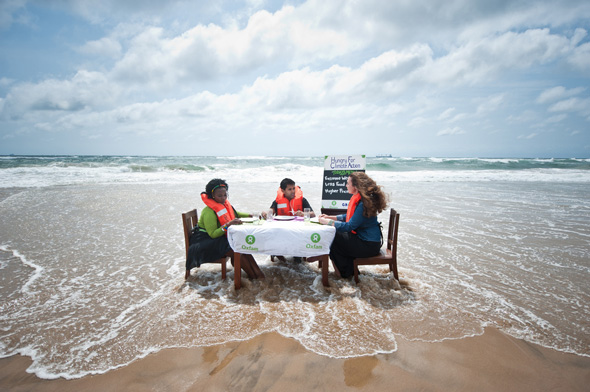
Photo Credit: “Oxfam hungry for climate action at Durban Climate Conference,” courtesy of Oxfam International and Ainhoa Goma. -
Can “Climate-Smart Agriculture” Help Feed Africa’s Growing Population?
›December 13, 2011 // By Brenda ZuluFood production needs to increase 70 percent by 2050 to meet the demands of a growing world population, said former UN Secretary-General Kofi Annan in a keynote address on “climate-smart agriculture” at a COP-17 event hosted by the World Bank and African Union. Annan, who is now chairman of the Alliance for a Green Revolution in Africa (AGRA), said this was a particular concern in Africa, where four out of five citizens are dependent on agriculture for their livelihoods.
One in seven people in the world do not have enough food to eat, Annan said, and climate change is expected to make this challenge more difficult to overcome. Climate-smart agriculture includes a wide variety of techniques that help increase the resilience of communities and protect them from extreme weather events, such as terracing to prevent soil erosion, improving weather forecasting, managing water runoff, and developing irrigation systems.
“Climate change affects us by undermining our resource base through water and soil degradation,” said Prime Minister of Ethiopia Meles Zenawi at the event. “There is need to protect the resources and to rehabilitate green areas of our land.” He said that since 70 percent of Africans are small-scale farmers and that most of the poor in Africa were farmers, there is no better way to fight poverty on the continent than through agriculture.
South African President Jacob Zuma said at the event that given that the UN projects a population of more than nine billion people in the world by 2050, agriculture should be a priority as it is more vulnerable to climate change than any other sector.
“Climate-smart agriculture includes proven practical techniques such as mulching, intercropping, conservation agriculture, integrated crop management and agro forestry, improved grazing, and innovative better weather management,” he said, all of which have the potential to help increase crop yields.
Mary Robinson, chair of the Global Leaders Council for Reproductive Health, said there could be no smart agriculture without integrating women’s issues, because climate change affects women disproportionately. “Women make the connection between climate-smart agriculture, food security, and gender,” she said.
“Our ability to feed the growing population under climate variability and change will require new expertise and harmonized efforts,” said Robinson.
Annan agreed, saying African women should be fully involved in early action that can support technical assistance, such as screening agriculture plans to ensure they are “climate smart” as well as integrating climate resilience and mitigation into ongoing poverty-reduction programs and testing new approaches.
But according to Brylyne Chitsunge, a farmer from Pretoria speaking on the panel, things will need to change considerably from the status quo. “The small-scale farmer remains very much marginalized in institutions,” she said. “They exist on paper but they really don’t exist.”
Brenda Zulu is a member of Women’s Edition for Population Reference Bureau and a freelance writer based in Zambia. Her reporting from the COP-17 meeting in Durban (see the “From Durban” series on New Security Beat) is part of a joint effort by the Aspen Institute, Population Action International, and the Wilson Center.
Sources: World Bank, World Food Programme.
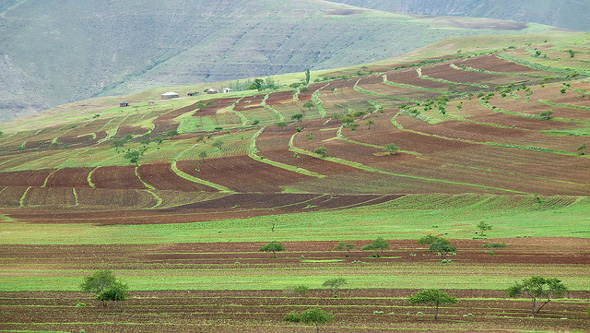
Photo Credit: “Cultivated hillsides,” courtesy of flickr user coda (Damien du Toit).
Showing posts from category climate change.