-
Natural Resource Management, Climate Change, and Conflict
›In Climate Change and Conflict: Lessons From Natural Resource Management, a new report from the Danish Institute for International Studies, authors Mikke Funder, Signe Marie Cold-Ravnkilde, Ida Peters Ginsborg, and Nanna Callisen Bang, review literature on how natural resource management, climate change, and conflict interact on the local, national, and transboundary levels, from which they offer lessons for development policymakers and programmers. Since natural resource management is “strongly related” to how climate change and conflict interact, they write, a better understanding of how natural resource management has taken conflict prevention and resolution into account would benefit development work aimed at mitigating climate change’s “multiplier effect” on conflict. Recommendations include working on as local a level as possible; working with and strengthening existing customary and legal conflict resolution frameworks; and coordinating development efforts across sectors so that policymakers and programmers can minimize the risk of unintentionally causing or aggravating conflict. In his March 2012 Transatlantic Academy paper, “The Geostrategic Implications of the Competition for Natural Resources: The Transatlantic Dimension,” François Heisbourg analyzes the strategic implications of emerging trends affecting the global energy marketplace, including climate change and scarcity. Whereas Europe and the United States shaped energy markets in the 19th and 20th centuries, respectively, there is no comparable leader in the 21st century marketplace, writes Heisbourg, nor is it clear that one will emerge. Instead, there will be a growing number of influential countries, like Brazil, India, and China, that will have an impact as both consumers and producers. That said, the Persian Gulf will remain geopolitically important given its dominance of the oil market, giving reason for the United States, Europe, India, and China to actively pursue cooperation in the Gulf in order to minimize the risk of future energy crises, Heisbourg concludes.
 -
Responses to JPR Climate and Conflict Special Issue: Steve Lonergan (University of Victoria)
›The relationship between climate change and conflict has been discussed for over two decades but most of the evidence of the link between the two has been anecdotal, drawing on extreme climate scenarios. The authors featured in the January special issue of the Journal of Peace Research devoted to climate change and conflict are therefore to be commended for their detailed investigations into a possible causal relationship between the two.
-
Responses to JPR Climate and Conflict Special Issue: François Gemenne (Sciences Po)
›If you want a government to address something, make it a defense issue. No need to hold a PhD in political science to know that governments tend to give the highest priority to issues that involve national security interests – one can complain and whine about it, but that’s the way it is.
-
Responses to JPR Climate and Conflict Special Issue: Solomon Hsiang (Princeton University) and Todd G. Smith (University of Texas, Austin)
›A January special issue of the Journal of Peace Research brings together a new collection of evidence on a subject that has been a mainstay of the environmental security agenda: the links between climate and conflict.
-
Much Ado About Conflict? Climate’s Links to Violence Reexamined
›Violence is on the wane in human affairs, even if slowly and irregularly. Could climate change reverse this trend? Pundits and politicians have raised the specter of havoc caused by rising temperature, erratic patterns of rainfall, and rising sea levels. In this way, so the story goes, climate change will produce famine and mass migration that threatens political stability and provokes violence. However, to date there is little evidence that the meteorological or agricultural conditions associated with climate change are actually a major source of violence.
-
Global Water Security Calls for U.S. Leadership, Says Intelligence Assessment
›March 26, 2012 // By Schuyler NullAlongside and in support of Secretary Clinton’s announcement of a new State Department-led water security initiative last week was the release of a global water security assessment by the National Intelligence Council and Director of National Intelligence. The aim of the report? Answer the question: “How will water problems (shortages, poor water quality, or floods) impact U.S. national security interests over the next 30 years?”
-
Fourth World Water Development Report Released by UN
›The beginning of last week’s World Water Forum in Marseille also marked the release of UNESCO’s fourth edition of the World Water Development Report. Chief amongst the challenges outlined in the new report are meeting demand from growing population and consumption. Agriculture accounts for 70 percent of water usage, according to the report, and globally we will require 70 percent more food over the next 40 years, introducing the possibility of overtaxing already-stressed water resources – all while adapting to climate change. There are substantial gains to be had in increasing farm-to-table efficiency, especially in developing countries, the authors sagely point out, but the supply challenge remains a huge one.
This year’s edition also adds several new sections, including on women and water. “The crisis of scarcity, deteriorating water quality, the linkages between water and food security, and the need for improved governance are the most significant in the context of gender differences in access to and control over water resources,” write the authors. “These challenges are expected to become more intense in the future.”
The integrated nature of today’s water issues is a highlight throughout the report. “Accelerated change” will create new threats and “interconnected forces” create uncertainty and risk, but UNESCO emphasizes that if policymakers are made aware of these issues, ultimately “these forces can be managed effectively and can even generate vital opportunities and benefits through innovative approaches to allocation, use, and management of water.”
Image Credit: Water Management Institute, via figure 15.5 from UNESCO World Water Development Report. -
Food Security in a Climate-Altered Future, Part Two: Population Projections Are Not Destiny
›March 20, 2012 // By Kathleen MogelgaardRead part one, on the food-population-climate vulnerability dynamics of Malawi and other “hotspots,” here.
Too often, discussions about future food security make only a passing reference to population growth. It is frequently framed as an inevitable force, a foregone conclusion – and a single future number is reported as gospel: nine billion people in 2050. But adhering to a single path of future population growth misses the opportunity to think more holistically about food security challenges and solutions. Several recent food security reports illustrate this oft-overlooked issue.
Accounting for Population a Challenge
Oxfam International’s Growing a Better Future: Food Justice in a Resource-Constrained World is a thorough and fascinating examination of failures in our current food system and future challenges related to production, equity, and resilience. It reports newly-commissioned research, carried out by modelers at the Institute of Development Studies, to assess future agricultural productivity and food prices given the anticipated impacts of climate change.
But both the modeling work and the report text utilize a single projection for population growth: the UN’s 2008 medium variant projection of 9.1 billion by 2050 (which has since been revised by the UN up to 9.3 billion). Early on, the report does recognize some degree of uncertainty about this number: “Greater investment in solutions that increase women’s empowerment and security – by improving access to education and health care in particular – will slow population growth and achieve stabilization at a lower level.” But such investments do not appear in the report’s overall recommendations or Oxfam’s food security agenda. This is perhaps a missed opportunity, since the range of possibilities for future population growth is wide: the UN’s low variant for 2050 is 8.1 billion, and the high variant is 10.6 billion.
Food Security, Farming, and Climate Change to 2050: Scenarios, Results, and Policy Options is another frequently-cited report published by the International Food Policy Research Institute in 2010. In recognizing that economic growth and demographic change have important implications for future food security, IFPRI researchers modeled multiple scenarios for the future: an “optimistic” scenario which embodies high GDP growth and low population growth, a “pessimistic” scenario with low GDP growth and high population growth, and a “baseline” scenario which incorporates moderate GDP growth and the UN’s medium population projection. Each of these scenarios was then combined with five different climate change scenarios to better understand a range of possible futures.
Using different socioeconomic scenarios enabled researchers to better understand the significance of socioeconomic variables for future food security outcomes. The first key message from the report is that “broad-based economic development is central to improvements in human well-being, including sustainable food security and resilience to climate change.” This focus on economic development is based in part on the “optimistic scenario,” which counts on high GDP and low population growth (translating to high rates of per capita GDP growth).
Unfortunately, the socioeconomic scenario construction for this analysis doesn’t allow for an independent assessment of the significance of slower population growth, since high population growth is paired only with low GDP and lower population growth is paired only with high GDP. Therefore, none of the report’s recommendations includes reference to reproductive health, women’s empowerment, or other interventions that would contribute directly to a slower population growth path.
Expanding the Conversation to Better Inform Policy
Without a more nuanced treatment of population projections in technical analysis and popular reporting on food security, decision-makers in the realm of food security may not be exposed to the idea that population growth, a factor so critical in many areas where food security is already a challenge, is a phenomenon that is responsive to policy and programmatic interventions – interventions that are based on human rights and connected to well-established and accepted development goals.
There are some positive signs that this conversation is evolving. A new climate change, food security, and population model developed by the Futures Group enables policymakers and program managers to quickly and easily assess the impact of slower population growth on a country’s future food requirements and rates of childhood malnutrition. In the case of Ethiopia, for example, the model demonstrates that by 2050, a slower population growth path would make up for the caloric shortfall that is likely to arise from the impact of climate change on agriculture and would cut in half the number of underweight children.
And recently, we’ve begun to see some of this more nuanced treatment of population, family planning, and food security linkages in a riveting, year-long reporting series (though perhaps unfortunately named), Food for 9 Billion, a collaboration between American Public Media’s Marketplace, Homelands Productions, the Center for Investigative Reporting, and PBS NewsHour.
In January, reporter Sam Eaton highlighted the success of integrated population-health-environment programs in the Philippines, such as those initiated by PATH Foundation Philippines, that are seeing great success in delivering community-based programs that promote food security through a combination of fisheries management and family planning service delivery. Reporting from the Philippines in an in-depth piece for PBS NewsHour, Eaton concluded:So maybe solving the world’s food problem isn’t just about solving the world’s food problem. It’s also about giving women the tools they want, so they can make the decisions they want – here in the world’s poorest places.
Making clear connections of this nature between population issues and the most pressing challenges of our day may be the missing link that will help to mobilize the political will and financial resources to finally fully meet women’s needs for family planning around the world – an effort that, if started today, can have ongoing benefits that will become only more significant over time. Integrating reproductive health services into food security programs and strategies is an important start.
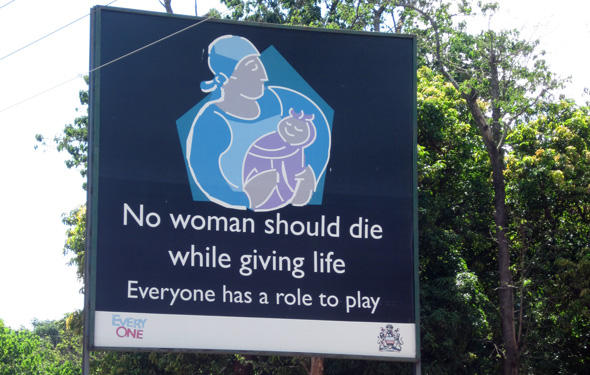
Back in Malawi, just before we turned off the highway to the Lilongwe airport, I asked the taxi driver to pull over in front of a big billboard. We both smiled as we looked at the huge government-sponsored image of a woman embracing an infant. The billboard proclaimed: “No woman should die while giving life. Everyone has a role to play.” Exactly. The reproductive health services that save women’s lives are the same services that can slow population growth and bring food security within closer reach.
Showing posts from category climate change.