Showing posts from category Africa.
-
Former Botswana President Champions Health, Governance Issues
›November 16, 2010 // By Wilson Center StaffOriginally featured in the Scholar Spotlight, Centerpoint, November 2010.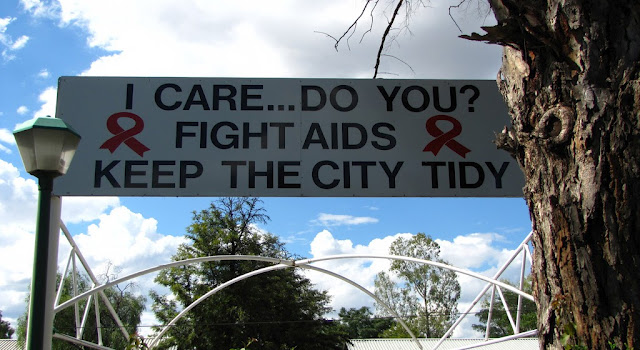
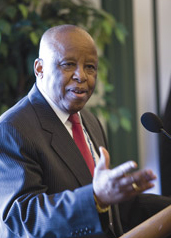
His Excellency Festus Mogae, who served as president of Botswana from 1998–2008, recently spent several months at the Wilson Center as a public policy scholar. During his stay, he conducted research, networked with senior policy officials in the U.S. government, the United Nations, and with NGO representatives in Washington and New York, and attended Wilson Center seminars related to health and governance.
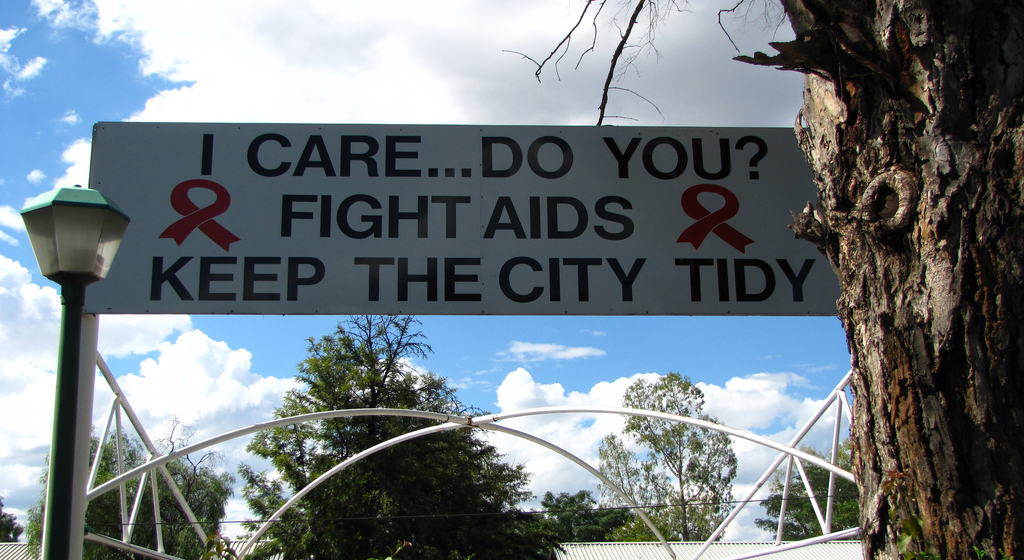
Since leaving office, Mogae has advocated for governance reform in Africa, notably presidential term limits, and efforts to mitigate the effects of climate change. Another critical initiative he is pursuing actively is HIV/AIDS prevention across Africa.
Mogae is the founder and chairman of Champions for an HIV-Free Generation, a group that assists current African presidents in dealing with the AIDS pandemic. This year, the delegation visited South Africa, Namibia, Mozambique, and Swaziland and, most recently, Zambia in October. The group seeks policy and attitude changes among the leaders of these nations and also advocates for increased financing for AIDS prevention in their health budgets. “If [these countries] allocate their own resources, the donor agencies will see they are serious about this problem” and match funds, said Mogae.
“We take the view that a more outspoken leadership must come from the continent regarding the AIDS epidemic,” he said. “African leaders must not only care but also be seen by donor countries and agencies as leading from the front on these matters.”
The group includes Mozambique’s Joaquim Chissano, Tanzania’s Benjamin Mkapa, Zambia’s first president Kenneth Kaunda, former Vice President of Uganda Speciosa Wandira, and former Chairperson of Kenya’s National AIDS Control Council, Miriam Were. Also in the coalition are two notables from South Africa, Nobel Laureate Archbishop Desmond Tutu and Constitutional Court judge, Justice Edwin Cameron.
The Champions coordinate with local health representatives based in Africa, from UNAIDS, the World Health Organization, PEPFAR, and the Gates Foundation, which prepare country reports on the status of AIDS. Then, armed with this research, the group meets with African leaders, including the presidents, finance and health ministers, local government and parliamentary officials, private sector, union, and civil society representatives, and church groups to lobby for policy changes.
“We highlight success stories on the continent so others can emulate them,” Mogae said. “We are calling for social behavioral change, but that can only happen if advocated and led by the top religious and traditional leadership.”
One particular challenge has been mother-to-child transmissions. He said in sub-Saharan Africa, in 2000, 40 percent of children born to HIV-positive mothers got infected but by 2008, the figure was down to three percent. The target is zero, he said.
Another major initiative chaired by Mogae is the Coalition for Dialogue on Africa, or, CoDA, a joint venture among the African Development Bank, the African Union Commission, and the UN Economic Commission for Africa. This global effort focuses on education, agriculture and conservation, energy and natural resources, and helping women. CoDA currently is organizing a symposium on women’s empowerment, he said, that will focus on education, and reforming land ownership and marriage laws.
These and other organizations with which he is affiliated aim to help shape policies and set priorities for Africa. He said, “We can’t ask the international community for help unless we first help ourselves.”
Dana Steinberg is the editor of the Wilson Center’s Centerpoint.
Photo Credit: AIDS sign in Gaborone, Botswana, courtesy of flickr user cordelia_persen. -
No Peace Without Women
›November 11, 2010 // By Kayly OberOn October 31, 2000, the UN Security Council adopted Resolution 1325, which calls for women’s equal participation in all efforts to maintain and promote peace and security. The resolution sought to exorcise the demons of the 1990s, when genocide took over 800,000 lives in Rwanda, thousands of women were raped in Bosnia, and millions more were displaced. However, the truth is that little progress has been made over these last 10 years and women remain on the periphery when it comes to post-conflict reconstruction and development.
-
Yale Environment 360: ‘When The Water Ends: Africa’s Climate Conflicts’
›November 10, 2010 // By Wilson Center StaffOriginally posted on Yale Environment 360:
For thousands of years, nomadic herdsmen have roamed the harsh, semi-arid lowlands that stretch across 80 percent of Kenya and 60 percent of Ethiopia. Descendants of the oldest tribal societies in the world, they survive thanks to the animals they raise and the crops they grow, their travels determined by the search for water and grazing lands.These herdsmen have long been accustomed to adapting to a changing environment. But in recent years, they have faced challenges unlike any in living memory: As temperatures in the region have risen and water supplies have dwindled, the pastoralists have had to range more widely in search of suitable water and land. That search has brought tribal groups in Ethiopia and Kenya in increasing conflict, as pastoral communities kill each other over water and grass.
When the Water Ends, a 16-minute video produced by Yale Environment 360 in collaboration with MediaStorm, tells the story of this conflict and of the increasingly dire drought conditions facing parts of East Africa. To report this video, Evan Abramson, a 32-year-old photographer and videographer, spent two months in the region early this year, living among the herding communities. He returned with a tale that many climate scientists say will be increasingly common in the 21st century and beyond — how worsening drought in parts of Africa, the Middle East, and elsewhere will pit group against group, nation against nation. As one UN official told Abramson, the clashes between Kenyan and Ethiopian pastoralists represent “some of the world’s first climate-change conflicts.”
But the story recounted in When the Water Ends is not only about climate change. It’s also about how deforestation and land degradation — due in large part to population pressures — are exacting a toll on impoverished farmers and nomads as the earth grows ever more barren.
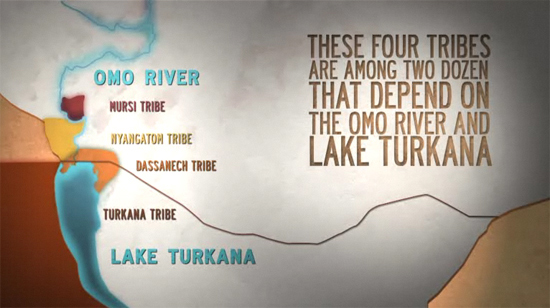
The video focuses on four groups of pastoralists — the Turkana of Kenya and the Dassanech, Nyangatom, and Mursi of Ethiopia — who are among the more than two dozen tribes whose lives and culture depend on the waters of the Omo River and the body of water into which it flows, Lake Turkana. For the past 40 years at least, Lake Turkana has steadily shrunk because of increased evaporation from higher temperatures and a steady reduction in the flow of the Omo due to less rainfall, increased diversion of water for irrigation, and upstream dam projects. As the lake has diminished, it has disappeared altogether from Ethiopian territory and retreated south into Kenya. The Dassanech people have followed the water, and in doing so have come into direct conflict with the Turkana of Kenya.
The result has been cross-border raids in which members of both groups kill each other, raid livestock, and torch huts. Many people in both tribes have been left without their traditional livelihoods and survive thanks to food aid from nonprofit organizations and the UN.
The future for the tribes of the Omo-Turkana basin looks bleak. Temperatures in the region have risen by about 2 degrees F since 1960. Droughts are occurring with a frequency and intensity not seen in recent memory. Areas once prone to drought every ten or eleven years are now experiencing a drought every two or three. Scientists say temperatures could well rise an additional 2 to 5 degrees F by 2060, which will almost certainly lead to even drier conditions in large parts of East Africa.
In addition, the Ethiopian government is building a dam on the upper Omo River — the largest hydropower project in sub-Saharan Africa — that will hold back water and prevent the river’s annual flood cycles, upon which more than 500,000 tribesmen in Ethiopia and 300,000 in Kenya depend for cultivation, grazing, and fishing.
The herdsmen who speak in this video are caught up in forces over which they have no real control. Although they have done almost nothing to generate the greenhouse gas emissions that cause global warming, they may already be among its first casualties. “I am really beaten by hunger,” says one elderly, rail-thin Nyangatom tribesman. “There is famine — people are dying here. This happened since the Turkana and the Kenyans started fighting with us. We fight over grazing lands. There is no peace at all.”
Watch When the Water Ends: Africa’s Climate Conflicts on Yale Environment 360.
For more on integrated PHE development and the Horn of Africa, see “The Beat on the Ground: Video: Population, Health, and Environment in Ethiopia” and “As Somalia Sinks, Neighbors Face a Fight to Stay Afloat,” on The New Security Beat. -
John Bongaarts on the Impacts of Demographic Change in the Developing World
›“The UN projects about 9.1 billion people by 2050, and then population growth will likely level off around 9.5 billion later in the century. Can the planet handle 9 billion? The answer is probably yes. Is it a desirable trajectory? The answer is no,” said John Bongaarts, vice president of the Policy Research Division at the Population Council, in this interview with ECSP.
Although family planning was largely brushed aside by international policymakers following the 1994 UN International Conference on Population and Development in Cairo, Bongaarts said he is hopeful because it is now enjoying a higher profile globally – and receiving greater funding.
“I am optimistic about the understanding now, both in developing and developed world, and in the donor community, that [family planning] is an important issue that should be getting more attention,” Bongaarts said. “And therefore I think the chances of ending up with a positive demographic outlook are now larger than they were a few years ago.”
The “Pop Audio” series is also available as podcasts on iTunes. -
Blue Ventures’ Integrated PHE Initiative in Madagascar
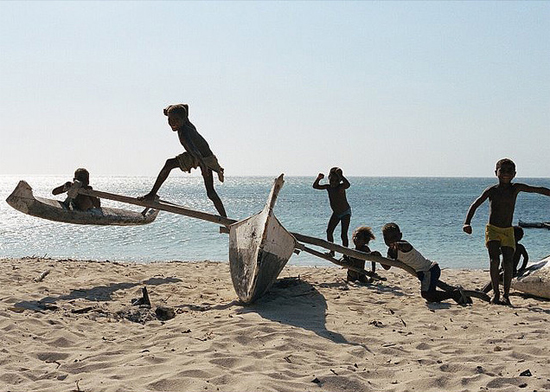
›In the small coastal village of Andavadoaka, Madagascar, the village elders offer a bottle of rum and two cigarettes to their ancestors before the men and their sons launch their wooden dugout canoes into the sea. Leaning over the side, their masked faces scour the water for their prey.
Meanwhile, the women – with babies on back and spears in hand – set out on foot into the shallow waters. One probes a small hole with her spear, and a tentacle reaches out to grapple with it. After careful coaxing, she pulls out an octopus, kills it, and adds it to her collection, which she tows on a string behind her.
In total, more than 1,850 pounds of octopus are collected on the opening day of the octopus harvest, a seasonal occurrence in Velondriake, the Indian Ocean’s first locally managed marine area.
Velondriake, which means “to live with the sea,” stretches along more than 40 km of southwestern Madagascar’s coast. The region encompasses 25 villages and is home to more than 8,000 people of the Vezo ethnic group, who are almost entirely dependent on marine resources, such as octopus, fish, and mangrove forests, for subsistence and income. But these resources are quickly disappearing due in large part to over-harvesting.
Blue Ventures Conservation – the London-based NGO I work for – has been working in the area since 2003 to protect the region’s coral reefs and mangroves, as well as their biological diversity, sustainability, and productivity, while also improving the quality of life of the local community.
To this end, Blue Ventures helped the community create a series of coastal marine reserves. Several permanent reserves protect the biodiversity of the coral reefs and mangroves, and help fish populations recover; while nearly 50 temporary reserves have increased the productivity of the octopus and crab fisheries. Octopuses reproduce quickly and juveniles grow at a nearly exponential rate, so a brief harvesting hiatus can lead to significant increases in yield. Increased yields translate to increased profits – something greatly welcomed by the people of this impoverished region.
The people of the region are also reproducing quickly: the average total fertility rate in Velondriake is 6.7 children per woman, according to our data. On average women are only 15 years old when they first conceive. To compound this problem, a majority of the population is under the age of 15 – at or approaching reproductive age. At the current growth rate, the local population will double in only 10 to 15 years. The local food sources, already heavily depleted, barely feed the current population, let alone twice that amount. Without enabling these coastal communities to stabilize their population growth, efforts to improve the state of marine resources and the community’s food security are considerably hindered.
In August 2007, Blue Ventures launched its Population, Health, & Environment (PHE) program as a weekly family planning clinic in Andavadoaka, which provided access to ingestible and injectable birth control options, as well as condoms. The clinic increased the village’s contraceptive prevalence rate (CPR) from 9.4 percent to 36.3 percent, and the Velondriake region’s CPR from 11.0 percent to 15.1 percent, in its first two years. (CPR data for the third year is not yet available, but should be notably higher, especially at the regional level.)
In 2009, Blue Ventures opened two more clinics and began holding quarterly outreach clinics in all Velondriake villages. We started offering long-acting, reversible contraceptive options, including Implanon and IUDs. Most recently, we have implemented a community-based distributor (CBD) program to provide wider access to contraceptives around the region, particularly for villagers that could not easily reach one of the clinic sites. These expansions paid dividends: the number of patients increased almost four-fold between the second and third years, with a cumulative total for all three years of just under 1,700 patients.
Recently, the PHE program began a partnership with the UN Population Fund (UNFPA), becoming the first PHE project to receive support from the UNFPA within Madagascar. The UNFPA funds will allow us to add new regional clinics; launch a behavior change campaign, including a regional theater tour and educational events; and further develop the CBD program.
UNFPA’s support of this initiative represents an important endorsement of Blue Ventures’ integrated approach to the challenges of marine sustainability, food security, reproductive health, and population growth. Funding applications to focus on improving maternal and infant health and to conduct a full health-needs assessment of the Velondriake region are pending.
In taking a population, health, and environment approach, Blue Ventures creates synergies that allow for the more effective achievement of health and conservation outcomes. Through providing family planning and health options – services the community really wants – Blue Ventures generates more support for all of its other initiatives, such as conservation and aquaculture programs.
This integrated multi-pronged approach also helps speed up the move towards a more sustainable future. By empowering and enabling couples to take control of their fertility, couples are able to have the size family they want. The use of family planning helps lower the population growth rate, and lower growth rates decrease pressures on natural resources. Decreased pressures on natural resources lead to healthier ecosystems; healthier ecosystems mean more natural resources available; and more resources lead to healthier families.
Through recognizing this inextricable link between communities, their health, and the environment they live in, Blue Ventures hopes to preserve not just the local coral reefs and mangroves, but the Vezo seafaring lifestyle. This way, the sons on the boats and the babies on the women’s backs may still have enough octopus and fish to harvest when they take their own children out to sea.
Matthew Erdman is the PHE coordinator for Blue Ventures. For more information about Blue Ventures’ PHE activities, please contact phe@blueventures.org, or visit their website at www.blueventures.org.
Photo Credit: Adapted from “07,” courtesy of Blue Ventures. -
UNFPA State of World Population 2010
›Today marks the release of the United Nations Population Fund (UNFPA) annual State of the World Population Report. But the 2010 edition, “From Conflict and Crisis to Renewal: Generations of Change,” is unlike those that have come before. In lieu of the traditional statistic-driven report, this year’s edition has enlisted another tool to document living conditions across the world — storytelling. In addition to demographers, the UNFPA looked to journalists to fan out across the world to gather stories on the ground and paint a portrait of the challenges and opportunities facing today’s global population that goes beyond the numbers, with particular focus on gender issues and human insecurity.
For more on the UNFPA report, be sure to listen to The New Security Beat’s interview with one of its authors, Barbara Crossette, who talks about her experiences dealing with family planning around the world, as part of our ongoing Pop Audio series.
Video Credit: UNFPA. -
Tackling Youth Unemployment, Instability in Kenya
›
Today, Kenya’s youth unemployment rate stands at 65 percent, among the highest in the world. Three in five unemployed Kenyans are 15 – 35 years old. The situation is exacerbated by a shrinking economy, political instability, and pervasive income inequality.
Significantly, youth are engaged in the informal sector, which is largely unregulated and subjects workers to low earnings and long hours, without any formal contract. Suffering under a slow-growing economy, youth, whether well educated or uneducated, have increasingly turned to crime and violence, serving as watu wa mkono (handymen) to the ruling elite and intimidating and harassing their political opponents.Violence during Kenya’s disputed 2007 elections left approximately 1,133 people dead and 650,000 displaced from their land. Many of these atrocities were committed by youth, for sums as low as $6. With the 2012 elections fast approaching, Kenya risks renewed violence if its daunting youth unemployment rate is not properly addressed.
Against this backdrop, the Kenyan government has established the Youth Enterprise Development Fund (YEDF) and Kazi kwa Vijana (KKV), which means “jobs for youth,” to boost employment and entrepreneurship among people 18 to 35 years old.
Through YEDF, groups of up to 12 people can submit a business plan and apply for funding, as well as other services such as training, mentorship, and market access. The fund also connects youth with local and international job markets. KKV facilitates access to temporary, labor-intensive jobs for generally low wages, and also offers some business training.
Given the high poverty levels among youth in Kenya, temporary jobs can help young people learn the marketable skills they need to find decent work. But it’s not a long-term solution, as these low-paying jobs can also trap people in poverty, making crime and violence seem like the only viable exit.
Kenya would do well to learn from other countries’ efforts, where similar programs have long existed. For example, Italy’s Imprenditorialita Giovanile, or “Young Entrepreneurs’ Company,” and the UK’s Prince Trust exist solely to support young people’s start-up businesses.
Like Kenya’s efforts, these two programs provide training and mentoring to young people. However, they also have autonomy from their respective governments, which gives them freedom to operate without political interference and burdensome bureaucracy. Services are delivered by highly competent, successful entrepreneurs, who inspire youth to become entrepreneurs, not as an alternative to joblessness, but as a genuine career path with financial reward and work satisfaction. Through these programs, youth have managed to start and sustain viable businesses, and attain financial independence and stability.
Compared to these cases, Kenya’s KKV and YEDF fall short. Their activities overlap, and their objectives are too broad, which makes them unachievable within a reasonable timeframe.
They are also constrained by heavy government control. The prime minister’s office oversees KKV, while the Ministry of Sports and Youth Affairs manages YEDF. As a consequence, the programs are burdened by politics rather than buoyed with professionalism.
The tendency to treat youth as a homogenous group could isolate some young people who cannot fulfill YEDF’s requirements, such as a business development plan, a registered group, or an existing bank account. The rules should be more flexible and needs-based in order to benefit some of the needy and illiterate youth who require more rigorous training and support to succeed.
Finally, the programs’ near-sighted focus on temporary employment is but a bandage; Kenya needs long-term strategies to enable youth to access more rewarding and productive work.
Fundamentally, the problem requires properly planned, well-structured, and broad-based programs, and so far the government seems to be tinkering at the superficial level without a long-term, comprehensive plan. Accelerating economic growth is central to creating employment opportunities for youth, as well as providing market-driven education, training, and life skills.
In order to make a smooth transition to adulthood, young people require decent work and the ability to actively contribute to economic and political development and stability. Short of this, youth will remain at the margin of the economy, to serve as the violent watu wa mkono in 2012 and beyond.
Margaret Wamuyu Muthee is Programs Manager for Kenya’s University of Nairobi Center for Human Rights and Peace, and is currently an Africa Program Scholar at the Woodrow Wilson Center.
Photo Credit: Adapted from “Promulgation,” courtesy of flickr user ActionPixs (Maruko). -
Ethiopian Case Study Illustrates Shortcomings of “Land Grab” Debate
›The lines have been drawn in the “land grab” debate: Will foreign investors displace small, local land-holders, damaging the environment with exploitive practices? Or will a combination of infrastructure investment and employment opportunities lead to a virtuous development cycle?
Recent reports suggest that the former is more likely than the latter (e.g., see the Oakland Institute, GRAIN, and the Food and Agriculture Organization). In each case, the proposed antidote is the typical wish-list: Boost institutional capacity to ensure that agreements are honored, environmental and labor regulations are observed, and local populations are given a stake in the process.
While it incorporates a broader swath of data and country case studies, the recent World Bank report, “Rising Global Interest in Farmland: Can It Yield Sustainable and Equitable Results?” largely recycles this tired diagnosis, as noted recently by Michael Kugelman on The New Security Beat.
But the two months we spent in the Amhara and Oromia regions of Ethiopia, surveying smallholders and profiling large-scale commercial farms, left us with a different impression. After completing 1,200 pages of surveys on smallholder livelihood strategies and farm management practices with 120 local farmers, as well as six profiles of private investors’ farms, we identified several key points that these reports missed.
Strong Laws Don’t Always Scare Investors Away
The World Bank report focuses on the belief that countries with weak institutions attract predatory investors, who use lack of oversight to their advantage by exploiting local populations, abusing regulations, etc. Ethiopia, however, has high institutional capacity relative to other African nations, yet still receives enormous land investment.
Every commercial farm we profiled received yearly visits from multiple regional and federal agencies investigating regulatory compliance. Moreover, two of the farms had been sold to their current owners because the previous business ventures failed to observe the terms of their business proposals. These terms included bringing certain amounts of foreign exchange into the country and hitting export targets.
Ethiopia attracts investors for other reasons. Official documents tout the diversity of its micro-climates, but we suspect investors are more likely drawn by a lease rate roughly 100x lower per hectare than the African average.
Given the emphasis on boosting institutional capacity as a means to ensure positive development outcomes, it’s too bad that the World Bank didn’t choose to conduct one of its case studies on Ethiopian commercial farms. Such a study could provide grounds for discussing what investment governed by stronger institutions would look like.
An Incomplete Paradigm
The potential for population displacement (with or without compensation), job creation, and infrastructure development is a well known and well studied paradigm. The World Bank report investigates the occurrence of these phenomena in its case studies, and the results are unsurprising: Sometimes things go OK and sometimes they go badly. This same story emerges in studies of foreign investments of all stripes: logging, oil and natural gas extraction, precious mineral mining, among others.
A more inventive analysis of land grabs could yield meaningful findings, however. Investors and smallholders are engaged in the same activity — farming — and in the case of cereal farms, they are producing the same crops. The resulting overlap allows for a multitude of creative interactions between smallholders and investors that should receive more attention.
Two of the investors we interviewed used these creative interactions to promote their business plans to regional development authorities. One farm sold certified seed to local farmers; another imported an irrigation system new to the region and plans to introduce it to the broader community. They each rented farm equipment to smallholders and held demonstration days to discuss farming techniques and new crop types with community members. One had already introduced new crops to the adjacent village via an “outgrowing” scheme and was exporting smallholder products from the farm, thus diversifying livelihoods for local farming households.
These are, of course, anecdotal accounts. But they suggest a broader point: More attention must be given to “secondary” benefits like technology and knowledge transfers, outgrowing or renting schemes, and informal interactions. Given the unique attributes of large-scale commercial investment in the agricultural sector, which continues to provide most Ethiopians’ livelihoods, these secondary benefits are the mechanism through which livelihoods seem most likely to be transformed. In this case, the preoccupation with displacement, formal compensation, jobs created, and infrastructure development only leads to generalized and ineffective analysis.
Our smallholder surveys and commercial farm profiles point to one conclusion: The commercial farms in our sample that engaged most fully in those creative interactions will generate substantial benefits for local populations over the next 5-10 years (quantitative analysis to be published in our final report this spring). The particular interactions taking place between these smallholders and commercial farms directly alleviate the primary constraints to smallholder livelihoods identified by our survey, such as lack of mechanization, lack of access to inputs, and inability to generate cash through sale of crops.
It’s far from clear that the World Bank analysis would have captured this reality in Ethiopia given its limited focus. Ideas like outgrowing receive scant attention, and are usually only discussed in hypothetical terms or in parentheticals – a trend the World Bank report unfortunately continued.
Incorporate Case Studies and Put Livelihoods First
So while our limited analysis may not enable us to speak broadly about the effects of commercial farming, we can offer two observations.
First, the creative arrangements that accompany the introduction of commercial farming must be front and center of any study. The study should be grounded in an understanding of the livelihood constraints faced by local populations, followed by an analysis of the types of interactions between commercial farms and smallholders that may affect those constraints, including not only traditional effects, such as displacement and employment, but also atypical impacts, such as improved seed distribution and technology demonstration.
Second, since Ethiopia has enough institutional capacity to be selective when choosing commercial investors (and to ensure they adhere to the terms), it embodies a number of principles the promoted by the World Bank report. Ethiopian Prime Minister Meles Zenawi views large-scale private farms as one piece of a broader commercialization effort to revolutionize smallholder agriculture, as described in the government’s development plan, PASDEP. This effort is in keeping with the report’s basic recommendation that host governments ensure that investment is compatible with domestic needs.
Understanding the phenomenon of large-scale land acquisitions should be at the top of the international research agenda. The effects on livelihood security and food security (in both developed and developing countries), as well as the potential contributions to resource conflicts, place such land deals among the most consequential recent trends in the international arena.
We believe a new framework must be brought to the analysis of land grabs. To effectively implement this framework, important but overlooked cases, such as we found in Ethiopia, should be included in future studies.
Nathan Yaffe and Laura Dismore are students at Carleton College, who just returned from researching commercial farming in Ethiopia. They can be reached at yaffen@carleton.edu and dismorel@carleton.edu.
Photo Credit: Adapted from “P8060261,” courtesy of flickr user Ben Jarman.