

Showing posts by Matthew Erdman.
-
Blue Ventures’ Integrated PHE Initiative in Madagascar
›In the small coastal village of Andavadoaka, Madagascar, the village elders offer a bottle of rum and two cigarettes to their ancestors before the men and their sons launch their wooden dugout canoes into the sea. Leaning over the side, their masked faces scour the water for their prey.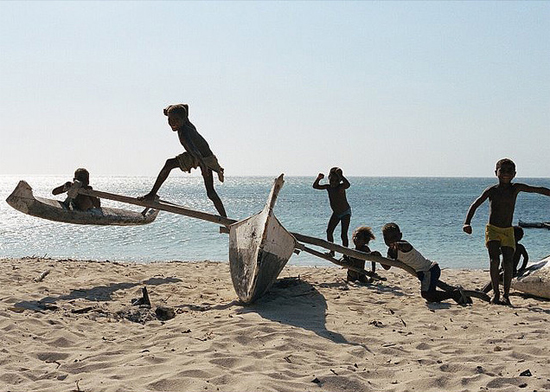
Meanwhile, the women – with babies on back and spears in hand – set out on foot into the shallow waters. One probes a small hole with her spear, and a tentacle reaches out to grapple with it. After careful coaxing, she pulls out an octopus, kills it, and adds it to her collection, which she tows on a string behind her.
In total, more than 1,850 pounds of octopus are collected on the opening day of the octopus harvest, a seasonal occurrence in Velondriake, the Indian Ocean’s first locally managed marine area.
Velondriake, which means “to live with the sea,” stretches along more than 40 km of southwestern Madagascar’s coast. The region encompasses 25 villages and is home to more than 8,000 people of the Vezo ethnic group, who are almost entirely dependent on marine resources, such as octopus, fish, and mangrove forests, for subsistence and income. But these resources are quickly disappearing due in large part to over-harvesting.
Blue Ventures Conservation – the London-based NGO I work for – has been working in the area since 2003 to protect the region’s coral reefs and mangroves, as well as their biological diversity, sustainability, and productivity, while also improving the quality of life of the local community.
To this end, Blue Ventures helped the community create a series of coastal marine reserves. Several permanent reserves protect the biodiversity of the coral reefs and mangroves, and help fish populations recover; while nearly 50 temporary reserves have increased the productivity of the octopus and crab fisheries. Octopuses reproduce quickly and juveniles grow at a nearly exponential rate, so a brief harvesting hiatus can lead to significant increases in yield. Increased yields translate to increased profits – something greatly welcomed by the people of this impoverished region.
The people of the region are also reproducing quickly: the average total fertility rate in Velondriake is 6.7 children per woman, according to our data. On average women are only 15 years old when they first conceive. To compound this problem, a majority of the population is under the age of 15 – at or approaching reproductive age. At the current growth rate, the local population will double in only 10 to 15 years. The local food sources, already heavily depleted, barely feed the current population, let alone twice that amount. Without enabling these coastal communities to stabilize their population growth, efforts to improve the state of marine resources and the community’s food security are considerably hindered.
In August 2007, Blue Ventures launched its Population, Health, & Environment (PHE) program as a weekly family planning clinic in Andavadoaka, which provided access to ingestible and injectable birth control options, as well as condoms. The clinic increased the village’s contraceptive prevalence rate (CPR) from 9.4 percent to 36.3 percent, and the Velondriake region’s CPR from 11.0 percent to 15.1 percent, in its first two years. (CPR data for the third year is not yet available, but should be notably higher, especially at the regional level.)
In 2009, Blue Ventures opened two more clinics and began holding quarterly outreach clinics in all Velondriake villages. We started offering long-acting, reversible contraceptive options, including Implanon and IUDs. Most recently, we have implemented a community-based distributor (CBD) program to provide wider access to contraceptives around the region, particularly for villagers that could not easily reach one of the clinic sites. These expansions paid dividends: the number of patients increased almost four-fold between the second and third years, with a cumulative total for all three years of just under 1,700 patients.
Recently, the PHE program began a partnership with the UN Population Fund (UNFPA), becoming the first PHE project to receive support from the UNFPA within Madagascar. The UNFPA funds will allow us to add new regional clinics; launch a behavior change campaign, including a regional theater tour and educational events; and further develop the CBD program.
UNFPA’s support of this initiative represents an important endorsement of Blue Ventures’ integrated approach to the challenges of marine sustainability, food security, reproductive health, and population growth. Funding applications to focus on improving maternal and infant health and to conduct a full health-needs assessment of the Velondriake region are pending.
In taking a population, health, and environment approach, Blue Ventures creates synergies that allow for the more effective achievement of health and conservation outcomes. Through providing family planning and health options – services the community really wants – Blue Ventures generates more support for all of its other initiatives, such as conservation and aquaculture programs.
This integrated multi-pronged approach also helps speed up the move towards a more sustainable future. By empowering and enabling couples to take control of their fertility, couples are able to have the size family they want. The use of family planning helps lower the population growth rate, and lower growth rates decrease pressures on natural resources. Decreased pressures on natural resources lead to healthier ecosystems; healthier ecosystems mean more natural resources available; and more resources lead to healthier families.
Through recognizing this inextricable link between communities, their health, and the environment they live in, Blue Ventures hopes to preserve not just the local coral reefs and mangroves, but the Vezo seafaring lifestyle. This way, the sons on the boats and the babies on the women’s backs may still have enough octopus and fish to harvest when they take their own children out to sea.
Matthew Erdman is the PHE coordinator for Blue Ventures. For more information about Blue Ventures’ PHE activities, please contact phe@blueventures.org, or visit their website at www.blueventures.org.
Photo Credit: Adapted from “07,” courtesy of Blue Ventures.


