

Showing posts from category Africa.
-
Defense, Development, Diplomacy Experts Debate DoD’s Role in Development
›July 18, 2008 // By Rachel Weisshaar“The U.S. military recognizes that the use of conventional military force is of limited use” in advancing U.S. national security, said Reuben Brigety II, director of the Sustainable Security Program at the Center for American Progress (CAP), at a July 18 launch of his report Humanity as a Weapon of War: Sustainable Security and the Role of the U.S. Military. The tragedy of 9/11, as well as the setbacks experienced in the wars in Afghanistan and Iraq, emphasized to the U.S. defense community that although combat operations remain critical to its mission, the military must also strive to “prevent conflict from emerging in the first place” through activities that stabilize societies, economies, and governments.
Brigety cited efforts by the Combined Joint Task Force for the Horn of Africa (CJTF-HOA), the nascent U.S. Africa Command (AFRICOM), and the U.S. Southern Command (SOUTHCOM) as examples of the U.S. military’s growing appreciation of how development assistance can help stabilize countries, build goodwill toward the United States, and increase U.S. understanding of local socio-political and economic conditions. In recent years, CJTF-HOA has dug wells, vaccinated livestock, and provided health services, while SOUTHCOM has a long track record of providing humanitarian assistance in Central and South America, particularly in the wake of natural disasters.
Although Brigety asserted that it is nothing “new for the military to be involved in addressing basic human needs,” he and his fellow presenters—Elisabeth Kvitashvili of the U.S. Agency for International Development (USAID), James Schear of the Institute for National Security Studies, and Stewart Patrick of the Council on Foreign Relations—agreed that the Department of Defense (DoD) has been undertaking an increasing share of the U.S. government’s development activities in recent years. As Brigety’s report notes, the “share of the U.S. government’s official development assistance, or ODA, spent by the Defense Department increased to 22 percent in 2005, the last year for which complete data is available, from 3.5 percent in 1998. Over the same time period, USAID’s share of ODA fell to less than 40 percent from 65 percent.”
Earlier this week, Secretary of Defense Robert Gates made waves when he said that “the United States military has become more involved in a range of activities that in the past were perceived to be the exclusive province of civilian agencies and organizations. This has led to concern among many organizations…about what’s seen as a creeping ‘militarization’ of some aspects of America’s foreign policy. This is not an entirely unreasonable sentiment.”
At the CAP launch, Patrick asserted that one reason why the DoD has become increasingly involved in development activities—in peaceful regions as well as violent ones—is the “massive budgetary asymmetry” between the DoD and the State Department and USAID. Gates made a similar point: “America’s civilian institutions of diplomacy and development have been chronically undermanned and underfunded for far too long—relative to what we spend on the military, and more important, relative to the responsibilities and challenges our nation has around the world.”
Kvitashvili agreed that USAID is underfunded and understaffed, but said the solution was not having the military take the lead in development activities. She argued that the military—which, unlike USAID, is not staffed by development professionals—tends to engage in “feel-good, short-term, one-off” projects that do not lead to sustainable gains for local populations. Instead, she welcomed a stepped-up supporting role for the military in development activities. -
Population, Health, Environment in Ethiopia: “Now I know my family is too big”
›July 16, 2008 // By Sonia Schmanski In “Life in Abundance,” an article from the latest issue of Sierra magazine, Paul Rauber gives us an inside look at family planning in Ethiopia, speaking with women in urban and rural environments to understand what government support of family planning has meant in practice. The government’s official embrace of family planning is a sharp and welcome shift from the previous dictatorship’s ban on mentioning it, but this endorsement, welcome as it is, doesn’t guarantee funding. Consequently, family planning programming, robust in urban areas, has yet to reach much of the vast rural expanse of Ethiopia. It is also heavily dependent on outside donors and NGOs for funding.
Thanks to one of the highest fertility rates in the world—5.4 children per woman—Ethiopia’s population has quintupled in the last 70 years. It now stands at 77 million, and is projected to double by 2050. Other indicators are equally discouraging: Rauber reports that average life expectancy is 48 years, that one in eight children dies before reaching five years of age, and that half of all children are undernourished.
One group trying to improve these statistics is Pathfinder International, whose integrated population-health-environment program in Ethiopia aims to “boost family planning, healthcare access, and environmental-restoration efforts through improving the lot of women and girls.” Rauber notes that Ethiopian women with at least some secondary education have one-third as many children as women with no or little education. Ethiopia, he says, is ripe for such integrated interventions; two-thirds of women want but lack access to family planning, and only one in 10 rural women uses any form of contraception. Pathfinder’s program, strongly backed by communities, has been successful in enrolling women in literacy classes, testing for HIV, planting mango and avocado trees, and curbing female genital mutilation.
For a look at another integrated PHE program in Ethiopia, see ECSP Director Geoff Dabelko’s photographs of the Berga Wetland Project, which includes conservation activities oriented around the White-Winged Flufftail bird; a small health facility offering basic maternal, children’s, and reproductive health services; and a community school.
Ethiopia has hosted several large PHE events in recent months, demonstrating the country’s enthusiasm for the approach. In November 2007, more than 200 members of the PHE community gathered in Addis Ababa for “Population, Health, and Environment: Integrated Development in East Africa,” a conference sponsored by the Population Reference Bureau and LEM Ethiopia. Rauber’s tour of Ethiopia, which also included substantial birdwatching, was jointly organized by the Sierra Club and the Audubon Society, both participants at the November meeting. Also emerging from this conference, which ECSP helped organize, was the East Africa Population-Health-Environment Network, a group working toward “an Eastern African region where men, women, and children are healthy, the environment is conserved, and livelihoods are secure.” In May of this year, Ethiopia launched its national chapter of the network, the Consortium for Integration of Population, Health, and Environment, in Ambo.
Photo: Health workers in Ethiopia’s Berga valley, where families average seven children. Now, thanks to the Ethiopian Wildlife and Natural History Society’s Berga Wetlands Project, hundreds of local women get contraceptives from health worker Gete Dida, allowing them to limit their family size – and giving the area’s wildlife a chance at survival. Reproduced from Sierraclub.org with permission of the Sierra Club. © 2008 Sierra Club. All rights reserved. -
African Development, Security at Forefront of G8 Summit
›July 11, 2008 // By Kai CarterWednesday marked the close of the G8 Summit, where critical topics like climate change, global food security, and development were on the table. Much of the discussion of the latter centered on
It seems, however, that the G8 may have renewed its commitment to global health, including maternal and child health and nutrition. The declaration stated:In some developing countries, achieving the MDGs on child mortality and maternal health is seriously off-track, and therefore, in country-led plans, the continuum of prevention and care, including nutrition should include a greater focus on maternal, new born and child health. Reproductive health should be made widely accessible.
The United Nations has urged the G8 to demonstrate its commitment to these areas by increasing funding. Secretary-General Ban Ki-moon has stated that $10 billion dollars would ensure basic coverage of maternal and child health worldwide. The G8 has finally caught on to these critical needs; it is now time to make real financial commitments to global health. -
Increasing Human Security Through Water and Sanitation Services in Rural Madagascar
›For the past several months, I have been working with a team of other researchers in partnership with WaterAid and Columbia University’s School of International and Public Affairs to find new techniques for measuring the benefits of improved water and sanitation in rural Madagascar (draft report). Studies of the impact of water and sanitation programs tend to focus on health treatment costs avoided and time saved obtaining water, but our field visits and analysis suggest that water and sanitation development projects can also improve food security, education, and local community governance, and may even introduce new forms of conflict resolution.
After our team’s initial field visit to rural communities around Ambositra, a small commercial town several hours south of the capital, we decided to broaden our scope of analysis. We had noticed that livelihoods and community management were dramatically different in villages with clean water nearby than in villages whose residents continued to walk long distances to sources of questionable quality.
By conducting focus group interviews with community organizations, community councils, and other community leaders, we discovered that the new water projects led to the creation of water committees to oversee the maintenance and long-term use of these services. As these committees gained respect and legitimacy within their communities, they encouraged and managed additional community improvement projects. For instance, one committee collected contributions and organized the construction of a community storage facility for surplus rice harvests (which also stored the tax payments for the new water system, which are often made in rice, not currency). In another village, the water committee members coordinated efforts to self-finance and build a new one-room primary school, which subsequently required the government to fund water and sanitation facilities for the school. This brought water services to an entire new section of the village in addition to the school.
The committees’ direct interaction with the users of the tap stands increased the communities’ trust in the committees, a fact reflected in statements gathered through household surveys. Several water committees organized their communities to participate in a regional economic fair, showcasing their vegetable production and arts and crafts, an opportunity that other villages did not seize.
In addition, the committees codified conflict resolution mechanisms in their founding committee rules, formalizing a crucial tool for mediating conflicts between community members over water. These committees are also empowered to resolve water-related conflicts that existed prior to the project. The water committees are evidence of the first institutions developing in these small communities. Although our report includes suggestions for measuring some of the diverse impacts of improved water and sanitation, such as education and livelihoods, further questions remain: How do we measure the impact of water and sanitation projects on governance and natural resource management? Are there ways to quantify community-level social changes?
Food security is another area that changed after the introduction of improved water sources. The close proximity of water to the houses dramatically increased the variety and quantity of vegetables grown. Our interviews revealed a dramatic upsurge in the cultivation of high-value crops that are more sensitive to rainfall variability. The reliable small-scale irrigation made possible by the water project allowed farmers to cultivate crops that had previously been off-limits to them. These new crops diversified production and decreased dependence on other foods for basic consumption, promoting better nutrition and sustainable harvests. In addition, one water committee actively sought out secondary water sources in order to ensure sufficient water flow throughout the dry season, further increasing households’ food security.
There are additional indicators that we did not have time to adequately study and quantify, including increased environmental awareness; the impact on gender dynamics and women’s earning power; the psychological impact of clean water and improved sanitation; and higher earning potential due to higher rates of school attendance and the attainment of more advanced education levels. The team hopes that additional work will be carried out on these and other potential benefits of water and sanitation projects, so that governments, donors, NGOs, and private citizens will see that these projects are not just investments in pipelines and latrines, but in food security, governance, education, economies, and conflict resolution—all of which contribute to human dignity and security.
Alex Fischer is a policy associate at WaterAid America, where he works on the management and development of water resources. He is also involved with several projects focusing on environmental governance in post-conflict settings. He holds a master of international affairs degree from Columbia University.
Photo: A water system in a village near Ambositra has multiple uses, including drinking water, small-scale irrigation, clothes washing, and composting. Courtesy of Alex Fischer. -
Growing Food Insecurity Threatens Ethiopians With HIV/AIDS
›June 27, 2008 // By Kai CarterPlusNews recently reported on the harmful impact of rising food prices on HIV-positive Ethiopians. According to the nation’s Central Statistical Agency, the price of food has increased 40 percent since last year. The situation has been particularly devastating for those with HIV, as poor nutrition weakens the immune system and “hastens the development of HIV into AIDS.” For those on antiretrovirals, malnutrition reduces the treatment’s effectiveness and increases its toxicity to the body. As Gideon Cohen of the UN World Food Programme (WFP) explained, antiretroviral treatment “can’t work if people aren’t eating enough.”
The consequences extend far beyond HIV-positive individuals themselves, however. For infected mothers who have been advised against breastfeeding, purchasing milk or formula drastically increases household expenses and is often unaffordable. In addition, HIV augments adults’ energy requirements by 10-30 percent. Without sufficient nutrition, it becomes difficult for these individuals—who constitute almost eight percent of Ethiopia’s urban population—to work and provide for their families, undermining food security even further. So as the current food crisis threatens the lives and livelihoods of the HIV-positive in Ethiopia, it also increases the rest of the population’s susceptibility to the virus and other illnesses.
Unfortunately, this problem is not a new one. At a 2006 Wilson Center event, Jordan Dey, director of the U.S. Relations Office at WFP, said, “Hunger weakens immune systems, increases vulnerability to disease, and creates a platform for disability.” A Wilson Center On the Hill event today from 12:00 noon to 1:15 p.m. in the Rayburn House Office Building will examine what the United States can do to relieve the global food crisis.
According to PlusNews, WFP’s HIV/AIDS feeding programme in Ethiopia has exceeded its budget by 44 percent, and has had to borrow funds from other UN programmes. This alarming situation illustrates the severity of the situation in Ethiopia and calls not only for increased humanitarian aid, but also for mechanisms to ensure long-term food security. Nations will not be healthy, prosperous, and peaceful until their people are properly nourished and given the chance to develop to their full capacity. -
In Ethiopia, Food Security, Population, Climate Change Align
›June 24, 2008 // By Daniel Gleick“The only future is resettlement,” a local Ethiopian official recently told the Economist, commenting on dire conditions in the Goru Gutu district, which is facing starvation following unpredictable rains and insect infestations. “Ethiopia has been synonymous with disastrous famine since the 1980s,” notes Sahlu Haile in “Population, Development, and Environment in Ethiopia“, his award-winning article for Environmental Change and Security Program Report 10. In fact, writes Haile, “the agricultural sector—the mainstay of the national economy—is less productive per capita today than it was 20 years ago.”
If resettlement were to take place in Goru Gutu, roughly 4,000 people would have to be resettled every year, and the government has a budget equal to only a fraction of the task. In addition, previous resettlement attempts have been disastrous. According to Haile, “previous resettlement programs were not voluntary…neither were they based on serious economic, social, and environmental studies.” As a result, they led to hardship for the migrants and to conflict with local populations, who felt threatened by the newcomers.
In “The Missing Links: Poverty, Population, and the Environment in Ethiopia,” Mogues Worku points out that in coming years, a rapidly growing population—the result of a lack of access to family planning and education among women—will put additional stress on the country’s ability to feed itself. In addition, Worku explains that climate change “has intensified these environmental problems by altering the region’s rainfall patterns.” Ethiopia’s population and climate challenges will likely lead to additional pressure for resettlement, paving the way for possible conflict. There are many national and international NGOs doing impressive work in Ethiopia on food security, family planning, sustainable livelihoods, and other issues, but much work remains to be done. -
Weekly Reading
›An alert from USAID’s Famine Early Warning Systems Network warns that despite generally good rains, “conflict, livestock disease, and high prices for cereals and other essential goods have minimized the extent to which pastoralists can benefit from these rains, undermining their recovery from drought and elevating their food insecurity, which is evidenced by alarming rates of child malnutrition in several areas.”
The UN Security Council held a special session on gender-based violence this week, and the New York Times’ Nicholas Kristof applauded the Council’s (belated) attention to the issue. ECSP recently sponsored an event on gender-based violence in conflict and post-conflict situations.
East Timor’s citizens are demanding that the government revoke an MOU signed with an Indonesian company that would grant the company 100,000 hectares of land to plant sugarcane. -
MEND Makes Headlines With Most Ambitious Oil Attack Yet
›June 19, 2008 // By Sonia SchmanskiThe Movement for the Emancipation of the Niger Delta, or MEND (seen in a photo by Dulue Mbachu, courtesy of ISN Security Watch and Flickr), has attacked Nigeria’s oil infrastructure again, this time significantly enough to cause Royal Dutch Shell to suspend its production at the damaged facility. Worldwide crude price levels rose in the wake of the attack, as well as amidst concerns that a Nigerian oil worker strike could be imminent.
The attack, which took place today in the Bonga oil field some 75 miles off Nigeria’s coast, is being described as unusually ambitious for a group that has focused mainly on the creeks and swamps of the Niger Delta. In a statement released to the media, the group explained that “the location for today’s attack was deliberately chosen to remove any notion that off-shore oil exploration is far from our reach.” Shell spokeswoman Eurwen Thomas said that the attack marked the first time MEND has managed to achieve the sophisticated planning and acquire the advanced equipment required to successfully target such a remote rig.
Though Nigeria is Africa’s biggest oil producer and a member of OPEC, most areas remain mired in poverty and plagued by pollution. Widespread resentment over inequitable revenue disbursement has spawned numerous groups agitating for a greater share of the country’s vast oil wealth. MEND is only the latest of these groups, but it has made a name for itself through attention-grabbing attacks like this one. The group’s claim to have captured an American worker was substantiated by private security officials, who said that two other workers were injured. Since the upswing in violence that began in early 2006, Nigerian rebel groups have taken more than 200 hostages.
Eleven percent of U.S. oil imports—46 percent of Nigeria’s total production—come from Nigeria, making this escalating series of attacks particularly relevant to American officials, and perhaps providing incentives to mediate talks between Nigeria’s government and Niger Delta militants, which have thus far been unsuccessful. Yet negotiations will be difficult between such polarized players. Said MEND, “the oil companies and their collaborators do not have any place to hide in conducting their nefarious activities.”


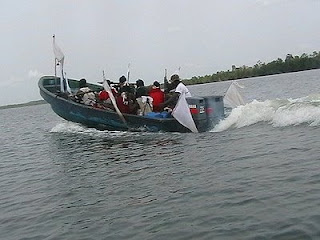 The Movement for the Emancipation of the Niger Delta, or MEND (seen in a photo by Dulue Mbachu, courtesy of ISN Security Watch and

