

Showing posts from category Africa.
-
New International Peace Institute Paper Examines Resource Scarcity, Insecurity
›June 18, 2008 // By Daniel Gleick“Often, those who are already vulnerable to threats because they are poor, illiterate, lack political power, or face gender or ethnic discrimination are the ones who find themselves in the front lines of the negative dimensions of environmental change,” writes Richard Matthew of the Center for Unconventional Security Affairs at the University of California, Irvine, in “Resource Scarcity: Responding to the Security Challenge,” a new paper from the International Peace Institute. Vulnerable populations “face water and land scarcity, are displaced into marginal ecosystems where they encounter unfamiliar parasites, experience severe weather events, lose everything to floods and mudslides, and daily eke out an existence in peri-urban areas awash with human waste.”
Researchers continue to debate the security implications of various kinds of resource scarcity, but according to Matthew, there are at least four areas of general agreement:
• Resource scarcity is never the sole cause of conflict, but is often a contributing factor;
• Migration is frequently the link between resource scarcity and conflict;
• Rapid changes in access to resources are more likely to cause conflict than gradual changes; and
• Climate change will lead to resource scarcity in many areas that are experiencing or vulnerable to conflict.
Despite these dire circumstances, Matthew believes key actions and policies could significantly reduce the likelihood that resource scarcity will lead to conflict and insecurity. He offers 14 specific recommendations for NGOs, governments, and international organizations, which include supporting “the effort in UNEP to integrate the environment into post-conflict assessment, disaster management, and peacebuilding” and mobilizing “the enormous capacity of the private sector and NGO communities…around sustainable development, conflict resolution, and peacebuilding.”
-
Africa Atlas’s Exquisite Images Reveal Effects of 40 Years of Environmental Degradation
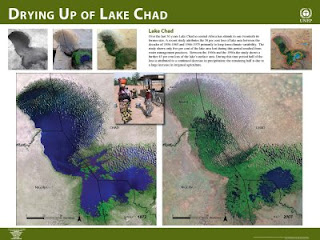
›June 16, 2008 // By Daniel Gleick On June 10, at the 12th session of the African Ministerial Conference on the Environment, the UN Environment Programme (UNEP) released Africa: Atlas of Our Changing Environment, a comprehensive look at the environmental devastation being wrought in Africa. Highlighting the ecological damage caused by high population growth, climate change, and the unsustainable use of natural resources, the atlas shows before-and-after satellite images of “disappearing forests, shrinking lakes, vanishing glaciers and degraded landscapes.” The above image, courtesy of UNEP, shows how Lake Chad has shrunk to one-twentieth of its size 30 years ago.
As The Independent put it: “Put it all together and you have a picture that is hard to credit, so enormous is the destruction.” Much of the impetus behind the atlas was to spur African governments to improve their environmental records.
On July 1, ECSP will host UNEP Executive Director Achim Steiner at the Washington, DC, launch of the atlas. -
In Egypt, Record Food Prices Lead to Family Planning
›June 12, 2008 // By Geoffrey D. DabelkoAt Egypt’s National Population Conference on Monday, Egyptian President Hosni Mubarak—whose government has struggled to respond to recent civil unrest over skyrocketing food prices and bread shortages—told attendees that high population growth is a “major challenge and fundamental obstacle” to development. The following day, Egyptian Minister of Health and Population Hatem el-Gabali announced an $80 million national family planning program with the slogan “Two children per family—a chance for a better life.” Egypt’s current fertility rate is 2.7 children per woman.
With a population of 81 million, Egypt is the 16th most populous country in the world, and, according to Philippe Fargues of the American University in Cairo (AUC), excluding the desert, Egypt has the highest population density in the world—twice that of Bangladesh.
Is the government’s plan a productive long-term response to the food crisis? How can it be part of a larger package? Or is population a distraction from the real issue of corruption, as identified by interviewees in the Washington Post article where I first read about the programs.
I posed these questions to a demography and security listserv and got some interesting responses. According to Valerie Hudson of Brigham Young University, a political scientist known best for her book Bare Branches on the security implications of imbalanced male-female population ratios: “Mubarak would do more to achieve his goal of 2.0 children per woman by a focused plan to raise the status of women, for example, by:- Outlawing polygamy, or erecting such high legal barriers to it that it becomes impractical
- Fully implementing CEDAW [the Convention on the Elimination of Discrimination Against Women]
- Enforcing the ban on FGM [female genital mutilation]; 97% of Egyptian women are circumcised
- Educating women on a parity with men; the median number of years of schooling for men is 6.3; that for women is 4.4
- Raising average age at first marriage for rural women (current average is 19)
- Creating more parity in family law for women in matters such as divorce, inheritance, etc.—all of which can be found in CEDAW.”
“I don’t think population pressure is a distraction from the real issue of corruption; though the government of Egypt is indeed corrupt by developed-world standards (or maybe by any standard). Corruption, which is symptomatic of state weakness, limits the ability of the Egyptian government to address this problem credibly and effectively. But it doesn’t mean they are wrong about the problem.
I was actually struck by the modesty of official ambition to reduce the fertility rate from 2.7 (which is slightly above the world median, apparently) to 2.0 (which I’m guessing is pretty close to the middle). This assumes that, basically, a steady state population of, say, 100M Egyptians would be sustainable indefinitely. I’m not so sure of that. The impact of anticipated climate change on Egypt may prove quite formidable by the end of this century. I’m not sure a leveling off after some additional increase will do the trick….Too pessimistic? I hope so.” -
Climate Change, Resource Scarcity Motivating Local-Level Conflict in West Africa
›June 10, 2008 // By Daniel GleickThis weekend, Jan Egeland, UN Secretary-General Ban Ki-moon’s special adviser on conflict, concluded a trip through Burkina Faso, Mali, and Niger to study the effects of climate change on the Sahel. The “trip has convinced me that there is a very clear link between climate induced resource competition and conflict, and I will be using what I have seen here to convince sceptics ahead of the Copenhagen meeting in 2009,” writes Egeland in one of his daily dispatches to IRIN News.
Climate change is causing diminished rainfall in the Sahel, and what rain there is comes in unpredictable flood/drought cycles, which alternately sweep away and wither crops. Local farmers adapt to these changes by using unsustainable farming practices, which may produce higher initial yields, but ultimately lead to lower long-term yields. Growing populations further strain these countries’ shrinking water supplies.
With limited water and fertile land, conflict and the potential for conflict are on the rise. “As was explained to me by the Nigerien minister of water who travelled with me in one of the many cars in our convoy through the desert, there are already many conflicts between and among nomads and agricultural people in Niger, and between various ethnic groups, because of the scarcity of resources,” writes Egeland. “Others have estimated that around Lake Chad there are as many as 30 or more named armed groups, and the potential for increased conflict is endless.” These conflicts are almost universally local—in Mali alone, “there are hundreds of small and quite localized conflicts,” he says. The brewing and active conflicts fuel arms trafficking, a security concern in its own right.
Egeland believes that major international investment in climate change adaptation is important to reducing both poverty and the potential for conflict in the region. He calls for developed countries to provide both monetary and technical aid to African countries struggling to adapt to the effects of climate change, and he plans to continue his advocacy in preparation for the 2009 climate meeting in Copenhagen. -
Scarcity and Abundance Collide in the Niger Delta
›May 29, 2008 // By Sonia SchmanskiThe Movement for the Emancipation of the Niger Delta (MEND) has claimed responsibility for a May 26 night attack on a Shell oil facility. A government spokesman confirmed the explosion, suggesting “that explosives might have been used by miscreants.” Through its website, MEND claims that 11 deaths resulted from the blast, although officials deny that anyone was hurt. The Niger Delta has long been plagued by violence, including the January 2006 kidnapping of four Shell workers by MEND and the October 1998 explosion that killed more than 1,000 people in Jesse, Nigeria. These and other episodes of violence—including pipeline sabotaging and kidnapping—have regularly disrupted the Niger Delta. Anger over increased economic marginalization—in 2006, Nigeria ranked 159th out of 177 countries on the UN Human Development Index—distrust of the national government, and a lack of effective avenues of recourse for those left behind by Nigeria’s oil boom have driven violent protests against the state and international oil corporations. Moreover, local people, many of whom live on less than $1 per day, sometimes cut holes in the pipes to siphon oil, which can inadvertently cause dangerous explosions.
Earlier this month, more than 100 people were killed when a construction vehicle struck an oil pipeline in Nigeria, reports the Nigerian Red Cross. Reports indicate that this event was an accident, but the explosion nevertheless prompted the editorial board of the Abuja-based newspaper Leadership to suggest that “all those who live near oil pipelines should consider relocating to safer places,” and to condemn the “wealth-seeking, greedy soldiers and policemen who are supposed to protect us and our property from criminals.”
For more on the politics and conflict surrounding oil in Nigeria, see this article by Kenneth Omeje, a research fellow at the University of Bradford in the United Kingdom, which examines Nigeria’s experience with oil extraction, the paradoxical circumstance of simultaneous resource scarcity and abundance, and the violent outbursts spawned by perceived government mismanagement of the country’s oil reserves. -
Questioning Widespread Assumptions on HIV/AIDS, Conflict, Poverty
›May 12, 2008 // By Kai CarterThe authors of “Reassessing HIV Prevention,” an article in the most recent issue of Science, question the assumptions behind current HIV prevention interventions in
Studies have shown that civil war and the breakdown of health service delivery result in an increase in preventable deaths—such as those due to malnutrition, diarrhea, and malaria—but perhaps HIV follows a different pattern. Clearly, there is a need for research that compares the spread of HIV/AIDS in politically stable, wealthier African countries with those torn by conflict.
At a 2007 ECSP event on the human cost of war, Dr. Frederick Burkle of the Harvard Humanitarian Initiative—who will discuss public health management after natural disasters on June 17—admitted that the direct impact of poverty, inequality, and cultural incompatibilities on the spread of infectious diseases and mortality during complex emergencies is “difficult, if not impossible,” to measure. -
Environmental Security Heats Up ISA 2008
›May 9, 2008 // By Meaghan ParkerAfter a few years left out in the cold, environmental security came home to a warm welcome at this year’s International Studies Association conference in San Francisco, drawing large crowds to many star-studded panels. Water, climate, energy, and AFRICOM were hot topics, and the military/intelligence communities were out in force. Many of the publishers indicated they were seeking to acquire titles or journals on environmental security, given the scarcity of books on the topic currently in the works. Demographic security even got a few shout-outs from well-placed supporters.
Climate change and energy security panels dominated the program. Chaired by the National Intelligence Council’s Mathew Burrows, “Militarization of Energy Security” featured contributors to the edited volume forthcoming from Daniel Moran and James Russell of the Naval Postgraduate School—including original resource conflict gadfly Michael Klare, who claimed that lack of oil itself isn’t the problem, but that efforts to extract less accessible supplies would provoke violence in places like Nigeria, Venezuela, and Siberia. The intense discussion contrasted the approaches of China and the United States to ensuring energy security; Moran pointed out that China sent “bankers and oilmen” into Africa, whereas the United States created AFRICOM. “If the Chinese had created a military command in Africa, there wouldn’t be a dry seat in the Pentagon,” he added. David Hamon of the Defense Threat Reduction Agency observed that BP has a “security regime to protect their interests that would make a military blush.”
At “Climate Change, Natural Disasters, and Armed Conflict,” Clionadh Radleigh put the kibosh on the fearmongering predictions of waves of transnational “environmental refugees.” Similarly, Halvard Buhaug explored weaknesses in the reported links between climate change and conflict, calling for more rigorous research on this currently trendy topic. Christian Webersik’s research found links between negative rainfall and higher incidences of conflict in Somalia and Sudan, but he cautioned against using this relationship to predict climate-induced conflict.
A flood of panels on water, conflict, and cooperation took advantage of the conference’s West Coast location to call on water world heavies Aaron Wolf and Peter Gleick, who participated in a lively standing room-only roundtable chaired by ECSP’s Geoff Dabelko. Despite the obvious interest in the topic, publishers in the exhibit hall didn’t have much to offer on water and security.
AFRICOM drew some heat, especially from a panel of educators from military academies who explored peace parks and other “small-ball” approaches to conflict prevention. All the panelists were generally supportive of AFRICOM’s efforts to integrate nontraditional development work into the military’s portfolio—which, as discussant and retired U.S. Army Col. Maxie McFarland pointed out, it is already doing “by default” in Iraq and Afghanistan. McFarland cautioned, however, that “just because the Army can do it, doesn’t mean you want them to do it.” Air War College Professor Stephen Burgess predicted that the groundswell of climate change awareness would push the next president to include it in his or her National Security Strategy.
Rich Cincotta’s demographic security panel attracted significant interest—no small feat on the last day. The Department of Defense’s (DoD) Thomas Mahnken said that demographic trends and shocks are of “great interest to us in the government”—particularly forecasting that could identify what countries or regions the DoD should be worried about—particularly China and India (good thing demographer Jennifer Sciubba is on the case in his office).
The emphasis on prediction and forecasting stood out from the general trend of ISA panels, which mostly focus on analysis of current or past events. Mathew Burrows called for government and academia to “push the frontiers” on forecasting even further—particularly on the impacts of food security, water shortages, and environmentally induced migration.
Despite the warm, fuzzy feelings for environmental security, there were few panels devoted to general natural resource conflict, and none to post-conflict environmental peacebuilding (Michael Beevers contributed one of the few papers to explicitly address the topic).
What’ll be next year’s hot topics? Submit your proposals by May 30 for the 2009 ISA Annual Conference in New York City.
To download any of the papers mentioned above, visit the ISA’s online paper archive.
For more on ECSP at ISA, see “Environmental Security Is Hot Topic at the 2008 International Studies Association Conference.” -
Ghana’s Oil: Curse or Blessing?
›May 7, 2008 // By Liat RacinConcerned Ghanaian officials believe the country’s discovery of domestic oil reserves last year represents “perhaps the greatest managerial challenge” since its independence, reports IRIN News. Though oil revenues could boost Ghana’s sagging economy and improve its infrastructure, there are real fears that mismanagement could destabilize the country and exacerbate social inequalities. Francis Ackah, engineering manager of the Ghana National Petroleum Company (GNPC), confessed that the country currently lacks the “know-how” to manage the resource constructively.
In an attempt to avoid the “resource curse,” Ackah confirmed the government’s desire to implement the “Norway model” of resource revenue management, which deposits oil funds in a national petroleum fund at the central bank, hires external managers to invest the money, and uses the revenue to fund social services.
Ghanaian President John Kufuor warned that “oil sometimes proves the undoing” of countries blessed with reserves. Other oil-rich African countries—such as Nigeria, Chad, and Angola—have been plagued by insecurity and underdevelopment. Nigeria has been plagued by rebel attacks on strategic oil pipelines.
 On June 10, at the 12th session of the

