

Showing posts from category Africa.
-
The Air Force’s Softer Side: Airpower, Counterterrorism, and Human Security
›January 15, 2009 // By Rachel Weisshaar“The countries in which terrorism could gain a foothold contain vast areas that are poverty-stricken and lawless. The common denominator within these areas is the absence of human security for the local population,” argues Major John Bellflower in “The Soft Side of Airpower” in the Small Wars Journal. “[A]dopting a human security paradigm as a counterinsurgency strategy could generate positive effects in the war on terror, particularly within AFRICOM,” and the Air Force could play a significant role in bringing human security to vulnerable populations, he claims.
When we picture the Air Force as an instrument of soft power, we tend to think of planes airlifting humanitarian aid into impoverished or disaster-stricken areas. But Bellflower argues that the Air Force could also help fulfill the longer-term health, food, economic, environmental, and community aspects of human security. For instance, the Air Force currently provides short-term health care in Africa through MEDFLAG, a biannual medical exercise. Bellflower suggests MEDFLAG “could be expanded to include a larger, centrally located field hospital unit that could serve a number of dispersed clinics.”
Bellflower also advocates deploying the Air Force’s Rapid Engineer Deployable Heavy Operational Repair Squadron Engineers (REDHORSE) into impoverished, unstable areas to build airstrips, drill wells, and employ local labor to construct “clinics, schools, police stations, community centers, or whatever is needed for a particular area. Additionally, these units could repair existing facilities to allow electricity, water, and other needed life support systems to become functional or construct earthen dams or the like to protect against natural disaster and meet environmental security needs.” Employing young men to build this infrastructure “results in a lower chance of these individuals succumbing to the lure of terrorist group recruiting tactics,” asserts Bellflower.
Bellflower joins a growing cadre of academics and practitioners arguing that the Department of Defense (DoD) should be more involved in peacebuilding and international development. He makes an original contribution in detailing how the Air Force—typically viewed as the most hands-off branch of the armed forces—could help stabilize poor, volatile regions. Yet his vision would likely attract objections from both sides. Many humanitarian aid groups would resist what they view as DoD’s repeated incursions into an area in which it lacks expertise and has ulterior (i.e., national security) motives. On the other side, many military personnel would view this as an example of mission creep, and would hesitate to send soldiers into risky areas simply for humanitarian reasons.
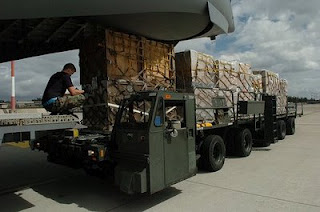
Photo: A U.S. Air Force Europe airman from the 793rd Air Mobility Squadron moves humanitarian supplies into position for loading in support of the humanitarian mission to Georgia in August 2008. Photo courtesy of Captain Bryan Woods, 21st TSC Public Affairs, and Flickr user heraldpost. -
‘miniAtlas’ Misses Opportunity to Map Environmental Causes of Conflict
›January 7, 2009 // By Will Rogers“Former UN Secretary-General Kofi Annan said that there can be no development without security—and no security without development,” says the miniAtlas of Human Security, a global atlas illustrating international and civil conflicts, as well as human rights abuses. The atlas explains that human security comprises the broader pillar of freedom from want (for basic necessities like food, water, shelter, education, employment, and health care) and the narrower pillar of freedom from violence. Although freedom from want is vital to sustainable development and long-term security, the atlas only maps instances where freedom from violence has been marred by inter- or intrastate conflict.
While the atlas openly admits its exclusion of the broader pillar of human security—which notably includes environmental issues—it nevertheless misses the opportunity to acknowledge that the environment can span both pillars of human security. Though the atlas notes that the environment can be used as a weapon of violence—by poisoning wells, for instance—it never explains the role of the environment as a cause of violent conflict—in land disputes, local conflicts over water, or by spurring climate change-induced migration.
The authors of the miniAtlas of Human Security argue that today, most violent conflicts are rooted in poverty and politics. “Poor countries, unlike rich ones, lack the resources to address the grievances that can spark armed uprisings,” the report explains, and “poor countries tend to have weak security forces and so find it difficult to deter rebellions and to crush those that cannot be deterred.” In addition, dictatorships and “anocracies—regimes that are neither dictatorships nor full democracies—are the most prone to armed conflict” and human rights abuses. Though generally speaking, both of these statements are true, there are other causes of violent conflict that are just as important and have serious implications for human security.
For instance, the environment has helped spark conflict in many parts of the world. Competition over natural resources—whether diamonds in Angola and Sierra Leone, timber in Liberia, or coltan in the eastern Democratic Republic of the Congo—has been a source of violent conflict between warlords, governments, and civilian populations. Getting policymakers to recognize that the environment is a cause of violent conflict is an essential step to preventing conflict, as well as conducting successful post-conflict environmental and disaster management. Until we recognize that the environment can increase the risk of violence, global security itself will suffer.
Photo: The Zambezi (Chobe) River borders eight African states: Angola, Botswana, Namibia, Malawi, Mozambique, Tanzania, Zambia, and Zimbabwe. In an effort to improve governance and prevent violent conflict from erupting, these eight states are working for the establishment of a commission to govern this vital water resource. Courtesy of Flickr user Mara 1. -
The 10 Most Popular Posts of 2008
›From climate change to coltan, poverty to population, and water to war: These are the 10 most popular New Security Beat stories of the year. Thanks for your clicks, and we’ll see you in 2009!
1. Desertification Threatening China’s Human, Economic Health
2. PODCAST – Climate Change and National Security: A Discussion with Joshua Busby, Part 1
3. In the Philippines, High Birth Rates, Pervasive Poverty Are Linked
4. Climate Change Threatens Middle East, Warns Report
5. Population, Health, Environment in Ethiopia: “Now I know my family is too big”
6. Guest Contributor Colin Kahl on Kenya’s Ethnic Land Strife
7. Coltan, Cell Phones, and Conflict: The War Economy of the DRC
8. “Bahala na”? Population Growth Brings Water Crisis to the Philippines
9. Population Reference Bureau Releases 2008 World Population Data Sheet
10. Guest Contributor Sharon Burke on Climate Change and Security -
Could Threat of Regional Cholera Pandemic Finally Topple Zimbabwe’s Mugabe?
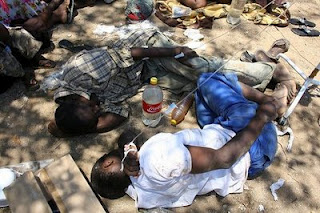
›December 23, 2008 // By Rachel WeisshaarZimbabwe’s current cholera epidemic has killed more than 1,100 people and sickened nearly 24,000, prompting the United States, the United Kingdom, and some African nations to press for sanctions on—and the resignation of—President Robert Mugabe. The impoverished country ranks 151 out of 177 on the UN Human Development Index and has an average life expectancy of 34 for women and 37 for men. Although it has suffered yearly cholera outbreaks since 1998, this year’s epidemic dwarfs previous ones. The epidemic is being aggravated by severe food shortages and the country’s high prevalence of HIV/AIDS, and is expected to continue through the end of the rainy season in March.
-
VIDEO: Crisis Management and Natural Resources Featuring Charles Kelly
›December 19, 2008 // By Wilson Center Staff“Governance is key. If you don’t have a competent government after the war, you’re not going to solve the problems that weren’t solved before the war because of incompetent governance,” said Charles Kelly at “Sustaining Natural Resources and Environmental Integrity During Response to Crisis and Conflict,” a November 12 event.
In this latest video from the Environmental Change and Security Program, Kelly discusses the importance of carefully planning and executing post-conflict environmental assistance, which can lead to renewed conflict if not implemented properly. He highlights ongoing post-conflict and disaster management operations in Sudan and Haiti, offering suggestions for the way forward. -
Weekly Reading
›“Climate change of that scale [a 5° C increase] will cause enormous resource wars, over water, arable land, and massive population displacements. We’re not talking about ten thousand people. We’re not talking about ten million people, we’re talking about hundreds of millions to billions of people being flooded out, permanently,” said Steven Chu, President-elect Barack Obama’s choice for secretary of energy, at the National Clean Energy Summit this summer.
“As the world focuses on the outcomes of the meeting on climate change that just concluded in Poznan, Poland, I am sitting in a workshop in Nazret, Ethiopia, listening to a panel of farmers talking about the effects of climate change on their lives – less rain, lower crop yields, malaria, no milk for their children,” writes Karen Hardee on Population Action International’s blog. “They are acutely aware that farm sizes shrink with each generation and speak eloquently of the need for access to family planning so they can have fewer children.”
The New York Times reports on the fight for control over uranium deposits in northern Niger, part of its ongoing series on resource conflict.
The current volume of Global Governance: A Review of Multilateralism and International Organizations examines global water governance.
On the Carnegie Council’s “Policy Innovations” website, Rebecca Laks reports on efforts to incorporate alternative fuels into refugee camps in order to reduce deforestation in the surrounding environment.
The Center for American Progress has released “Putting Aid and Trade to Work: Fostering Development for Sustainable Security,” along with related documents.
The Sabaot Land Defence Force and the Kenyan army have been fighting over the rights to land in western Kenya for years, and local women are suffering, reports IRIN News. Fighters from both sides often rape women, giving them HIV/AIDS.
“Cleaning the environment has been identified as major tool in waging war against mosquitoes” and malaria in Nigeria, reports the Vanguard. -
In Somalia, a Pirate’s Life for Many
›December 16, 2008 // By Will Rogers“Young boys there say they want to grow up to be pirates,” reports National Public Radio’s Gwen Thompkins from Somalia, where piracy has become a lucrative practice, despite the international community’s sporadic efforts to thwart the hijacking of ships off of Somalia’s coast. As conditions in the country continue to deteriorate, more and more Somali youth have turned to piracy to make a living. With 45 percent of the population under 15, the 2008 Failed States Index ranked Somalia as the state with the most demographic pressure (tied with Bangladesh).
Somalia’s chronic poverty, political turmoil, and violence have fostered a “humanitarian nightmare,” with economic opportunity almost impossible to come by. And in Somalia, “there’s no fallback job…There is no real opportunity for people who need to make money,” turning many young men to piracy as a way to earn a living.
Though piracy has only made headlines over the last year, the roots of the problem go back more than a decade. “Illegal fishing is the root cause of the piracy problem,” one Somali resident told the BBC. For years, Somali fishermen struggled to compete against illegal fishing trawlers that cost many fishermen their livelihoods. The government’s inability to enforce fishing regulations drove many fishermen to raid illegal fishing trawlers, and this vigilantism eventually became the piracy that plagues the Gulf of Aden today.
Most Somali pirates are young, between 20-35 years old, mainly from fishing towns, and they can split an average of $2 million in ransom for hijacked vessels. As piracy continues to make global headlines, the lifestyle has become romanticized in Somali society. According to The National, “Marrying a pirate is every Somali girl’s dream. He has power, money, immunity, the weapons to defend the tribe and funds to give to the militias in civil war.”
Meanwhile, Somali pirates, who benefit from current lawless conditions, have been helping al Shabaab, the youth wing of Somalia’s Islamist movement, fund their insurgency against President Abdullahi Yusuf’s government. For example, according to the Telegraph, in April, al Shabaab secured a five percent cut of a $1.5 million ransom for a Spanish fishing boat and its 26-member crew.
Meanwhile, al Shabaab, which the U.S. Department of State has designated a foreign terrorist organization, has become an increasing concern for U.S. military officials, who suspect the youth terrorist wing has ties to al Qaeda. As hijackings become more high-profile—such as the Ukrainian ship carrying 33 tanks, or the Saudi supertanker carrying more than $100 million in crude oil—al Shabaab fetches more from each ransom, which could be used to fund attacks against U.S. troops in Iraq and Afghanistan. In light of these possible linkages, the United States on Wednesday began circulating a draft resolution to the UN Security Council that would permit foreign countries to hunt down pirates on land, in what is a growing trend by the international community to stop pirate attacks in the Gulf of Aden.
According to the United Nations, Somali pirates have netted £80 million, or more than $120 million, in ransom payments so far this year. And despite threats made by the international community, this nascent and lucrative industry likely won’t hurt for recruits. Until Somalia has a functioning government and economy that can offer youth legitimate livelihoods, piracy will continue to be a thorn in the side of the international shipping industry.
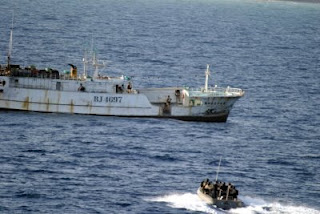
Photo: A U.S. Navy rescue team provides assistance to the crew of the Ching Fong Hwa, a Taiwanese-flagged fishing trawler, which was released in November 2007 after being hijacked and held by Somali pirates for seven months. Courtesy of the U.S. Navy. -
Food Production Goes Global, Sparking Land Grabs in Developing World
›December 8, 2008 // By Will Rogers As global food prices soar and population growth and urbanization shrink the supply of arable land, many countries have been forced to adopt new forms of production to secure their food supply. But instead of embracing sustainable land-use practices and improving rural development, some nations have shifted food production overseas, igniting a massive land grab in the developing world.
From the Persian Gulf to East Asia, governments and international companies alike have been lobbying developing countries in Africa and Asia to produce grain for food and alternative energy. The Guardian reported on November 22nd that Qatar recently leased 40,000 hectares of Kenyan farmland in return for funding a £2.4 billion port on the island of Lamu, a popular tourist site just off the Kenyan coast. The Saudi Binladen Group is said to be finalizing a deal with Indonesia to lease land for basmati rice production, while other Arab investors, including the Abu Dhabi Fund for Development, have bought land rights for agricultural production in Sudan and Pakistan. Ethiopian Prime Minister Meles Zenawi has been “courting would-be Saudi investors,” despite his country’s own deplorable food insecurity and chronic malnutrition.
Meanwhile, the Telegraph reported that South Korea’s Daewoo Logistics has been working to secure a 99-year lease for 3.2 million hectares of farmland in Madagascar that it will use to “grow 5 million metric tons of maize a year and 500,000 tons of palm oil” to use as biofuel in South Korea. The company says it expects to pay almost nothing besides infrastructure costs and employment training in return for its use of the land. Despite Madagascar’s rapid population growth and pervasive food insecurity, the deal, if signed, will allow the South Korean company to lease approximately half of the current arable farmland on the island state.
In an effort to combat a freshwater shortage, China has secured an agreement with Laos for a 50-year lease of 1,600 hectares of land in return for funding a new sports complex in Vientiane for the 2009 Southeast Asian Games. And with only 8 percent of the world’s arable land and more than one-fifth of the world’s population to feed, China continues to encourage its businesses to go outside China to produce food, looking to developing countries in Africa and Latin America.
Jacques Diouf, director-general of the UN Food and Agricultural Organization, recently warned that these deals are a “political hot potato” that could prove devastating to the developing world’s own food supply, as several of these states already face severe food insecurity. Diouf has expressed concern that these deals could breed a “neo-colonial” agricultural system that would have the world’s poorest and most malnourished feeding the rich at their own expense.
And with land rights a contentious issue throughout the developing world—including in Haiti, Kenya, and Sudan, for instance—these agreements could spark civil conflict if governments and foreign investors fail to strike equitable deals that also benefit local populations. “Land is an extremely sensitive thing,” warns Steve Wiggins, a rural development expert at the Overseas Development Institute. “This could go horribly wrong if you don’t learn the lessons of history” and attempt to minimize inequality.
As food prices continue to climb, more and more countries are likely to scramble to gain access to the developing world’s arable land. Without land-use agreements that ensure a host country’s domestic food supply is secure before its foreign investor’s, long-term sustainable development could be set back decades, something impoverished developing countries simply cannot afford.
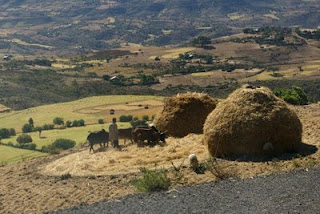
Photo: A man threshing in Ethiopia. Long plagued by acute food insecurity, Ethiopia’s arable land is sought by more-developed countries to ensure the stability of their own food stocks. Courtesy of Flickr user Eileen Delhi.
 “
“
 “Young boys there say they want to
  As global food prices soar and population growth and urbanization shrink the supply of arable land, many countries have been forced to adopt new forms of production to secure their food supply. But instead of embracing sustainable land-use practices and improving rural development, some nations have shifted food production overseas, igniting a massive land grab in the developing world.

