

-
Rwanda: More Than Mountain Gorillas
›February 27, 2009 // By Rachel Weisshaar If you’ve visited
Destination Nyungwe Project (DNP), which I visited yesterday with the leaders of the East Africa PHE Network, is trying to change all that. It envisions
Nyungwe has a lot to offer; as the largest montane rainforest in
As these larger projects are constructed, DNP—which is funded by the U.S. Agency for International Development and implemented by International Resources Group, Family Health International, and the Wildlife Conservation Society—is also working to improve the health, livelihoods, and environmental management of the local communities. A health coordinator works with local clinics to improve maternal and child health, family planning and reproductive health, and hygiene. Health and family-planning activities are key to ensuring the park’s survival because high population growth, and the resulting demand for land, is one of the key threats to the park, says Munanura. A small-grants program provides micro-loans to local people for sustainable livelihoods, such as setting up cultural tourism attractions or producing soap, lotion, and oils from forest products.
Nyungwe National Park still struggles to attract tourists, as it lacks the luxury accommodations offered at
Rachel Weisshaar is attending the meeting of the East Africa PHE Network in Kigali,
Photo: Nyungwe National Park, Rwanda. Courtesy of Rachel Weisshaar. -
From Report 13: Watch Jennifer Dabbs Sciubba on Population in Defense Policy Planning
›February 25, 2009 // By Wilson Center Staff“Demography will have a greater role in defense planning in the future,” says Jennifer Dabbs Sciubba in this short video preview of her article, “Population in Defense Policy Planning,” now appearing in the 13th issue of Environmental Change and Security Program Report. “Robert Gates has put a lot of emphasis on development as a key to peace, and Africa Command may be the area that brings together issues of demography, the environment, and development, and sends those observations back up the higher levels at DOD,” she observes. Sciubba, Mellon Environmental Fellow in the Department of International Studies at Rhodes College, and six other demographic experts analyze the links connecting population and environmental dynamics to conflict in a set of commentaries on “New Directions in Demographic Security.” -
East Africa PHE Network: Translating Strong Results Into Informed Policies
›February 24, 2009 // By Rachel Weisshaar“The road to inaction is paved with research reports,” said Marya Khan, our Population Reference Bureau facilitator, opening today’s East Africa Population-Health-Environment (PHE) Network workshop on bridging the research-to-policy gap.
At the Environmental Change and Security Program, we know all too well that even the best program or most dramatic research findings don’t stand a chance of being implemented unless they are communicated to policymakers in succinct, persuasive formats. Yet researchers often neglect to convey their results to decision makers and donors, assuming they won’t be interested or won’t appreciate their methodologies, explained Khan. Furthermore, researchers are often hesitant to draw out the policy implications of their findings, believing this is policymakers’ responsibility, while policymakers tend to think this is researchers’ duty—so these critical implications are often never explored.
Today’s sessions aimed to empower the PHE working groups from Rwanda, Uganda, Ethiopia, and Kenya to develop their own strategies to bridge the research-to-policy gap. The groups brainstormed policy communications objectives they wished to achieve—such as officially launching their country PHE network—as well as concrete outcomes that would contribute to accomplishing those objectives—such as convincing representatives from various national government ministries to join their network.
Rachel Weisshaar is attending the meeting of the East Africa PHE Network in Kigali, Rwanda. She will be posting daily updates on the New Security Beat throughout the week (see yesterday’s post).
Photo: Members of the Kenya PHE Working Group discuss communications strategies. Courtesy of Rachel Weisshaar. -
East Africa Population-Health-Environment Conference Kicks Off in Kigali
›February 23, 2009 // By Rachel WeisshaarRwandan Minister of Natural Resources Stanislas Kamanzi officially launched the meeting of the East Africa PHE Network this morning, stating that Rwanda’s highest-in-Africa population density of 365 people per square kilometer—which he argued leads to environmental degradation and poor human health in both rural and urban areas—compels an integrated approach to development. Kamanzi said that Rwanda’s National Environment Policy and national development plan, Vision 2020, both recognize population-health-environment (PHE) links, and he expressed Rwanda’s commitment to implementing the recommendations of the First Inter-ministerial Conference on Health and Environment in Africa, which was co-hosted by the World Health Programme and the UN Environment Programme in Gabon in August 2008. -
New Director of National Intelligence Assesses Climate, Energy, Food, Water, Health
›February 18, 2009 // By Rachel WeisshaarIn the annual threat assessment he presented last week to the Senate Select Committee on Intelligence, new Director of National Intelligence Dennis Blair named the global economic crisis—not terrorism—the primary near-term threat to U.S. national security, prompting accusations of partisanship from the Washington Times. Yet as the U.S. Naval War College’s Derek Reveron notes, “the economic turmoil of the early 20th century fueled global instability and war,” and today’s economic collapse could strengthen extremists and deprive U.S. allies of the funds they need to deploy troops or increase foreign assistance to vulnerable regions.
Further down the list of potential catastrophes—after terrorism, cybersecurity, and the “arc of instability” that stretches from the Middle East to South Asia—the assessment tackles environmental security threats. The four-page section, which likely draws on sections of the recent National Intelligence Council report Global Trends 2025: A Transformed World, summarizes the interrelated natural-resource and population challenges—including energy, food, water, demography, climate change, and global health—the U.S. intelligence community is tracking.
The world will face mounting resource scarcity, warns Blair. “Access to relatively secure and clean energy sources and management of chronic food and water shortages will assume increasing importance for a growing number of countries. Adding well over a billion people to the world’s population by 2025 will itself put pressure on these vital resources,” he writes.
Drawing on the conclusions of the 2008 National Intelligence Assessment on the impacts of global climate change to 2030, Blair portrays climate change as a variable that could place additional strain on already-stressed agricultural, energy, and water systems: “We assess climate change alone is unlikely to trigger state failure in any state out to 2030, but the impacts will worsen existing problems such as poverty, social tensions, environmental degradation, ineffectual leadership, and weak political institutions.” Direct impacts to the United States include “warming temperatures, changes in precipitation patterns, and possible increases in the severity of storms in the Gulf, increased demand for energy resources, disruptions in US and Arctic infrastructure, and increases in immigration from resource-scarce regions of the world,” writes Blair.
Africa, as usual, is the last of the world’s regions to be analyzed in the assessment. Blair notes that “a shortage of skilled medical personnel, deteriorating health systems, and inadequate budgets to deal with diseases like HIV/AIDS, malaria, and tuberculosis” is threatening stability in sub-Saharan Africa, and explains that agriculture, which he rightly calls “the foundation of most African economies,” is not yet self-sufficient, although some countries have made significant improvements in infrastructure and technology. He highlights ongoing conflicts in the Democratic Republic of the Congo, Nigeria, Sudan, and Somalia as the most serious security challenges in Africa. He fails to note, however, that all four have environmental/natural resource dimensions (see above links for details). -
Weekly Reading
›Conflicts among pastoralists over water and land have increased in drought-stricken northeastern Kenya, reports IRIN News.
Country for Sale, a report by Global Witness, alleges that Cambodia’s oil, gas, and mineral industries are highly corrupt.
Foreign Policy features an interview with General William “Kip” Ward, the commander of the new U.S. Africa Command. The New Security Beat covered General Ward’s recent comments on civilian-military cooperation.
Healthy Familes, Healthy Forests: Improving Human Health and Biodiversity Conservation details Conservation International’s integrated population-health-environment projects in Cambodia, Madagascar, and the Philippines.
Double Jeopardy: What the Climate Crisis Means for the Poor, a new report on climate change and poverty alleviation, synthesizes insights from an August 2008 roundtable convened by Richard C. Blum and the Brookings Institution’s Global Economy and Development Program at the Aspen Institute.
“Although the long-term implications of climate change and the retreating ice cap in the Arctic are still unclear, what is very clear is that the High North is going to require even more of the Alliance’s attention in the coming years,” said NATO Secretary General Jaap de Hoop Scheffer at a seminar on security prospects in the High North hosted by the Icelandic government in Reykjavik.
“I think we will work our way towards a position that says that having more than two children is irresponsible. It is the ghost at the table. We have all these big issues that everybody is looking at and then you don’t really hear anyone say the “p” word,” says UK Sustainable Development Commission Chair Jonathon Porrit, speaking about population’s impact on the environment. Porrit has drawn criticism for his remarks.
A local priest has warned that a Norwegian company’s proposed nickel mines will threaten food security on the Philippine island of Mindoro. -
Head of AFRICOM Discusses Civilian-Military Cooperation
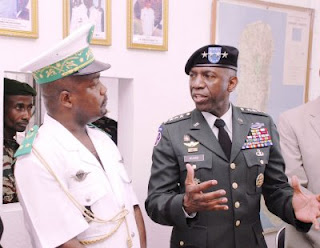
›January 28, 2009 // By Rachel WeisshaarCritics have warned that the new unified U.S. Africa Command (AFRICOM) could threaten the sovereignty of African nations and encroach on the portfolios of other U.S. agencies like the U.S. Agency for International Development (USAID). But in an interview with USAID newsletter FrontLines, General William E. “Kip” Ward, head of AFRICOM, went out of his way to dispel these fears. Some of the most interesting parts of the interview:
On AFRICOM’s humanitarian efforts:
“We know that our piece is only a very small part of the totality of humanitarian assistance that’s being performed by USAID and other agencies. We would not look to take those roles over.”
On civilian-military cooperation:
“We are learning to understand one another better and truly, as [USAID] Administrator [Henrietta] Fore and [Defense] Secretary [Robert] Gates said, we are seeing with greater clarity the importance of all these efforts working as cohesively together as they can. Security and development go hand-in-hand to produce stability that we all seek.”
On coordinating with USAID and host countries:
“We would get involved where those development projects complemented the work being done by developmental agencies, USAID, in very close coordination with the country team, the ambassador, and representatives from USAID that are there on the ground. We want to ensure that we don’t do things that conflict with the work being done by others. This might include a school being built so we can complement each other’s efforts. Or, at the request of a country, we might conduct an exercise and we may need to build a road to get to a training area. And if building the road in one place or another could help the population, then we would look to work with the country team and the ambassador so it provides benefits to the population.”
Photo: Comoran Defense Chief of Staff Salimou Mohamed Amiri (left) talks with General William E. Ward, commander of U.S. Africa Command (right), on January 21, 2009. Ward met with Comoran government officials as part of his first official visit to the island nation. Courtesy of by Kenneth Fidler, U.S. Africa Command. -
Egyptian, Sudanese Governments Stall Nile Treaty
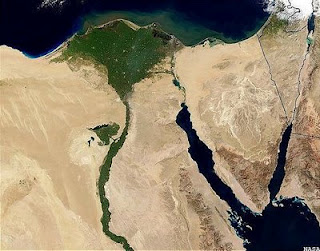
›January 16, 2009 // By Rachel WeisshaarTen years of negotiations over a new pact governing the use of the Nile River have come to a halt, due to Egyptian and Sudanese reluctance to relinquish their near-total control over the distribution of water resources. “The technocrats had worked out all the paper work for a good protocol but the politicians have thrown a clean piece of cloth in the mud,” Professor Afuna Aduula, chair of the Nile Basin Discourse Forum, told IPS News. “Since Egypt must consent to other nations’ use of the Nile’s water, most of the other basin countries have not developed projects that use it extensively. Not surprisingly, over the years other basin countries have contested the validity of these treaties and demanded their revocation to make way for a more equitable system of management,” explains Patricia Kameri-Mbote in “Water, Conflict, and Cooperation: Lessons From the Nile River Basin.” Decreasing water levels in Lake Victoria, the Nile’s source, have also added to upstream countries’ concerns about water allocation.
Despite the political tensions between many of the 10 Nile Basin riparians—which also include Burundi, the Democratic Republic of the Congo, Eritrea, Ethiopia, Kenya, Rwanda, Tanzania, and Uganda—and the critical importance of water to agriculture, health, and economic growth, analysts think it is unlikely that tensions over water will lead to war. All 10 countries belong to the Nile Basin Initiative, a ministerial-level body that has conducted the negotiations, as well as other cooperative and confidence-building measures. “While formally framed as a development enterprise, these efforts also implicitly serve as a means to prevent conflict predicated on environmental interdependence,” notes ECSP Director Geoff Dabelko in “An Uncommon Peace: Environment, Development, and the Global Security Agenda.”
Photo: Satellite image of the northern Nile River. Courtesy of Flickr user thevoyager.
Showing posts from category Africa.
 If you’ve visited
 Rwandan Minister of Natural Resources
  Critics have warned that the new unified U.S. Africa Command (
 Ten years of negotiations over a new pact governing the use of the Nile River have come to a halt, due to Egyptian and Sudanese reluctance to relinquish their near-total control over the distribution of water resources. “The technocrats had worked out all the paper work for a good protocol but the politicians have thrown a clean piece of cloth in the mud,” Professor Afuna Aduula, chair of the Nile Basin Discourse Forum, told

