-
Protecting Water in the Mining Rush: A World Water Day Panel
April 16, 2026 By Claire Doyle
From Zambia to Indonesia, recent headlines about catastrophic toxic mining spills grimly underscore how the global push to secure one set of resources, critical minerals, might be compromising another: water.
“This isn’t just an environmental story,” said Lauren Risi, Director of the Stimson Center’s Environmental Security Program, at a recent event on protecting water resources amid increasing mining, held ahead of World Water Day 2026. “For many of these communities, the water being put at risk is their source of drinking water. It’s critical to subsistence farming and livelihoods. It sits at the center of daily life. When mining degrades or disrupts access to it, the consequences are immediate and personal,” she said.
Water Impacts and the Governance Landscape
Mineral extraction and processing can affect water resources both in quantity and quality, said Susanne Schmeier, Professor of Water Cooperation, Law, and Diplomacy at the IHE Delft Institute for Water Education. One study from the World Resources Institute reveals that 16 percent of land-based mines, deposits, and districts are in highly water-stressed areas. For certain minerals like lithium, this proportion rises to over 50 percent, raising concerns over water availability for communities and ecosystems. Mining also can lead to pollution, thereby degrading water quality.
Schmeier also pointed out that these issues often have a transboundary dimension, which complicates governance: “Water moves from one country to another, and with that movement move the impacts.”
There are a handful of existing governance frameworks that could be applied to these challenges, including obligations to conduct transboundary environmental impact assessments, Indigenous and human rights law, and the international water law regime. For instance, Schmeier noted that international water law “clearly defines that you should be using water resources in an equitable and reasonable way, and that you shouldn’t be causing significant harm, both of which can be affected by mining.”
By and large, however, current governance frameworks have fallen short. Transboundary basin organizations have only recently begun considering water quality as a key challenge. Quantity has long been considered the more salient issue—as well as the one most likely to lead to community access conflicts.
“One important thing to note is how far behind we are in addressing these mining-related water challenges generally, but especially in the water sector,” said Schmeier. “There’s also a lot of catch-up work to be done for these basin organizations and for governments.”
Water-Mining Dilemmas in Zimbabwe
Obert Bore, Programmes Manager at the Zimbabwe Environmental Law Organization (ZELO), shared how challenges linked to mining, water, and governance play out on the ground in his country, which is Africa’s leading producer of lithium.
Zimbabwe’s push towards processing is aimed at moving up the value chain amid the global rush for minerals. But it has been accompanied by significant concerns over water security. Bore noted that the type of lithium found in Zimbabwe (hard rock spodumene) requires more than 50,000 liters of water per ton of the mineral processed, which is especially significant given that many lithium projects are in arid parts of the country.
The result, Bore explained, is “competition between companies, who require the water for processing, and communities who require water for their livelihoods, livestock, and agricultural purposes.” ZELO now pushes for the establishment of processing facilities in areas of the country that are less dry.
Lithium extraction and processing also have contaminated water sources in Zimbabwe. In 2023, the Bikita Minerals mine, which is the country’s largest source of lithium, discharged potentially toxic mining effluent into a water body that hundreds of families relied on for agriculture, fishing, and household water supply.
Bore said that ZELO recently began working with communities to monitor water quality in Zimbabwe. But the county’s regulatory environment is a critical hurdle. “A lot of the legislation that regulates water has not yet caught up with the developments that are happening with mining,” he added.
The quality of required Environmental Impact Assessments for mining projects varies widely, and they do not always clearly indicate how companies will manage water-related risks. Penalties for infractions also are weak; Sinomine Resource Group was fined just $5,000 in response to the Bikita Minerals incident in 2023—the highest penalty for polluters under Zimbabwean law.
“The law is not sufficient, [it] is not punitive enough, and companies end up just polluting and paying the fine because it is cheaper and easier for them,” concluded Bore.
Disrupting Assumptions in the Mekong River Basin
The Mekong River in Southeast Asia is widely perceived as a clean river basin. But a recent interactive dashboard of over 800 unregulated mining activities along Mekong mainstream and its tributaries, put together by the Stimson Center’s Southeast Asia Program, is challenging this assumption.
Regan Kwan, Research Analyst with the Southeast Asia Program, said that a key catalyst for their work was Typhoon Yagi in September 2024, when communities along the Kok River in Myanmar began noticing a new type of silt. When the dry season came, the river remained muddy and turbid, rather than clearing up as it normally did. “Communities really were being impacted, but they couldn’t really figure out what was happening,” he explained.
A subsequent investigation by the Shan Human Rights Foundation revealed that two rare-earth mines on the Kok River, just over the border in Thailand, were likely responsible for the mysterious murkiness. In November 2025, the Southeast Asia Program launched the dashboard, uncovering hundreds of mining sites that could be leaching toxic chemicals into waterways. The dashboard uses satellite imagery and builds on existing data obtained from the Shan Human Rights Foundation and from Global Witness.
Since the dashboard was published, the region has seen a proliferation of water-testing initiatives—including by citizen scientists, governments, and international organizations—that reveal the scope of water pollution in the Mekong basin. “All the results have shown that heavy metal presence was above the WHO standards, and that it was much more widespread than we had initially imagined,” said Kwan.
Now, Kwan and his colleagues are bringing together communities and other non-state actors in the region to unpack what is happening upstream and discuss the issue more broadly. These sobering findings not only challenge the assumption that the Mekong River system is largely clean, but they also attest to the importance of data-gathering in tackling water pollution.
“You can’t manage what you don’t know,” concurred Schmeier.
Promoting Transparency and Moving Beyond Legal Compliance
The Initiative for Responsible Mining Assurance (IRMA), which leads third-party audits of industrial mines, is one of the foremost organizations working to increase transparency in mining. Their voluntary standard, established through a decade-long process involving numerous stakeholder groups, includes water management as a core component.
Scott Sellwood, the organization’s Civil Society Sector Lead, noted that “IRMA’s approach to water management recognizes…the interconnected risks that mining poses, first from contamination from mine waste, but also in terms of impacts on water availability.”
Participating companies are required to consider water risks up front, including identifying waste streams from facilities and ascertaining who else is using water in the area. From there, water management is built into IRMA as a continuous process. Sites must have comprehensive monitoring systems and adaptive management plans. IRMA also requires that communities receive funding, if requested, to hire independent monitoring experts to ensure their meaningful participation in monitoring.
The standard is spreading across the globe. In Zimbabwe, ZELO is encouraging companies to undergo IRMA audits, and one company in the lithium sector (operating in a water-stressed region in Zimbabwe) will soon do so.
“We will never be a substitute for more effective government regulation and enforcement,” Scott cautioned. “But what is often missing is transparency, and that is one of the places where the IRMA system can be a complement [and] create value for sites to go beyond legal compliance.”
Efforts such as those undertaken by IRMA, ZELO, and the Stimson Center’s Southeast Asia Program are helping protect water resources by addressing myriad issues, from transparency gaps to regulatory and enforcement gaps. Yet across all of these initiatives, one thread in particular stands out—especially in a context where geopolitical competition and national interests loom large: at the end of the day, communities bear the brunt when mining impacts water. Community engagement is crucial to charting a path forward for mining that not only minimizes environmental harms but also drives inclusive development.
Claire Doyle is a Research Analyst in the Stimson Center’s Environmental Security Program.
Sources: Business Insider Africa, Global Witness, Heinrich-Böll-Stiftung, Mongabay, Oxpeckers, Shan Human Rights Foundation, Stimson Center, World Resources Institute.
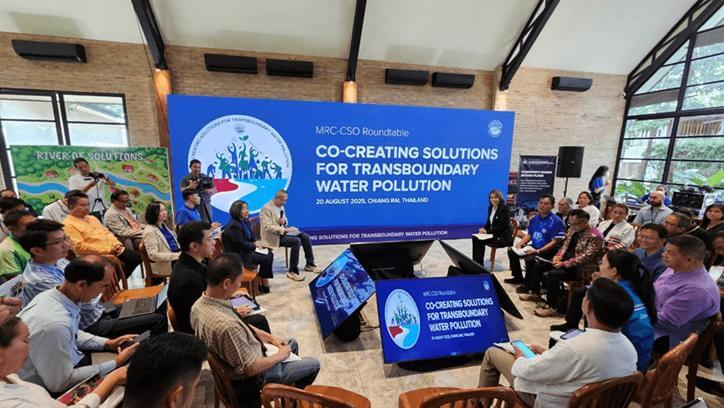
Photo Credits: Mekong River Commission held a consultation with community members, government officials, and civil society groups in Chiang Rai, Thailand on August 20, 2025. Image courtesy of the Mekong River Commission Facebook Page.
 A Publication of the Stimson Center.