-
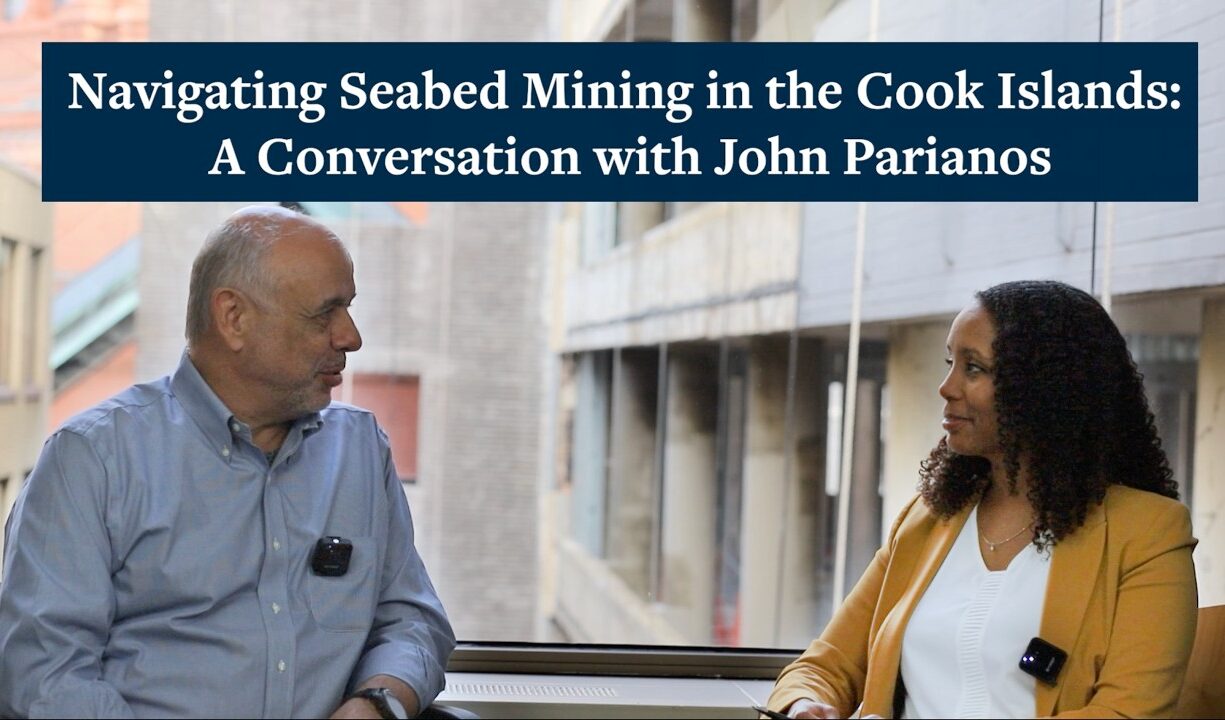
Navigating Seabed Mining in the Cook Islands: A Conversation with John Parianos
April 7, 2026 By Environmental Security Staff
Mahlet Mesfin: Since they’ve been discovered, seabed minerals have been in active debate around who owns them, how they are harvested, and the impact of such activities. Some of these minerals can be found in international waters or areas beyond national jurisdiction, and the International Seabed Authority, or the ISA, was established to organize and control mineral resources in those areas.
For the last few years, countries have been working to agree on an international regulatory framework, or mining code, through the ISA that would help govern future exploitation activities in that area. But seabed minerals are not only found in areas beyond national jurisdiction — they’re also found in countries’ exclusive economic zones, or EEZs. And in those cases, governments must design their own domestic systems in order to pursue resource development.
The Cook Islands have long been known to have an abundance of marine minerals, and they’ve spent decades working through their regulatory and legislative systems to manage seabed mining. There are many strong opinions on this issue, but there is general agreement that protecting the marine environment and limiting potential harms will come from having robust regulatory frameworks in place. I’m grateful to be joined today by Dr. John Parianos from the Cook Islands Seabed Minerals Authority, to get some insights into the details of a system that one could argue sets a standard for open, transparent, and comprehensive regulatory approaches to seabed mineral resource development.
John, could you introduce yourself and your role related to seabed minerals in the Cook Islands, and provide a brief overview of the system you have in place?
Dr. John Parianos: I’m Dr. John Parianos, and I’m Director of Knowledge Management at the Cook Islands Seabed Minerals Authority. Our job is basically to collect and collate information so that stakeholders in the Cook Islands — and abroad — are as well-informed as possible about how to manage this opportunity going forward. As you mentioned, the green environment is important, and a reasonable return is also important. What my staff and I do is try to present as complete a picture as possible for our government, our people, and other stakeholders — to see where we are today in this journey, and where we might go.
The Cook Islands is blessed to have an exceptional deposit of polymetallic nodules on the seabed. But if it is going to be brought to account, we will not entertain any shortcuts. Things have got to be done properly. If you don’t do it properly, you’ll be held to account and could damage the very thing you’re hoping to nurture.
Mahlet Mesfin: A central challenge in these discussions is environmental risk and managing it. As seabed mining moves from exploration to potential commercial activity, governments really have to face decisions on how they’re regulating an industry that has never operated at scale in the deep ocean in these environments. How do you think about environmental assessment in those cases, when there’s no commercial-scale mining experience to draw from?
Dr. John Parianos: It is a little bit like taking a step into the unknown. However, it’s better to try and design the rules in advance than to make them up as you go. What we’ve done is taken the information we can find, pulled it together, and realized we actually know quite a lot.
The big gap — one of the big gaps, I should say — is really a large-scale demonstration of what would happen if you proceeded. But smaller-scale pilot testing has happened before, probably four or five times now, dating back to the 1970s when there were three trials. There was also disturbed-sediment testing done in the 1990s, and most recently, two more demonstrations in the last few years — in fact, a third one was completed last year as well.
So what you do is compile the information you have, and then make a structured, hopefully balanced risk assessment of the impacts. And very importantly, you qualify your level of confidence.
The Cook Islands has done that. We conducted a Strategic Environmental Assessment, and all of the assessments in that process were carried out by external consultants — specialists in environmental assessment with a great deal of experience. We provided and worked with them to compile the information, but we let them do the core assessment.
The other thing that’s really important is what you assess against. There’s a lot of discussion and negotiation at the International Seabed Authority, and sometimes it’s not really clear what they’re assessing things against — for example, what is “serious harm”? We don’t use that term in the Cook Islands the way the ISA does. We have our own nomenclature, derived from other standards. A lot of what we’ve done we took from an organization called NIWA, which is now part of Earth Sciences New Zealand. They developed a series of guidance documents on how to assess these things, and we took that. We’d like to think we improved it in a few critical ways — and that’s what things were assessed against. So we can have a much more structured and balanced discussion about it.
The answer, basically, is that there’s still more we need to learn — especially around some of the more severe impacts where equipment might directly interface with the seabed and affect ecosystems.
To read the full interview, visit Navigating Seabed Mining in the Cook Islands: A Conversation with John Parianos.
Dr. John Parianos is the Director of Knowledge Management at the Cook Islands Seabed Minerals Authority.
Dr. Mahlet N. Mesfin is a Nonresident Fellow at the Stimson Center in the Environmental Security Program. Most recently, she served as the Deputy Assistant Secretary for Ocean, Fisheries and Polar Affairs in the U.S. Department of State’s Bureau of Oceans and International Environmental and Scientific Affairs and as a senior advisor on the Secretary of State’s Policy Planning Staff in the Biden-Harris administration.
 A Publication of the Stimson Center.