-
Mapping Refugees and Urban Job Opportunities
July 2, 2018 By Daniel Lohmann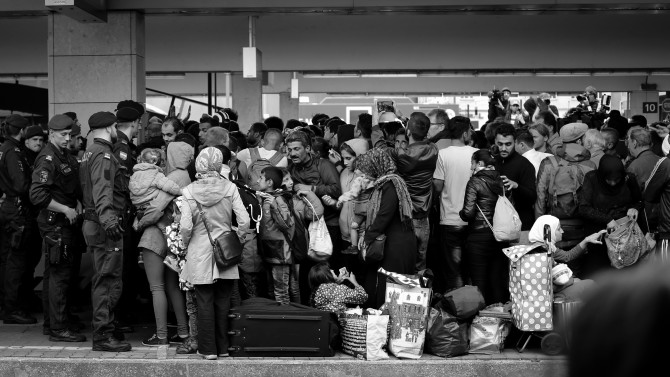
Although most of us picture refugees living in remote, dusty camps, as many as 2.1 million of the developing world’s working-age refugees reside in major urban areas—where they should have greater access to employment opportunities. However, according to a new report from the Center for Global Development, finding employment remains “one of the major unmet needs identified by refugees.”
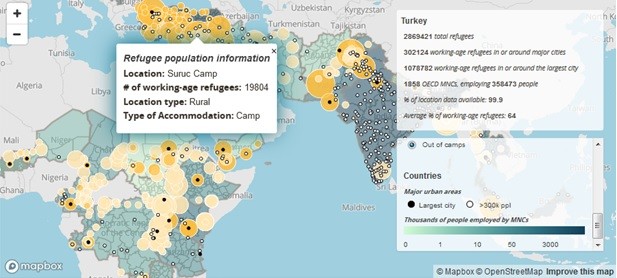
To help illuminate this potential workforce, the Center for Global Development created an interactive map tool that displays the locations and sizes of refugee population relative to urban areas within 31 developing countries. Powered by open source mapping platform Mapbox, the map plots refugee populations by size and location (urban or rural). Hovering over a particular country will yield total refugee population, the percentage of working-age refugees, the breakdown between urban and rural populations, and the number of multinational companies and how many people they employ.
Comparing data across regions yields interesting trends; for example, the share of refugees in Asia that are of working age averages 50-60 percent (excluding Afghanistan), while in sub-Saharan Africa the share is only 30-40 percent. Urban refugees are clustered in countries that border active conflicts in Syria and Afghanistan, suggesting that for neighboring countries such as Turkey and Pakistan, the capacity of traditional refugee camps was overwhelmed by the numbers escaping these crises.

While this tool provides a helpful geographic overview of opportunities for refugee employment in developing countries, it does not include information about barriers to employment, particularly legal restrictions that prevent employers from hiring refugees. Other barriers include discrimination, lack of in-demand skills, and inequitable labor protections, which are described in more detail in an accompanying report. Finding a way to incorporate these factors into the interactive could give potential employers, refugee advocates, and local policymakers a clearer picture of the possibilities and challenges of employing local refugees.
By illuminating the overlap between where refugees live and urban employment demand in developing countries, this tool goes beyond the more typical maps of refugee flows. It could help alert both developing countries and global employers of an economic opportunity that could support economic growth and alleviate an ongoing social crisis.
Sources: Center for Global Development, Mapbox
Photo Credits: Refugees in Vienna, Austria, September 2011, courtesy of Josh Zakary; Interactive Map of Locations of UNHCR-recognized Refugees in Relation to Major Urban Areas, courtesy of the Center for Global Development
Topics: Afghanistan, Africa, data, demography, Eye On, featured, livelihoods, migration, Pakistan, population, Syria, Turkey, urbanization
 A Publication of the Stimson Center.