-
Sexual Violence Beyond the Warzone, and the Relationship Between Child Marriage and Fragile States
August 20, 2014 By Sarah Meyerhoff
Two recent reports reaffirm the particular vulnerability of women and children in disasters, conflicts, and fragile states, but also highlight gaps in common perceptions of their experiences.
Two recent reports reaffirm the particular vulnerability of women and children in disasters, conflicts, and fragile states, but also highlight gaps in common perceptions of their experiences.
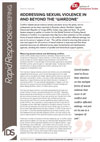
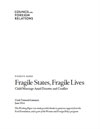
A briefing from the Institute of Development Studies presses leaders and humanitarian organization to “focus their attention on the multiple forms of sexual violence that occur in all conflict and conflict-affected settings, not just on its use as a ‘weapon of war.’” While international legal frameworks have criminalized the rape of women by soldiers and non-state militants, they do not address other forms of conflict-related sexual violence, including sex trafficking and survival sex. Humanitarian approaches tend to overlook how conflict affects not only the warzone but refugee camps and urban spaces nearby, where gender inequality and discrimination can open up new spaces for sexual violence by spouses, migrants, police, and peacekeepers. These dynamics also keep at-risk groups from seeking care and legal action. Women raped by husbands or partners, for example, are less able to access medical and social support than those who are victims of the enemy, according to the brief, and men raped by other men often do not prosecute attackers in places where homosexuality is stigmatized.A working paper by the Council on Foreign Relations’ Gayle Tzemach Lemmon calls attention to the understudied relationship between child marriage and state stability. In many fragile states, which generally experience the highest rates of child marriage, parents understand child marriage as a safeguard against financial instability, food shortages, and upticks in violence, says Lemmon. Physical and economic insecurity keeps girls out of school in disproportionate numbers compared to boys and marriage is often thought of as a more promising path for their futures. However, there is evidence that denying women income equality and worsening maternal and child health simply reinforces instability, creating a vicious cycle. “Child marriage is more than a violation of human rights,” writes Lemmon. “By exacerbating poverty, cutting short education, and limiting the economic possibilities for girls and women, the practice hinders the opportunity to increase global prosperity and stability.” She calls on governments and relief organizations to prioritize research during and after responses to natural disasters and conflicts in order to collect more hard data on the relationship and build better policy.Sources: Council on Foreign Relations, Institute of Development Studies.
 A Publication of the Stimson Center.