-
Peter Gleick on Peak Water
› “The purpose of the whole debate about peak water is to help raise awareness about the nature of the world’s water problems and to help drive toward solutions,” says the Pacific Institute’s Peter Gleick. But Gleick asserts that in the same way certain countries have been contending with “peak oil” concerns in recent years, they may soon also have to deal with “peak water” as well.
Unlike oil, water is largely a renewable resource, but countries in Asia, the Middle East, and elsewhere are pumping groundwater faster than aquifers can replenish naturally. Gleick explains “there will be a peak of production in many of those places and eventually the food that we grow with that water or the widgets that we make from the factories that use that water will be nonsustainable and production will have to drop.”
The world’s surface and groundwater resources can be used sustainably even in the face of continued global population growth, says Gleick, but only “if we are careful about the ecological consequences and the efficiency with which we use it.” However, to date, he says, “those issues have not adequately been brought into the discussion about water policy.”
The “Pop Audio” series is also available as podcasts on iTunes. -
Research Findings and Programmatic Implications
Gender-Based Violence in the DRC
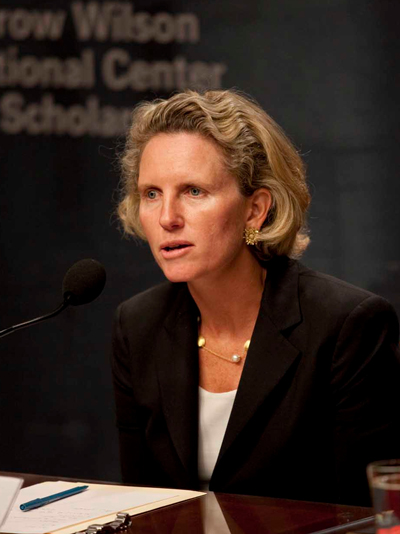
›In the Democratic Republic of the Congo (DRC), “armed conflict has resulted in mass displacement and widespread sexual violence; the problem is that it hasn’t always been quantified,” said Dr. Lynn Lawry, senior health stability and humanitarian assistance specialist at the U.S. Department of Defense. Presenting findings from the first cross-sectional, randomized cluster study on gender-based violence in the DRC, Lawry was joined at the Wilson Center by Heidi Lehmann, director of the Gender-based Violence Unit at the International Rescue Committee, and Dr. Nancy Glass, associate professor at the Johns Hopkins School of Nursing and associate director at the Johns Hopkins Center for Global Health. “We found that sexual violence in these areas is conflict-related, prevalent, systematic, and widespread,” said Lawry. [Video Below]
Study Finds “Female Perpetrators”
The first of its kind in the region, the population-based, quantitative study covers three districts in the DRC and a total of 5.2 million adults. It comprehensively assesses gender-based violence, including its prevalence, circumstances, perpetrators, and physical and mental health impacts.
Overall, the study found that 2.1 million women and 1.3 million men in the region had suffered sexual violence. Nearly three-quarters of all sexual violence reported was a direct result of conflict. In the study region, 20 percent of the population fought in conflicts, and 48 percent of these combatants were female.
Further, 39 percent of female survivors and 15 percent of male survivors reported female perpetrators. “These findings challenge the paradigm of male perpetrator and female victim,” said Lawry. “Policymakers and donors should adjust societal paradigms of sexual and gender-based violence and also direct attention to female perpetrators and male survivors.” Survivors of sexual violence in conflict, both male and female, are more at risk of later becoming perpetrators, particularly if unrecognized and untreated. To “break the cycle of violence,” prevention and response programs should address the needs of survivors and combatant perpetrators of both genders.
“Community-related violence is a general crime; conflict-related violence is a war crime,” Lawry said. While many efforts have focused on the Congolese military, she called for the DRC government and the International Criminal Court to also investigate and prosecute members of rebel groups, who were found to be the main perpetrators of sexual violence and other human rights abuses in this study.
Prevention: The Best Response
“Meeting the immediate consequences of violence is not enough,” said Lehmann. To effectively address gender-based violence, programs must provide medical and social services, promote social empowerment, respond to emergencies, and take part in advocacy and coordination efforts.
In the DRC, programs supported by the International Rescue Committee serve approximately 350 to 400 survivors per month, 75 percent of whom report that the perpetrators are members of armed groups.
Scaling up is a major challenge. “Providing essential services alone require enormous investment, and there is no common understanding of comprehensive programming,” said Lehmann. “We recognize that a program alone cannot solve all of these problems, especially in the DRC.”
“Good response is about prevention,” concluded Lehmann. She recommended supporting robust, long-term programming; integrating gender-based violence prevention efforts into other sectors; and investing in partnerships. “We are not going to end the violence unless Congolese women and girls are part of the conversation.”
Pigs for Peace: A Holistic Approach
Health care, economic development, and social programs should be integrated “to provide a holistic and comprehensive approach” to the problem of gender-based violence, said Glass. “Rape destabilizes families and communities,” she said.
Survivors rarely get immediate treatment for their injuries and trauma, or the risk of HIV, STIs, and infertility. “Many rural primary health centers and hospitals have been looted of medicines and materials by rebels and soldiers,” said Glass. Conflict in the DRC has also caused health care professionals to leave unstable rural areas, and poor roads and limited transportation make it unsafe and expensive to seek care.
To rebuild families and communities, “women and men need to regain their economic resources to provide for the future of their family and community,” said Glass. Pigs for Peace, for example, has supplied more than 100 women — many of them rape survivors — and their families with pigs to set them on the path to recovery through psychological, social, and economic empowerment. This program aims not only to supplement household income, but to reduce the stigma of rape as survivors become productive parts of their families and communities.
Photo Credit: “Congo kivu,” courtesy of flickr user andré thiel. -
Water as a Strategic Resource in the Middle East
‘Clear Gold’ Report From CSIS
›“The real wild-card for political and social unrest in the Middle East over the next 20 years is not war, terrorism, or revolution – it is water,” begins the CSIS Middle East Program’s latest report, Clear Gold: Water as a Strategic Resource in the Middle East, by Jon B. Alterman and Michael Dziuban.
The authors contend that with growing populations, groundwater depletion, not the more traditional questions about transboundary river governance, poses a “more immediate and strategically consequential challenge,” particularly because many Middle Eastern governments have deflated the true cost of water to help spur growth and garner popularity.
In the accompanying video feature above, much-troubled Yemen is outlined as one of the most at-risk countries for water-induced instability. The narrator notes that “with Yemen’s population growing fast and almost half of agricultural water going towards the narcotic leaf qat instead of food, experts think that Sanaa [the capital] could run out of water in seven years or less and the rest of the country may not be far behind.”
In an interview with Reuters in 2008, Yemeni Water and Environment Minister Abdul-Rahman al-Iryani said the country’s burgeoning water crisis is “almost inevitable because of the geography and climate of Yemen, coupled with uncontrolled population growth and very low capacity for managing resources.”
Yemen is a particularly abject example because water availability is only one contributor in a long list of domestic problems, including a large youth population, gender inequity, immigration from the Horn of Africa, corruption, ethnic tensions, and terrorism.
The narrator concludes that “Yemen is the most worrisome example but clearly not the only one.” Alterman and Dziuban also point to Jordan and Saudi Arabia as states vulnerable to groundwater depletion.
For more on the Middle East’s current and future environmental security issues, be sure to check out The New Security Beat’s “Crossroads” series, with features on Iraq, Israel, Jordan, Lebanon, Syria, and Yemen.
Video Credit: “Clear Gold: Water as a Strategic Resource in the Middle East,” courtesy of CSIS. -
A Crucial Connection: India’s Natural Security
›January 5, 2011 // By Michael KugelmanExcerpted from the original op-ed, “A Crucial Connection,” by Michael Kugelman in The Times of India:
With India’s soaring growth and rising global clout hogging media headlines, it is easy to forget the nation is beset by security challenges. Naxalite insurgency rages across more than two-thirds of India’s states, while long-simmering tensions in Jammu and Kashmir exploded once again this summer. Meanwhile, two years post-Mumbai, Pakistan remains unwilling or unable to dismantle the anti-India militant groups on its soil. Finally, China’s military rise continues unabated. As Beijing increases its activities across the Himalayan and Indian Ocean regions, fears about Chinese encirclement are rife.
It is even easier to forget that these challenges are intertwined with natural resource issues. Policy makers in New Delhi often fail to make this connection, at their own peril. Twenty-five per cent of Indians lack access to clean drinking water; about 40 per cent have no electricity. These constraints intensify security problems.
India’s immense energy needs – household and commercial – have deepened its dependence on coal, its most heavily consumed energy source. But India’s main coal reserves are located in Naxalite bastions. With energy security at stake, New Delhi has a powerful incentive to flush out insurgents. It has done so with heavy-handed shows of force that often trigger civilian casualties. Additionally, intensive coal mining has displaced locals and created toxic living conditions for those who remain. All these outcomes boost support for the insurgency.
Meanwhile, the fruits of this heavy resource extraction elude local communities, fuelling grievances that Naxalites exploit. A similar dynamic plays out in Jammu and Kashmir, where electricity-deficient residents decry the paltry proportion of power they receive from central government-owned hydroelectric companies. In both cases, resource inequities are a spark for violent anti-government fervor.
Continue reading on The Times of India.
For more on India’s Naxalite rebellion and its natural resource drivers, see The New Security Beat’s “India’s Maoists: South Asia’s ‘Other’ Insurgency.”
Michael Kugelman is program associate with the Asia Program at the Woodrow Wilson International Center for Scholars.
Photo Credit: “Mysore Coal Man,” courtesy of flickr user AdamCohn. -
Paradise Beneath Her Feet: How Women Are Transforming the Middle East
›Isobel Coleman, senior fellow for U.S. foreign policy at the Council on Foreign Relations, said she believes demographic changes are intensifying the notion that women’s empowerment is key to the growth and prosperity of the economies of Arab and Muslim-majority countries.
Coleman, author of the book Paradise Beneath Her Feet: How Women Are Transforming the Middle East, spoke at the Wilson Center in October, with Haleh Esfandiari moderating.
In addition to the Middle East’s demographics, Coleman also discussed how women in these traditional societies face challenges expanding their roles because women’s rights are often seen in a negative light. Coleman noted that things are changing, however, because women in the Muslim world are turning towards an Islamic discourse, which allows them to expand their rights within society’s religious framework. With this tactical shift and gradual gains in education, Coleman explained how women are slowly yet steadily transforming their societies.Coleman began her talk by focusing on the demographic changes in the region, noting that 50 percent of the Arab world’s population is under the age of 22. Furthermore, education was once the exclusive preserve of men in many Arab and Muslim states (in some cases, only decades ago). Today, however, women often constitute the majority of those enrolled in these countries’ educational institutions: Females outnumber males in Jordan’s secondary schools and constitute 70 percent of all university students in Iran. While the levels of educational attainment and achievement among women are increasing, normative and legal restrictions on their socioeconomic mobility remain. Coleman indicated that this contradictory scenario has led to greater opposition to impediments to women’s equality.
Coleman went on to address the tactics being used by the latest generation of reform-minded women in the Muslim world. She said today’s reformist women are more cognizant of the religious conservatism in their societies and are taking on religion in a way earlier feminists did not. By making feminist arguments from an Islamic perspective they avoid being “slandered” by conservatives and traditionalists as pro-Western or anti-Islamic. Coleman noted that some women adopt such a stance out of deep religious conviction, while others do it in the name of expediency. She indicated this new strategy of compromise has given more women influence in social affairs and led to significant engagement with governments.
With the advent of new social media and technology, women have become more visible and able to express their opinions about previously taboo gender-related issues. Female journalists and bloggers are more stridently supporting feminist discourses. Coleman mentioned Sweet Talk, the Arabic language equivalent of the American television show, The View, on which the female co-hosts have addressed topics such as polygamy, rape, incest, and the Saudi prohibition on women driving.
According to Coleman, these factors of change – demographic transitions, the role of media, and an awareness of growing extremism in society – are contributing to women making strides in the region and a “wearing away” of gender inequality in the Muslim world. Given the gains women have made so far, Coleman said she is “cautiously optimistic” for the future.
Luke Hagberg is an intern with the Middle East Program at the Wilson Center; Haleh Esfandiari is the director of the Middle East Program.
Photo Credit: Yemeni women in computer class, courtesy of flickr user World Bank Photo Collection, and David Hawxhurt/Wilson Center. -
New Insights Into the Population Growth Factor in Development
›“We have not found any country that has developed or gotten out of poverty while maintaining high birth rates,” said Martha Campbell, president of Venture Strategies for Health and Development. “Family planning is not a cost to a Ministry of Finance – it’s an investment,” said Malcolm Potts of the University of California Berkeley.
Campbell and Potts were joined by panelists Eliya Msiyaphazi Zulu, director and founder of the African Institute for Development Policy, and Jotham Musinguzi, director of the African Region at Partners in Population and Development, for a Wilson Center discussion of the implications of rapid population growth on human and economic development. [Video Below]
Africa’s Key Population Growth Challenges
“Africa’s population of one billion can reach between 1.8 and 2.3 billion by 2050, depending on how well the continent actually does in reducing fertility,” Zulu said. In 2010, Africa accounted for 15 percent of the total world population, but current estimates suggest this will grow to 23 percent by 2050.
“Rapid growth, young age structures, and urbanization are Africa’s main population challenges,” said Zulu. “Addressing these concerns is increasingly seen to be the key to the continent’s development prospects and realization of the Millennium Development Goals.” With 40 to 50 percent of populations in Africa under the age of 15, there is “high momentum for further population growth,” he said.
“Africa has a very high demand for fertility control, and the demand will undoubtedly increase,” said Zulu. “The main challenge, therefore, is not that of demand, but how to ensure those who are in need actually have access to contraception.” In many African regions, current rates of contraception use are as low as seven percent. In some areas, as many as 97 percent of women cannot afford the full cost of contraception, he said.
“It’s not just about reducing fertility,” said Zulu. Improving education and increasing labor force opportunities will not only help populations develop economically, but will also allow African countries to take full advantage of the demographic dividend, he said.
“The international development community should build on Africa’s success stories and support efforts to achieve universal access to family planning, expand public education on reproductive matters, improve the status of women, and improve the situation in urban settings,” Zulu concluded.
Family Planning and the MDGs
“Women are dying; children are dying. They shouldn’t be,” said Musinguzi. “By investing US$1 million in family planning, you can prevent 800 maternal deaths, 11,000 infant deaths, 14,000 deaths in children under five, and 360,000 unwanted pregnancies.”
“Women are clearly saying they have a need for family planning,” Musinguzi said. Presenting statistics from sub-Saharan Africa, he noted that 31 countries have a total fertility rate of more than five. Fourteen million unintended pregnancies occur each year, but only 25 percent of women use family planning. In Uganda, for example, the population has more than doubled in less than 20 years; women on average have more than six children each; and only 18 percent of married women use modern contraception.
“For a country trying to achieve the MDGs…the question of addressing total fertility rate is very important,” said Musinguzi. Reducing unmet need for family planning services can help African countries reduce the costs of achieving several of the Millennium Development Goals, including offering universal primary education; reducing child mortality; improving maternal health; combating HIV/AIDS, malaria, and other diseases; and ensuring environmental sustainability.
Policy Implications
“This is an urgent message – waiting 10 years to get family planning back on the international agenda will be enormously costly,” Potts said. “Of all the medical interventions that exist, contraception is the single most powerful. It is the only one that can have an impact on maternal and infant mortality, on the autonomy of women, on economic progress, on social stability and the rate at which we destroy the environment,” he said.
“Education and family planning are the driving mechanisms of development – they’re synergistic,” said Potts. “One of our needs is to get economists, family planning, and development experts on the same page.”
Sources: Guttmacher Institute, Population Action International, Population Reference Bureau.
Photo Credit: Untitled, courtesy of flickr user stttijn. -
End of the Year Edition: Top 10 Posts for 2010
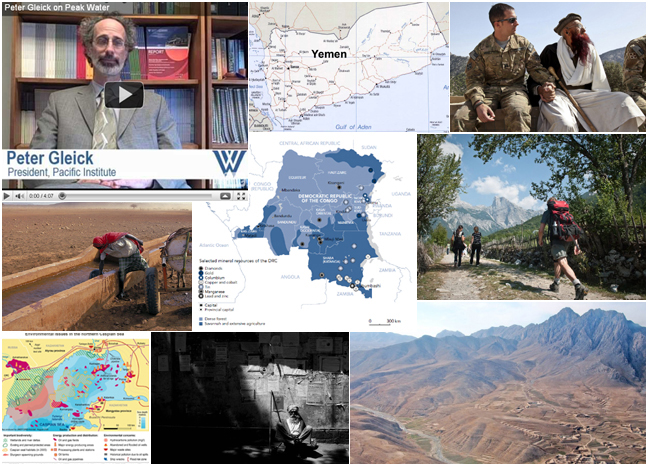
›The New Security Beat’s 2010 top ten (measured by unique pageviews) included guest contributions from Marc Levy, Todd Walters, and the UK’s Royal Society, a post by West Point Cadet Marie Hokenson, a video feature with Peter Gleick, and posts on global enviro-security hot spots Afghanistan, India, the Democratic Republic of the Congo, and Yemen:
1. Watch: Peter Gleick on Peak Water
“The concept of ‘peak water’ is very analogous to peak oil…we’re using fossil groundwater. That is, we’re pumping groundwater faster than nature naturally recharges it,” says Peter Gleick in this short expert analysis from the Environmental Change and Security Program. Gleick, president and co-founder of the Pacific Institute and author of the newest edition of The World’s Water, explains the new concept of peak water.
2. Copper in Afghanistan: Chinese Investment at Aynak
Will new investments by the Metallurgical Corporation of China (MCC) in the Aynak copper mine break Afghanistan out of its poverty trap? Will future revenues from the subsoil assets in Logar Province bring peace and stability to the ongoing conflict?
3. DRC’s Conflict Minerals: Can U.S. Law Impact the Violence?
Apple CEO Steve Jobs, in a personal email posted by Wired, recently tried to explain to a concerned iPhone customer the complexity of ensuring Apple’s devices do not use conflict minerals like those helping to fund the civil war in the Democratic Republic of Congo. However much one might be tempted to pile on Apple at the moment, Mr. Jobs is on to something with regard to the conflict minerals trade – expressing outrage and raising awareness of the problem is one thing but actually implementing an effective solution is quite another.
4. India’s Maoists: South Asia’s “Other” Insurgency
The Indian government’s battle with Maoist and tribal rebels – which affects 22 of India’s 35 states and territories, according to Foreign Policy and in 2009 killed more people than any year since 1971 – has been largely ignored in the West. That should change, as South Asia’s “other” insurgency, fomenting in the world’s largest democracy and a key U.S. partner, offers valuable lessons about the role of resource management and stable development in preventing conflict.
5. On the Beat: Climate-Security Linkages Lost in Translation
A recent news story summarizing some interesting research by Halvard Buhaug carried the headline “Civil war in Africa has no link to climate change.” This is unfortunate because there’s nothing in Buhaug’s results, which were published in the Proceedings of the National Academy of Sciences, to support that conclusion.
6. Guest Contributor Todd Walters: Imagine There’s No Countries: Conservation Beyond Borders in the Balkans
International peace parks have captured the imagination of visionaries like Nelson Mandela, who called them a “concept that can be embraced by all.” Such parks—also known as transboundary protected areas—span national boundaries, testifying to the peaceful collaborative relationship between neighboring countries and to the co-existence of humans and nature.
7. Restrepo: Inside Afghanistan’s Korengal Valley
Restrepo, the riveting new documentary film from Tim Hetherington and Sebastian Junger, follows a platoon of U.S. soldiers deployed in the dangerous Korengal Valley of Afghanistan. As a cadet at West Point majoring in human geography, I was fascinated to watch the ways the soldiers confronted and adapted to the challenges posed by the local culture of the remote Afghan community surrounding their outpost.
8. UK Royal Society: Call for Submissions: “People and the Planet” Study To Examine Population, Environment, Development Links
In the years that followed the Iranian revolution, when Ayatollah Khomeini returned from exile to Tehran and the country went to war against Iraq, the women of Iran were called upon to provide the next generation of soldiers. Following the war the country’s fertility rate fell from an average of over seven children per woman to around 1.7 children per woman – one of the fastest falls in fertility rates recorded over the last 25 years.
9. Demographics, Depleted Resources, and Al Qaeda Inflame Tensions in Yemen
A second spectacular Al Qaeda attack on Yemeni government security buildings in less than a month is a worrisome sign that the terrorist group may be trying to take advantage of a country splitting at the seams. U.S. officials are concerned that Yemen, like neighboring Somalia, may become a failed state due to a myriad of challenges, including a separatist movement in the south, tensions over government corruption charges, competition for dwindling natural resources, and one of the fastest growing populations in the world.
10. Eye on Environmental Security: Visualizing Natural Resources, Population, and Conflict
Environmental problems that amplify regional security issues are often multifaceted, especially across national boundaries. Obtaining a comprehensive understanding of the natural resource, energy, and security issues facing a region is not fast or easy.
Photo Credit: Collage from individual posts (left to right, top to bottom): Peter Gleick courtesy of ECSP’s Youtube channel; “Yemen pol 2002,” via Wikimedia Commons courtesy of the U.S. Federal Government; “Mutual support,” courtesy of flickr user The U.S. Army; “KE139S11 World Bank,” courtesy of flickr user World Bank Photo Collection; “Mineral and Forests of the DRC” from ECSP Report 12, courtesy of Philippe Rekacewicz, Le Monde diplomatique, Paris, and Environment and Security Institute, The Hague, January 2003; IPPE/Cory Wilson; “Environmental Issues in the Northern Caspian Sea,” courtesy of the Environment & Security Initiative; “Wandering Aesthetic” courtesy of flickr user Wen-Yan King; and “River and Mountains of Logar,” courtesy of flickr user AfghanistanMatters. -
Top 10 Posts for December 2010
›Pop Audios from Roger-Mark De Souza and John Bongaarts, water conflict on the Mekong river, a take on Restrepo from one of this summer’s West Pointers, and demographic security on the Hill topped the list last month:
1. Pop Audio: From Cancun: Roger-Mark De Souza on Women and Integrated Climate Adaptation Strategies
2. Managing the Mekong: Conflict or Compromise?
3. Pop Audio: John Bongaarts on the Impacts of Demographic Change in the Developing World
4. Restrepo: Inside Afghanistan’s Korengal Valley
5. Demographic Security Comes to the Hill
6. The Future of Sub-Saharan Africa’s Tentative Fertility Decline
7. On the Beat: Where Have all the Malthusians Gone?
8. Bringing Cambodia Back from the Brink: Audio Interview with Suwanna Gauntlett
9. COP-16 Cancun Coverage Wrap-up: An Integrated Climate Dialogue
10. India’s Maoists: South Asia’s “Other” Insurgency
 A Publication of the Stimson Center.