-
Top 10 Posts for November 2011
›ECSP Director Geoff Dabelko’s look at seven ways seven billion people affect the planet led the top 10 last month (by unique page views), followed by a number of posts on trends: visualizations of population, health, and climate trends; what El Niño and conflict patterns say about the relationship between the two; the policy decisions that led to a commitment to family planning in Rwanda; and the effects of global population on “peak water.” Captain Wayne Porter and Colonel Mark Mykleby’s new national security narrative presentation at the Wilson Center also remained popular, and a new guest contributor, American University student Olimar Maisonet-Guzman, joined the list for the first time:
1. Seven Ways Seven Billion People Affect the Planet
2. India’s Maoists: South Asia’s “Other” Insurgency
3. Tunisia’s Shot at Democracy: What Demographics and Recent History Tell Us
4. Eye On: STATcompiler: Visualizing Population and Health Trends
5. Peter Gleick: Population Dynamics Key to Sustainable Water Solutions
6. Eye On: Twin Challenges: Population and Climate Change in 2050
7. El Niño, Conflict, and Environmental Determinism: Assessing Climate’s Links to Instability
8. Building Commitment to Family Planning: Rwanda
9. In Search of a New Security Narrative: The National Conversation Series Launches at the Wilson Center
10. Guest Contributor Olimar Maisonet-Guzman: Bring the Water-Energy Nexus to Rio+20 -
Book Preview: In ‘War and Conflict in Africa’, GWU Scholar Skeptical That Natural Resources Play a Leading Role
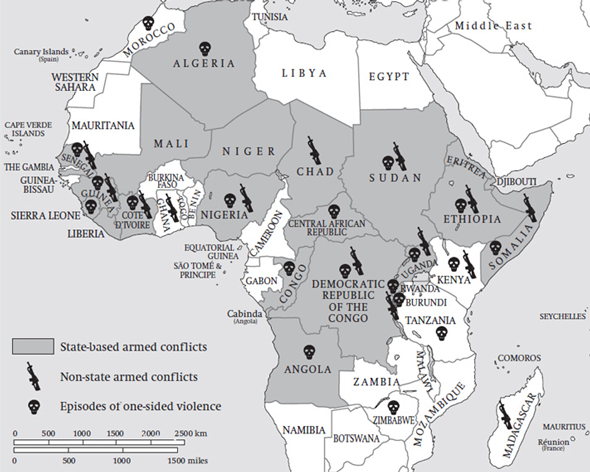
›November 30, 2011 // By Elizabeth Leahy MadsenWhile there is widespread agreement that the incidence of conflict in Africa is high, scholars and development agencies alike debate its driving forces and how to move toward solutions. Paul Williams, associate professor in the Elliott School of International Affairs at George Washington University and collaborator with the Wilson Center’s Africa Program, recently published a book that aims to both quantify African conflicts and devise a framework of their causes. In War and Conflict in Africa, Williams evaluates which factors explain the frequency of conflict in Africa during the post-Cold War era and how the international community has tried to build peace and prevent future conflict.
Although there have been promising trends toward establishing peace and democracy in some African countries, the continent still accounts for about one-third of all armed conflicts annually – more than Europe, the Middle East, and the Americas combined. International responses to these events range from focused humanitarian and conflict resolution efforts, to new regional organizations and global strategic and defense partnerships.
Seven of the 16 current UN peacekeeping missions operate in Africa, more than any other continent. The UK government has elected to spend nearly one-third of its development assistance in conflict-affected areas, and more than half of its “focus” countries are in Africa. In 2008, the Department of Defense created the U.S. Africa Command (AFRICOM), whose commander, General Carter Ham, in a speech to Congress earlier this year, described “an insidious cycle of instability, conflict, environmental degradation, and disease that erodes confidence in national institutions and governing capacity,” as motivation for American military attention. “This in turn often creates the conditions for the emergence of a wide range of transnational security threats,” he said.
Evaluating the Ingredients of Conflict
Williams rejects earlier theses that attribute conflict across the continent to a single factor, such as the boundary legacies of colonialism, greed, or ethnicity. Instead, he characterizes African conflicts as “recipes” composed of case-specific mixes of factors, many of which are underlying and only some of which are sufficient triggers for conflict. “Collier is wrong,” Williams explained in an email interview. “Governance structures are always an important part of the buildup to war.”
Five “ingredients” of conflict are examined in-depth: neo-patrimonial governance structures; natural and human resources; sovereignty and self-determination; ethnicity; and religion. Among these, the book presents a fairly skeptical view of resources, ethnicity, and religion as immediate drivers of conflict. This assessment that environmental and identity issues are not sufficient to generate conflict on their own aligns with the book’s overarching argument: The decisions of political actors can instigate conflict or motivate peace from virtually any context, manipulating factors such as ethnicity and religion for their own advantage.
Effects of Natural Resources Are “Open-Ended”
A widely publicized thread of peace and conflict studies posits that resources, either when scarce or abundant, have an important role in triggering wars. A 2009 UN Environment Programme report found that 40 percent of all internal conflicts since 1950 “have a link to natural resources.” Recent peer-reviewed research has suggested that certain environmental changes increase the likelihood of civil conflicts or are directly responsible for it. Yet the question remains a source of much debate. For his part, Williams asserts that natural resources alone are insufficient to cause conflict.
War and Conflict in Africa presents several reasons that researchers and policymakers should avoid linking resources directly to conflict without considering the influence of intervening factors. Chief among them is that the value of any resource is socially constructed – no stone or river carries worth until humans decide so. Therefore, Williams argues that “it is political systems, not resources per se, that are the crucial factor in elevating the risk of armed conflict.”
The book suggests that two extant theories successfully demonstrate the connection between resources and conflict. The first body of research finds that conflict is more likely in regions that face a combination of resource abundance and a high degree of social deprivation. The second theory suggests that the link between resources and conflict lies in bad governance, whether exploitative or unstable. Both theories have explanatory power for Williams’s central line of thinking: Resources can be either a blessing or a curse, depending on leadership.
“Inserted into a context where corrupt autocrats have the advantage, resources will strengthen their hand and generate grievances,” he writes (p. 93). “Inserted into a stable democratic system, they will enhance the opportunities for leaders to promote national prosperity.”
Population and the Environment
Williams does accede that particular resource factors – land and demography, for example – may play a more significant role than others in conflict, but calls for more research. In a brief discussion of population age structure, the book suggests that there is no single relationship between demography and conflict but multiple ways that the two can relate. Williams mentions the theory that “large pools of disaffected youth” with few opportunities can raise the risk of volatility. However, he then notes other research showing that the most marginalized members of certain African societies are less likely to participate in political protests and more likely to tolerate authoritarian rule than those who are better off.
“The most marginalized from society are the truly destitute without patrons and suffering from severe poverty. They may well be inclined to join an insurgency movement once it begins to snowball but they will not usually play a key role in establishing the rebel group in the first place,” Williams said. However, “any time there are large pools of poor and unemployed youth there is the potential for leaders to manipulate them.”
On environmental resources, the book argues that land should be a central feature of quantitative research on the relationship between resources and conflict. Most African economies continue to rely on agriculture, and Williams observes that land has been “at the heart” of many conflicts in the region through a variety of governance-related mechanisms relating to its management and control. He places less emphasis on water scarcity as a potential factor in conflict, noting that the 145 water-related treaties signed around the world in the past decade auger well for cooperation rather than competition.
Williams is also dubious of emerging arguments that climate change could directly increase the incidence of conflict, either through changing weather patterns or climate-induced migration.
“Because armed conflicts are, by definition, the result of groups choosing to fight one another, any process, including climate change, can never be a sufficient condition for armed conflict to occur,” he argued. “Armed conflicts result from the conscious decisions of actors which might be informed by the weather but are never simply caused by it.”
No Simple Formula
Williams is not the only observer to find the narrative that resource shortage (or abundance) precipitates conflict too simplistic. His message to policymakers is a common refrain from academics and analysts seeking to counteract policymakers’ quest for simple formulas: We need more data.
“When deciding how to spend our money, we need to spend more of it on developing systems which deliver accurate knowledge about what is happening on the ground, often in very localized settings,” Williams said. War and Conflict in Africa contributes to a more complex understanding of the political actors and systems that catalyze or prevent conflict and offers a cautionary tale to those who seek only proven, easy predictions.
Elizabeth Leahy Madsen is a consultant on political demography for the Wilson Center’s Environmental Change and Security Program and senior technical advisor at Futures Group. She was previously a senior research associate at Population Action International. Full disclosure: She was a graduate student of Paul Williams’ in 2007.
Sources: DFID, Englebert and Ron (2004), Ham (2011), Hsiang et al (2011), Kahl (1998), Leysens (2006),Østby et al (2009), Radelet (2010), Themnér and Wallensteen (2011), UNEP (2009), UN Peacekeeping, Williams (2011)
Image Credit: Conflicts in Africa 2000-09, reprinted with permission courtesy of P.D. Williams, War and Conflict in Africa (Williams, 2011), p.3. -
The Yasuní-ITT Initiative Is a Practical Climate Solution That Must Be Embraced at Durban
›As the world turns to Durban, South Africa, for this year’s UN climate summit, new findings are turning up the heat on the urgency to address climate change. The reality though is that we no longer have the luxury of resting our hopes solely on an internationally binding climate agreement; we must begin to look more closely at supporting immediate and tangible solutions. By complementing a global top-down effort of continued international negotiations with bottom-up approaches, we increase our chances at mitigating the most damaging effects of climate change. One of the most innovative models of such a bottom-up approach is the Yasuní-ITT Initiative being undertaken by the Government of Ecuador and supported by the UN Development Programme’s Multi-Partner Trust Fund Office (MPTF Office).
-
UNiTE To End Violence Against Women
›November 25, 2011 // By Schuyler NullToday is the International Day to End Violence Against Women, an awareness and advocacy campaign organized by a host of UN agencies and offices “to galvanize action across the UN system to prevent and punish violence against women.”
Gender equity and inequity play a role in a myriad of international development, health, security, and even environmental issues, from rape as a weapon of war; demography’s effects on political stability; maternal health and its impact on child development; women’s rights as a social stability issue; and the disproportionate effect of climate change on rural women.
The numbers around gender-based violence are staggering. According to the UN:
Here are some of New Security Beat’s posts on gender-based violence and inequity and their intersection with development, the environment, and security:- 70 percent of women experience physical or sexual violence from men in their lifetime.
- Approximately 250,000 to 500,000 women and girls were raped in the 1994 Rwandan genocide, and in the eastern Democratic Republic of Congo (DRC), at least 200,000 cases of sexual violence, mostly involving women and girls, have been documented since 1996, though the actual numbers are considered to be much higher.
- In the United States, one-third of women murdered each year are killed by intimate partners; in South Africa, a woman is killed every six hours by an intimate partner; in India, 22 women were killed each day in dowry-related murders in 2007; and in Guatemala, two women are murdered, on average, each day.
- Over 60 million girls worldwide are child brides, married before the age of 18, primarily in South Asia (31.1 million) and sub-Saharan Africa (14.1 million).
Gender-Based Violence in the DRC: Research Findings and Programmatic Implications:
Dr. Lynn Lawry, senior health stability and humanitarian assistance specialist at the U.S. Department of Defense, presented findings from the first cross-sectional, randomized cluster study on gender-based violence in the DRC at the Wilson Center this year. The first of its kind in the region, the population-based, quantitative study covered three districts in the DRC and a total of 5.2 million adults, comprehensively assessing gender-based violence, including its prevalence, circumstances, perpetrators, and physical and mental health impacts.
Pop Audio: Judith Bruce on Empowering Adolescent Girls in Post-Earthquake Haiti: “The most striking thing about post-conflict and post-disaster environments is that what lurks there is also this extraordinary opportunity,” said Judith Bruce, a senior associate and policy analyst with the Population Council. Bruce spent time last year working with the Haiti Adolescent Girls Network, a coalition of humanitarian groups conducting workshops focused on the educational, health, and security needs of the country’s vulnerable female youth population.
The Walk to Water in Conflict-Affected Areas: Constituting a majority of the world’s poor and at the same time bearing responsibility for half the world’s food production and most family health and nutrition needs, women and girls regularly bear the burden of procuring water for multiple household and agricultural uses. When water is not readily accessible, they become a highly vulnerable group. Where access to water is limited, the walk to water is too often accompanied by the threat of attack and violence.
Weathering Change: New Film Links Climate Adaptation and Family Planning: “Our planet is changing. Our population is growing. Each one of us is impacting the environment…but not equally. Each one of us will be affected…but not equally,” asserts the new documentary, Weathering Change, launched at the Wilson Center in September. The film, produced by Population Action International, explores the devastating impacts of climate change on the lives of women in developing countries through personal stories from Ethiopia, Nepal, and Peru.
Sajeda Amin on Population Growth, Urbanization, and Gender Rights in Bangladesh:
The Population Council’s Sajeda Amin describes the Growing Up Safe and Healthy (SAFE) project, launched in Dhaka and other Bangladeshi cities last. The initiative aims, to increase access to reproductive healthcare services for adolescent girls and young women, bolstering social services to protect those populations from (and offer treatment for) gender-based violence, and strengthen laws designed to reduce the prevalence of child marriage – a long-standing Bangladeshi institution that keeps population growth rates high while denying many young women the opportunity to pursue economic and educational advancement.
No Peace Without Women: On October 31, 2000, the UN Security Council adopted Resolution 1325, which called for women’s equal participation in all efforts to maintain and promote peace and security; however, little progress has been made over these last 10 years and women remain on the periphery when it comes to post-conflict reconstruction and development. A report from the humanitarian organization CARE concedes that “much of the action remains declarative rather than operational.”
Addressing Gender-Based Violence to Curb HIV: At last year’s International AIDS Conference in Vienna an astonishing development in the campaign to stem the spread of HIV/AIDS was unveiled – a microbicide with the ability to reduce the risk of transmission of HIV. This welcome development coincides with an intensified focus on women’s health and security needs among donors, especially the United States.
The Future of Women in the MENA Region: A Tunisian and Egyptian Perspective: Lilia Labidi, minister of women’s affairs for the Republic of Tunisia and former Wilson Center fellow, joined Moushira Khattab, former minister of family and population for Egypt, this summer at the Wilson Center to discuss the role and expectations of women in the Egyptian and Tunisian revolutions, as well as issues to consider as these two countries move forward.
Sources: UN Secretary-General’s Office. -
Supply and Demand, Land and Power in the Global South
›In “Competition over Resources: Drivers of Insecurity and the Global South,” author Hannah Brock examines how an increased demand for non-renewable resources could lead to insecurity and contribute to local and international discord. The first of four papers examining what the Oxford Research Group has identified as the “most important underlying drivers of insecurity,” the paper focuses on competition over resources – specifically energy, water, and food – and argues that “a new way of approaching security is needed, one that addresses the drivers of conflict: ‘curing the disease’ rather than ‘fighting the symptoms.’” Through numerous examples, Brock illustrates the various strategies that nations are currently undertaking to satisfy demand and cautions that “where northern states and corporations buy access to southern resources, regulatory principles may be required to ensure this competition does not impair the human rights and security of local populations.”A new briefing paper from Oxfam, “Land and Power: The growing scandal surrounding the new wave of investments in land,” heavily criticizes the rising trend of foreign land acquisitions, or “land grabs,” that have occurred since the 2007-08 food prices crisis, calling them an infringement on the rights of more vulnerable populations and decrying their environmental impact. The authors use case studies in Uganda, Indonesia, Guatemala, Honduras, and South Sudan to argue that land grabbing is a type of “development in reverse.” “National governments have a duty to protect the rights and interests of local communities and land rights-holders,” Oxfam writes, “but in the cases presented here, they have failed to do so.” The authors conclude with recommendations to improve transparency and shift power more towards local rights. -
7 Billion: Reporting on Population and the Environment
›“It’s an issue – population – that is immensely diverse in its effects and repercussions, and it’s a great opportunity for reporting,” said Jon Sawyer, executive director of the Pulitzer Center on Crisis Reporting at a November 1 roundtable discussion at the Wilson Center. The session, reporting on population and the environment connections, also featured Dennis Dimick, executive environment editor at National Geographic; Kate Sheppard, environment reporter for Mother Jones; and Heather D’Agnes, foreign service environment officer at USAID.
“It’s an issue – population – that is immensely diverse in its effects and repercussions, and it’s a great opportunity for reporting,” said Jon Sawyer, executive director of the Pulitzer Center on Crisis Reporting at a November 1 roundtable discussion at the Wilson Center. The session, reporting on population and the environment connections, also featured Dennis Dimick, executive environment editor at National Geographic; Kate Sheppard, environment reporter for Mother Jones; and Heather D’Agnes, foreign service environment officer at USAID.The PBS NewsHour segment on “seven billion” featuring collaboration with the Pulitzer Center and National Geographic.
A Cumulative Discussion
“I ended up covering reproductive rights and health issues because I saw a need and a gap in coverage,” said Kate Sheppard. “I had been an environmental reporter for years…and so it sort of became this add-on beat for me.” But, she emphasized, they are actually very related issues.
“It’s a cumulative discussion,” said Dennis Dimick, speaking about National Geographic’s “7 Billion” series this year. “[Population] really hasn’t been addressed that much in media coverage over the past 30 years, in this country at least, and I think that the idea was that it wasn’t really just a discussion about the number seven billion, which is a convenient endline and easy way to get into something, but really to talk about the meaning of it, and the challenges and the opportunities that means for us as a civilization living on this planet.”
The series has had stories on ocean acidification, genetic diversity of food crops, the transition to a more urban world, as well as case studies from Brazil, Africa’s Rift Valley, and Bangladesh. “What we are trying to do in this series is really paint a broad picture to try to unpack all these issues and try to come at this question in sort of broad strokes,” Dimick said. “It’s sort of like we are orchestrating a symphony. Even though it’s a printed magazine, it’s a multimedia project – more than just words and more than just pictures.”
Collaborative Reporting
The Pulitzer Center, a non-profit journalism organization that seeks to fill gaps in coverage of important systemic issues, was able to commission pieces for PBS NewsHour that complemented the National Geographic series. This population collaboration launched the Center’s own initiative on population. “Our hope was that by having that platform, and the visibility of National Geographic and NewsHour, that it would bring attention to the rest of our work,” Sawyer said. The Pulitzer Center has gateways on water, food insecurity, climate change, fragile states, maternal health, women and children, HIV/AIDS in the Caribbean, and Haiti, in addition to population.
Playing off a story that was already making world headlines, the Pulitzer Center supported reporting by freelance journalist Ellen Knickmeyer on the demographic dimensions of the Arab Spring, and particularly the role of young people. The stories explored youth’s frustration at high unemployment and lack of prospects, their roles in the revolutions, and their expectations for the future.
“Of course, we had the advantage that the world was interested in North Africa because of the amazing events that were taking place, but it was an opportunity to get them to look at the other dimension to it,” Sawyer said.
Based on a model developed to cover water and sanitation in West Africa, the Pulitzer Center also created a partnership with four African journalists to produce reporting on reproductive health that will be distributed in both international and African media outlets. “They have important things to say to American audiences, to international audiences,” Sawyer said. “And so we see this project as an opportunity to bring them into the international media discussion.” The journalists will be reporting from the upcoming International Conference on Family Planning in Dakar, Senegal, later this month.
Advocating Discussions
“It’s really a nuanced discussion, and that is why covering these topics, and looking at all the different aspects of it, is really important,” said USAID’s Heather D’Agnes. Furthermore, speaking as a development practitioner, she emphasized the importance of offering solutions, such as family planning, as part of an integrated development approach.
“In our journalism we don’t pretend not to have arguments, or ideas, or thoughts about the issues we are covering,” said Sheppard, speaking of Mother Jones. “I think that the value is that you tell the story well and you do solid reporting – that gives people a more informed perspective.” Especially with complicated issues, like population and the environment, “people find it more accessible if you have a perspective…they can associate better with a story if you walk them through the process you have gone through as a reporter.”
“What we are really trying to do is to advocate a discussion of issues that aren’t getting well-aired in other media,” said Dimick. Sometimes you need to find an interesting or counterintuitive framework, such as the National Geographic story about rural electrification and TV novelas in Brazil. It started as a story about the booming popularity of soap operas, but also created the opportunity to talk about gender equity, family planning, and other complex issues. While the magazine does not advocate a position, like the editorial page of a newspaper might, Dimick said, they do use case studies to guide readers through the range of risks, choices, and opportunities and to help them understand their implications.
Event ResourcesVideo Credit: “World’s Population Teeters on the Edge of 7 Billion — Now What?,” courtesy of PBS NewsHour; “7 Billion, National Geographic Magazine,” courtesy of National Geographic. -
Jill Shankleman for the U.S. Institute of Peace
Lifting the Veil: What Can We Learn From EITI Reports?
›November 22, 2011 // By Wilson Center StaffThe original version of this article, by Jill Shankleman, appeared on the United States Institute of Peace’s International Network for Economics and Conflict blog.
The Extractive Industries Transparency Initiative (EITI), launched in 2002, now has 35 participating countries that have committed to publish annual, independently verified reports on all mining, oil, and gas payments made by companies to governments and all revenues received by governments from these extractive industry companies. The EITI is based on the premise that making public reliable information about extractive industry payments will make corruption and theft of “resource rents” more difficult and will enable informed debate amongst citizens and politicians about how to use resource wealth. While initially some governments could object to joining on the grounds that EITI was “a bad boys’ club,” Norway is now a fully engaged member; the United States has just announced that it will participate; and Australia stated it will pilot-test the system.
The participants in EITI also include Liberia, East Timor, Sierra Leone, and Côte d’Ivoire, which, as post-conflict states, depend more than most on effective management of their resource wealth to establish the foundations for sustained economic growth. Citizens, journalists, and government officials in all the EITI countries now have access to some information on what extractive industry companies are paying to the government and what the government is receiving.
However, examination of country EITI reports reveals several shortcomings in reporting. What do the reports tell us beyond the headline numbers (i.e., total revenues and the size of any discrepancy between what companies report paying and what governments report receiving)? What do they tell us about revenue trends or about the significance of these revenues in total government receipts? How many countries have a pattern similar to Tanzania whereby the largest contribution documented in their first report was through companies collecting payroll taxes on behalf of the government? What is the value of “social investments,” training levies, or research and development contributions made by extractive industry companies? Where, and to what extent, do oil, gas and mining companies make payments to local governments?
Continue reading on the International Network for Economics and Conflict blog.
Jill Shankleman is a senior scholar at the Woodrow Wilson Center and former senior social and environmental specialist at the World Bank.
Video Credit: “Transparency Counts,” courtesy of vimeo user EITI International. -
George Washington University’s PISA Helps Share Rural Vietnamese Climate Adaptation Strategies
›“Climate change is not a topic of debate in Vietnam, it’s a real challenge to future prosperity and security,” says George Washington University’s Partnerships for International Strategies in Asia (PISA) program in this video about their climate adaptation and mitigation work in Nam Dinh province. “[Vietnam’s] population density (265 people/square kilometer), its long coastline (3,444 km), its two major rivers (the Red and Mekong) – all help make it one of the 10 countries considered most vulnerable to climate change,” the narrator says.
 A Publication of the Stimson Center.