-
The Youth of North Africa
Surging on a Knife’s Edge
›March 23, 2011 // By Christina DaggettThe Middle East/North Africa region is experiencing a “youth surge,” said Jack Goldstone, director of the George Mason University’s Center for Global Policy, at a recent GMU event. “In the last two decades the number of people in their late teens and twenties has increased… It’s doubled in Egypt; it’s grown by half in Tunisia; and nearly doubled in Libya,” he told Warren Olney on KCRW’s To the Point. Such youth surges are problematic because, Goldstone wrote in ECSP Report 13, “population distortions – in which populations grow too young, or too fast, or too urbanized – make it difficult for prevailing economic and administrative institutions to maintain stable socialization and labor-force absorption.”
In the case of Egypt, the youth surge put enormous pressure on a government system that could no longer guarantee jobs to every college graduate, said Goldstone. When government guarantees dried up, graduates found that their poor-quality degrees were of little use, especially in a system that prioritized connections and bribery. The result was an unemployment rate of 25 percent among Egyptian youth and a mounting sense of frustration with the economic system and the government.
This frustration found a symbol when Mohammed Bouazizi, a 26-year-old Tunisian, set himself – and an entire region – on fire after his third run-in with the police cut off his only source of income. Youth across North Africa and the Middle East, Goldstone said, could identify with Bouazizi’s desperation and frustration after years of dealing with a closed economic system and a corrupt government.
While overall economic growth has been strong in the region – a fact which had misled many observers (including himself, Goldstone admits) into thinking the region was more stable – these economic gains were apparently being captured by the ruling elite to a far greater degree than previously thought, said Goldstone. For example, it is estimated that ousted Egyptian president Hosni Mubarak and his family are worth between $40 and $70 billion.
Meanwhile, a burgeoning surge of young people were struggling to get by. Goldstone pointed to a Gallup poll conducted in 2010 in which only 12 percent of Egyptians and 14 percent of Tunisians would classify themselves as “thriving” – down from 25 and 24 percent, respectively, in 2007 and 2008.
While the Ben Ali and Mubarak regimes have fallen, these revolutions do not ensure the youth in these countries will have a prosperous future. They need not only access to capital, said Goldstone, but also access to information and social networks so that they can identify market opportunities and stay connected.
Immigration to more developed countries could also be an important avenue for economic growth and education. In a Foreign Affairs article, “The New Population Bomb,” Goldstone writes, “Given the dangers of young, underemployed, and unstable populations in developing countries, immigration to developed countries can provide economic opportunities for the ambitious and serve as a safety valve for all.”
The future of Middle Eastern youth, and that of the region at large, depends on the quality of their education and their ability to be productive, said Goldstone. They stand on “a knife edge,” he said, and the transition to democracy will not be smooth or easy.
Image Credit: “Protest Face Paint,” courtesy of flickr user Ahmad Hammoud.
Sources: The Economist, ECSP Report 13, Foreign Affairs, Gallup, International Monetary Fund, KCRW, Voice of America. -
Carla Koppell and Haleh Esfandiari
Make Sure Women Can Lead in the Middle East
›In Libya, Egypt, Bahrain, Yemen, Tunisia, and elsewhere, women have stood with men pushing for change. In Libya, Iman and Salwa Bagaighif are helping lead, shape, and support protesters. And in Egypt, the Egyptian Organization for Human Rights, one of the oldest and most well-known non-governmental organizations in Egypt, estimated that at least 20 percent of the protesters were women.
For example, the 26-year-old co-founder of Egypt’s April 6 Youth Movement, Asmaa Mahfouz, mobilized thousands of youth in support of the protest through her impassioned YouTube video. In Yemen, a 32-year-old mother of three, Tawakkul Karman, helped organize protests against the current government.
History of Frustration
Yet women’s leadership is not a new phenomenon. In Iran, women have for many years successfully pushed for greater freedom in personal status law and greater employment and educational opportunities. Many Iranian women have been imprisoned simply for endorsing the Million Signature Campaign, which seeks equal rights and the repeal of laws that discriminate against women.
Women have been using social media and leveraged communications technology to pursue greater social and political openness since before the arrival of Iranian President Mahmoud Ahmadinejad. Notwithstanding a rich history of non-violent activism and extraordinary leadership, women have rarely been involved in political decision-making in the Middle East and North Africa region.
At an even more basic level, women do not feel confident that their rights will be preserved under the systems emerging from recent political transformations.
In Iraq, there have been female judges since the 1950s and thus many of women’s rights have been protected since 1978 by a personal status law. Yet in 2003, the new Iraqi Governing Council sought to strip women of these rights. Only in the face of domestic petitions, letter writing, and face-to-face advocacy were women successful in ensuring their rights were preserved. Iraqi women continue to face efforts to reduce their freedoms and each time they have defeated the assault.
Already Egyptian women are risking similar marginalization. There are no women on the committee revising the constitution. In an almost uncanny parallel to the struggle of Iraqi women after former President Saddam Hussein, Egyptians have drafted a petition, endorsed by over 60 local organizations, decrying women’s absence from transitional political bodies.
Bias embedded in the new draft constitution suggests that these concerns may be real.
“Prerequisite for an Arab Renaissance”
The international community and the new generation of progressive, democracy-minded leaders in the Middle East need to see women as critical partners for change. The evidence is indisputable. The 2005 UN Arab Human Development Report cautions that under-employment and under-investment in women severely drains overall well-being and concludes that “the rise of women is in fact a prerequisite for an Arab renaissance, inseparably and causally linked to the fate of the Arab world.”
The world has an unprecedented opportunity to transform nations held down for decades by oppressive regimes. We must make sure that this opportunity is open to all citizens, including women.
Women’s role must be honored in the struggle and protected against the fundamentalist push. Most importantly, their involvement will be key to enabling pluralistic, economically thriving societies to emerge in a region where progress has been stalled for generations.
The window is small but the time is now and the opportunity is enormous. As we celebrate the 100th anniversary of International Women’s Day, let’s remember how critical advancing the status of women will be to success.
Carla Koppell is director of The Institute for Inclusive Security. Haleh Esfandiari is director of the Wilson Center’s Middle East Program. This article was originally written for the Common Ground News Service.
Sources: UN Development Programme, Women Living Under Muslim Laws.
Photo Credit: Adapted from “Just Passing Through,” courtesy of flickr user Alexbip. -
Mapping the Hot Spots of the 2010/11 Food Crisis
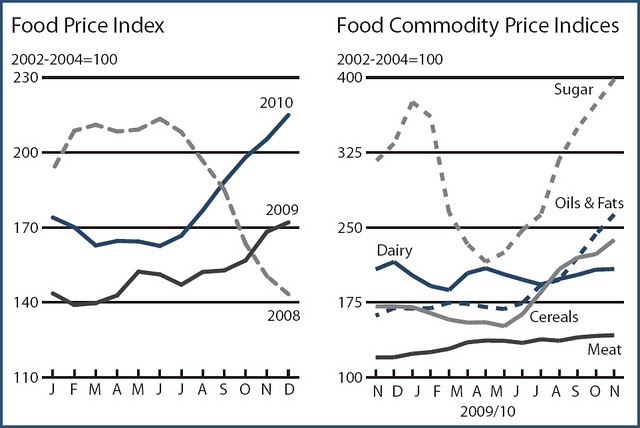
›If you’ve taken a trip to the supermarket lately or scanned the headlines you may have noticed something: Food prices are on the rise. Worldwide, food prices are on track to reach their highest point since their peak in 2008. Using data from the Food and Agriculture Organization (FAO), the International Food Policy Research Institute (IFPRI), and the World Bank, the Environmental Working Group (EWG) and ActionAid have collaborated to create an interactive world map called, “Hot Spots in the Emerging Global Food Crisis.”
The focus of the map is to highlight the 52 most at-risk countries where increases in staple food prices could tip the scales of stability. There are three variants of the map to choose from: countries at risk which depend on imported cereals, countries where prices are already increasing (featured above), and countries with vulnerable economies and high rates of hunger.Food prices have become a hot topic of conversation lately for their alleged role in the instability that is rocking the Middle East/North Africa region. But the Middle East is not the only area affected: Besides in Algeria, Tunisia, Morocco, Jordan, and Egypt, food-related riots and protests have also broken out in Mozambique, Bolivia, and India. As the map’s accompanying text puts it, these food riots “feed deeper discontent about economic inequalities and hunger and help give rise to revolutions that can topple governments, as in Tunisia and Egypt.”
Scrolling over a country reveals more information, like, for example, the specific percentage increases in the price of wheat or rice over the past year (wheat prices have risen 15.9 percent in China vs. 54 percent in Kyrgyzstan) or the amounts of corn, soybean, and wheat annually imported and exported (Afghanistan exported 908 million metric tons of wheat in 2010 while Egypt imported 4,978).
Users can also click on vulnerable countries to see how many people are malnourished and their per capita income per day. In the Democratic Republic of the Congo, for example, an estimated 42 million people were undernourished between 2005 and 2007, and the average person lives on $0.28 per day. According to EWG and ActionAid, the total number of people living in extreme poverty rose by 25 million in 2008 during the last global food crisis. Since June 2010, the start of the current upward trend in prices, the World Bank estimates that 44 million people have fallen into extreme poverty.
One recommendation from EWG and ActionAid for developed countries and the United States in particular: Stop looking to biofuels as an energy option. In their view, “spending scarce taxpayer dollars to shift crops from food to biofuels at the expense of hungry people and already stressed resources like soil, water, and air is unsustainable.”
Image Credit: Map courtesy of the Environmental Working Group and ActionAid, and Food Price Index and Food Commodity Indices, extracted from Global Food Price Monitor, January 2011, courtesy of the Food and Agriculture Organization.
Sources: ActionAid International, BBC News, CNN, the Environmental Working Group, The European Union Times, Time, Voice of America, World Bank. -
Watch: Richard Cincotta on Political Demography and Unrest in the Middle East
›March 9, 2011 // By Schuyler Null“Countries that have a high proportion of young people are typically more prone to political violence,” said demographer-in-residence at the Stimson Center, Richard Cincotta, in this interview with ECSP. “That is, not necessarily international war [but] internal conflict, which may take different forms,” including civil and ethnic strife, domestic terrorism, and violent political demonstrations.
The role of unemployed and angry youths in the recent unrest that has swept the Middle East has received a great deal of coverage, but though the region in general is very young, some countries are more so than others.
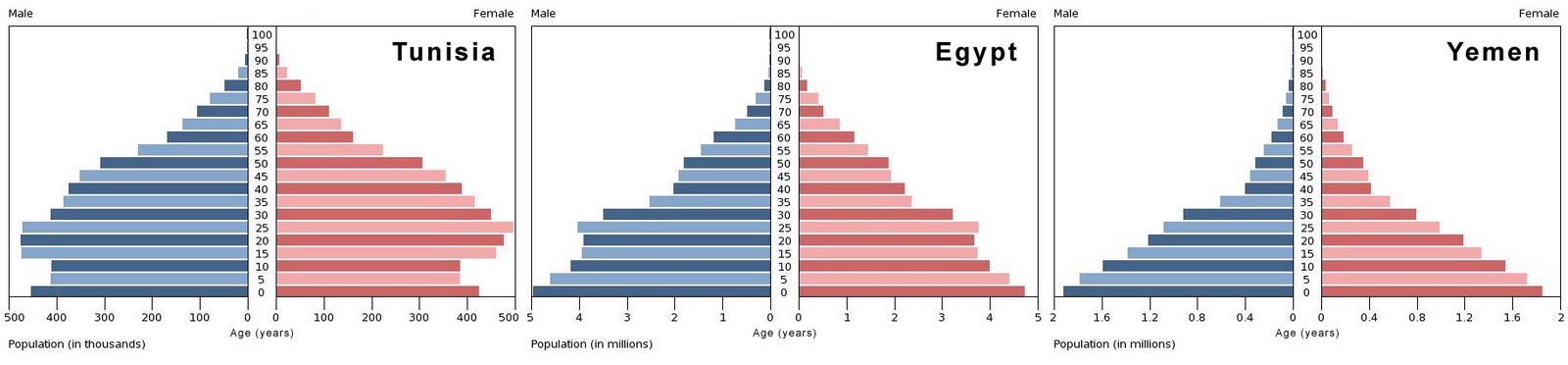
Tunisia (median age of 29) is actually well into its demographic transition, where fertility declines towards replacement level. “Fertility – the number of children women have in their lifetime – is now lower than it is in the United States,” said Cincotta. As a result, Tunisia’s prospects for achieving a stable, liberal democracy – based on the historical relationship between age structure and political freedoms (see Cincotta’s full post on Tunisia and the two follow-ups for a more complete treatment of that relationship) – are about even.
In contrast, Egypt’s age structure remains young (median age of 24) and Yemen’s (median age of 17) is extremely young. “Those difference are very stark,” said Cincotta, and they play out in the risk of political violence: Tunisia is less likely to experience continuing political violence; Egypt, more so; and Yemen, even more likely.
The relationships between age structure and political violence and the emergence of democratic institutions can be useful in other conflict-prone regions as well. “Afghanistan, Pakistan, Iraq, the Palestinian Authority, most of the central band of sub-Saharan Africa – from Nigeria to the Congo, to Kenya and Ethiopia – we know that these countries are volatile, we’re not always sure why,” said Cincotta. But “age structure gives you a clue, because it tells you something about a lot of barriers that are important to development.”
Sources: UN Population Division. -
Of Revolutions, Regime Change, and State Collapse in the Arab World
›The original version of this article, by David Ottaway and Marina Ottaway, was published by the Wilson Center’s Middle East Program.
With breath-taking speed, massive popular protests across the Arab world have swept away two Arab strongmen and shaken half a dozen monarchies and republics to their core. But the Arab world has yet to witness any fundamental change in ruling elites and even less in the nature of governance.
Libya now seems poised to be the first country to see a true change in governance, thanks to Muammar Qaddafi’s megalomania and his amorphous jamahiriya (state of the masses). But such change may not have a happy ending. The damage Qaddafi has inflicted on his country is likely to extend well past his demise because he leaves behind a weak state without functioning institutions.
The uprisings sweeping across the Middle East have similar causes and share certain conditions: authoritarian and ossified regimes, economic hardship, growing contrast between great wealth and dire poverty, all worsened by the extraordinarily large number of young people who demand a better future. But the consequences will not be the same everywhere.
Tunisia and Egypt: A System Still in Place
Pro-democracy protesters in Tunisia and Egypt have been quick to use the word “revolution” to describe their astounding achievement in forcing Presidents Zine el Abidine Ben Ali and Hosni Mubarak from power after decades of rule. Tunisia’s “Jasmine Revolution” and Egypt’s “January 25 Revolution” have certainly injected the long-silenced voice of the people into the autocratic politics of the region. But they have not brought to the fore a new ruling class, system of governance, or the profound social and economic changes associated with the classical meaning of revolution. And it remains to be seen whether they will succeed in doing so.
Continue reading at the Wilson Center’s Middle East Program.
Photo Credit: Adapted from “Libya-protests_025,” courtesy of flickr user Crethi Plethi. -
Yemen’s Revolt Won’t Be Like Egypt or Tunisia
›February 15, 2011 // By Schuyler NullInspired by the success of the recent Tunisian and Egyptian revolts, another key state in the Middle East is under pressure from youth-led unrest: Yemen. Again the United States must decide whether to support a corrupt autocrat (albeit one that has been helpful in the war on terror) or face the uncertainty of life without. The Saleh regime in Yemen has been in power for three decades, but major protests led by multiple opposition groups have forced recent concessions, including agreement that neither President Ali Abdullah Saleh nor his son will run for re-election in 2013.
-
Food Price Shocks and Instability Highlight Weaknesses in Governance and Markets
›Unrest across the Middle East has been front-page news for weeks, with commentators searching for explanations to account for the shifting political winds. Many, such as Thomas Friedman and Kevin Hall, have drawn connections between food prices and instability. But, as they point out, high food prices do not deterministically lead to unrest. Instead, rising prices highlight the degree to which governments and governance processes provide and ensure sustainable livelihoods for their people. What these and other commentators point to is that recognizing the role of government in providing food and security is vital: high food prices, they argue, don’t directly cause unrest, but high food prices in poorly managed countries creates a dangerous environment in which unrest may be more likely.
-
More on Tunisia’s Age Structure, its Measurement, and the Knowledge Derived
›February 4, 2011 // By Richard CincottaThis post is a response to the questions and comments that my fellow demographers Elizabeth Leahy Madsen, Jack Goldstone, and Jennifer Dabbs Sciubba put to my recent assessment of Tunisia’s chances for democracy. I’ve divided my response to address the principal questions. (Note: Throughout, “young adults” refers to 15-24 year olds, and “working age population” refers to those between 15-64 years old.)
1. Tunisia’s age structure is still quite young – aren’t the effects associated with youth bulge still at work?
Tunisia’s age structure (median age, 29 years) is in the early stages of transiting between the instability that typically prevails in countries with youthful age structures (median age <25), and the stability that is typical of mature structures (median age between 35 to 45). I classify Tunisia’s age structure as intermediate (between 25 to 35). The Jasmine Revolution has featured a mix of both types of sociopolitical behavior: some violence and property damage, perpetuated by both the state and demonstrators; evidence of a mature, professionally-led institution (the Tunisian army); and demonstrations that are peaceful and in which women and older people participate.
By any legitimate youth bulge measure, Tunisia’s age-structure is similar to that of South Korea, Taiwan, and Thailand’s during the mid-1990s. In 2010, Tunisia’s proportion of young adults in the working age population was almost precisely the same as South Korea’s in 1993. South Korea’s median age in 1993 was 28.5, compared to Tunisia’s 29 today.
Consistent with these numerical similarities, Tunisia’s political behavior is not much different than the sociopolitical events observed in South Korea, Taiwan, or Thailand in the early 1990s when these countries experienced an age structure of similar maturity. As these countries matured, political violence and destructive protests occurred less frequently but dissidence lingered in more peaceful, isolated incidents. For example, South Korea experienced several deadly anti-U.S. demonstrations in 1988-89 and only a few minor incidents in the early 1990s. By 1993, the public was demonstrating against extremism, and public protest had turned peaceful and symbolic.
Even today, public protest in Thailand (median age, 33 years) is commonplace. Thai political rights are constrained, and accordingly the country has been dropped in Freedom House’s annual assessment of political freedoms from “free” to “partly free.” However, unlike the student and worker riots that occurred sporadically throughout the 1970s and 80s, Thai demonstrations are typically non-confrontational political rallies attended by T-shirt-clad grandparents and families who bus into town for the event.
2. Why use the population’s median age rather than the youth bulge measures that political demographers (including me) have previously employed with considerable success?
I’m experimenting, and so far, I’ve found that median age replicates prior published results concerning civil conflict and stable liberal democracy. Median age’s ability to span the entire length of the demographic life-cycle of the state is its primary advantage. Youth bulge indicators do not; neither do indicators focused on working-age adults, nor those measuring seniors. In addition, median age integrates many factors that change in parallel with the age-structural transition, including income, education, women’s participation in society, secularization, and technological progress. Still, median age doesn’t track the youth bulge measures perfectly, so why use it?
Currently, foreign affairs policymakers see few linkages between a country’s (1) risk of civil and political violence; (2) its propensity to accumulate savings and human capital; (3) its chances of attaining stable liberal democracy; (4) the challenges that arise to adequately funding pensions and senior healthcare; and (5) rapid ethnic change in low fertility societies. Political demographers understand that these effects on the state are indeed related and that the rising and ebbing probabilities associated with these effects occur sequentially. Understanding this sequence is key to understanding the world’s international relations future. Median age allows political demographers to view that sequence.
As Jennifer Sciubba points out, the disadvantage of median age is its apparent lack of resonance with theories that have historically informed political demography, including theories of cohort crowding, dependent support, and life-cycle savings. I don’t believe that political and economic demographers should (or will) abandon these indicators, which help them observe the inner workings of age-structural phenomena. Nonetheless, I find it useful to make analysts aware of the advantageous and disadvantageous pressures that age structure exerts across the entire demographic life cycle of the state.
3. Can the deposed regime’s multi-faceted problems be captured by the age-structural transition?
No, age-structure cannot account for leadership – clumsy or deft, corrupt or honest. The method is limited to predictions that draw on sociopolitical behaviors that are associated with age structures, or by knowledge gained from deviations from these predictions. Nonetheless, I question the value of many of the after-the-fact observations of the Ben Ali Regime. Tunisia’s fallen regime was indeed oppressive, corrupt, and nepotistic – but so are most authoritarian regimes in Asia and Africa. Lack of job creation and preferential access to employment are valid grievances across much of the developing world, but the lack of informal sector statistics renders country comparisons difficult.
Some analysts have hypothesized that global warming has been a contributor (also applied to Egypt), others point to economic globalization and pressures on Tunisia’s middle class. Whether these assertions are wrong or right, it is difficult for me to see how such post hoc observations add to analysts’ knowledge of regime change or democratization or help them explain why other countries with similar problems have not undergone similar sociopolitical dynamics. In contrast, hypotheses based on quantitative relationships between age structural indicators and sociopolitical behaviors generate testable and repeatable predictions that can be checked and held accountable after an event.
What I find most surprising about the age-structural approach to predicting liberal democracy is how often states ascend to liberal democracy as they approach, or pass, the 0.50 probability mark. If either “triggers” of regime change or key institutions were very important, this observation would be unlikely.
A Concluding Note on Political Demography
If political demographers are serious about advancing policymakers’ ability to understand the present and future of global politics and security, political demography will have to become a scientific discipline – a field of study in which assertions are consistently tied to data and tested whenever possible. In many cases, though not all, we’re lucky – demographers provide us with timely estimates and projections at the national level. Nonetheless, for our field to succeed, political demographers must take full advantage of these data, encourage sub-national data to be collected and published, and make a clean break from the tradition of conjecture that currently pervades international relations.
Richard Cincotta is a consulting political demographer for the Wilson Center’s Environmental Change and Security Project and demographer-in-residence at the Stimson Center.
Sources: CIA World Factbook, Freedom House, Jadaliyya.
Image Credit: Adapted from “Viva the Tunisian Revolution,” courtesy of flickr user freestylee (Michael Thompson).
Showing posts from category Tunisia.