Showing posts from category Nigeria.
-
Nigeria Beyond the Headlines: Demography and Health [Part One]
›
“Nigeria is a country of marginalized people. Every group you talk to, from the Ijaws to the Hausas, will tell you they are marginalized,” said Peter Lewis, director of the African Studies Program at the Johns Hopkins University School of Advanced International Studies. Lewis spoke at an April 25 conference on Nigeria, co-hosted by ECSP and the Wilson Center’s Africa Program, assessing the country’s opportunities for development given its demographic, governance, natural resource, health, and security challenges. [Video Below]
-
PBS ‘NewsHour’ and Pulitzer Center Examine Water Shortage and Health Issues in Ghana and Nigeria
›The PBS NewsHour continued its collaboration with the Pulitzer Center on Crisis Reporting on international reporting last week with an episode on water infrastructure in Ghana and Nigeria. The coverage is especially apropos on World Water Day.
Correspondent Steve Sapienza spoke to reporters in Ghana and Nigeria to highlight long-running access and sanitation issues in both countries caused by poor infrastructure that has not kept up with growth.
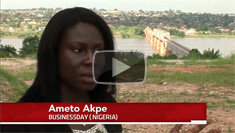
Ameto Akpe is a local reporter for Nigeria’s BusinessDay, where her stories “target the contradiction of a country with immense oil wealth and great water resources that are not reaching their citizens.” In the city of Makurdi, capital of the north-central Benue State, she reports on the hundreds of thousands of people who rely on either high-priced water delivery or untreated water drawn straight from the Benue River.
“The previous attempt to build a water treatment plant ended in scandal in 2008,” says Sapienza, “with an unfinished treatment facility and city officials unable to account for $6 million.”
“Unfortunately, the waterworks is only half of the solution to Makurdi’s water problem,” writes Akpe on the Pulitzer Center. “The other half is a system of pipes to deliver the water to the people – and that project is just a twinkle in the eye of a handful of contractors and bureaucrats.”
In Ghana, metro TV reporter Samuel Agyemang explains similar access and sanitation issues in the capitol of Accra and its suburb of Teshie, where some residents have waited decades for piped water, despite substantial foreign investments.
The Pulitzer Center’s Peter Sawyer explains in a companion piece that “the population of Accra has grown enormously in the past several decades. But the water supply system has not grown with it.” As a result, the Ghana Water Company is constantly playing catch-up to provide water to communities, many of whom do not understand how to demand accountability from their officials, says Agyemang.
According to UN estimates, Ghana’s population has increased by more than 10 million people since 1990. Nigeria is one of the fastest growing countries in the world, with 158 million people currently and the UN medium projection estimating a possible 389 million by mid-century.
Reporter Ameto Akpe will be speaking about Nigeria’s water and sanitation problems at an upcoming all-day event on Nigeria at the Wilson Center, scheduled for April 25.
Sources: PBS NewsHour, Pulitzer Center for Crisis Reporting, UN Population Division. -
Elizabeth Grossman, Yale Environment 360
How a Gold Mining Boom Is Killing Children in Nigeria
›March 5, 2012 // By Wilson Center StaffThe original version of this article, by Elizabeth Grossman, appeared on Yale Environment 360.
In early 2010, while working in the impoverished rural region of Zamfara in northwestern Nigeria, the group Médecins Sans Frontières – Doctors Without Borders – encountered many young children suffering from fevers, seizures, and convulsions. An unusually high number of very young children, many under age five, were dying, and there were many fresh graves.
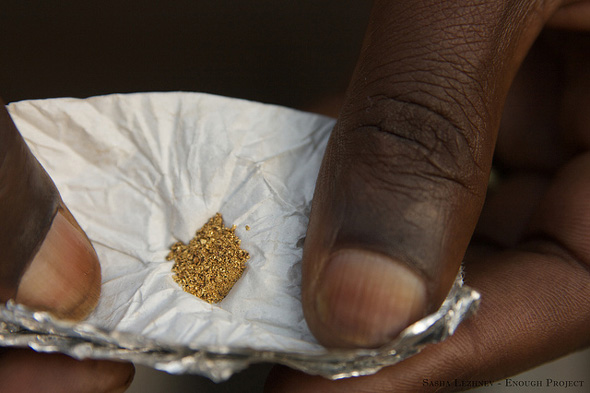
The doctors initially suspected malaria, meningitis, or typhoid, all common in the region. But when the sick children didn’t respond to anti-malarial drugs or other antibiotics, one of the physicians began to wonder if local mining activity might be implicated. Historically an agricultural area, Zamfara had been experiencing a small-scale gold rush, thanks to rapidly rising gold prices that encouraged the pursuit of even the most marginal sources of ore. Mining work was taking place in and around the villages and within many of the mud-walled compounds where families were using flour mills to pulverize lead-laden rocks to extract gold.
Médecins Sans Frontières (MSF) doctors sent children’s blood samples for testing and the results revealed acute lead poisoning. Many of the children had blood lead levels dozens, even hundreds, of times higher than international safety standards. Within a week, an emergency medical and environmental remediation team arrived and began to grapple with an epidemic of childhood lead poisoning that is being called unprecedented in modern times. In the past two years, more than 400 children have died in Zamfara, more than 2,000 have been treated with chelation therapy, and thousands more have been – and continue to be – severely poisoned by exposure to pervasive lead dust.
Continue reading on Yale Environment 360.
Photo Credit: “Conflict minerals 1,” courtesy of the ENOUGH Project/Sasha Lezhnev. -
Paul Francis, Deirdre LaPin, and Paula Rossiasco for the Africa Program
Securing Development and Peace in the Niger Delta: A Social and Conflict Analysis for Change
›Excerpted below is the introduction by Steve McDonald. The full report is available for download from the Wilson Center’s Africa Program.
This study, Securing Development and Peace in the Niger Delta: A Social and Conflict Analysis for Change, draws together a vast range of information about Nigeria’s delta region not previously available in a single publication. It richly illuminates the social history and underlying causes of unrest in the area. Equally important, the study adds to the empirical research available to us about conflict prevention and approaches to post-conflict reconstruction in regions harmed by the extraction of natural resources.
It examines the complex interactions between the social, political, economic, environmental, and security factors that drive and sustain conflict. It also reviews the main policy responses and initiatives that have already been brought to bear in the delta and maps out key policy options for the future.
Encouragingly, the study finds that many of the elements of sustainable pathways to development and peace already exist or can readily be realized. What is needed is a systematic framework and, most critically, a leadership consensus and the political will to marshal them. Nigeria’s development partners are already showing a renewed commitment to support solutions to the delta’s challenges. Imaginative dialogue and partnership between them and with critical stakeholders in government, the private sector, civil society, and communities holds the promise of yielding effective strategies for sustainable development and peace that befit the region’s unique character and history.
This study, then, emerges at a time of particular opportunity and hope. And yet it must be noted that the present time also holds a considerable potential risk. Without appropriate and thoughtful action, the legitimate aspirations of the citizens of the delta and their compatriots in Nigeria as a whole will, yet again, go unrewarded. For the Niger Delta today, any plan or project must be rooted in practical and active understanding of the origins and risks of conflict in order to sustain the momentum of peaceful development and avoid planning that does not take into account the dynamics of conflict and its core causes.
Finally, the importance of the issues dealt with in this study extends beyond the delta or Nigeria as a nation. They are much broader when viewed from Nigeria’s place in the sub-region and the world economy. While the delta is unique, there are also lessons that can be learned for other conflict situations, and especially for the expanding number of new oil producing countries along the Guinea coast. For all, the key lesson is that peace is hard work. It requires a leadership committed to equitable government, dialogue with citizens, and sustainable development.
Download the full report from the Wilson Center. -
UNEP Maps Conflict, Migration, Environmental Vulnerability in the Sahel
›A new set of maps from the United Nations Environment Programme (UNEP) identifies “climate hotspots” – areas vulnerable to instability exacerbated by climate change – in 17 sub-Saharan countries in and bordering the Sahel region. The maps reflect the fact that, more often than not, the impact of climate change on local populations is compounded by changes in migration, conflict, or both. According to Livelihood Security: Climate Change, Migration and Conflict in the Sahel, the UNEP report accompanying the maps, understanding “the exacerbating effect of changes in climate on population dynamics and conflict in the region” will be essential to developing successful adaptation strategies throughout the region.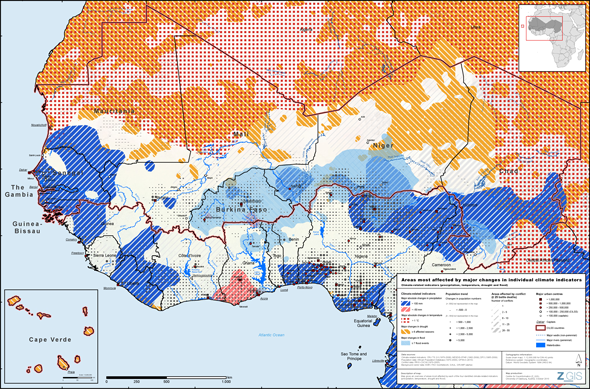
UNEP’s maps analyze 40 years of data to pinpoint where the region’s most at-risk populations are located based on environmental, population, and conflict trends dating back to 1970. In a single map pinpointing the Sahel’s 19 hotspots, UNEP synthesizes subnational data from four environmental indicators over time – rainfall (from 1970 to 2006), temperature changes (1970 to 2006), drought (1982 to 2009), and flooding (1985 to 2009) – which are then layered on top of population trends (1970 to 2010) and conflict data (1970 to 2005) in order to identify the region’s most insecure areas.
Composite Vulnerability
At first glance, the map can appear hard to decipher; it is flooded with different colors and symbols, each indicating something different about the extent of climate change, migration, and conflict in the region. A Google Earth version of the map (available for download here) makes all this information easier to process by allowing users to select which indicators they want to see mapped out, cutting back on the number of lines, dots, colors, and pie charts the user has to decode.
Given the vast amount of the information being condensed into these maps, the report is a helpful and worthwhile read. For instance, eight hotspots are in places with growing populations and another seven are located in places that have experienced conflict; altogether, 4 of the 19 hotspots have both past conflict and growing populations. The report digs deeper into the confluence of climate, conflict, and migration by discussing case studies that highlight how the three intersect in local communities (at the same time, the report is careful to avoid suggesting that there is a causal relationship between the three issues.). In Niger, Nigeria, and Chad, for example, tensions have been mounting between northern pastoralists and southern farmers as each group has moved further and further afield in search of water and arable land to sustain their livelihoods.
Holes In the Data
While the hotspot maps include a wealth of information, the report makes clear that it is by no means exhaustive. Rising sea levels are, for instance, a major impending threat to coastal populations in the Sahel, but only the downloadable Google Earth map – not the hotspot map in the report or the Google Earth map as presented online – incorporates this factor. Compounded with a skyrocketing population in the coastal areas – the coast between Accra and the Niger delta is expected to be “an urban megalopolis of 50 million people” by 2020, according to the report – an increase in sea levels could have a huge impact on the region’s stability.
The report also readily admits that the datasets for population trends and conflict have shortcomings. Population data is largely based on censuses, which both the report and its data sources (UNEP’s African Population Database and the Gridded Population of the World, version 3) acknowledge can be inconsistent in their accuracy. Additionally, after 2000, population data is based on projections rather than estimates, which, as last year’s update from the UN Population Division showed, have often proven inaccurate, particularly in sub-Saharan Africa.
Regarding conflict, the UNEP report is straightforward in admitting its limits. The report lacks data on small-scale conflict (fewer than 25 battle deaths, following the Uppsala Conflict Data Program’s threshold that separates conflicts from lower-level violence), even as it acknowledges that such conflict is “often the first to occur” when climate change threatens communities’ access to resources and livelihoods.
Ultimately, however, these maps give valuable data on specific locations that are uniquely vulnerable to trends in population, climate, migration, and conflict. They add focus to the conventional wisdom that climate change will impact the region’s stability, and, taken together, the maps and the report provide a valuable resource for scholars and policymakers attempting to craft adaptation policies that take into consideration these complex links.
Sources: Socioeconomic Data and Applications Center at Columbia University’s Earth Institute, UNEP, Uppsala Conflict Data Program.
Image Credit: UNEP. -
Engaging Faith-Based Organizations on Maternal Health
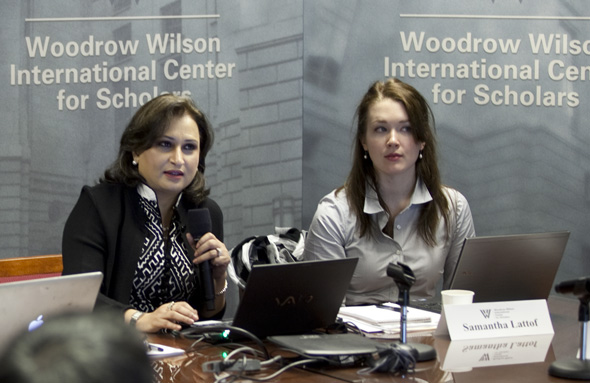
›“Faith-inspired organizations have many different opportunities [than non-faith-based NGOs]. The point that is often reiterated is that religions are sustainable. They will be there before the NGOs get there and will be there long after,” said Katherine Marshall, executive director of the World Faiths Development Dialogue at the Wilson Center on November 16. Marshall noted in her opening remarks that maternal health should be an easy issue for all groups, regardless of religious tradition, to stand behind. Yet, in reality, maternal health is a topic that “very swiftly takes you into complex issues, like reproductive health, abortion, and family planning,” she said.
As part of the Advancing Dialogue on Maternal Health series, the Woodrow Wilson International Center for Scholars’ Global Health Initiative collaborated with the World Faiths Development Dialogue and Christian Connections for International Health to convene a small technical meeting on November 15 with 30 maternal health and religious experts to discuss case studies involving faith-based organizations in Bangladesh, Nigeria, Pakistan, and Yemen. The country case studies served as a springboard for group discussion and offered a number of recommendations for increasing the capacity of faith-based organizations (FBOs) working on maternal health issues.
Engaging Religious Leaders in Pakistan
“When working with religious leaders to improve maternal health there are some do’s and don’ts,” said Nabeela Ali, chief of party with the Pakistan Initiative for Mothers and Newborns (PAIMAN). Ali described a PAIMAN project that worked with 800 ulamas (religious leaders) to increase awareness about pregnancy and promote positive behavior change among men.
One of the “do’s” highlighted by Ali was the need to build arguments for maternal health based on the Quran and to tailor terminology according to the ulamas preferences. The ulamas who worked with PAIMAN did not want to utilize the word “training,” so instead they called their education programming “consultative meetings.” More than 200,000 men and women were reached during the sermons and the strategy was been picked up by the government as one of the best practices written into in the Karachi Declaration, signed by the secretaries of health and population in 2009.
Despite the successes of the program, Ali warned against having unrealistic expectations for religious leaders interfacing with maternal health. She stressed the importance for having a long-term “program” approach to the issue, as opposed to a short-term “project” framework.
Behavior Change in Yemen
“Religion is a main factor in decisions Yemeni people make about most issues in their lives and religious leaders can play a major role in behavior change,” said Jamila AlSharie a community mobilizer for Pathfinder International.
Eighty-two percent of Yemeni women say the husband decides if they should receive family planning and 22 percent say they do not take contraception because they belief it is against their religion and fertility is the will of God, said AlSharie. Therefore, the adoption of healthy behavior change requires the involvement of key opinion leaders and the alignment of messages set in religious values. Trainings with religious leaders included family planning from an Islamic perspective, risks associated with early pregnancy, nutrition, education, and healthcare as a human right.
Male Participation a Key Strategy
“As a faith-based organization we believe it is a God-given right to safe health care and delivery so we mobilize communities to support pregnant women to address their needs, educate families about referrals and existing services in the community,” said Elidon Bardhi, country director for the Bangladesh arm of the Adventist Development and Relief Agency (ADRA).
Through female-run community organizations, ADRA educates men and women about the danger signs of labor and when to seek care. For example, many men in Bangladesh hold the belief that women should eat less during pregnancy to ensure a smaller baby is born, thereby making delivery easier, said Bardhi. ADRA addressed such misconceptions through a human rights-based approach and emphasized male participation as a key strategy, ensuring there were seven male participants for every one female.
A Culturally Nuanced Approach in Nigeria
The Nigerian Urban Reproductive Health Initiative (NURHI) is a public-private partnership that identifies and creates strategies for integrating family planning with maternal health. According to Kabir Abduallahi, team leader of NURHI, “family planning” is not as acceptable a term as “safe birth spacing” in Nigeria, so the project highlighted how family planning can help space births and save lives.
Religion and culture play an important role in the behavior of any community. The introduction of a controversial healthcare intervention (such as family planning) in a religiously conservative community requires careful assessment of the environment and careful planning for its introduction, said Abduallahi. Baseline surveys and formative research data helped NURHI understand the social context and refine intervention strategies.
Ten Ways to Increase the Capacity of FBOs
Faith-based organizations’ close links to communities provide them with an opportunity to promote behavior change and address other cultural factors contributing to maternal mortality rates such as early marriage and family planning.
Working in collaboration with FBOs and other stakeholders is critical to promoting demand for maternal and reproductive health services; however, there is limited knowledge about faith-based maternal healthcare and FBOs are often left off the global health agenda. In conclusion, Marshall noted 10 areas the group identified as areas to focus on:- Move projects to programs: Projects are often donor driven and limited in scope and duration. Donors and policymakers should move from project-oriented activities to local, regional, and national-level advocacy programs to build sustainable change.
- Coordinate, coordinate, coordinate: Significant resources are wasted due to a lack of coordination between FBOs and development agencies. A country-level coordinating mechanism should be developed to streamline efforts not only between agencies but also across faiths.
- Context, context, context: A thorough understanding of the local culture and social norms is imperative to successful program implementation.
- Terminology is important: In Pakistan, religious leaders redefined sensitization meetings around family planning and maternal and child health as “consultative meetings” not “trainings.” In Nigeria, the culture prefers “child birth spacing” over “family planning.” In Yemen, it’s “safe age of marriage” instead of “early childhood marriage.”
- Most religious leaders are open and with adequate information can produce behavior and value changes. Utilizing the Quran, Hadith, and Bible can support arguments and emphasize the issue of health and gender equity.
- Relationship building: Winning the trust of religious leaders can be difficult and time-consuming but is necessary for opening doors to patriarchal societies.
- Rights-based approach: A human rights-based approach can be a very powerful agent of change for addressing negative social structures such as violence against women, but it can also create controversy. In Bangladesh, ADRA utilized the approach to educate men about nutrition, dowry and child marriage, and education of women.
- Networks: There is a significant need to create forums that bring together the various FBO and global development communities in order to share knowledge and enhance advocacy messages. Networks are needed to streamline resources and inventory existing research, projects, and faith-based models that work.
- Monitoring and evaluation systems: There is a striking lack of data about the impact and outcomes of FBOs. Increasing the monitoring and evaluation skills of FBO workers can improve evaluation systems and meet the demand for new data.
- There needs to be greater political will for engaging the faith-inspired community.
Event ResourcesPhoto Credit: David Hawxhurst/Wilson Center. -
Jake Naughton, Pulitzer Center for Crisis Reporting
Pulitzer Center Launches Collaborative Reporting Project on Reproductive Health
›The original version of this article, by Jake Naughton, appeared on the Pulitzer Center for Crisis Reporting blog.
The Pulitzer Center launched its collaborative reproductive health-reporting project at this year’s International Conference on Family Planning (ICFP) in Dakar, Senegal. The project brings together four journalists from Africa and four from the United States who will collaborate to enhance local and international reporting about reproductive health across the continent.
The African journalists are Mae Azango of Liberia, Estelle Ellis of South Africa, Sam Olukoya of Nigeria, and Ken Opala of Kenya. Their U.S. counterparts are Christian Science Monitor correspondent Jina Moore; New Yorker editorial staffer Alexis Okeowo; and the Pulitzer Center’s managing director Nathalie Applewhite and visual media coordinator Jake Naughton.
More than two thousand reproductive health professionals and hundreds of journalists from all over the world participated in the conference, which sought to shine a spotlight on the unmet need for family planning services worldwide, and to focus on integrating family planning into general health services.
Continue reading on the Pulitzer Center for Crisis Reporting blog.
Video Credit: “Meet the Journalists: Dakar,” courtesy of the Pulitzer Center. -
Climate Change, Uncertainty, and Conflict in the Niger River Basin
›New research on the Niger River Basin finds that the effects of climate change in the region are pervasive and that “latent conflict” between groups – disagreements and disputes over damage to farmland and restricted access to water, but not physical violence – is common.
“You’ve got vulnerable people, vulnerable households, vulnerable communities living within…fragile systems – governance systems [and] environmental systems,” said Phil Vernon, International Alert’s director of programs for Africa and peacebuilding issues, at “Climate Change, Water, and Conflict in the Niger River Basin,” an event hosted by the Wilson Center on November 17. [Video Below]
Together with his colleagues Lulsegged Abebe and Marisa Goulden of the University of Anglia, Vernon examined how communities in Mali, Nigeria, and Niger have been impacted by climate change, how they have adapted to those impacts, and whether these changes spurred conflict.
Competition Over Dwindling Resources
Climate change destabilizes communities by adding uncertainty and stress, Vernon said, and when a community is already vulnerable, the impacts of those uncertainties and stresses are amplified and the potential for conflict is greater. In every community examined in the study, climate-induced vulnerability led to some kind of conflict. More often than not, however, that conflict took the form of disagreements, or “latent conflict,” rather than violent conflict – a reason for optimism in the face of dire predictions that an era of climate wars is upon us.
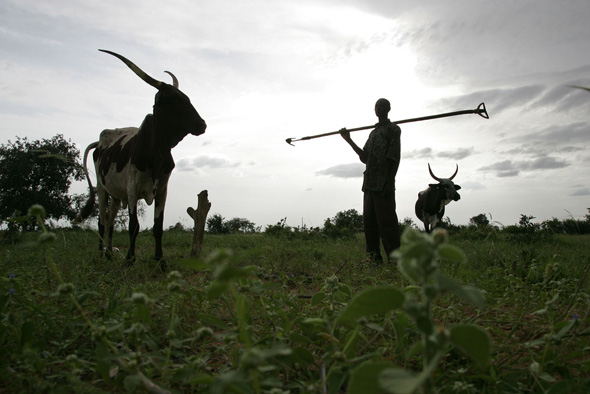
Throughout the basin, river flows and rainfall have been decreasing since the 1970s, said Goulden, creating tension between two of the major communities living in the basin – farmers and pastoralists. Pastoralists are forced to travel farther to bring their herds to water, while farmers are expanding their cropland to feed growing populations, reducing the pathways available to herders and their livestock.
Unfortunately, poor policy decisions have made tensions worse in some places. In Lokoja, Nigeria, for example, the government began dredging the Niger River in 2009 to improve commercial shipping. Officials said the dredging would reduce flooding, but in 2010, farmers suffered immensely from floods. The government’s false promises increased the farmers’ vulnerability, said Goulden, because, expecting to be protected from flooding, they were not adequately prepared, making the damage worse.
As a result, farmers are now building homes and developing cropland further away from the river, reducing land available to pastoralists and increasing the potential for conflict between the two communities.
Increased Resilience Is a “No-Brainer”
Climate in the Niger River Basin is marked by a high degree of variability – rainfall, river flows, and temperature already fluctuate a great deal and could become even more variable in the future, said Goulden.
That uncertainty has important implications for how people think about responding to climate change, said Abebe. “Development and adaptation policies must be flexible enough to cope with extreme variability both in the wetter and the dry conditions in the Niger River Basin,” he said.
Boosting resilience will be key to ensuring that vulnerable communities have the flexibility they need to respond to future crises, Vernon said.
“If the interaction of stress and vulnerability is the problem…it’s somewhat of a no-brainer that increased resilience is part of the answer,” said Vernon. And decisions on how to increase resilience “should be made at the lowest appropriate level…from high policy down to household and individual decisions.”
Different People, Different Levels of Resilience
Vernon’s emphasis on making decisions at the “lowest appropriate level” reflects the reality that various communities – and individual community members – experience climate change in different ways. Fostering adaptation strategies that take these variations into consideration will be an essential strategy for avoiding climate-driven conflict in the future.
In Mali, the Niger River flooded downstream of the Selingué Dam in 2001 and 2010, and in each case, researchers found divergent responses to the crises.
In the lead-up to the 2001 flood, dam operators had been intentionally keeping reservoir levels high in anticipation of increased demand for hydroelectric power during an upcoming soccer championship match. When heavy rains hit the area, though, the operators were forced to release huge amounts of water over a short period of time, causing massive flooding downstream.
In the flood’s aftermath, downstream farmers were able to successfully sue the power company for their losses, but downstream pastoralists had no comparable option. The pastoralists were therefore more vulnerable to the flood’s long-term impacts.
Responses differed within communities as well, often breaking down along gender lines. In 2010, when floods hit Mali again, men “were trying to help people move away from the flood water, and then afterward with rebuilding of homes,” said Goulden, “whilst women are concerned with finding shelter, cooking, and caring for the sick, elderly, and children.”
No “Massive Risk of Violence” in the Near Future
Policymakers are left with an urgent crisis – climate change – and a solution that is inherently time-intensive: building resilience in vulnerable communities down to the individual level, said Vernon.
“There is a risk of undermining the elements of resilience which exist already in responding too rapidly and too urgently based on the anxieties we have to the problem of climate change and insecurity,” he cautioned.
Fortunately, although the threat of climate change is urgent, Vernon said that the risk of that threat spilling over into violent conflict is still a long way off. “I think policymakers have got to be thinking about where might this lead,” he said, “but at the moment, in terms of this research, there was no evidence that there’s a massive risk of violence happening any time soon.”
Event Resources
Sources: AlertNet, BBC, International Alert.
Photo Credit: “Cattle manure millet field in Niger,” courtesy of flickr user ILRI (International Livestock Research Institute).