-
Minority Youth Bulges and the Future of Intrastate Conflict
›October 13, 2011 // By Richard Cincotta
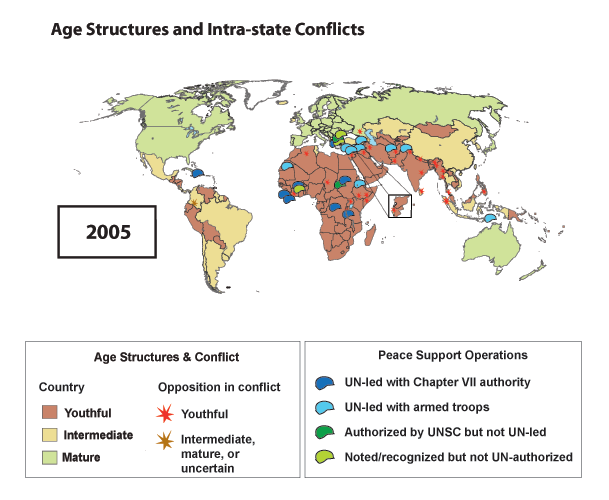
From a demographic perspective, the global distribution of intrastate conflicts is not what it used to be. During the latter half of the 20th century, the states with the most youthful populations (median age of 25.0 years or less) were consistently the most at risk of being engaged in civil or ethnoreligious conflict (circumstances where either ethnic or religious factors, or both, come into play). However, this tight relationship has loosened over the past decade, with the propensity of conflict rising significantly for countries with intermediate age structures (median age 25.1 to 35.0 years) and actually dipping for those with youthful age structures (see Figure 1 below).
-
Aaron Wolf on Water Management, Agriculture, and Population Growth in the Middle East
›In terms of groundwater depletion, “Yemen and Gaza are probably the two places worst off in the Middle East,” Aaron Wolf told ECSP in a recent interview. Wolf, a water expert and geography professor at Oregon State University, said population growth across the broader Middle East region has led to intensified groundwater pumping in recent years. This trend has raised the prospects for water-related conflict down the road, as countries drain their groundwater stocks faster than the aquifers can recharge. Potentially complicating matters further, said Wolf, is that most aquifers in the Middle East cross international boundaries.
Despite the region’s history of water tensions, Wolf said the unprecedented level of demographic change currently being experienced across the Middle East is not necessarily a recipe for future confrontations over the resource, in part thanks to the existence of water-sharing agreements in the area. Nevertheless, mounting demand will likely force water-users across the region – especially within the agriculture sector – to change the ways they utilize the resource.
Accounting for 80 to 90 percent of total water usage in some Middle Eastern countries, agricultural operations have already been forced to adjust to the evolving water-access situation. While moving from flood irrigation to drip irrigation represents one policy option if sufficient funds are available, Wolf said doing away with local food production “is a path that a lot of countries are going to have to take” to ensure a relatively stable water supply for their populations’ drinking, cooking, and cleaning needs.
Wolf added that one frequently discussed but not entirely realistic option for addressing the region’s water-supply concerns involves desalination. To date, widespread deployment of the technology has been hampered by high costs and substantial energy requirements, although that hasn’t stopped a few countries in the region – among them the United Arab Emirates, Saudi Arabia, and Israel – from becoming partially reliant on converted fresh water.
Wolf maintained that desalination’s hefty price tag means the technology is useful only for urban population centers near the coast. Moving converted sea water further inland remains a non-starter, he said, because transporting it requires an enormous amount of energy (a cubic meter of water weighs a metric ton).
For the same reasons, Wolf asserted, using desalinated water for agriculture doesn’t seem to be in the cards any time soon. “Right now a cubic meter of desalinated water costs about 40 cents, and you can’t use that for agriculture unless it drops down to about 8 cents a cubic meter,” Wolf said. “So until you can irrigate with desalinated water, it really doesn’t go a long way towards mitigating the larger water crisis.”
The “Pop Audio” series is also available as podcasts on iTunes.
Sources: American University, International Food Policy Research Institute, World Bank. -
Youth Bulge and Societal Conflicts: Have Peacekeepers Made a Difference?
›August 22, 2011 // By Richard CincottaUntil recently, the question of which countries are at the most risk of violent societal conflict could be answered with a terse, two-part response: “the young and the war-torn.” This simple characterization regarding youth and conflict worked well, until the first decade of the 21st century. The proportion of youthful countries experiencing one or more violent intrastate conflicts declined from 25 percent in 1995 to 15 percent in 2005. What’s behind this encouraging slump in political unrest? One hypothesis is that peace support operations (PSOs) – peacekeepers, police units, and specialized observers that are led, authorized, or endorsed by the United Nations – have made a difference.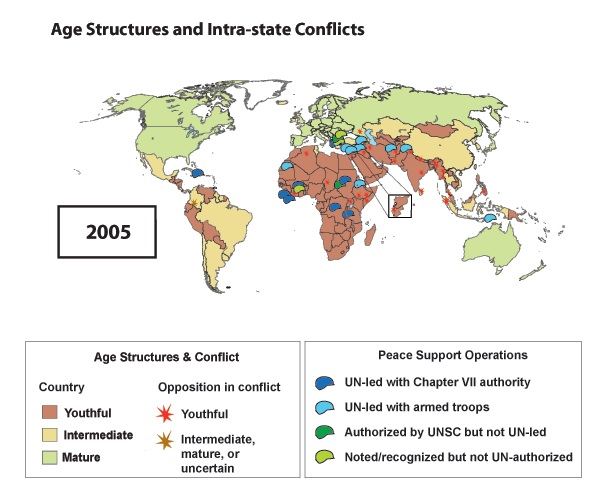
From the 1970s through the 1990s, more than 90 percent of all societal conflicts broke out in countries with a youthful age structure – a population with a median age of 25 years or less. And wherever civil and ethnic wars emerged, they tended to persist. The average societal conflict that began between 1970 and 1999 continued without a one-year break in battle-associated fatalities for about six years. Some – including the Angolan civil war, Northern Ireland’s “Troubles,” Peru’s war against the Shining Path, and the Afghan civil war – endured for decades. In contrast, inter-state conflicts that began between 1970 and 1999 lasted, on average, less than two years (see the UCDP/PRIO Conflict Database).
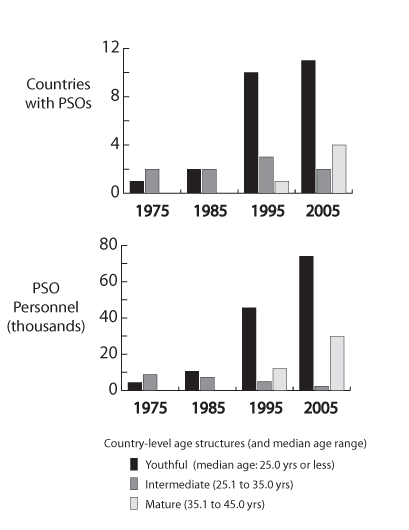
Taking on Intra-State ConflictsBeginning in the early 1990s, however, there was a marked expansion in size and number of PSOs deployed in the aftermath of societal warfare, which appears to have dampened the persistence of some conflicts and prevented the reemergence of others. The annual number of active PSOs deterring the re-emergence of societal conflict jumped from just 2 missions during 1985 to 22 in 2005. In contrast, those led, authorized, or endorsed by the UN to maintain cease-fire agreements between neighboring states during that same period only increased from three active missions to four. By 2009, nearly 100,000 peacekeepers were stationed in countries that had recently experienced a societal conflict. About 70 percent were deployed in countries with a youthful population (see Figures 2A and B). Why the sudden expansion in use of PSOs?
According to William Durch and Tobias Berkman, this upsurge was less a change of heart or modification of a global security strategy and more an outcome of the unraveling web of Cold War international relations. Before the 1990s, the majority of PSOs were United Nations-led operations that were mandated to monitor or help maintain cease-fires along mutual frontiers. Because insurgents were typically aligned with either the Soviets or a Western power, Security Council authorization to mediate a societal conflict was difficult to secure.
This situation changed with the breakup of the Soviet Union and the initiation of PSOs by regional organizations, including operations by the Economic Community of West African States (ECOWAS) in Liberia and Sierra Leone and the NATO-led Kosovo Force in 1998-99.
Demographic Forecasting
What do national demographic trends suggest for the demand for PSOs over the next two decades? For societal conflict, political demographers foresee that the demand for PSOs will continue to decline among states in Latin America and the Caribbean – with the exception of sustained risk in Guatemala, Haiti, Bolivia, and Paraguay. Similarly, demand for peacekeeping is expected to continue to ebb across continental East Asia.
Gauged by age structure alone, the risk of societal warfare is projected to remain high over the coming two decades in the western, central, and eastern portions of sub-Saharan Africa; in parts of the Middle East and South Asia; and in several Asian-Pacific island hotspots – Timor-Leste, Papua New Guinea, the Philippines, and Solomon Islands. But even in some countries that are losing their youthful blush, domestic political relations could turn out less rosy than this simple age-structural model forecasts.
In other words, there are roadblocks to a “demographic peace.” Among them is an increasing propensity for a specific demographic configuration of ethnic conflict: warfare between state forces and organizations that recruit from a minority that is more youthful than the majority ethnic group. Examples of these conflicts include the Kurds in Turkey, the Shiites in Lebanon, the Pattani Muslims in southern Thailand, and the Chechens of southern Russia.
However, this twist on the youth bulge model of the risks of societal conflict is a discussion for another installment on New Security Beat. Suffice it to say that when political demographers look over the UN Population Division’s current demographic projections, they see few signs of either the waning of societal warfare, or the withering of the current level of demand for PSOs.
Richard Cincotta is a consultant on political demography for the Wilson Center’s Environmental Change and Security Program and demographer-in-residence at The Stimson Center.
Sources: PRIO, The Stimson Center, UN Population Division.
Chart Credit: Data courtesy of the UN Population Division 2011, PRIO, and Durch and Berkman (2006). Arranged by Richard Cincotta. -
Russell Sticklor, World Politics Review
The Hungry Planet: Global Food Scarcity in the 21st Century
›August 16, 2011 // By Wilson Center StaffThe original version of this article, by Russell Sticklor, appeared on World Politics Review.
At the dawn of the 20th century, the world population was inching toward a modest two billion. In the 111 years since, notwithstanding the impact of war, genocide, disease, and famine, the global population has soared, reaching three billion around 1960 and now quickly approaching the neighborhood of seven billion. By 2050, the planet will likely be home to two billion more.
We may not be witnessing the detonation of the “population bomb” that Paul Ehrlich warned of in his seminal 1968 book, but such rapid demographic change is clearly pushing the international community into uncharted territory. With a limited amount of arable land and a finite supply of fresh water for irrigation, figuring out how to feed a planet adding upward of 70 million people each year looms as one of the 21st century’s most pressing challenges.
The push to ensure global food security transcends the desire to avoid repeating the famines that devastated the Soviet Union, China, North Korea, Ethiopia, and so many other corners of the world during the past century. Instead, aid and development organizations today rightly view food insecurity problems as deeply intertwined with issues of economic development, public health, and political stability, particularly in the developing world. To maintain order in the international community and prevent the emergence of new failed states in the decades ahead, it will be critical to find innovative means of feeding the rapidly growing populations of sub-Saharan Africa, the Middle East, and South and East Asia.
Continue reading on World Politics Review.
Note: World Politics Review has graciously white-listed all entrances from NSB for this article, so as long as you use the above link, you should be able to read the full article for free.
Russell Sticklor is a consultant for the Environmental Change and Security Program.
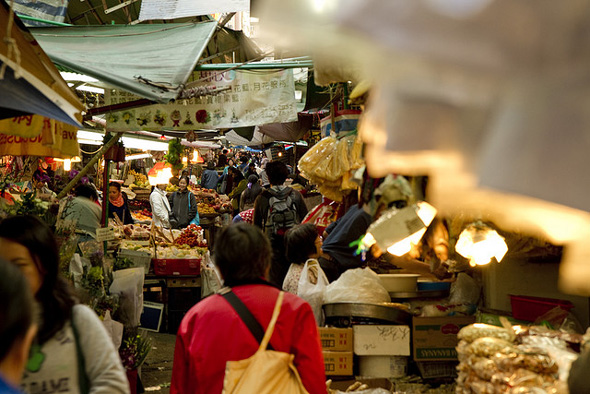
Photo Credit: “Crowded market street,” courtesy of flickr user – yt –. -
PRB’s Population Data Sheet 2011: The Demographic Divide
›August 9, 2011 // By Kellie Furr“Today, most population growth is concentrated in the world’s poorest countries – and within the poorest regions of those countries,” write the authors of the 2011 Population Data Sheet, an analysis tool published annually by the Population Reference Bureau (PRB). The population projections between poor and rich countries are “stark and very sad,” said Carl Haub Haub, senior demographer at PRB, at the July 28 web-based launch of the Data Sheet: “We call it the demographic divide. It shows the vast difference that has developed between the rich and poor countries of the world.”
The Population Data Sheet offers insight on global population trends using detailed statistical information along 18 demographic, population, health, and environment indicators for more than 200 countries and regions. The data sheet is based on the latest projections of the UN Population Division. Carl Haub and James Gribble of PRB discussed the long-term implications of the data sheet’s projections during web-based launch that included open questions.
Conflicting Trends
“Even though the world population growth rate has slowed from 2.1 percent per year in the late 1960s to 1.2 percent today, the size of the world’s population has continued to increase – from 5 billion in 1987, to 6 billion in 1999, and to 7 billion in 2011,” write the authors in PRB’s July Population Bulletin, “The World at 7 Billion.” To put those population totals into perspective, it took from the inception of human existence until the year 1800 – a total of approximately 50,000 years – to reach the first billion.
Fortunately, the recent (relative) decline in global growth rate has already curbed what could have been a considerable surge in the world’s population: “If the late 1960s population growth rate of 2.1 percent – the highest in history – had held steady, world population would have grown by 117 million annually, and today’s population would have been 8.6 billion,” said PRB President Wendy Baldwin in a press release. However, the world’s population still grows significantly at 77 million people annually, according to the UN, and we’re slated to reach 8 billion in just another 12 years. How can this dichotomy of large population totals in the face of lowered fertility be explained?
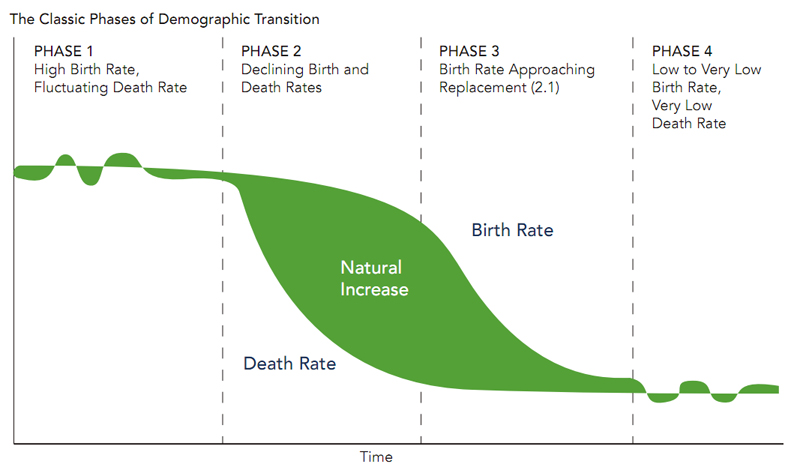
The Phases of Demographic Transition
“To understand global, we actually have to think local,” said PRB in their film short, “7 Billion and Counting,” released alongside the data sheet. Individual countries go through demographic transitions at different times, and the disparity in where countries are along in their progression varies greatly.
A demographic transition essentially hinges on two trends: the decline of birth and death rates over time. These trends do not necessarily change simultaneously however, resulting in most cases, first, a natural increase (when mortality rates decline but birth rates remain high) followed by a natural decrease in population (when birth rates also decline). Though the timing and magnitude of these trends differ from place to place, there are broad similarities across countries which have been conceptualized as phases by demographers, such as Carl Haub and James Gribble.Phase one is characterized by high birth rates and fluctuating death rates, found in countries such as Niger, Afghanistan, and Uganda; typically only death rates decline in this phase. Phase two, encompassing mostly lower-middle income countries such as Guatemala, Ghana, and Iraq, is marked by a continued decline in death rates but only slightly lower birth rates. The potential for large population growth exists in these countries, as they still possess a large youth population.
Countries in phase three have yet lower birth and death rates and overall total fertility rates close to the widely-accepted replacement level of 2.1 children per woman; these countries are home to approximately 38 percent of the world’s population and include India, Malaysia, and South Africa. Phase three countries often still possess a disproportionately large working age population as an echo of their previous growth, which allows them to take advantage of the “demographic dividend.”
Finally, phase four countries have the lowest birth and death rates, with some even seeing negative growth as total fertility rate falls at or below the natural replacement rate; countries in this phase include most of Europe and other developed countries, such as Japan and the United States (though relatively high levels of immigration keeps overall growth higher).
The data sheet shows that most developing countries still remain in the earlier phases of demographic transition, especially those in sub-Saharan Africa and the Middle East. Relatively recent public health improvements in these countries have decreased death rates at a rapid rate, and though total fertility rates (TFR) have declined as well, they have not kept the same pace: “This lag between the drop in death rates and the drop in birth rates produced unprecedented levels of population growth,” wrote Haub and Gribble in the Population Bulletin.
A Tale of Two Worlds
The data sheet authors observe that poverty is strongly associated with countries which are stalled in their progression through the demographic transition:Poverty has emerged as a serious global issue, particularly because the most rapid population growth is occurring in the world’s poorest countries and, within many countries, in the poorest states and provinces…Relatively high population growth rates make it more difficult to lift large numbers of people out of poverty.
In her primer video on demographic security for ECSP, demographer Elizabeth Leahy Madsen said, “we are in an era of unprecedented demographic divergence,” and characterized the phenomenon of population trends moving simultaneously in different directions as “rapid” and “unprecedented.”
Haub used Italy and the Democratic Republic of Congo (DRC) as an example to illustrate the divide. Although both countries currently sit at around 60 million people each, Italy is only projected to grow by 2 million through 2050, while the DRC is projected to reach a staggering 149 million people. Italy has a gross national income per capita of about $35,000, whereas DRC has only $180 per capita, according to the World Bank.
This observation has been corroborated by other demographers: “In 1950, 68 percent of the world’s population resided in developing regions. Today that’s up to 82 percent. But in the year 2050, it’s projected to be 86 percent,” said demographer David Bloom on NPR’s global health blog, Shots.
Demography ≠ Destiny
A poor country is not necessarily tethered to its projections, which are based on assumptions, said the authors, “but when, how, and whether [the demographic transition] actually happens cannot be known.”
Low development indicators do not always dictate that a country will lag in a demographic transition. “Government commitment to a policy to lower [birth rates] has succeeded quite well in countries with a low level of development,” said Haub in a 2008 PRB discussion on the demographic divide. Bangladesh and Iran are two examples of countries that significantly affected their demographic trajectories in the 20th century with targeted programs.
Proactivity certainly plays a role, as the PRB “7 Billion and Counting” video puts it (see above): “Understanding how and why the world’s population is growing will help nations better plan for the future…and for future generations.”
Sources: NPR, Population Reference Bureau, UN-DESA, UNICEF, World Bank.
Video and Image Credit: “7 Billion and Counting,” courtesy of PRB’s Youtube channel, and stages of demographic transition courtesy of PRB’s 2011 Population Data Sheet. -
In Rush for Land, Is it All About Water?
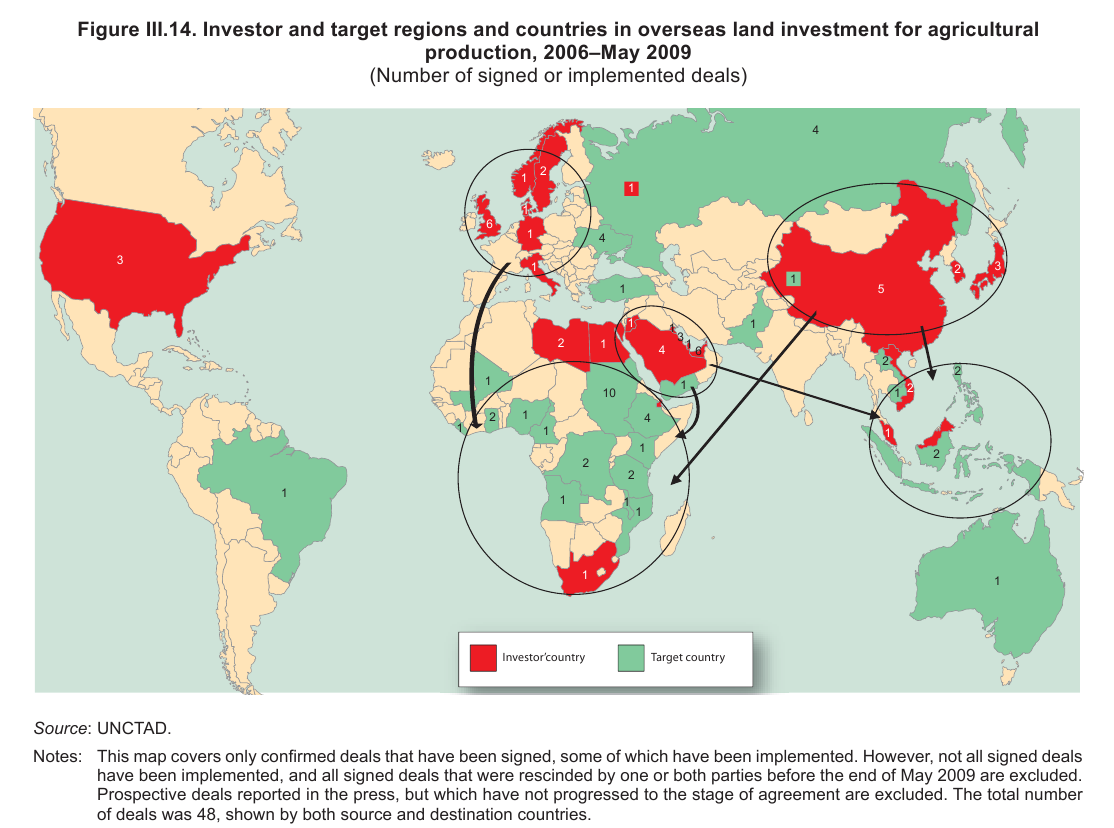
›July 26, 2011 // By Christina DaggettOver the past few years, wealthy countries with shrinking stores of natural resources and relatively large populations (such as China, India, South Korea, and the Gulf states) have quietly purchased huge parcels of fertile farmland in Africa, South America, and South Asia to grow food for export to the parent country. With staple food prices shooting up and food security projected to worsen in the decades ahead, it is little wonder that countries are looking abroad to secure future resources. But the question arises: Are these “land grabs” really about the food — or, more accurately, are they “water grabs”?
The Great Water Grab
With growing urban populations, an expanding middle class, and increasingly scarce arable land resources, some governments and investors are snapping up the world’s farmland. Some observers, however, have pointed out that these dealmakers might be more interested in the water than the land.
In an article from The Economist in 2009, Peter Brabeck-Letmathe, the chairman of Nestlé, claimed that “the purchases weren’t about land, but water. For with the land comes the right to withdraw the water linked to it, in most countries essentially a freebie that increasingly could be the most valuable part of the deal.”
Consider some of the largest investors in foreign land: China has a history of severe droughts (and recently, increasingly poor water quality); the Gulf nations of Saudi Arabia, Kuwait, Qatar, and Bahrain are among the world’s most water-stressed countries; and India’s groundwater stocks are rapidly depleting.
A recent report from the World Bank on global land deals highlighted the effect water scarcity is having on food production in China, South Asia, the Middle East, and North Africa, stating that “in contrast, Sub-Saharan Africa and Latin America have large untapped water resources for agriculture.”
Keeping Engaged and Informed
“The water impacts of any investment in any land deal should be made explicit,” said Phil Woodhouse of the University of Manchester during the recent International Conference on Global Land Grabbing, as reported by the New Agriculturist. “Some kind of mechanism is needed to bring existing water users into an engagement on any deals done on water use.”
At the same conference, Shalmali Guttal of Focus on the Global South cautioned, “Those who are taking the land will also take the water resources, the forests, wetlands, all the wild indigenous plants and biodiversity. Many communities want investments but none of them sign up for losing their ecosystems.”
With demand for water expected to outstrip supply by 40 percent within the next 20 years, water as the primary motivation behind the rush for foreign farmland is a factor worth further exploration.
Global Farming
According to a report from the Oakland Institute, nearly 60 million hectares (ha) of African farmland – roughly the size of France – were purchased or leased in 2009. With these massive land deals come promises of jobs, technology, infrastructure, and increased tax revenue.
In 2008 South Korean industrial giant Daewoo Logistics negotiated one of the biggest African farmland deals with a 99-year lease on 1.3 million ha of farmland in Madagascar for palm oil and corn production. The deal amounted to nearly half of Madagascar’s arable land – an especially staggering figure given that nearly a third of Madagascar’s GDP comes from agriculture and more than 70 percent of its population lives below the poverty line. When details of the deal came to light, massive protests ensued and it was eventually scrapped after president Marc Ravalomanana was ousted from power in a 2009 coup.
While perhaps an extreme example, the Daewoo/Madagascar deal nonetheless demonstrates the conflict potential of these massive land deals, which are taking place in some of the poorest and hungriest countries in the world. In 2009, while Saudi Arabia was receiving its first shipment of rice grown on farmland it owned in Ethiopia, the World Food Program provided food aid to five million Ethiopians.
Other notable deals include China’s recent acquisition of 320,000 ha in Argentina for soybean and corn cultivation – a project which is expected to bring in $20 million in irrigation infrastructure, the Guardian reports – and a Saudi Arabian company which has plans to invest $2.5 billion and employ 10,000 people in Ethiopia by 2020, according to Gambella Star News.
But governments in search of cheap food aren’t the only ones interested in obtaining a piece of the world’s breadbasket: Individual investors are also heavily involved, and the Guardian reports that U.S. universities and European pension funds are buying and leasing land in Africa as well.
The Future of Land and Water
Whatever the benefits or pitfalls, large-scale land deals around the world look set to continue. The world is projected to have 7 billion mouths to feed by the end of this year and possibly 10 billion plus by the end of the century.
Currently, agriculture uses 11 percent of the world’s land surface and 70 percent of the world’s freshwater resources, according to UNESCO. If and when the going gets tough, how will the global agricultural system respond? Whose needs come first – the host countries’ or the investing nations’?
Christina Daggett is a program associate with the Population Institute and a former ECSP intern.
Photo Credit: Number of signed or implemented overseas land investment deals for agricultural production 2006-May 2009, courtesy of GRAIN and the UN Conference on Trade and Development (UNCTAD).
Sources: BBC News, Canadian Water Network, Christian Science Monitor, Circle of Blue, The Economist, Gambella Star News, Guardian, Maplecroft, New Agriculturalist, Oakland Institute, State Department, Time, UNFPA, UNESCO, World Bank, World Food Program. -
Watch ‘Dialogue’ TV on the Future of Women and the Arab Spring
›This week on Dialogue, host John Milewski discusses the role that women played in the Arab Spring and how these roles might evolve in the coming months and years with the enormous political changes sweeping the region. He is joined by Moushira Khattab, Lilia Labidi, and Haleh Esfandiari. [Video Below]
Moushira Khattab is a human rights activist who formerly served as Minister of Family and Population for Egypt. She also served as Assistant Minister of Foreign Affairs, Vice Chair of the UN Committee on the Rights of the Child, and was Egypt’s ambassador to South Africa during the Mandela era. Lilia Labidi is an anthropologist and professor at the University of Tunis who currently serves as Minister of Women’s Affairs in the Republic of Tunisia. Previously she was a visiting professor at the American University in Cairo and a fellow at the Wilson Center. Haleh Esfandiari is author of the book, My Prison My Home: One Women’s Story of Captivity in Iran. Haleh serves as the director of the Wilson Center’s Middle East Program.
Dialogue is an award-winning co-production of the Woodrow Wilson International Center for Scholars and MHz Networks that explores the world of ideas through conversations with renowned public figures, scholars, journalists, and authors. The show is also available throughout the United States on MHz Networks, via broadcast and cable affiliates, as well as via DirecTV and WorldTV (G19) satellite.
Find out where to watch Dialogue where you live via MHz Networks. You can send questions or comments on the program to dialogue@wilsoncenter.org. -
Shall the Religious Inherit the Earth?
›“The world as a whole is getting more religious,” said Professor of Politics at the University of London Eric Kaufmann, speaking at the Wilson Center for the launch of his latest book, Shall the Religious Inherit the Earth? Due to their consistently higher birthrates, religious fundamentalists may reverse the tide of secularism within the next century, he said. [Video Below]
Showing posts from category Middle East.