-
Iran’s Surprising and Shortsighted Shift on Family Planning
›August 8, 2012 // By Elizabeth Leahy Madsen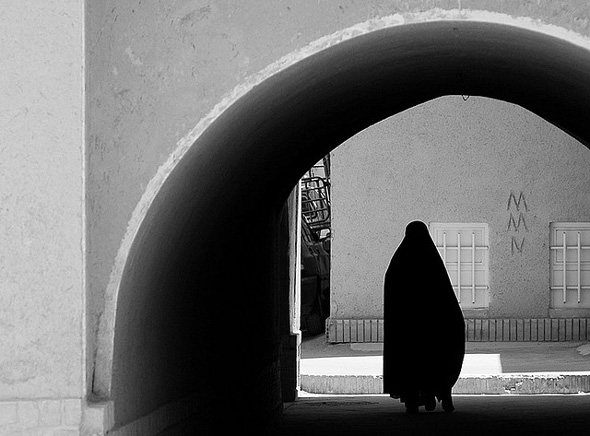
In late July, Iran’s government announced that it would no longer fund family planning programs, a dramatic reversal following 20 years of support. The change is especially abrupt for a country that has been lauded as a family planning success story, with thorough rural health services and an educated female population contributing to one of the swiftest demographic transitions in history.
-
Emmanuel Karagiannis: Mediterranean Oil and Gas Discoveries Could Change Regional Alignments, Global Energy Equation
› “The discovery of gas reserves in the eastern Mediterranean comes at a time when world demand for energy is growing rapidly and many are questioning the reliability of supplies from North Africa and the Middle East,” said Emmanuel Karagiannis, assistant professor of Russian and post-Soviet politics at the University of Macedonia, in an interview at the Wilson Center.The newly-discovered fields contain about 122 trillion cubic feet of recoverable natural gas reserves, 25 trillion of which are located within Israeli territorial waters. “That’s twice the reserves Libya has,” according to Karagiannis. The remaining fields have been claimed by the Republic of Cyprus, the Turkish Republic of Northern Cyprus, Syria, and Lebanon.
Europe currently depends on Russia for most of its gas supplies, so the new fields could provide an “important alternative source for European economies,” said Karagiannis.
The discovery also has the potential to increase stability in the region by serving as an incentive for nations to work together. “For example, Israel and Cyprus have come closer to each other in many respects, including military cooperation,” Karagiannis said. Greece and Israel have also strengthened their relationship, in part due to the historical relationship between Cyprus and Greece but also because the latter could serve as an energy hub to transport gas throughout Europe, he said. “In effect Israel, Greece, and Cyprus could form a new axis of stability in the region.”
“Turkey can also play a significant part in the business of transporting energy resources to Europe,” Karagiannis said, but Syria and Lebanon, the two other countries that lie adjacent to the newly discovered gas reserves, are less likely to benefit in the near future from the find, given their current political circumstances. “It’s very difficult to imagine their participation in the regional energy projects,” he said. Lebanon has tried and failed to sell offshore exploratory licenses twice due to its lack of a state petroleum administration, while the current uprising against President Bashar al-Assad is preventing any progress in Syria.
In part as a result of these political challenges, the gas fields also have the potential to generate conflict in the region. There will be a divide between “haves and have-nots,” explained Karagiannis. According to a report by the Institute for National Strategic Studies, “piping Israeli gas to the RoC [Republic of Cyprus] and then onto Turkey, which could be the gateway to the European market, is unlikely due to current tensions between Ankara, the RoC, and Tel Aviv.” Since the discovery of the fields, “Turkey has already issued military threats against Cyprus in order to stop the gas exploration process that is currently taking place in the Cypriot Exclusive Economic Zone,” Karagiannis said. The Israeli government issued a response to the threat, stating that they are committed to protecting energy infrastructure in the region.
The first new natural gas field in the region is expected to begin full-scale production this year, with two additional fields coming on-line over the next six years.
Keenan Dillard is a cadet at the United States Military Academy at West Point and an intern with the Woodrow Wilson Center’s Environmental Change and Security Program.
Sources: Institute for National Strategic Studies, Noble Energy Inc., Turkish Weekly, U.S. Geological Survey. -
World Population Day 2012: Looking Beyond Reproductive Health
›How should the seven billion or so of us on Earth mark World Population Day? Today, major global players are focusing on increasing access to family planning around the world. But there are other important aspects to population that also deserve our sustained attention.
The links between demography and development have come into the limelight over the last few months, first as advocates decried the last minute removal of reproductive rights language from the Rio+20 outcome document and now as the Bill and Melinda Gates Foundation prepares a massive funding push for reproductive health (starting today, not coincidentally).
“Multiple crises – food, fuel, and financial – have caused significant suffering and served as a wake-up call about the need to pay far more attention to the building blocks of sustainable development,” UN Secretary-General Ban Ki-moon says in an address for today. “Reproductive health is an indispensable part of the sustainable development equation.”
The sustainable development connection is fairly obvious. Environmental destruction in some of the most biodiversity-rich parts of the world has complex but significant population drivers, as Wilson Center consultant Laurie Mazur explains:Human impact on the environment is mediated by a host of factors, including culture, technology, institutions, and market forces. And inequitable socioeconomic systems mean that some human beings have far greater impact than others.
“Often, the value of biodiversity becomes apparent only when it is lost,” Mazur continues. “For example, with the global decline of honeybee populations, growers can now calculate the monetary value of pollination services that were once provided for free by nature. ‘Bee pollination is worth $190 billion,’ said Pavan Sukhdev, a Yale environmental economist, in an interview with Bloomberg. ‘But when did a bee ever send you an invoice?’”
But some generalizations can be made. We live on a planet dominated and transformed by human activity. As we have become more numerous, we have also become more adept at altering ecosystems for human use, replacing species-rich natural landscapes with simpler monocultures.
In other areas, population drivers threaten more basic scarcities: food and water, which in turn impede development and cost human lives. Some of the most successful efforts to address these relationships have combined women’s empowerment, family planning, and basic health interventions with site-based conservation and livelihood efforts.
But besides reproductive rights, there are other important aspects of population that deserve attention on this day.
The demographic dividend – a concept that marries population dynamics and development economics – requires more than just fertility decline to take effect in countries. Economic and social policies that prepare and enable young people to enter the workforce are just as important.
And the Arab Spring helps illustrate the complex relationship between population and democracy. “Among the five countries where revolt took root, those with the earliest success in ousting autocratic leaders also had the most mature age structures and the least youthful populations,” writes Wilson Center consultant and demographer Elizabeth Leahy Madsen. The work of fellow Wilson Center consulting demographer Richard Cincotta shows that countries with very young age structures are prone both to higher incidence of civil conflict and undemocratic governance. What happens next in Egypt, Libya, Yemen, and Syria will further test the connection between youth and democracy.
In South Asia, Madsen finds that as Afghanistan and Pakistan’s political circumstances have become more entwined, their demographic paths are more closely parallel than expected. “For Afghanistan, given its myriad socioeconomic, political, cultural, and geographic challenges, this is good news. But for Pakistan, where efforts to meet family planning needs have fallen short of capacity, it is not,” she writes in the first issue of the newly re-launched ECSP Report, “Afghanistan, Against the Odds: A Demographic Surprise.”
In more developed countries, population aging is a concern. At the Wilson Center last year, economists Andrew Mason and Ronald Lee explained the challenges that those on the other side of the “demographic divide” will face in the near future. From 2010 to 2015, 85 countries are projected to witness the largest absolute increase in history of their populations aged 60 and over, straining public welfare systems and reducing labor forces. It’s not the “catastrophe” that it has been portrayed to be in the media, they said, but like many demographic issues, it is a challenge that will require planning for.
These connections demonstrate the wide importance of population dynamics to understanding how the world works today. Demography is the study of us – all seven billion of us. Demography affects – and is affected by – economics, political stability, health, the environment, food security, foreign policy, development, and conflict. Let’s not overlook that breadth on this World Population Day 2012.
For more, be sure to read some of our additional resources from the recent archives:- Food Security in a Climate-Altered Future: More Than a Supply Problem
- Taming Hunger in Ethiopia: The Role of Population Dynamics
- Uganda’s Demographic and Health Challenges Put Into Perspective With Newfound Oil
- New Surveys Generate Mixed Demographic Signals for East and Southern Africa
- In Building Resilience for a Changing World, Reproductive Health Is Key
- Demographic Security 101 (video)
- Yemen: Revisiting Demography After the Arab Spring
- Hania Zlotnik Discusses Latest Changes to UN Population Projections (audio)
- Book Review: ‘World Population Policies’
- Tunisia’s Shot at Democracy: What Demographics and Recent History Tell Us
- Joel E. Cohen on Solving the Resource-Population Equation in the Developing World (video)
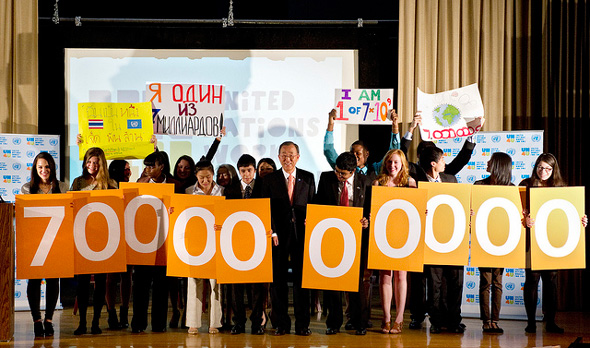
Photo Credit: UN Day Secretary-General Ban Ki-moon with students in October celebrating the seven billion mark, courtesy of Eskinder Debebe/UN Photo. -
Jennifer Dabbs Sciubba, The Huffington Post
Global Threats Exist, But Also Many Global Demographic Opportunities for the United States
›July 3, 2012 // By Wilson Center StaffThe original version of this article, by Jennifer Dabbs Sciubba, appeared on The Huffington Post.
Events like the Arab Spring gave birth to a generation of demographic converts in the national security community. Many are now convinced that demography matters because demographers today can clearly show how youthful population profiles in the developing world could lead to conflicts over the next 20 years – a major concern for policymakers.
Too much focus on demography and conflict, though, means policymakers miss opportunities for cooperation.
We are used to thinking of the wealthy and stable “Global North” and the poor and tumultuous “Global South,” but a demographic divide within the developing world is emerging, a third category of states that are growing older, more urban, more prosperous, more peaceful, and active in international affairs. These states – particularly India, Brazil, and South Africa – represent opportunities for building U.S. and world security.
Even as it maintains its longstanding relationships in Europe and elsewhere in the developed world, the U.S. should be more assertive in seeking partnerships with India as both a counterbalance to China and as a global security partner in addressing piracy and terrorism and in distributing international aid.
Continue reading on The Huffington Post.
Photo Credit: Tahrir 2011, courtesy of flickr user Denis Bocquet. -
What Are the Most Important Factors in the Failed States Index?
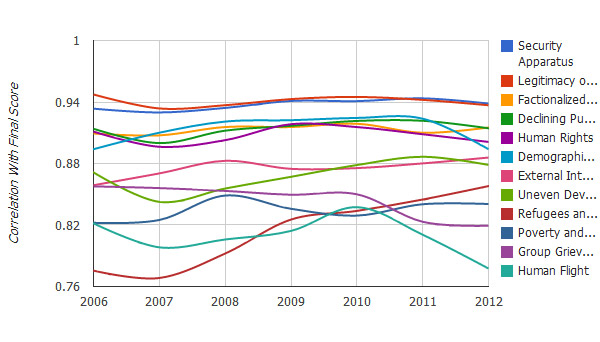
›Last week, the Fund for Peace issued its eighth annual Failed States Index (FSI). The index gives 177 countries a score between 1.0 and 10.0 for 12 indicators, ranging from the legitimacy of the state and the security apparatus to demographic pressure and uneven development (high being bad, low being good – see full descriptions of the indicators here). But which of these indicators has the biggest impact? We did a quick analysis of the Failed States Indexes published from 2006 to 2012 to show which of the indicators correlate most with a high score. (We skipped 2005 since the roster of analyzed countries was significantly smaller.)
-
Gidon Bromberg at TEDx on Peacebuilding Through Water in the Middle East
›“Cooperation over water is not a privilege, it’s a necessity,” said Gidon Bromberg, co-director of Friends of the Earth Middle East, in a TEDx talk at Yale. He sees the shortage of water in Jordan, Israel, and Palestine as an opportunity to bring these contentious communities together – even more so during this period of upheaval in the region.
Water woes have long contributed to regional tensions, said Bromberg. Water rights between Israel and Palestine were supposed to be settled during the Oslo accords in 1993, but negotiations were unsuccessful and water discussions were consequently left unfinished. The lack of formal negotiations caused each side to seize whatever resources they could Although Jordan was not part of the negotiations, it does share water resources with Israel and the West Bank and thus has been impacted by the lack of formal allocation processes. Both Jordan and Israel have diverted flow of the Jordan River into dams and irrigation projects. As a result, the Jordan River has lost 98 percent of its historic flow and the Dead Sea has lost one-third of its surface area.
Today, Israel has restricted Palestinian water use such that Palestinians have access to water only once a week in winter and once every three weeks in the summer, leading them to store water in containers on their roofs, Bromberg said. Though mismanagement is as much to blame as conflict, he notes, Palestinians chafe under the limitations.
Yet Friends of the Earth Middle East has used this difficult situation to educate the public, propose reforms, and build trust between Palestinian, Jordanian, and Israeli communities. Bromberg highlighted “fear of a small but vocal minority on both sides” as a key factor in preventing dialogue between the communities, but insists that water can bring people together. Neighboring communities have to work together, he said, “not because they’re best friends,” but to improve their own water situations.
Friends of the Earth provides that opportunity with their Good Water Neighbors project and hopes the trust built between communities extends beyond water issues as well. Since communities have strong motives to solve these problems, they work together more effectively than high-level politicians who may not be as apt to collaborate.
A positive update on the state of the Jordan River given in an interview with ECSP in October suggests that Bromberg may be on to something.
Sources: Amnesty International, Friends of the Earth.
Video Credit: TEDx. -
The Year Ahead in Political Demography: Top Issues to Watch
›June 8, 2012 // By Elizabeth Leahy Madsen2011 and the first half of 2012 have been a remarkable period for political demography, with theories about the relationships between age structure and governance validated in real time by the events of the Arab Spring. Although such game-changers are rarely predictable, the year ahead promises to be eventful as well, with new demographic research and major policy initiatives on the horizon. Below are brief assessments of some of the top issues to watch between now and next summer.
1. The Evolving Story of the Arab Spring
The Arab Spring was anticipated by few observers, but for a handful of political demographers it was a watershed of sorts. As readers of this blog know, political demography research shows that countries with very young age structures are prone both to higher incidence of civil conflict and – most relevant to the outcomes of the Arab Spring – to undemocratic governance. This nuance escaped many observers of the region’s drama. Violence and conflict erupted not from raging citizens in the streets but from military and militia forces unleashed by autocrats unwilling to cede their grip on power. Young people, and their fellow protestors of all ages, were acting as a force for positive change in their demonstrations against corrupt and unrepresentative leadership. The difference in outcomes across the region, according to Richard Cincotta, can be attributed to the fact that as age structures mature, elites become less willing to trade their political freedoms to autocratic leaders in exchange for the promise of security and stability.
When considered with this important distinction in mind, the initial events following the uprising in Tunisia that quickly spread across the region played out in a neatly linear fashion. Among the five countries where revolt took root, those with the earliest success in ousting autocratic leaders also had the most mature age structures and the least youthful populations.
In Tunisia, with a median population age of 29, one month passed between a fruit seller’s self-immolation and Zine El Abedine Ben Ali’s flight to exile. In Egypt and Libya, where median age is close to 25 years (identified by Cincotta as a threshold when countries are at least 50 percent likely to be democratic), Hosni Mubarak and Moammar Gaddafi took three weeks and eight months, respectively, to lose their titles. Ali Abdullah Saleh in Yemen (median age 17), took one year to be convinced to formally resign, while in Syria (median age 21), the 15-month uprising continues to be brutally repressed by Bashar Assad’s forces.
Of course, overthrowing a dictator, while inspiring and liberating to those whose rights have been repressed, is only the first step in achieving democracy. In the coming year, the countries that have already taken steps toward solidifying regime change will face continued tests as internal tensions surface. Even in Tunisia, recent clashes signal that political divisions and economic uncertainty have not been resolved. With potentially divisive elections ahead in Egypt and Libya, a holdover from the Saleh regime leading Yemen, and Syria’s fate unknown, the coming year should offer political demographers further evidence of the soundness of the age structure and democracy thesis.
2. New Commitments to Family Planning
Reproductive health and demography go hand-in-hand, and two milestones for family planning advocates are fast approaching: the 20th anniversary of the 1994 International Conference on Population and Development in Cairo, and the 2015 endpoint of the Millennium Development Goals.
These historic commitments by governments will be joined by a major initiative to generate new funding and political will this summer at an international family planning summit in London on July 11. The summit will be co-hosted by the Bill and Melinda Gates Foundation (Melinda made an impassioned TEDxChange speech in support of the issue in April), and the UK’s Department for International Development, for whom family planning is a priority in efforts to reduce maternal and child mortality.
Details of the summit have yet to be finalized and publicly released, but financial commitments from donors and developing countries are anticipated toward meeting a new and ambitious goal of generating $4 billion to fund contraceptives for 120 million women in developing countries by 2020. Assuming these are new users, rather than those who would be expected by projecting recent growth in contraceptive use forward, this would represent more than half of the estimated 215 million women with an unmet need for family planning.
Why does new family planning funding matter for political demography? Rates of contraceptive use are lowest and fertility highest in countries with youthful age structures. Such population dynamics exacerbate the challenges governments face in providing education, health, and basic infrastructure services, as well as supporting an economic climate conducive to industry diversification and job creation. In turn, the likelihood of civil conflict and undemocratic governance is higher in such countries.
While policies that recognize the benefits of family planning may be solid, funding and implementation often fall woefully short. In the least developed countries, less than one-third of reproductive-age women are using any contraception, and the rate has grown by just 0.4 percentage points annually over the past decade. Meanwhile, funding from all sources is less than half the amount required to meet unmet need. If the July summit motivates a new groundswell of financial support, 2012 could incite major strides toward improvements in individual health and well-being as well as demographic momentum in the remaining high-fertility countries.
3. Demographic Diversity in Sub-Saharan Africa
The current era of global demographic diversity has been distinguished by both record-low fertility rates in parts of Europe and eastern Asia and persistently high fertility across most of western, central, and eastern Africa. More than one-quarter of women in sub-Saharan Africa would like to postpone or avoid pregnancy, but are not using contraception, demonstrating a large unmet need for family planning.
The U.S. government-funded Demographic and Health Survey (DHS) program is the largest single source for detailed data on health status and behavior in high-fertility developing countries, and in turn informs estimates and projections of demographic trends. Recently, DHS reports have been released showing that contraceptive use over the past five years is growing much faster than the regional average in Ethiopia, Malawi, and Rwanda. In turn, fertility rates have dropped, ranging from a relatively modest 0.3 children per woman in Malawi and an unprecedented 1.5 children per woman in Rwanda.
These findings suggest that the pattern of demographic stagnation in sub-Saharan Africa may be shifting, perhaps due to governments’ and donors’ investments in family planning. However, newer survey results for Mozambique, Uganda, and Zimbabwe present a more mixed picture, with modest gains in contraceptive use in Uganda, offset by declines in the other two countries.Click here for the interactive version (non-Internet Explorer users only).
Additional recent survey results show that use of modern contraceptive methods has barely increased in Senegal (from 10 percent in 2005 to 12 percent in 2010-11). And while modern contraceptive use increased in the Republic of Congo from 13 percent in 2005 to 20 percent currently, fertility also rose slightly, from 4.8 to 5.1 children per woman.
Approximately 10 countries in sub-Saharan Africa are slated for DHS fieldwork this year, including one of the continent’s giants, the Democratic Republic of the Congo, and several of the highest-fertility countries in the region. (Outside of sub-Saharan Africa, the demographic heavyweights in this year’s group of DHS reports are Bangladesh, Indonesia, and Pakistan.)
The upcoming surveys will provide greater clarity about whether the promising signs of family planning adoption and the potential for progress through the demographic transition in Ethiopia, Malawi, and Rwanda are initiating widespread change across the continent, or whether the need for commitments such as those generated by the London summit is even stronger.
4. New Population Projections
DHS reports are critical inputs for the world’s most comprehensive and readily accessible set of demographic data, the UN Population Division’s World Population Prospects. This database is fully updated and revised biannually, in large part due to the steady stream of newly available estimates from the DHS and related sources, such as national censuses. The next revision of World Population Prospects, based on estimates for mid-year 2012, is expected to be published in spring 2013.
The previous revision of World Population Prospects was notable for its methodological overhaul. In addition to extending the projections until 2100, the Population Division shifted to a probabilistic technique (as opposed to assuming convergence at a single fertility rate of 1.85 children per woman) that generates 100,000 possible fertility trajectories for each country and selects the median as the medium fertility variant, commonly cited as the most likely projection. Still, the basic parameters remain the same: With fertility rates the strongest driver of population projections, low, medium, and high fertility variants are constructed around the assumption that countries will converge towards replacement level fertility, around 2.1 children per woman.
In some cases, this results in projections that are vastly at odds with recent trends. For example, in Japan, fertility has fallen by 38 percent, from replacement level in the early 1970s to 1.3 children per woman in 2010, but the UN projects it to immediately reverse course and begin rising to 1.8 by mid-century. If the projection holds, Japan’s population will decline relatively modestly, from 127 million to 109 million. But if fertility stays constant at current levels, the population will fall below 100 million. For low-fertility countries like Japan, all UN scenarios assume constant or rebounding fertility rates, even though continued decline may be a plausible outcome in some cases.
When next year’s projections are released, a cluster of media articles will report the projected world population for 2050. In last year’s revision, the medium fertility variant resulted in a projection of 9.3 billion, an increase from the 9.1 billion projected two years earlier based on higher projected fertility in the future. Such reports often overlook the range of population totals possible depending on fertility paths: If the global fertility rate varies by 0.5 children per woman in either direction, the total population could be more than one billion higher or lower in 2050, with an even wider range possible by 2100.
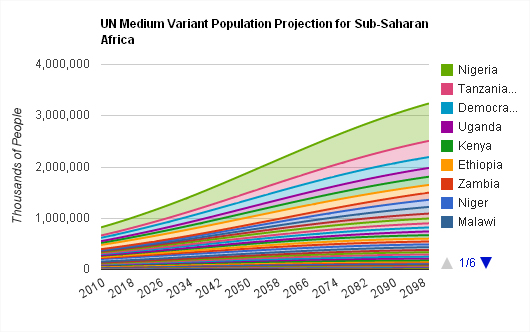
Most of the projected growth in world population, and its potential range, will be driven by the high-fertility countries concentrated in sub-Saharan Africa. Population projections for these countries vary tremendously based on fertility scenarios informed by the recent DHS results described above.
In Nigeria, Africa’s most populous country, fertility has fallen over the past 40 years, but by a gradual 15 percent. The UN projects it to drop more than twice as fast, by more than two children per woman (39 percent), in the next four decades. In any scenario, Nigeria is on track for rapid population growth, but the potential range based on fertility outcomes is wide. If fertility declines as projected in the medium variant, the country would grow from 158 million to 390 million. And although unlikely, the constant fertility projection of 504 million Nigerians in 2050 should be kept in mind given the slow pace of fertility decline to date.
Population projections are highly wonky, but their careful production and regular revision are essential for accurate planning of economic and social needs in countries around the world. While governments with dedicated census agencies, such as those in the U.S., Japan, or India, rely on internally-generated estimates, the UN projections serve as the primary indication of population trends in countries with spottier data coverage and have tremendous utility in gauging future needs for infrastructure, housing, health care across the life cycle, education, jobs, and other investments.
By no means is this an exhaustive list of factors that will affect political demography research and policy over the coming year. Other events to watch for include the Rio+20 conference on sustainable development in June, where the priority issues of jobs, energy, infrastructure, and resources will be shaped by demographic trends, and continued attention to prospects for the demographic dividend in Africa. Political demography is inherently cross-disciplinary, and the field’s researchers and practitioners will be engaged on multiple fronts in the year ahead.
Elizabeth Leahy Madsen is a consultant on political demography for the Wilson Center’s Environmental Change and Security Program and senior technical advisor at Futures Group.
Sources: Al Jazeera, Bongaarts (2008), Cincotta (2008), Cincotta (2012), Cincotta and Leahy (2006), Grist, Guttmacher Institute, MEASURE DHS, The New York Times, NPR, Population Reference Bureau, UN Population Division, The Washington Post.
Image Credit: “The Face of a Tyrant,” courtesy of flickr user freestylee (Michael Thompson); video courtesy of TED; chart created by Schuyler Null, data from UN Population Division. -
Valerie Hudson and Chad Emmett: Women’s Well-Being Is the Best Predictor of State Stability
›May 22, 2012 // By Kate Diamond“The best predictor of a state’s stability and security is the level of violence against women in society,” said Texas A&M University’s Valerie Hudson in this interview with ECSP. That link is “based on rigorous empirical analysis,” she said. “There’s something to it. It’s not just political correctness.”
Showing posts from category Middle East.