Showing posts from category Bangladesh.
-
The Economist
Afghanistan’s Demography: A Bit Less Exceptional
›The original version of this article appeared in The Economist, and is based on ECSP Report 14, Issue 1.
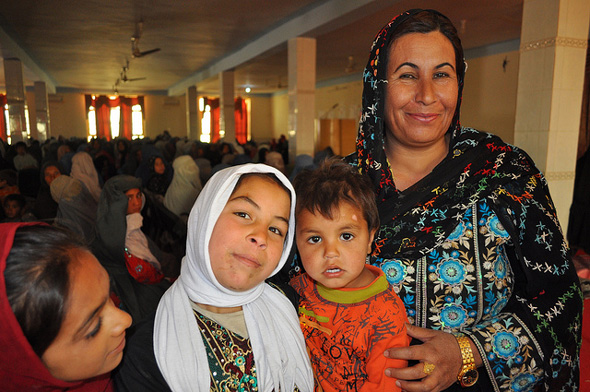
This is a story from Afghanistan which is not about fighting, bombs, or the Taliban. It even contains a modicum of good news. It is about demography.
Afghanistan has long been seen as a demographic outlier. In 2005-10, according to the United Nations Population Division, its fertility rate was 6.6 – the second-highest in the world after Niger (the fertility rate is the number of children a woman can expect to have during her lifetime). The contrast with the rest of South Asia is extreme: fertility ranged from four (in Pakistan) to below three (in Bangladesh, India, and Sri Lanka). Afghanistan’s sky-high fertility seems consistent with a view of the country as trapped in an exceptional and dysfunctional mode of development, marked by war, religious extremism, tribal honor codes, and the subjugation of women.
But this fertility rate was always a bit of a guess. The last census was taken in 1979, the year of the Soviet invasion. A whole generation has grown up since then, amid pervasive violence and uncertainty. It has been extremely hard to know how fertility has been changing.
Hence the significance of the Afghanistan Mortality Survey. Based on interviews with 48,000 women and girls aged 12 to 49, it is the nearest thing the country has had to a national census for 30 years (there were smaller surveys in 2003 and 2007-08, but their coverage was not national).
Continue reading on The Economist.
Read more about the Afghanistan Mortality Survey here on the blog with Elizabeth Leahy Madsen’s original posts here and here.
Photo Credit: “Celebrating International Women’s Day in Afghanistan,” courtesy of the U.K. Department for International Development. -
PHE and Community-Based Adaptation to Climate Change: Stronger Together
›Over the past several years, community-based adaptation has emerged alongside national and regional climate change initiatives as a strategic, localized approach to building resilience and adaptive capacity in areas vulnerable to climate change.
-
Bringing Environment and Climate to the 2012 Population Association of America Annual Meeting
›June 5, 2012 // By Sandeep BathalaOver 2,100 participants attended the 2012 Population Association of America (PAA) annual meeting in San Francisco this May. PAA was established in 1930 to research issues related to human population. This year, for the first time, the meeting featured a notable contingent of demographers, sociologists, and public health professionals working on environmental connections.
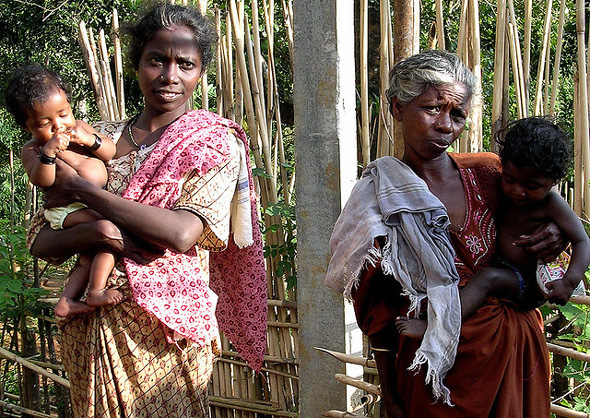
I followed as many of the environment-population discussions on newly published or prospective research papers as possible (about 20 in total). I found four papers particularly noteworthy for the connections made to women, family planning, and climate change adaptation.
Samuel Codjoe of the University of Ghana spoke about adaptation to climate extremes in the Afram Plains during one of the population, health, and environment (PHE) panels organized by Population Action International. Although developed nations are historically the major contributors of greenhouse gases due to comparatively high levels of consumptions, developing countries are the most vulnerable to the consequences of climate change – in part because of continued population growth. As a result, adaptation strategies in countries like Ghana are particularly important; and given women’s often-outsized role in water and natural resource issues, a focus on gender-specific adaptation even more so.
Codjoe presented an analysis of preferred adaptation strategies to flood and drought, broken down by gender and three common occupations – farming, fishing, and charcoal production). He said he hopes his assessment – part of a collaborative research effort with Lucy K.A. Adzoyi-Atidoh of Lincoln University – will aid in the selection and implementation of successful adaptation options for communities and households in the future.
“Understanding differences in the priorities that women place on adaptation may prove to be important in the effectiveness of climate change adaptation – and the sustainability of communities,” he said.
David López-Carr of the University of California, Santa Barbara, speaking on behalf of a group of researchers with World Wildlife Fund, teased out the gender dynamic further when he presented on ways to help the conservation sector determine next steps for existing PHE projects. Practitioners from seven of the eight PHE projects currently implemented by conservation organizations (defined by having been involved for at least three years in bringing family planning to local communities) recently said the links to women’s empowerment were among the most important aspects of successful projects.
López-Carr therefore emphasized the need for additional research on how PHE projects can support and empower women, both economically and socially. He also noted, like Codjoe, the potential impact women often have on the management of their community’s natural resources, saying this was another area where research on the empowering effect of PHE programs can provide further backing for integrated programs.
Karen Hardee of Futures Group spoke about how the experiences of integrated PHE projects, despite most not being designed to respond to climate change specifically, have lessons to offer climate change efforts. Her work was done in partnership with the Population Reference Bureau, Population Action International, and U.S. Agency for International Development. She concluded that community-based adaptation approaches should consider population dynamics in vulnerability assessments. Meeting unmet need for family planning, she said, can assist communities adapting to climate change by building resilience. And as result, “PHE approaches should be able to qualify for funding under community-based adaptation programs.”
Shah Md. Atiqul Haq of the City University of Hong Kong presented research he conducted in Bangladesh that found that women tended to feel that a large family size was not advantageous during floods. This, he said, was indicative of their increased understanding of vulnerability and an endorsement of providing knowledge and access to family planning services as part of climate change adaptation strategies.
The inclusion of more environment, and particularly PHE, related presentations at this year’s conference was good to see – perhaps a sign that demography is becoming a more complex and comprehensive field, with a focus more on population structure and its interactions with other issues, rather than a singular fascination with growth.
In particular, panelists showed that the nexus between demography, gender equity, and climate change continues to grow in importance, both in the research and practitioner communities.
Photo Credit: Tribal women and children in Kerala state, India, courtesy of flickr user Eileen Delhi. -
Carl Haub, Behind the Numbers
Bangladesh 2011 Demographic and Health Survey Shows Continued Fertility Decline, Improved Health Indicators
›May 7, 2012 // By Wilson Center StaffThe original version of this article, by Carl Haub, appeared on the Population Reference Bureau’s Behind the Numbers blog.
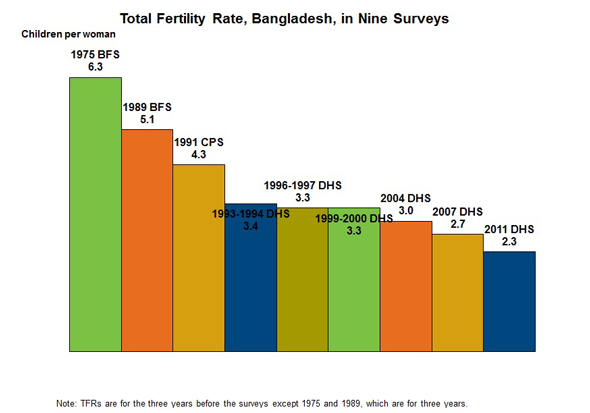
The Bangladesh 2011 Demographic and Health Survey is the ninth demographic survey taken in the country since 1975. Except for a few very small countries and city-states, Bangladesh is the world’s most densely populated country with about 1,100 people per sq. kilometer. The country’s area is about the same as the U.S. state of Arkansas and a bit more than Greece but is home to over 150 million people.
The preliminary 2011 report has just been released and it shows that fertility has continued its decline to a low level. The total fertility rate (TFR) for the three-year period before the survey was 2.3 – 2.0 in urban areas and 2.5 in rural areas. The survey interviewed 17,842 ever-married women ages 12 to 49 and 3,997 ever-married men ages 15 to 54 from July to December 2011. Rural women accounted for two-thirds of those interviewed. From 1975 to 1994, the TFR in Bangladesh was in continuous decline. But the next three surveys showed a tendency for TFR decline to “stall” at a medium level (see graph). Desired family size has greatly decreased. In the survey, 76.2 percent of women with two living children said that they did not wish to have any more children, an additional 5.3 percent had been sterilized, and 1.3 percent said they were incapable of conceiving.
In the survey, 61.2 percent of currently married women said that they were using some form of family planning, a level comparable to developed countries. The use of modern methods was quite high at 52.1 percent. Unlike neighboring India, where female sterilization predominates, the contraceptive pill is the most widely used modern method at 27.2 percent, followed by injectables (11.2 percent), and the male condom (5.5 percent). Contraceptive use has risen steadily in surveys, up from 7.7 percent in 1975. Family planning use has risen despite the fact that fewer women report a visit from a family planning worker, either government or private. Overall, only 15.5 percent reported contact with a home visitor, which has been an important part of the country’s family planning program. The report notes that this may be due to workers deciding to provide services from community clinics for three days a week.
Continue reading on Behind the Numbers.
Sources: MEASURE DHS.
Imaged Credit: Carl Haub/Behind the Numbers. -
The Future of South Asian Security: Prospects for a Nontraditional Regional Architecture?
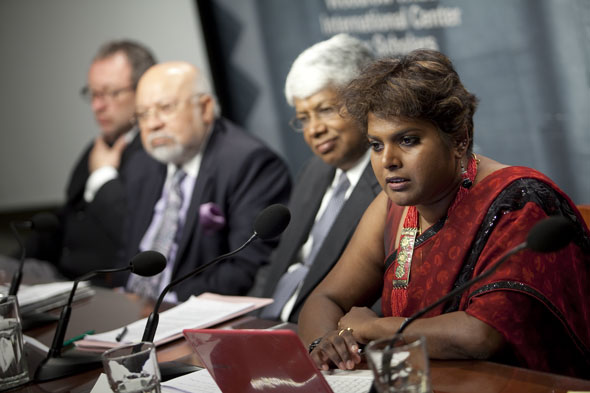
›May 7, 2012 // By Kate Diamond“The nontraditional security threats of tomorrow could themselves become sources of future traditional conflict if they’re not effectively addressed today,” said Mahin Karim, the senior associate for political and security affairs at The National Bureau of Asian Research (NBR). Karim spoke during an April 11 policy briefing on nontraditional security threats in South Asia, hosted by the Wilson Center.
“The nature of nontraditional security challenges faced by South Asia may offer opportunities to change the security agenda, perhaps even subsuming traditional security concerns in the region,” she added.
Karim, along with Roy Kamphausen, Dennis Pirages, Mallika Joseph, Amal Jayawardane, Tariq Karim, and Richard Matthew, presented findings from a three-year NBR project that assessed potential threats to the region through 2025, possible policy responses, and the feasibility of implementing those responses at the national, sub-regional, and regional levels.
In looking at the potential for environmental, population, health, resource, and demographic challenges to threaten security within the region, Karim said several trends became evident across the three workshops and five reports the project produced: the growing impact of nontraditional threats on security; the potential for the region to benefit from a demographic dividend; the growing opportunities for collaboration afforded by increasing media and technological connectivity; India’s own rise as a regional and global power; and the need to examine new and alternate options for sub-regional cooperation.
A Blurring Line Between Traditional and Nontraditional Threats
The growing importance of nontraditional threats is already apparent in India, said Mallika Joseph, the executive director for the Colombo-based Regional Centre for Strategic Studies.
“Many of the challenges which we have grown up understanding as nontraditional security challenges have now migrated and are being termed as traditional security threats, and the line dividing them continues to blur,” said Joseph.
Poor governance and resource management has exacerbated economic inequalities, which are “ever-increasing, despite sustained economic growth,” said Joseph. Meanwhile, more connectivity between different regions and classes in the country has created “greater expectations, worse disappointments, and social unrest.” That unrest has been most visible in the country’s Naxalite insurgency, where years of superficial policy “address[ing] the symptom, rather than the disease itself,” means that “what was earlier a deficit of human security has morphed itself into a situation where the state now faces a security deficit.”
As India’s policymakers attempt to minimize economic inequalities, they must do so against the backdrop of a rapidly growing population. Between now and 2025, population growth in India will account for one-fifth of growth worldwide, said Joseph. While “population trends by themselves are neither inherently good or bad, they do create conditions for peace or conflict within which states must respond.”
“Demography Is a Multiplier”
The region’s changing demographics will also impact its ability to mitigate future security threats. “Demography is a multiplier,” said Joseph. “If a state has weak governance, demography can exacerbate conditions for instability.”
Sri Lanka’s recent history is a testament to this. The country’s youth “played a very important role” in the three major insurgencies that plagued the country since the 1970s, said Amal Jayawardane, an international relations professor at the University of Colombo, Sri Lanka.
Today, although the government provides free education up to the university level, youth are hampered by a disproportionately high rate of unemployment – 19 percent compared to a national average of 4.2 percent, according to the latest government labor force report. Investment in workforce opportunities for youth, along with “institutional reforms like good governance, transparency, and … eradicat[ing] corruption” will have to be considered in order to minimize the potential for youth-driven instability in the future, Jayawardane said.
Messy Boundaries, Messy Threats
“I think that one of the things that this project revealed is that we don’t have a simple definition of what constitutes South Asia per se,” said University of California, Irvine’s Richard Matthew. “It’s an interesting idea, but there’s disagreement over its actual boundaries. And it’s not clear that however we define the boundaries, they align perfectly with the threats. So the threats are messy and the boundaries of South Asia are messy.”
Many of the nontraditional threats facing the region are transnational in nature – glacial melt in the Himalayas affects water supply throughout the region, for example. Those cross-border issues merit a cross-border response.
“It isn’t like there’s a uniform response that would work for China and India and Pakistan on water security,” said Matthew. “We could and we ought to start experimenting with systems that we have reason to believe might be useful, moving them out of their national containers and into regional settings, like REDD and REDD+ and Payment for Ecosystem Services.”
Transnational Solutions for Transnational Problems
Along these lines, Mahin Karim said that the region’s youth are uniquely positioned to foster new and different ways of thinking about public policy. “The region’s youth bulge, particularly in the context of an emerging or next generation of policymakers, offers opportunities for new thinking on traditional security issues that are unhampered by the baggage of history,” she said. “Perhaps we might have a generation that’s more willing to engage multilaterally than previous or current generations have demonstrated to have been.”
Tariq Karim, Bangladesh’s high commissioner to India, said his country will depend on exactly that kind of multilateral cooperation in the coming years.
“I look at the map, I look at where Bangladesh is situated, and I can’t escape my geography,” he said. “My geography compels me to keep looking at that map and see how we can resolve our issues. On our own, it’s not possible – it’s just not possible.”
Event ResourcesSources: Sri Lanka Department of Census and Statistics.
Photo Credit: David Hawxhurst/Wilson Center. -
Kavita Ramdas: Why Educating Girls Is Not Enough
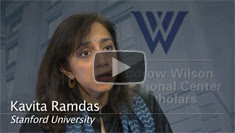
›“I’m a big proponent of girl’s education. I believe that it’s a very important and a very valuable human rights obligation that all countries should be meeting,” said Kavita Ramdas, executive director for programs on social entrepreneurship at Stanford University, at the Wilson Center. However, “in the past seven to eight years we have found ourselves in a situation where there’s kind of an enchantment with girl’s education, as though it were the new microenterprise magic bullet to solve everything from poverty, to malnourishment, to inequality.”
“The outcomes that we ascribe to girl’s education…are not anything that I would argue with,” she said, yet, this enchantment “has happened simultaneously with a significant drop in both funding and support for strategies that give girls and women access to reproductive health and choices, particularly family planning.”
This is a problem, said Ramdas, because we cannot rely on education alone to do all the heavy lifting required to empower women.
“I think it’s important for us to recognize that there are societies where girls and women have achieved significantly high levels of education in which gender inequality remains,” she said, “for example, places like Japan and Saudi Arabia, where you have high per capita income, high levels of education, and yet…where women and girls are still marginalized and on the edges in terms of decision making.”
“I don’t think we have to wait for one to be able to do the other,” she said. “As we support programs for girls’ education, we also need to demand that those programs be buttressed by strong programs in adolescent health, strong programs in sex education, strong programs that actually provide girls and women with access to family planning and contraception.” -
USAID’s New Climate Strategy Outlines Adaptation, Mitigation Priorities, Places Heavy Emphasis on Integration
›February 29, 2012 // By Kathleen MogelgaardIn January, the U.S. Agency for International Development released its long-awaited climate change strategy. Climate Change & Development: Clean Resilient Growth provides a blueprint for addressing climate change through development assistance programs and operations. In addition to objectives around mitigation and adaptation, the strategy also outlines a third objective: improving overall operational integration.
The five-year strategy has a clear, succinct goal: “to enable countries to accelerate their transition to climate-resilient low emission sustainable economic development.” Developed by a USAID task force with input from multiple U.S. agencies and NGOs, the document paints a picture of the threats climate change poses for development – calling it “among the greatest global challenges of our generation” – and commits the agency to addressing both the causes of climate change and the impacts it will have on communities in countries around the world.
These statements are noteworthy in a fiscal climate that has put development assistance under renewed scrutiny and in a political environment where progress on climate change legislation seems unlikely.
Not Just Challenges, But Opportunities
To make the case for prioritizing action on climate change, the strategy cites climate change’s likely impact on agricultural productivity and fisheries, which will threaten USAID’s food security goals. It also illustrates the ways in which climate change could exacerbate humanitarian crises and notes work done by the U.S. military and intelligence community in identifying climate change as a “threat multiplier” (or “accelerant of instability” as the Quadrennial Defense Review puts it) with implications for national security.
Targeted efforts to address climate change, though, could consolidate development gains and result in technology “leap-frogging” that will support broader development goals. And, noting that aggregate emissions from developing countries are now larger than those from developed countries, the strategy asserts that assisting the development and deployment of clean technologies “greatly expands opportunities to export U.S. technology and creates ‘green jobs.’”
In addition to providing a rationale for action, the strategy provides new insights on how USAID will prioritize its efforts on climate change mitigation and adaptation. It provides a clear directive for the integration of climate change into the agency’s broader development work in areas such as food security, good governance, and global health– a strong and encouraging signal for those interested in cross-sectoral planning and programs.
Priorities Outlined, Tough Choices Ahead
President Obama’s Global Climate Change Initiative, revealed in 2010, focuses efforts around three pillars: clean energy, sustainable landscapes, and adaptation. USAID’s climate strategy fleshes out these three areas, identifying “intermediate results” and indicators of success – such as the development of Low Emission Development Strategies in 20 partner countries, greenhouse gas sequestration through improved ecosystem management, and increasing the number of institutions capable of adaptation planning and response.
In laying out ambitious objectives, however, the authors of the strategy acknowledge constrained fiscal realities. The strategy stops short of identifying an ideal budget to support the activities it describes, though it does refer to the U.S. pledge to join other developed countries in providing $30 billion in “fast start financing” in the period of 2010 to 2012 and, for those USAID country missions that will be receiving adaptation and mitigation funding, establishes “floors” of $3 million and $5 million, respectively.
The final section of the strategy lists over thirty countries and regions that have already been prioritized for programs, including Bangladesh, India, Kenya, Malawi, and Peru. But “we are unable to work in every country at risk from climate change impacts or with the potential for low carbon sustainable growth,” the strategy asserts. An annex includes selection criteria to guide further funding decisions, including emission reduction potential, high exposure to physical climate change impacts, a suitable enabling environment, coordination with other donors, and diplomatic and geographic considerations.
“Integration” Central to Strategy
The concept of integration figures prominently throughout the 27-page document. For those of us working in the large and growing space where the global challenges of climate change, food security, health, livelihoods, and governance overlap, this attention is heartening. While it may sometimes seem simply fashionable to pay lip service to the idea of “breaking out of stovepipes,” the strategy identifies concrete ways to incentivize integration.
“Integration of climate change into USAID’s development portfolio will not happen organically,” the strategy says. “Rather, it requires leadership, knowledge and incentives to encourage agency employees to seek innovative ways to integrate climate change into programs with other goals and to become more flexible in use of funding streams and administrative processes.”
To this end, USAID plans to launch a group of pilot activities. USAID missions must submit pilot program proposals, and selected programs will emphasize integration of top priorities within the agency’s development portfolio (including Feed the Future and the Global Health Initiative). Among other criteria, pilots must demonstrate buy-in from multiple levels of leadership, and will be selected based on their potential to generate integration lessons and tools over the next several years.
This kind of integration – the blending of key priorities from multiple sectors, the value of documented lessons and tools, the important role of champions in fostering an enabling environment – mirrors work carried out by USAID’s own population, health, and environment (PHE) portfolio. To date, USAID’s PHE programs have not been designed to address climate challenges specifically, and perhaps not surprisingly they aren’t named specifically in the strategy. But those preparing and evaluating integration pilot proposals may gain useful insights on cross-sectoral integration from a closer look at the accumulated knowledge of more than 10 years of PHE experience.
Population Dynamics Recognized, But Opportunities Not Considered
Though not a focus of the strategy, population growth is acknowledged as a stressor – alongside unplanned urbanization, environmental degradation, resource depletion, and poverty – that exacerbates growing challenges in disaster risk reduction and efforts to secure a safe and sufficient water supply.
Research has shown that different global population growth scenarios will have significant implications for emissions growth. New analysis indicates that the fastest growing populations are among the most vulnerable to climate change and that in these areas, there is frequently high unmet need for family planning. And we have also clearly seen that in many parts of the world, women’s health and well-being are increasingly intertwined with the effects of changing climate and access to reproductive health services.
In its limited mention of population as a challenge, however, the strategy misses the chance to identify it also as an opportunity. Addressing the linked challenges of population growth and climate change offers an opportunity to recommit the resources required to assist of the hundreds of millions of women around the world with ongoing unmet need for family planning.
The strategy’s emphasis on integration would seem to be an open door to such opportunities.
Integrated, cross-sectoral collaboration that truly fosters a transition to climate-resilient, low-emission sustainable economic development will acknowledge both the challenge presented by rapid population growth and the opportunities that can emerge from expanding family planning access to women worldwide. But for this to happen, cross-sectoral communication will need to become more commonplace. Demographers and reproductive health specialists will need to engage in dialogues on climate change, and climate specialists will need both opportunities and incentives to listen. USAID’s new climate change integration pilots could provide a new platform for this rare but powerful cross-sectoral action.
Kathleen Mogelgaard is a writer and analyst on population and the environment, and a consultant for the Environmental Change and Security Program.
Sources: FastStartFinance.org, International Energy Agency, Maplecroft, Population Action International, The White House, U.S. Department of Defense, USAID.
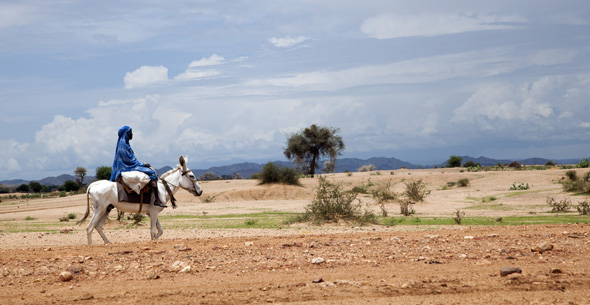
Photo Credit: “Displaced Darfuris Farm in Rainy Season,” courtesy of United Nations Photo. -
Engaging Faith-Based Organizations on Maternal Health
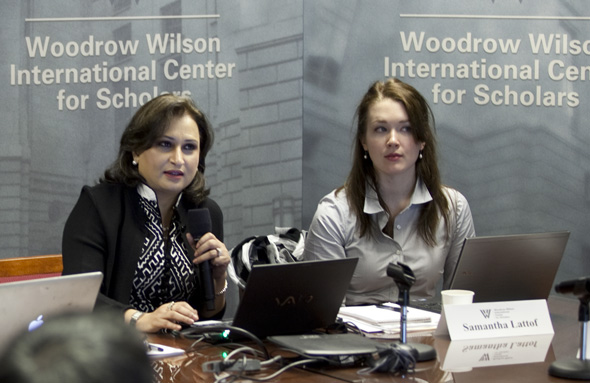
›“Faith-inspired organizations have many different opportunities [than non-faith-based NGOs]. The point that is often reiterated is that religions are sustainable. They will be there before the NGOs get there and will be there long after,” said Katherine Marshall, executive director of the World Faiths Development Dialogue at the Wilson Center on November 16. Marshall noted in her opening remarks that maternal health should be an easy issue for all groups, regardless of religious tradition, to stand behind. Yet, in reality, maternal health is a topic that “very swiftly takes you into complex issues, like reproductive health, abortion, and family planning,” she said.
As part of the Advancing Dialogue on Maternal Health series, the Woodrow Wilson International Center for Scholars’ Global Health Initiative collaborated with the World Faiths Development Dialogue and Christian Connections for International Health to convene a small technical meeting on November 15 with 30 maternal health and religious experts to discuss case studies involving faith-based organizations in Bangladesh, Nigeria, Pakistan, and Yemen. The country case studies served as a springboard for group discussion and offered a number of recommendations for increasing the capacity of faith-based organizations (FBOs) working on maternal health issues.
Engaging Religious Leaders in Pakistan
“When working with religious leaders to improve maternal health there are some do’s and don’ts,” said Nabeela Ali, chief of party with the Pakistan Initiative for Mothers and Newborns (PAIMAN). Ali described a PAIMAN project that worked with 800 ulamas (religious leaders) to increase awareness about pregnancy and promote positive behavior change among men.
One of the “do’s” highlighted by Ali was the need to build arguments for maternal health based on the Quran and to tailor terminology according to the ulamas preferences. The ulamas who worked with PAIMAN did not want to utilize the word “training,” so instead they called their education programming “consultative meetings.” More than 200,000 men and women were reached during the sermons and the strategy was been picked up by the government as one of the best practices written into in the Karachi Declaration, signed by the secretaries of health and population in 2009.
Despite the successes of the program, Ali warned against having unrealistic expectations for religious leaders interfacing with maternal health. She stressed the importance for having a long-term “program” approach to the issue, as opposed to a short-term “project” framework.
Behavior Change in Yemen
“Religion is a main factor in decisions Yemeni people make about most issues in their lives and religious leaders can play a major role in behavior change,” said Jamila AlSharie a community mobilizer for Pathfinder International.
Eighty-two percent of Yemeni women say the husband decides if they should receive family planning and 22 percent say they do not take contraception because they belief it is against their religion and fertility is the will of God, said AlSharie. Therefore, the adoption of healthy behavior change requires the involvement of key opinion leaders and the alignment of messages set in religious values. Trainings with religious leaders included family planning from an Islamic perspective, risks associated with early pregnancy, nutrition, education, and healthcare as a human right.
Male Participation a Key Strategy
“As a faith-based organization we believe it is a God-given right to safe health care and delivery so we mobilize communities to support pregnant women to address their needs, educate families about referrals and existing services in the community,” said Elidon Bardhi, country director for the Bangladesh arm of the Adventist Development and Relief Agency (ADRA).
Through female-run community organizations, ADRA educates men and women about the danger signs of labor and when to seek care. For example, many men in Bangladesh hold the belief that women should eat less during pregnancy to ensure a smaller baby is born, thereby making delivery easier, said Bardhi. ADRA addressed such misconceptions through a human rights-based approach and emphasized male participation as a key strategy, ensuring there were seven male participants for every one female.
A Culturally Nuanced Approach in Nigeria
The Nigerian Urban Reproductive Health Initiative (NURHI) is a public-private partnership that identifies and creates strategies for integrating family planning with maternal health. According to Kabir Abduallahi, team leader of NURHI, “family planning” is not as acceptable a term as “safe birth spacing” in Nigeria, so the project highlighted how family planning can help space births and save lives.
Religion and culture play an important role in the behavior of any community. The introduction of a controversial healthcare intervention (such as family planning) in a religiously conservative community requires careful assessment of the environment and careful planning for its introduction, said Abduallahi. Baseline surveys and formative research data helped NURHI understand the social context and refine intervention strategies.
Ten Ways to Increase the Capacity of FBOs
Faith-based organizations’ close links to communities provide them with an opportunity to promote behavior change and address other cultural factors contributing to maternal mortality rates such as early marriage and family planning.
Working in collaboration with FBOs and other stakeholders is critical to promoting demand for maternal and reproductive health services; however, there is limited knowledge about faith-based maternal healthcare and FBOs are often left off the global health agenda. In conclusion, Marshall noted 10 areas the group identified as areas to focus on:- Move projects to programs: Projects are often donor driven and limited in scope and duration. Donors and policymakers should move from project-oriented activities to local, regional, and national-level advocacy programs to build sustainable change.
- Coordinate, coordinate, coordinate: Significant resources are wasted due to a lack of coordination between FBOs and development agencies. A country-level coordinating mechanism should be developed to streamline efforts not only between agencies but also across faiths.
- Context, context, context: A thorough understanding of the local culture and social norms is imperative to successful program implementation.
- Terminology is important: In Pakistan, religious leaders redefined sensitization meetings around family planning and maternal and child health as “consultative meetings” not “trainings.” In Nigeria, the culture prefers “child birth spacing” over “family planning.” In Yemen, it’s “safe age of marriage” instead of “early childhood marriage.”
- Most religious leaders are open and with adequate information can produce behavior and value changes. Utilizing the Quran, Hadith, and Bible can support arguments and emphasize the issue of health and gender equity.
- Relationship building: Winning the trust of religious leaders can be difficult and time-consuming but is necessary for opening doors to patriarchal societies.
- Rights-based approach: A human rights-based approach can be a very powerful agent of change for addressing negative social structures such as violence against women, but it can also create controversy. In Bangladesh, ADRA utilized the approach to educate men about nutrition, dowry and child marriage, and education of women.
- Networks: There is a significant need to create forums that bring together the various FBO and global development communities in order to share knowledge and enhance advocacy messages. Networks are needed to streamline resources and inventory existing research, projects, and faith-based models that work.
- Monitoring and evaluation systems: There is a striking lack of data about the impact and outcomes of FBOs. Increasing the monitoring and evaluation skills of FBO workers can improve evaluation systems and meet the demand for new data.
- There needs to be greater political will for engaging the faith-inspired community.
Event ResourcesPhoto Credit: David Hawxhurst/Wilson Center.