Showing posts from category Asia.
-
Mapping Population and Climate Change
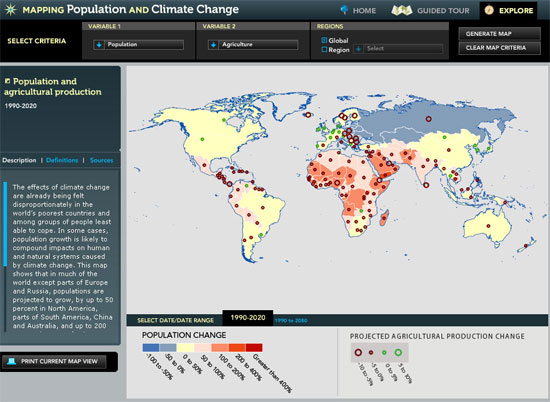
›Climate change, population growth, unmet family planning needs, water scarcity, and changes in agricultural production are among the global challenges confronting governments and ordinary citizens in the 21st century. With the interactive feature “Mapping Population and Climate Change” from Population Action International, users can generate maps using a variety of variables to see how these challenges relate over time.
Users can choose between variables such as water scarcity or stress, temperature change, soil moisture, population, agriculture, need for family planning, and resilience. Global or regional views are available, as well as different data ranges: contemporary, short-term projections (to the year 2035), and long-term projections (2090).In the example featured above, the variables of population change and agricultural production change were chosen for the time period 1990-2020. Unfortunately, no country-specific data is given, though descriptions in the side-bar offer some helpful explanations of the selected trends.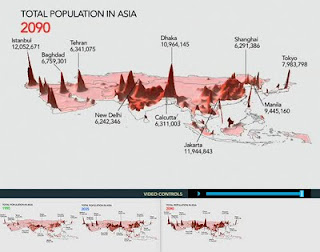
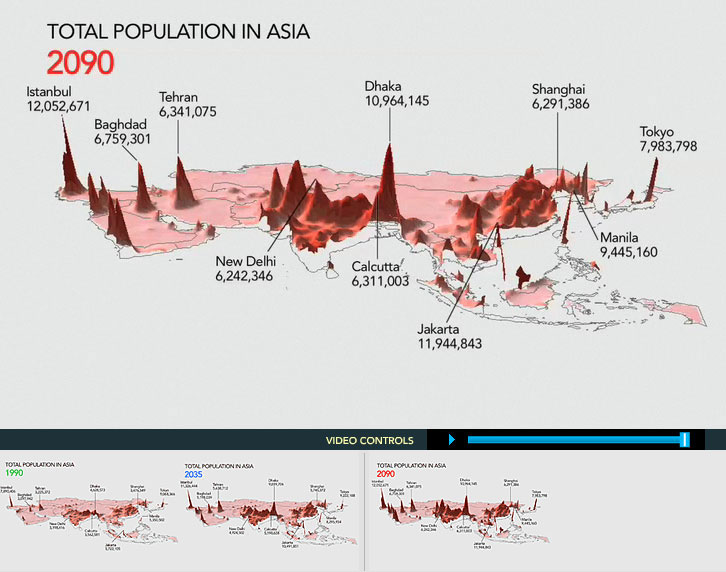
In addition, users can view three-dimensional maps of population growth in Africa and Asia for the years 1990, 2035, and 2090. These maps visually demonstrate the projected dramatic increases in population of these regions by the end of the century. According to the latest UN estimates, most of the world’s population growth will come from Africa and Asia due to persistently high fertility rates.
Image Credit: Population Action International. -
“The Second Front in the War on Terror”
USAID, Muslim Separatists, and Politics in the Southern Philippines
›For some years after the terrorist attacks of 9/11, the existence of violent Muslim separatists on the southern Philippine island of Mindanao gave U.S. officials significant cause for concern. In 2005, for example, the U.S. embassy charge d’affaires to the Philippines, Joseph Mussomeli, told reporters that “certain portions of Mindanao are so lawless, so porous…that you run the risk of it becoming like an Afghanistan situation. Mindanao is almost, forgive the poor religious pun, the new Mecca for terrorism.” During the Bush administration, officials referred to the region as a “second front” in the War on Terror: the region was once seen as a “new Afghanistan” that “threatened to become an epicenter of Al Qaeda.” [Video Below]
Nevertheless, as noted by Wilson Center Fellow Patricio Abinales at an Asia Program event on May 11, U.S. efforts to co-opt and pacify separatist guerrillas have proven remarkably successful in some areas of the islands. Some commentators have highlighted the role of the U.S. military in bringing a relative sense of security to troubled regions, noting that Mindanao presents a “future model for counterinsurgency.” However, Abinales’s research shows the military activities have had little effect, often because troops are stationed far from potential areas of conflict. Instead, it is the civilian side of the American presence that has dampened conflict in the war zones of the southern Philippines.
Abinales specifically explored the factors behind the success of the U.S. Agency for International Development’s (USAID) Growth with Equity in Mindanao (GEM) program in demobilizing and reintegrating 28,000 separatist guerrillas of the Moro National Liberation Front (MNLF), as well as the long-term political consequences of this accomplishment.
“Arms to Farms”
Usually, USAID programs are organized on the basis of grants for specific and limited projects. In contrast, GEM arose as a long-term umbrella organization that oversees the disbursement and management of American funding across a number of long-term projects. Coordinators are trained directly in Mindanao and are encouraged to “go native,” living in the area and becoming part of the community. GEM prioritizes cultural understanding, respect for community leaders, an appreciation of the important role that women play in local societies, and sensitivity to potential divisions within separatist groups and their security concerns vis-à-vis the Philippine government.
There has often been a general tendency for aid organizations to associate the demobilization of warring groups with disarmament. While Philippine officials on Mindanao have sometimes tried this approach, cash-for-guns amnesty schemes have opened up opportunities for corruption and have not been particularly effective. Understanding that one of the major concerns of guerrilla rebels is exploitation by corrupt government officials, GEM established an “Arms to Farms” scheme, whereby Muslim rebels are trained to engage in agriculture, but are not encouraged to put away their weapons. In this way, the program keeps potential guerrillas and Al Qaeda recruits busy with legitimate and peaceful economic activity, while it assuages their concerns about the threat from corrupt government officials, who may otherwise take the fruits of agricultural labor by force.
In fact, Abinales noted that one of the keys to GEM’s success is that the organization has never submitted to the official local authorities, and has largely been allowed a free reign by Manila to conduct its activities on Mindanao. It is precisely because the state has not been successful in delivering welfare regimes which provide stability to the area that GEM is seen as an alternate source of development and security in the region. Moreover, because of GEM’s activities, other American officials are allowed relatively free access, and are even welcomed into areas where the authority of the Philippine government holds no sway. Most of GEM’s activities are conducted with the MNLF, which has maintained its own official treaties and agreements with Manila since the 1970s. However, the American organization is beginning to enter the territory of the Moro Islamic Liberation Front, a splinter group of the MNLF that rejects relations with the national government outright, but one whose leaders are jealous of the development gains the MNLF has made under GEM.
Abinales was quick to point out that although GEM’s activities have been successful, they are tailor-made to specific circumstances. It is therefore difficult to present them as a generalized model that can be applied to other separatist conflicts. Nevertheless, Abinales’s work suggests that government agencies working on counterinsurgency efforts elsewhere might do well to examine the benefits of the flexible civilian approaches to conflict resolution formed with a deep understanding of the concerns of the specific communities involved.
Bryce Wakefield is program associate with the Asia Program at the Woodrow Wilson Center. -
Connections Between Climate and Stability: Lessons From Asia and Africa
›“We, alongside this growing consensus of research institutes, analysts, and security agencies on both sides of the Atlantic, think of climate change as a risk multiplier; as something that will amplify existing social, political, and resource stressors,” said Janani Vivekananda of International Alert, speaking at the Wilson Center on May 10. [Video Below]
Vivekananda, a senior climate policy officer with International Alert’s Peacebuilding Program, was joined by co-presenter Jeffrey Stark, the director of research and studies at the Foundation for Environmental Security and Sustainability (FESS), and discussant Cynthia Brady, senior conflict advisor with USAID’s Office of Conflict Management and Mitigation, to discuss the complex connections between climate change, conflict, stability, and governance.
A Multi-Layered Problem
Climate change and stability represent a “double-headed problem,” said Vivekananda. Climate change, while never the only cause of conflict, can increase its risk in certain contexts. At the same time, “states which are affected by conflict will already have weakened social, economic, and political resilience, which will mean that these states and their governments will find it difficult to address the impacts of climate change on the lives of these communities,” she said.
“In fragile states, the particular challenge is adapting the way we respond to climate change, bearing in mind the specific challenges of operating in a fragile context,” said Vivekananda. Ill-informed intervention programs run the risk of doing more harm than good, she said.
For example, Vivekananda said an agrarian village she visited in Nepal was suffering from an acute water shortage and tried adapting by switching from rice to corn, which is a less water-intensive crop. However, this initiative failed because the villagers lacked the necessary technical knowledge and coordination to make their efforts successful in the long term, and in the short term this effort actually further reduced water supplies and exacerbated deforestation.
“Local responses will only be able to go so far without national-level coordination,” Vivekananda said. What is needed is a “harmony” between so-called “top-down” and “bottom-up” initiatives. “Adapting to these challenges means adapting development assistance,” she said.
“What we’re finding is that the qualities that help a community, or a society, or in fact a government be resilient to climate change are in fact very similar qualities to that which makes a community able to deal with conflict issues without resorting to violence,” said Vivekananda.
No Simple, Surgical Solutions
“The impacts of environmental change and management of natural resources are always embedded in a powerful web of social, economic, political, cultural, and historical factors,” said Stark. “We shouldn’t expect simple, surgical solutions to climate change challenges,” he said.
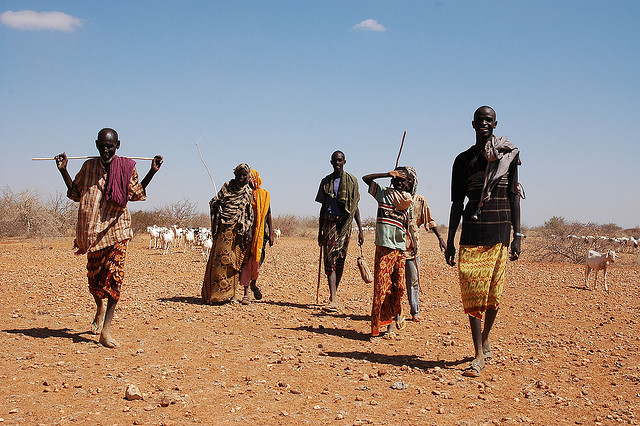
Uganda and Ethiopia, for example, both have rich pastoralist traditions that are threatened by climate change. Increasing temperatures, drought, infrequent but intense rains, hail, and changes in seasonal patterns are threatening pasture lands and livelihoods.
At the same time, pastoralists are confronting the effects of a rapidly growing population, expanding cultivation, forced migration, shrinking traditional grazing lands, anti-pastoralist attitudes, and ethnic tensions. As a result, “any intervention in relation to climate adaptation – whether for water, or food, or alternative livelihoods – has to be fully understood and explicitly acknowledged as mutually beneficial by all sides,” Stark said. “If it is seen in any way to be favoring one group or another it will just cause conflict, so it is a very difficult and delicate situation.”
Yet, the challenges of climate change, said Stark, can be used “as a way to involve people who feel marginalized, empower their participation…and at the same time address some of the drivers of conflict that exist in the country.”
Case Studies: Addressing the “Missing Middle”
When doing climate change work in fragile states, “you have to think about your do-no-harm parameters,” said Brady. “Where are the opportunities to get additional sustainable development benefit and additional stabilization benefit out of reducing climate change vulnerability?”
More in-depth case studies, such as the work funded by USAID and conducted by FESS in Uganda and Ethiopia, are needed to help fill the “missing middle” between broad, international climate change efforts – like those at the United Nations – and the community level, Brady said.
The information generated from these case studies is being eagerly awaited by USAID’s partners in the Departments of State, Defense, and Treasury, said Brady. “We are all hopeful that there will be some really significant common lessons learned, and that at a minimum, we may draw some common understanding about what climate-sensitive parameters in fragile states might mean.”
Image Credit: “Ethio Somali 1,” courtesy of flickr user aheavens. -
Momentum Magazine
Where Does It Hurt? Climate Vulnerability Index
›The original version of this article appeared in the University of Minnesota’s Momentum Magazine. Text by Mary Hoff, page layout by Todd Reubold.
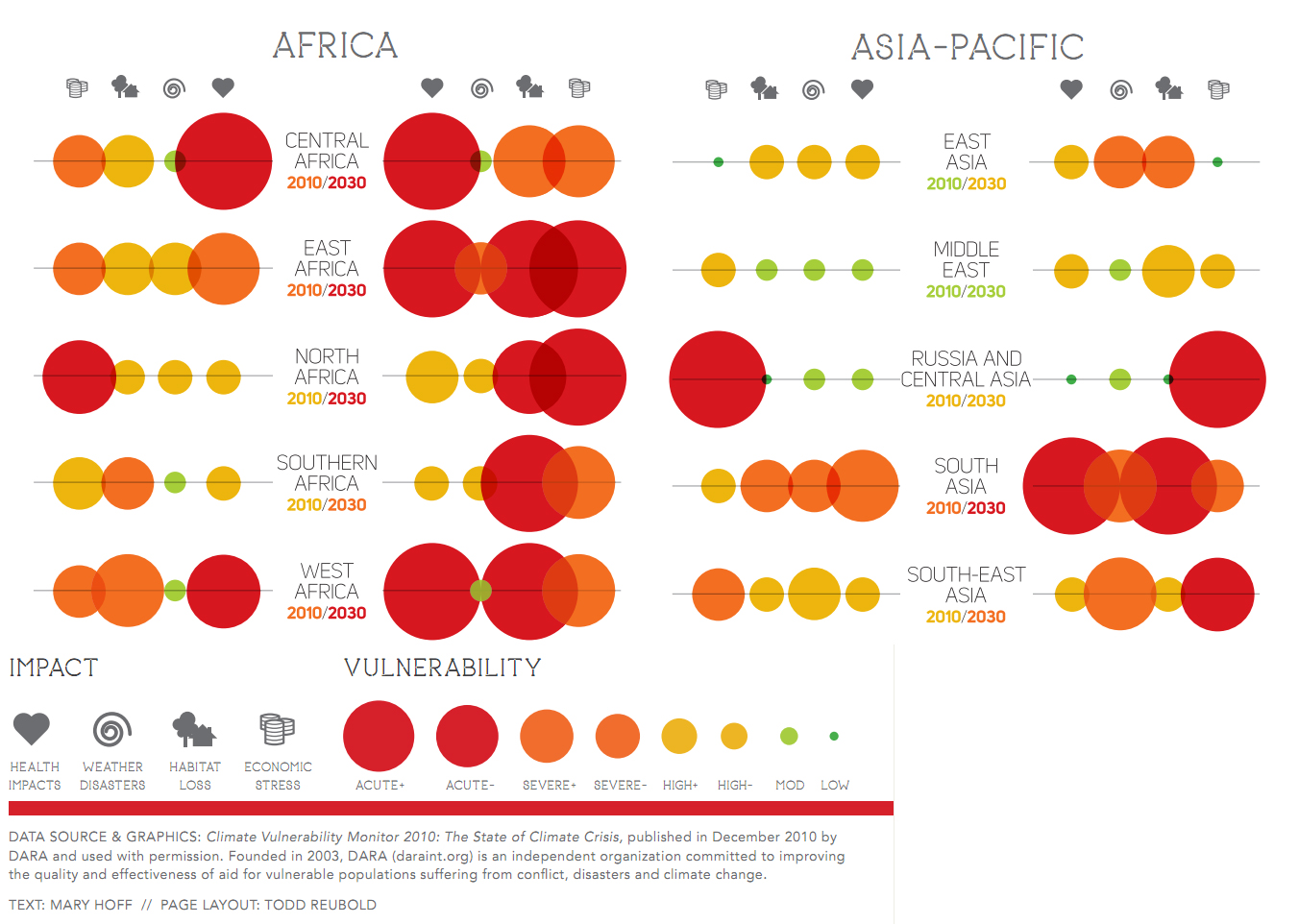
The punch climate change packs varies from one country, region, or continent to another. DARA, a Madrid-based humanitarian advocacy organization, recently partnered with the Climate Vulnerable Forum, comprising countries particularly vulnerable to climate change, to create Climate Vulnerability Monitor 2010, an atlas of vulnerability. This infographic presents a small portion of the picture the Climate Vulnerability Monitor paints.
Vulnerability is grouped into four categories: health impacts, weather disasters, habitat loss and economic stress. Circles on the left side of each set indicate relative magnitude of vulnerability in 2010. Circles on the right indicate the same for 2030.
See the full “Where Does it Hurt?” infographic on the Momentum site or download the Climate Vulnerability report from DARA.
Image Source: Climate Vulnerability Monitor 2010: The State of Climate Crisis, published in December 2010 by DARA (daraint.org). Used with permission. -
David Biello, Momentum Magazine
Coping with Change: Climate Adaptation Today
›May 2, 2011 // By Wilson Center StaffThe original version of this article, by David Biello, appeared in the University of Minnesota’s Momentum Magazine.
The view from space offers a clarity about our changing planet less visible from the ground: spring thaw coming sooner year after year, the iconic snows of Kilimanjaro and glaciers across the globe dwindling – and a great green wall of vegetation spreading across the region just south of Africa’s Sahara Desert.
This arid expanse, known as the Sahel, stretches from the Atlantic Ocean to the Red Sea. It has undergone a remarkable transformation since farmers in nations across the region began to allow trees to grow amidst their crops.
In some places it was by accident, as seeds sprouted from manure spread as fertilizer in Niger. In others it was by design, such as the “green dam” against the desert started in Algeria in 1971. But the result has been the same: improved harvests of millet, sorghum, and other staple crops in a region gripped by perennial drought.
Such “agroforestry” boosts yields by returning vital nutrients to the soil in the form of decaying leaves, shading crops from the harshest sun, and recharging underground water reserves. The trees also provide an additional source of income: wood for fires and construction. And they have another even more important benefit: They may help some of the poorest farmers in the world adapt to climate change – while potentially removing as much as 50 billion metric tons of carbon dioxide from the atmosphere, according to agronomist Dennis Garrity, head of the Nairobi-based World Agroforestry Centre.
“The transformation of agriculture into agroforestry is well underway,” Garrity says. “Agricultural systems incorporating trees increase overall productivity and incomes in the face of more frequent droughts, and agroforestry systems provide much greater carbon offset opportunities than any other climate mitigation practice in agriculture.”
Climate change is already worse than anticipated by the UN Intergovernmental Panel on Climate Change. Extreme precipitation events, such as last spring’s flooding in Nashville, Tenn., or last winter’s drought in China, have become more frequent. Sea ice extents have reached record lows in the Arctic. And 2010 marked the end of the hottest decade in recorded history.
Not only that, but the 0.7-degree-Celsius uptick in global average temperatures we’ve seen so far is only half the warming that can be expected from the concentrations of greenhouse gases already in the atmosphere, according to a 2010 report from the U.S. National Research Council. And as warming continues, according to the NRC report, the world can expect (among other things) a drop in the yield of cereal crops due to higher temperatures, an increase in heavy rainfall, and a rise in ocean levels.
In other words, whatever measures might be adopted to reduce emissions of greenhouse gases, the world will still need to adapt to a changing climate. Indeed, that process has already begun.
Continue reading on the University of Minnesota’s Momentum Magazine site.
Photo Credit: Deep in the Sahel, the dwindling Lake Chad borders Niger, Chad, and Nigeria. Courtesy of flickr user NASA Goddard Photo and Video. -
Overcoming Pakistan’s Demographic Challenges
›Download Reaping the Divided: Overcoming Pakistan’s Demographic Challenges from the Wilson Center. Excerpted below is the introductory essay, “Pakistan’s Demographics: Possibilities, Perils, and Prescriptions,” by Michael Kugelman.
On July 11, 2010, Pakistani Prime Minister Yousaf Raza Gilani delivered a speech in Islamabad to commemorate World Population Day. He announced that in order to highlight the crucial connection between demographics and economic growth, 2011 would be designated “Population Year” in Pakistan. “All hopes of development and economic prosperity would flounder if we as a nation lose the focus and do not keep [the] population issue in the spotlight,” he declared.
Hopefully that spotlight comes with a long shelf life. Pakistan faces acute population challenges. If they are to be overcome, they will need to be illuminated for far more than a year.
Yet, there are exciting opportunities here as well. A long-term approach to managing the challenges presented by Pakistan’s burgeoning population, if accompanied by effective policies and sustained implementation, could spark a monumental transformation: one that enables the country to harness the great promise of a large population that has usually been viewed as a hindrance to prosperity. Indeed, demographers contend that Pakistan’s young, growing, and rapidly urbanizing population can potentially bring great benefits to the country. If birth rates fall substantially, and if young Pakistanis are properly educated and successfully absorbed into the labor force, then the nation could reap a “demographic dividend” that sparks economic growth, boosts social well-being, and promotes the rejuvenation of Pakistan.
The Young and the Rising
Because Pakistan has not conducted a census since 1998, estimating the country’s total population size is a highly inexact science. The Pakistani government lists the current figure at about 175 million people, while the United Nations believes the number is closer to 185 million. However, while the precise figure may be in doubt, the population’s rapid rise is not. Though no longer increasing at the 3 percent-plus rate seen in the 1980s, Pakistan’s population is still growing at a 2 percent pace. According to the UN Population Division’s latest mid-range demographic projections, released in 2009, the population will rise to 335 million by 2050. More than 60 million people are expected to be added in just the next 15 years.
This explosive increase, however, merely represents the best-case scenario, and will prevail only if the country’s fertility rates drop from the current average of about four children per woman to two. Should fertility rates remain constant, the UN estimates the population could exceed 450 million by 2050, with a total population of nearly 300 million as early as 2030.
Pakistan’s population is not only large and growing, but also very young, with a median age of 21. Currently, two-thirds of Pakistanis are less than 30 years old. As a percentage of total population, only Yemen has more people under the age of 24. Additionally, given that more than a third of Pakistanis are now 14 years old or younger, the country’s population promises to remain youthful over the next few decades. In the 2020s, the 15-to-24 age bracket is expected to swell by 20 percent. Pakistan’s under-24 population will still be in the majority come 2030. And as late as 2050, the median age is expected to be only 33.
Pakistan’s demographic profile contrasts with what is happening in much of the rest of the world. Sub-replacement level fertility rates (about two births per woman) prevail not only throughout the developed world, but also across much of Southeast Asia, the Middle East, and Latin America. As one commentator has noted, “the twenty-first century’s hallmark [demographic] trend appears to be a fertility implosion.” South Asia, along with sub-Saharan Africa, is one of the last regional bastions of youthful, rapidly proliferating populations. Yet even within South Asia, Pakistan stands out. Excluding Afghanistan, of all the member states of the South Asian Association for Regional Cooperation – Bangladesh, Bhutan, India, Maldives, Nepal, and Sri Lanka – Pakistan has the highest population growth, birth, and fertility rates; the youngest median age (tied with Nepal); and the largest percentage of people 14 years old or younger.
Continue reading “Pakistan’s Demographics: Possibilities, Perils, and Prescriptions,” or download the full report from the Wilson Center.
Michael Kugelman is a program associate with the Asia Program. -
What “Lost” Cultures Can Contribute to Management of Our Planet
›“Climate change is not a technical problem for indigenous people – it’s a psychological and spiritual problem,” said Wade Davis, explorer-in-residence at National Geographic, at a recent Wilson Center event, the third in a series co-sponsored by George Mason University and the Environmental Change and Security Program. Indigenous people are “being driven out of existence,” as climate change alters landscapes and weather patterns that they have carefully adapted to over centuries, he said. These people are not “failed attempts at being modern…they are unique answers to the fundamental question, ‘what does it mean to be human and alive?’” he said. “It behooves us to pay attention to how they choose to live upon the earth.” [Video Below]
-
Congressional Report on Avoiding “Water Wars” in Afghanistan and Pakistan
›March 15, 2011 // By Schuyler Null“Water plays an increasingly important role in our diplomatic and national security interests in [Central and South Asia], and we must ensure that our approach is carefully considered and coordinated across the interagency,” begins a new staff briefing, Avoiding Waters Wars: Water Scarcity and Central Asia’s Growing Importance for Stability in Afghanistan and Pakistan, prepared for the Senate Foreign Relations Committee. “As water demand for food production and electricity generation increases, in part as a result of the quickening pace of climate change, so too must our efforts to provide water security,” write the authors.
The report focuses mainly on Afghanistan and Pakistan but also considers “the interests in the shared waters by India and the neighboring five Central Asian countries – Uzbekistan, Tajikistan, Kazakhstan, Kyrgyzstan, and Turkmenistan.”
ECSP is cited twice in the report, both from “Water Can Be a Pathway to Peace, Not War,” in ECSP Report 13:The Navigating Peace Initiative’s Water Conflict and Cooperation Working Group correctly summarized the current state of water use by saying, “water use is shifting to less-traditional sources such as deep fossil aquifers and wastewater reclamation. Conflict, too, is becoming less traditional, driven increasingly by internal or local pressures or, more subtly, by poverty and instability. These changes suggest that tomorrow’s water disputes may look very different from today’s.”
And again in breaking down the notion of impending water wars:Given the important role water plays in Central and South Asia as a primary driver of human insecurity, it is important to recognize that for the most part, the looming threat of so-called “water wars” has not yet come to fruition. Instead, many regions threatened by water scarcity have avoided violent clashes through discussion, compromise, and agreements. This is because “[w]ater – being international, indispensable, and emotional – can serve as a cornerstone for confidence building and a potential entry point for peace.”
USAID’s “Changing Glaciers and Hydrology in Asia: Addressing Vulnerabilities to Glacier Melt Impacts,” which was launched here at the Wilson Center last fall, also made an appearance:Central Asia and India face critical challenges in monitoring glaciers and tracking changes, particularly differences from year to year. As USAID’s report “Changing Glaciers and Hydrology in Asia: Addressing Vulnerabilities to Glacier Melt Impacts” noted, “[t]he review of scientific information about glacier melt in High Asia revealed, first and foremost, a lack of data and information, a lack that hampers attempts to project likely impacts and take action to adapt to changed conditions.” The United States should engage in collaborative glacier monitoring programs and those that develop local or sub-national water monitoring capacity.
The report concludes that “water scarcity, coupled with how governments address these challenges,” can either exacerbate conflict or promote cooperation in the region. It’s also worth noting that the authors specifically mention the links between increased water use and growing populations in the region, specifically with regard to India and Pakistan:With a population already exceeding 1.1 billion people and forecasts indicating continued growth to over 1.5 billion by 2035, India’s demand for water is rising at unprecedented rates.
The drive to meet energy and development demands from both countries has led to plans for extensive hydrological projects that could spark tensions between the two over the Indus Waters Treaty (which has withstood four Indo-Pakistani wars).
The authors praise the attention given to the matter thus far by the Obama administration, but they also write that “although it is still too early to determine the impacts of our efforts in the broader region, now is the time to begin evaluating water-related trends” at a more systematic level.
Sources: U.S. Senate Committee on Foreign Relations.