Showing posts from category Asia.
-
In Rush for Land, Is it All About Water?
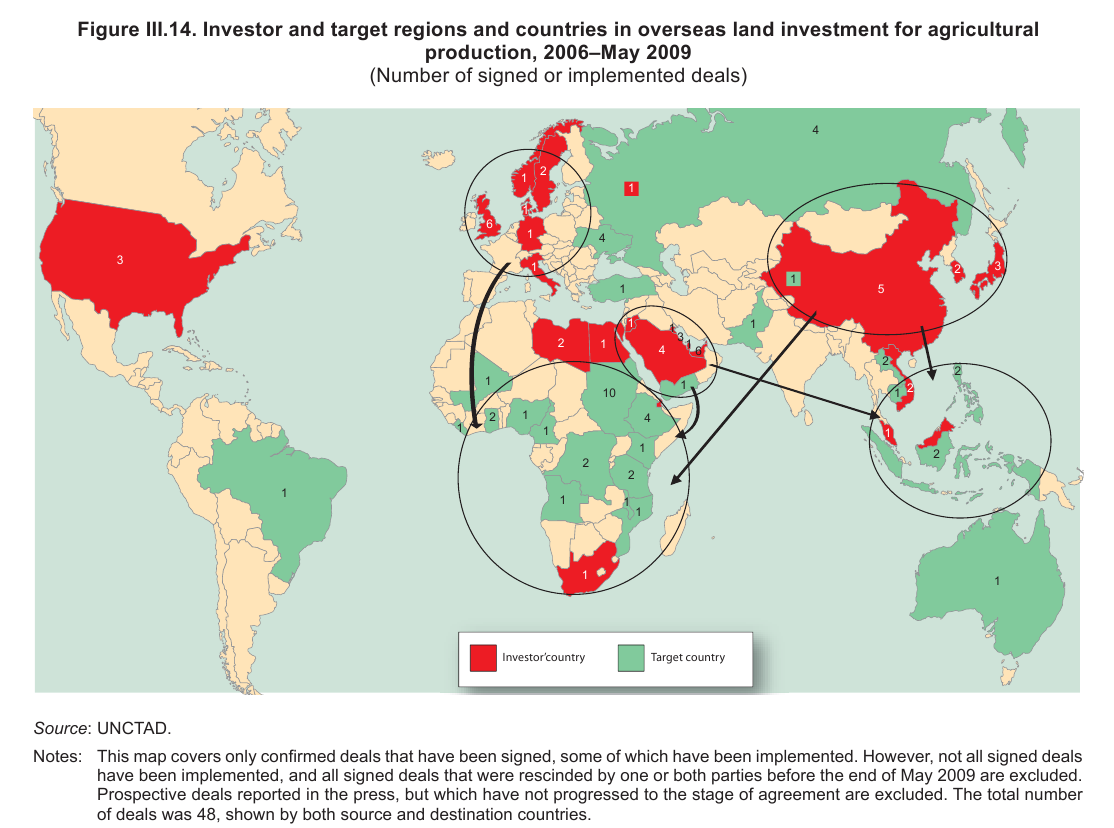
›July 26, 2011 // By Christina DaggettOver the past few years, wealthy countries with shrinking stores of natural resources and relatively large populations (such as China, India, South Korea, and the Gulf states) have quietly purchased huge parcels of fertile farmland in Africa, South America, and South Asia to grow food for export to the parent country. With staple food prices shooting up and food security projected to worsen in the decades ahead, it is little wonder that countries are looking abroad to secure future resources. But the question arises: Are these “land grabs” really about the food — or, more accurately, are they “water grabs”?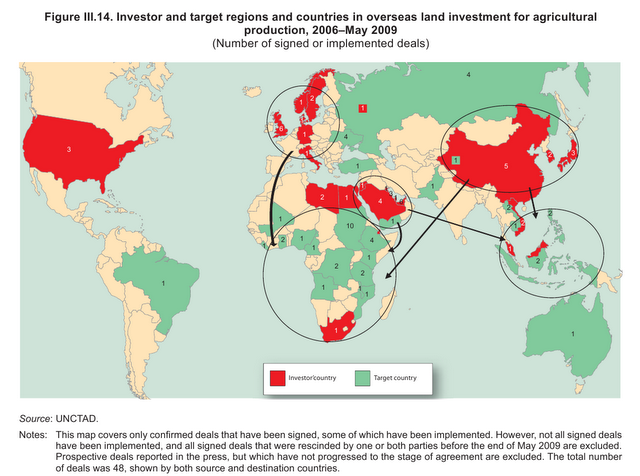
The Great Water Grab
With growing urban populations, an expanding middle class, and increasingly scarce arable land resources, some governments and investors are snapping up the world’s farmland. Some observers, however, have pointed out that these dealmakers might be more interested in the water than the land.
In an article from The Economist in 2009, Peter Brabeck-Letmathe, the chairman of Nestlé, claimed that “the purchases weren’t about land, but water. For with the land comes the right to withdraw the water linked to it, in most countries essentially a freebie that increasingly could be the most valuable part of the deal.”
Consider some of the largest investors in foreign land: China has a history of severe droughts (and recently, increasingly poor water quality); the Gulf nations of Saudi Arabia, Kuwait, Qatar, and Bahrain are among the world’s most water-stressed countries; and India’s groundwater stocks are rapidly depleting.
A recent report from the World Bank on global land deals highlighted the effect water scarcity is having on food production in China, South Asia, the Middle East, and North Africa, stating that “in contrast, Sub-Saharan Africa and Latin America have large untapped water resources for agriculture.”
Keeping Engaged and Informed
“The water impacts of any investment in any land deal should be made explicit,” said Phil Woodhouse of the University of Manchester during the recent International Conference on Global Land Grabbing, as reported by the New Agriculturist. “Some kind of mechanism is needed to bring existing water users into an engagement on any deals done on water use.”
At the same conference, Shalmali Guttal of Focus on the Global South cautioned, “Those who are taking the land will also take the water resources, the forests, wetlands, all the wild indigenous plants and biodiversity. Many communities want investments but none of them sign up for losing their ecosystems.”
With demand for water expected to outstrip supply by 40 percent within the next 20 years, water as the primary motivation behind the rush for foreign farmland is a factor worth further exploration.
Global Farming
According to a report from the Oakland Institute, nearly 60 million hectares (ha) of African farmland – roughly the size of France – were purchased or leased in 2009. With these massive land deals come promises of jobs, technology, infrastructure, and increased tax revenue.
In 2008 South Korean industrial giant Daewoo Logistics negotiated one of the biggest African farmland deals with a 99-year lease on 1.3 million ha of farmland in Madagascar for palm oil and corn production. The deal amounted to nearly half of Madagascar’s arable land – an especially staggering figure given that nearly a third of Madagascar’s GDP comes from agriculture and more than 70 percent of its population lives below the poverty line. When details of the deal came to light, massive protests ensued and it was eventually scrapped after president Marc Ravalomanana was ousted from power in a 2009 coup.
While perhaps an extreme example, the Daewoo/Madagascar deal nonetheless demonstrates the conflict potential of these massive land deals, which are taking place in some of the poorest and hungriest countries in the world. In 2009, while Saudi Arabia was receiving its first shipment of rice grown on farmland it owned in Ethiopia, the World Food Program provided food aid to five million Ethiopians.
Other notable deals include China’s recent acquisition of 320,000 ha in Argentina for soybean and corn cultivation – a project which is expected to bring in $20 million in irrigation infrastructure, the Guardian reports – and a Saudi Arabian company which has plans to invest $2.5 billion and employ 10,000 people in Ethiopia by 2020, according to Gambella Star News.
But governments in search of cheap food aren’t the only ones interested in obtaining a piece of the world’s breadbasket: Individual investors are also heavily involved, and the Guardian reports that U.S. universities and European pension funds are buying and leasing land in Africa as well.
The Future of Land and Water
Whatever the benefits or pitfalls, large-scale land deals around the world look set to continue. The world is projected to have 7 billion mouths to feed by the end of this year and possibly 10 billion plus by the end of the century.
Currently, agriculture uses 11 percent of the world’s land surface and 70 percent of the world’s freshwater resources, according to UNESCO. If and when the going gets tough, how will the global agricultural system respond? Whose needs come first – the host countries’ or the investing nations’?
Christina Daggett is a program associate with the Population Institute and a former ECSP intern.
Photo Credit: Number of signed or implemented overseas land investment deals for agricultural production 2006-May 2009, courtesy of GRAIN and the UN Conference on Trade and Development (UNCTAD).
Sources: BBC News, Canadian Water Network, Christian Science Monitor, Circle of Blue, The Economist, Gambella Star News, Guardian, Maplecroft, New Agriculturalist, Oakland Institute, State Department, Time, UNFPA, UNESCO, World Bank, World Food Program. -
Leona D’Agnes on Evaluating PHE Service Delivery in the Philippines
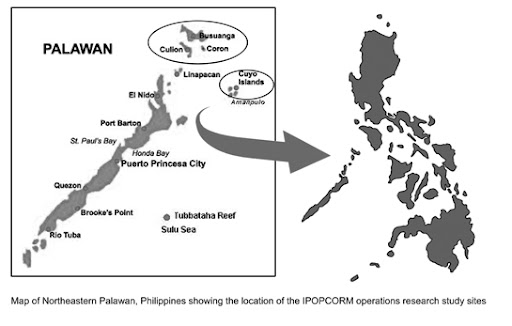
›“By reducing population growth, we are going to have a better chance of sustaining the gains of an environmental conservation project,” said Leona D’Agnes in this interview with ECSP. D’Agnes, a technical advisor to PATH Foundation Philippines, served as lead author on a research article published late last year in Environmental Conservation titled, “Integrated Management of Coastal Resources and Human Health Yields Added Value: A Comparative Study in Palawan (Philippines).” The study provided concrete statistical evidence that integrated development programming incorporating population, health, and the environment (PHE) can be more effective in lowering population growth rates and preserving critical coastal ecosystems than single-sector development interventions.
“What set this research apart from earlier work on integrated programming was the rigorous evaluation design that was applied,” said D’Agnes. “What this design aimed to do is to evaluate the integrated approach itself. Most of the previous evaluations that have been done on integrated programming were impact evaluations — they set out to evaluate the impact of the project.” This most recent research project, on the other hand, sought to evaluate the effectiveness of cross-sectoral interventions based on “whether or not synergies were produced,” said D’Agnes.Although it took her team six years to generate statistically significant findings in Palawan, D’Agnes reports that the synergies of PATH Foundation Philippines’ PHE intervention took the form of reduced income poverty, a decreased average number of children born to women of reproductive age, and the preservation of coastal resources, which helped bolster the region’s food security.
Going forward, D’Agnes said, an integrated approach to environmental conservation should also prove appealing because of its cost effectiveness. “This has huge implications for local governments in the Philippines, where they are struggling to meet the basic needs of their constituents in the face of very small internal revenue allotments that they get from the central government,” she said. “They can really pick up on this example to see that at the local level, if somehow they can do this integrated service delivery that was done in the Integrated Population and Coastal Resource Management (IPOPCORM) model, that they’ll be able to achieve the objectives of both their conservation and their health programs in a much more cost-effective way, and, in the process, generate some other [positive] outcomes that perhaps they didn’t anticipate.”
D’Agnes expects the study’s results will prompt a fresh look at cross-sectoral PHE programming. “I hope that this evidence from this study will help to change the thinking in the conservation community about integrated approaches to conservation and development,” she said.
The “Pop Audio” series is also available as podcasts on iTunes. -
Life on the Edge: Climate Change and Reproductive Health in the Philippines
›July 18, 2011 // By Hannah MarquseeHigh population growth and population density have placed serious stress on natural resources in the Philippines. No one lives far from the coast in the 7,150-island archipelago, making the population extremely dependent on marine resources and vulnerable to sea-level rise, flooding, and other effects of climate change. The coastal megacity of Manila – one of the most densely populated in the world – is beset by poor urban planning, lack of infrastructure, and a large population living in lowland slums, making it particularly vulnerable to increased flooding and natural disasters. [Video Below]
The Philippines is now home to 93 million people and by 2050 is expected to reach 155 million, according to the UN’s medium fertility variant projections. Development programs in the country have made great strides towards increasing access to family planning and reproductive health services as well as improving management of marine resources, but the underlying trends remain troubling.
The Battle Over Reproductive Health
Since 1970, the government’s Commission on Population has been addressing population growth, reproductive health, and family planning. “The impact of the high rate of population growth is intricately linked to the welfare and sustainable development for a country like the Philippines, where poverty drives millions of people to overexploit their resource base,” wrote the commission. As a result of these efforts and others, total fertility rate has dropped from 6.0 children per woman in 1970, to the present 3.2.
The Philippines has also made great gains towards achieving Millennium Development Goal targets, “particularly in the alleviation of extreme poverty; child mortality; incidences of HIV/AIDS, tuberculosis, and malaria; gender equality in education; household dietary intake; and access to safe drinking water,” according to the United Nations Development Program (UNDP). Yet, “glaring disparities across regions persist,” UNDP states.
One of the poorest regions in the country, the Autonomous Region of Muslim Mindanao, is also home to a violent separatist movement. With limited access to health services, fertility and population growth rates are the highest in the country. Women in Mindanao average 4.2 children per woman; one in four married women has an unmet need for contraception; and 45 percent of households live in poverty (compared to 24 percent nationally).
Nationally, “serious challenges and threats remain with regard to targets on maternal health, access to reproductive health services, nutrition, primary education, and environmental sustainability,” according to UNDP–in particular, indicators on maternal health are “disturbing” and of all the MDGs, are labeled “least likely to be achieved.”
Out of three million pregnancies that occur every year, half were unplanned and one-third of these end in abortions, according to a 2006 report of the Allan Guttmacher Institute conducted in the Philippines. Induced abortion was the fourth leading cause of maternal deaths, and young women accounted for 17 percent of induced abortions. Over half of births occurred at home and one-third of them were assisted by traditional birth attendants. Around 75 percent of the poorest quintile did not have access to skilled birth attendants compared to only 20 percent of the richest quintile.
The politically influential Catholic Church recently blocked passage of a reproductive health bill, despite support by President Benigno Aquino and a majority of Filipinos. The bill seeks to provide universal access to contraception and would make sex education required from fifth grade onwards, a provision that has angered Church officials.
Manila Under Water
The Philippines’ combination of high population growth and limited land area (nearly all of which is near the coast) makes the country extremely vulnerable to the effects of climate change. Sixty-five percent of Filipinos live in coastal areas and 49 percent live in urban areas. Paul Hutchcroft, in Climate Change and Natural Security, writes that “even in the best of times, the frequency of typhoons, floods, earthquakes, and volcanic eruptions makes the Philippines one of the most disaster-prone countries in the world” (p. 45).
Population growth, climate change, and deforestation will only increase the severity of these disasters, he concludes. Hutchcroft points out that by 2080, projected temperature increases of between 1.2 to 3.9 degrees Celsius could raise sea levels by an estimated 0.19 to 1.04 meters – a scary thought for the 15 million living within a one-meter elevation zone (p. 46).
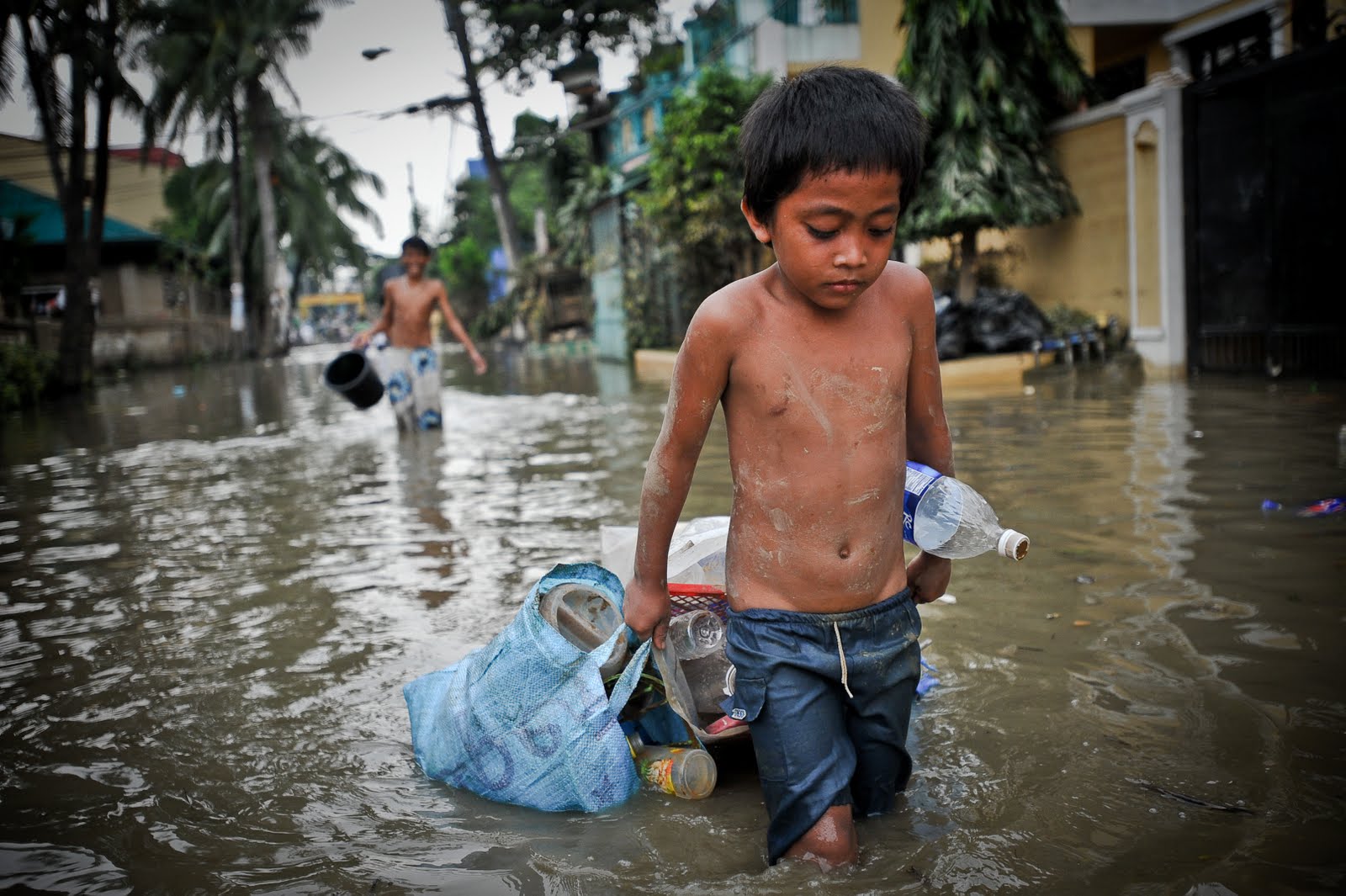
In 2009, metropolitan Manila, currently home to 11 million people (18,650 per square kilometer) and projected to grow to 19 million by 2050, was hit by tropical storms that caused devastating flooding – at their peak, waters reached nearly seven meters, according to a World Bank report. “More than 80 percent of the city was underwater,” write the authors, “causing immense damage to housing and infrastructure and displacing around 280,000-300,000 people.”
“Even if current flood infrastructure plans are implemented, the area flooded in 2050 will increase by 42 percent in the event of a 1-in-100-year flood,” says the World Bank report. Climate change could also increase the cost of flooding as much as $650 million, or 6 percent of GDP. Only by considering climate-related risks in urban planning can the Philippines hope to mitigate the effects of climate change, the report concludes.
Integrated Development: One Piece of the Puzzle?
Population, health, and environment (PHE) programs that integrate family planning and natural resource management are one way to help the majority of Filipinos that live in densely populated and resource-stressed coastal areas.
In ECSP’s FOCUS Issue 15, “Fishing for Families: Reproductive Health and Integrated Coastal Management in the Philippines,” Joan Castro and Leona D’Agnes explain how Path Foundation Philippines, Inc.’s IPOPCORM project – which ran from 2000 to 2006 – helped “improve reproductive health and coastal resource management more than programs that focused exclusively on reproductive health or the environment – and at a lower total cost.” A recent peer-reviewed study, co-authored by Castro and D’Agnes and published in Environmental Conservation, proved the same point with rigorous analysis.
“When we started IPOPCORM, there was really nothing about integrating population, health, and environment,” said Castro in an interview with ECSP. IPOPCORM provided some of the first evidenced-based results showing there is value added to implementing coastal resource management and family planning in tandem rather than separately. In part due to the success of the IPOPCORM, the Philippines have become one of the major PHE development implementers in the world.
Creating sustainably managed marine sanctuaries while improving access to family planning provides a way forward for many coastal communities. However, the Philippines’ urban woes – 44 percent of urban dwellers live in slums, according to the Population Reference Bureau – internal divisions, and natural vulnerability will likely make it difficult to dodge considerable climate-related effects in the near future. Already the archipelago’s vast biodiversity is in crisis, according to studies over two thirds of native plant and animal species are endemic to the islands and nearly half of them are threatened; only seven percent of its original old-growth less than 10 percent of the islands’ original vegetation remains; and 70 percent of nearly 27,000 square kilometers of coral reefs are in poor condition.
Sources: CIA, Conservation International, Field Museum, The Guardian, The Huffington Post, Philippines National Statistics Office, Population Reference Bureau, United Nations, U.S. Census Bureau, World Bank, World Wildlife Fund.
Photo Credit: “Climate Risk and Resilience: Securing the Region’s Future” courtesy of Flickr user Asian Development Bank. -
Watch: Michael Renner on Creating Peacebuilding Opportunities From Disasters
›Michael Renner is a senior researcher at the Worldwatch Institute working on the intersection between environmental degradation, natural resource issues, and peace and conflict. Recently, Renner has focused on water use and its effects on the Himalayan region. In particular he’s working to find positive opportunities that can turn “what is a tremendous problem, into perhaps an opportunity for collaboration among different communities, among different regions, and perhaps…ultimately across the borders of the region,” he said during this interview with ECSP.
-
Rare Earths No More? Mineral Discoveries a Potential Game-Changer for East Asia
›July 7, 2011 // By Schuyler NullDiscoveries announced in a journal article over the weekend may prove a game-changer for global rare earth supplies and recent diplomatic maneuvering in East Asia between China, Japan, Vietnam, and the United States. A team of researchers from Japan’s Agency for Marine-Earth Science and Technology published findings in Nature Geoscience that indicate vast underwater reserves of rare earth minerals are scattered across a huge swath of the Pacific, including south and east of Japan. The U.S. Geological survey estimates current global reserves of rare earth minerals at about 110 million tons; Yasuhiro Kato, the lead author of the Japanese team, told Reuters that the sites surveyed could contain an additional 80 to 100 billion metric tons (yes, with a “b”) of the valuable resources.
The authors write that an “area of just one square kilometer, surrounding one of the sampling sites, could provide one-fifth of the current annual world consumption of these elements.” The team collected data from 78 sites in total, with the largest concentrations centered east of the Hawaiian and Polynesian islands (see a map of the surveyed areas here).
Resource Relationships
The discovery could prove crucial for Japan, as it has been seeking alternative sources of rare earth minerals after an embargo earlier this year by China, which controls 97 percent of the world’s current supply. The embargo (which China denied) was imposed in October of last year after the Japanese navy arrested the captain of a Chinese fishing boat, which was alleged to be encroaching on Japanese territorial waters. China’s response increased tensions across the region and produced a flurry of warnings in Washington over the security of U.S. supplies.
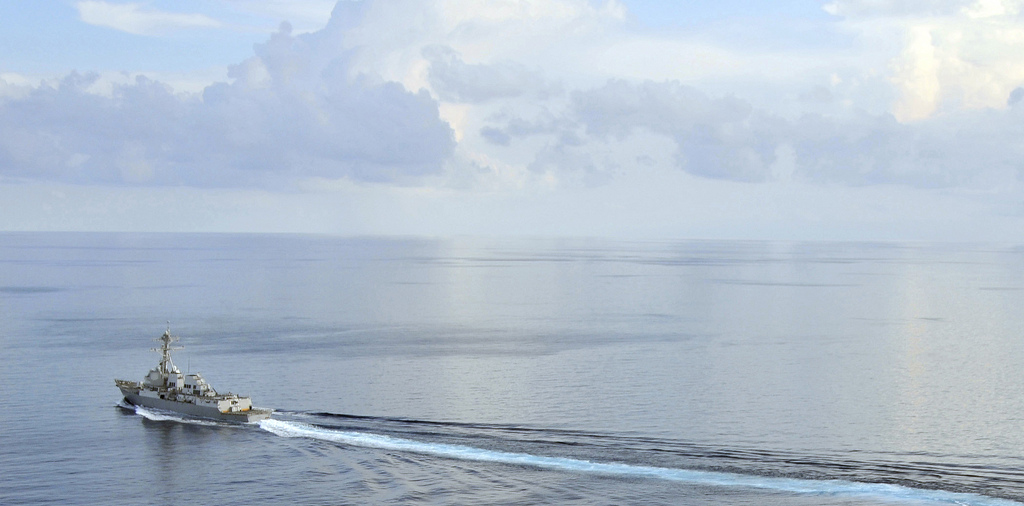
Although the embargo was later lifted, Japan and Vietnam reached an agreement for development of Vietnamese mines in November. The tensions sparked by the encounter also spread to the South China Sea where Chinese, Vietnamese, and Filipino forces have stepped up their jockeying over disputed and resource-rich waters to the highest levels in years. Vietnamese and Chinese naval forces recently held mirror exercises, and Filipino officials invoked a 1950-era defense pact with the United States. Chinese Vice Foreign Minister Cui Tiankai told reporters in June: “I believe the individual countries are actually playing with fire, and I hope the fire will not be drawn to the United States.”
Secretary of State Hillary Clinton called concerns over navigability and Chinese insistence on bilateral (as opposed to multilateral) negotiations in the South China Sea a matter of “national interest” for the United States last year.
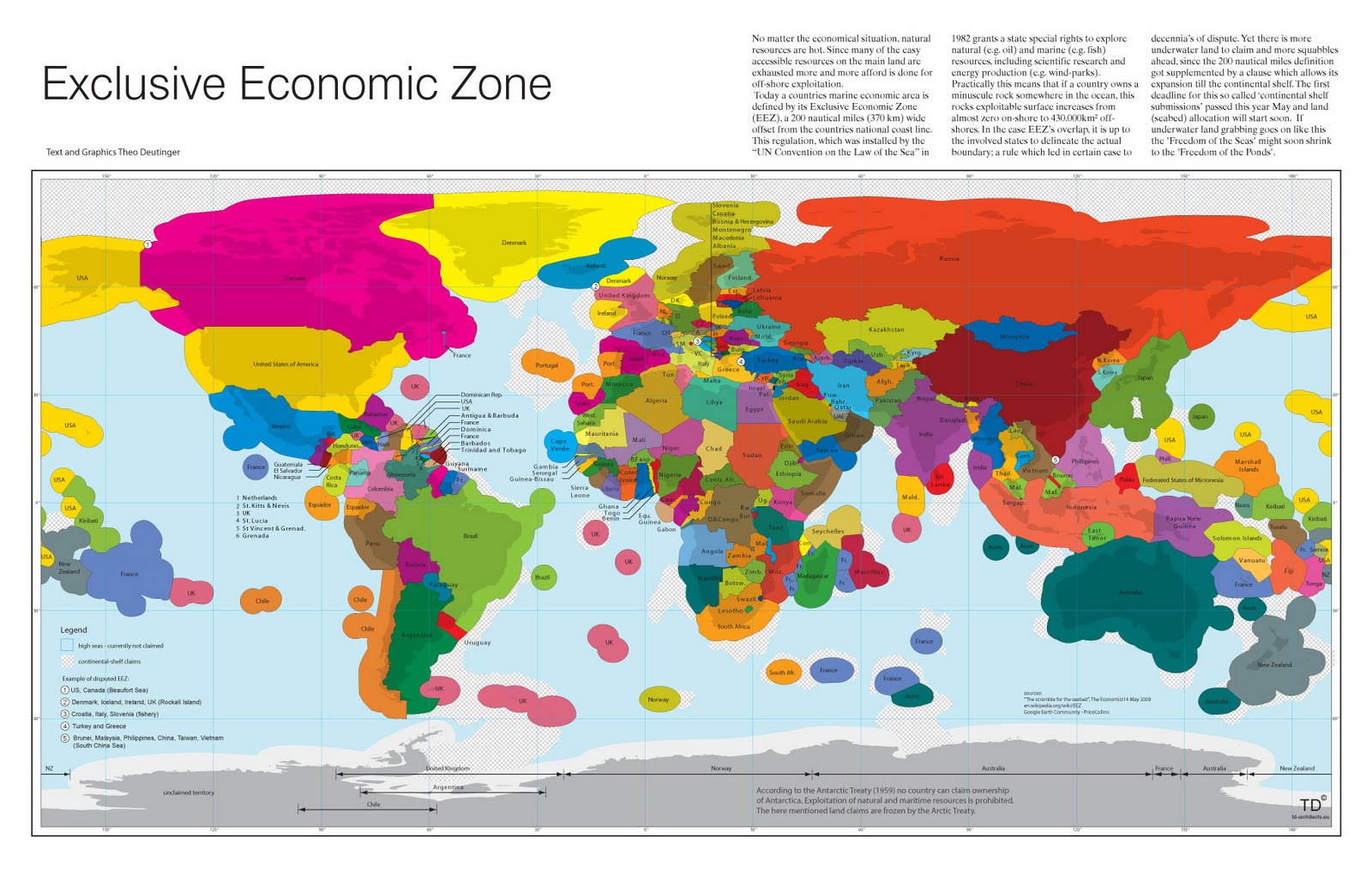
The Japanese team’s discovery has the potential to significantly impact the power dynamics behind these tensions. China has used its rare earth monopoly to pressure Japan and the United States, which in turn may have also helped embolden its recent more aggressive maritime policies. If the new rare earth discoveries prove viable, that calculus could change considerably.However serious questions remain: Many of the discoveries lie outside of established exclusive economic zones, so who has the rights to mine them? They’re also between 11,500 and 20,000 feet below the surface – how long before we have the technologies to extract them at an industrial scale? And how safe – both for humans and the environment – will those processes be? Aboveground rare earth mines are some of the most damaging to the environment – part of the claimed reason China curbed overall exports earlier this year, which drove up global prices and drew the ire of the World Trade Organization.
For more on the importance of rare earth minerals to the defense and electronics industries, see New Security Beat’s “Rare Earth: A New Roadblock for Sustainable Energy?” and “Reading Radar: The Mineral Security of the United States.” For more on the exclusive economic zones map, see “Eye on Environmental Security: Natural Resource Frontiers at Sea;” and on the South China Sea and what it reveals about future diplomatic fault lines between the United States and China, see “U.S. v. China: The Global Battle for Hearts Minds and Resources.”
Sources: Asia Sentinel, The Atlantic, BBC, Government Accounting Office, Nature Geoscience, The New York Times, Reuters, Tech News Daily, U.S. Department of State.
Photo Credit: Adapted from “USS Mustin underway in the Pacific Ocean,” courtesy of flickr user Official U.S. Navy Imagery, and “Exclusive Economic Zone,” used with permission courtesy of Theo Deutinger and TD Architects. -
Pakistan’s Population Bomb Defused?
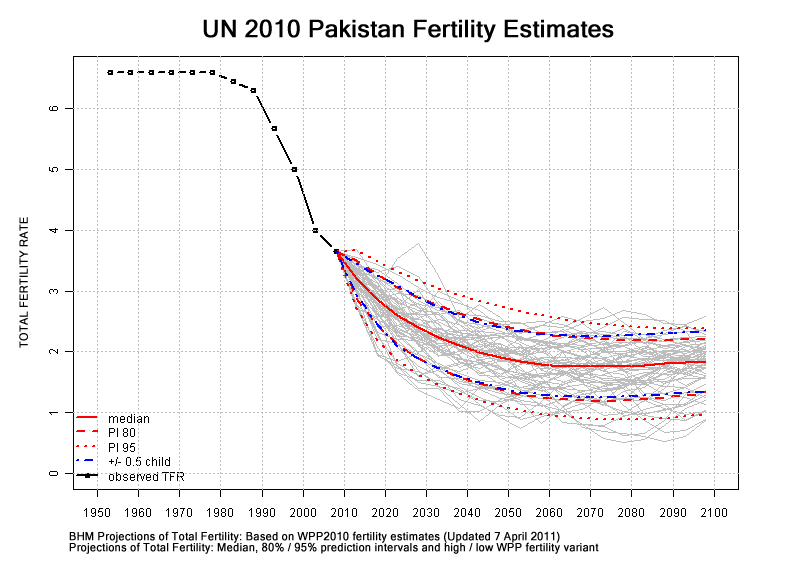
›What is going on over at the UN Population Division? In response to The New Security Beat’s post on the UN’s sub-Saharan projections, Ed Carr of USAID recently highlighted what appears to be gross overestimations in the 2010 population revision for Ghana. Yet in the case of Pakistan, the opposite is seemingly at play – the projections appear to wildly (and unrealistically) underestimate population numbers for the coming decades.
The 2008 revision’s mid-variant estimate for Pakistan in 2050 was 335 million people. The new revision projects only about 275 million by that year. Even the new high-variant estimate (314 million) falls below the earlier mid-variant projection. Furthermore, the constant-fertility variant estimate for 2050 has fallen from 450 million to under 380 million.
What gives? Thanks to some helpful staff at the Population Division and Population Action International’s Elizabeth Leahy Madsen (who helped translate the UN’s demographic-ese for this non-specialist), I can only conclude that the UN has decided to hedge its bets that Pakistan’s fertility rates will fall, simply because its South Asian neighbors (and other nations) have followed this trajectory.
If so, I believe this assumption is spurious. As reported in the Wilson Center’s recent book on Pakistan’s population challenges, though Pakistan’s fertility rate is in decline, it is falling at a considerably slower pace than that of its neighbors, and the rate of decrease has slowed considerably over the last decade. The country’s total fertility rate (TFR) today is just under four, considerably above the replacement level rate (2.1).
By many indications, Pakistan’s TFR does not figure to fall quickly anytime soon. Pakistan’s maternal and reproductive health sector is deeply troubled, with family planning services either of poor quality or nonexistent – particularly in rural areas. Many rural women are obliged to travel on average 50 to 100 kilometers to obtain such services. Meanwhile, the status of Pakistani women is dreadful; female literacy is estimated to stand at only 44 percent (some places it as low as 35 percent), while women’s labor participation rates barely approach 20 percent. Not surprisingly, Pakistan’s contraceptive prevalence rate is quite low (30 percent), while its rate of unmet need for family planning is high (25 percent).
With all of Pakistan’s problems, improving access to family planning is simply not a front-burner issue for Islamabad (in fact, as our book notes, demography on the whole is largely neglected in Pakistan), which makes the 2010 revision’s projections all the more questionable.
The UN is expected to release details on the methodology behind its basic assumptions in the coming weeks; here’s hoping for some clarity. (Editor’s note: As Liz Madsen points out, there’s also a white paper on the new probabilistic model to sift through, if you’re prepared for some heavy reading.)
Michael Kugelman is a program associate for the Asia Program at the Woodrow Wilson Center.
Chart Credit: Modification of projections of total fertility based on Bayesian hierarchical model, courtesy of the UN Population Division. -
Global Climate Change Vulnerability and the Risk of Conflict
›In a study from the Center for Sustainable Development at Uppsala University in Sweden titled “Climate Change and the Risk of Violent Conflicts in Southern Africa,” authors Ashok Swain, Ranjula Bali Swain, Anders Themnér, and Florian Krampe examine the potential for climate change and variability to act as a “threat multiplier” in the Zambezi River Basin. The report argues that “socio-economic and political problems are disproportionately multiplied by climate change/variability.” A reliance on agriculture, poor governance, weak institutions, polarized social identities, and economic challenges in the region are issues that may combine with climate change to increase the potential for conflict. Specifically, the report concludes that the Matableleland-North Province in Zimbabwe and Zambezia Province in Mozambique are the areas in the region most likely to experience climate-induced conflicts in the near future.The “Climate Vulnerability Monitor 2010: The State of the Climate Crisis,” published by Madrid-based DARA and the Climate Vulnerable Forum, is a comprehensive atlas of climate change vulnerability around the world. The report examines country vulnerability in four impact areas – health, weather disasters, habitat loss, and economic stress – and compares current levels of vulnerability with those expected in 2030. Of the 184 assessed countries, nearly all registered high vulnerability to at least one impact area. The report estimates that there are 350,000 “climate-related deaths” each year, almost 80 percent of which are children living in South Asia and sub-Saharan Africa. Finally, the report features an overview of climate change basics, country profiles, and reviews on the effectiveness of several climate adaptation methods. -
Elizabeth C. Economy, Council on Foreign Relations
The Truth About the Three Gorges Dam
›May 26, 2011 // By Wilson Center StaffThe original version of this article, by Elizabeth C. Economy, appeared on the Council on Foreign Relations’ Asia Unbound blog.
It has only taken 90 years, but China’s leaders have finally admitted that the Three Gorges Dam is a disaster. With Wen Jiabao at the helm, the State Council noted last week that there were “urgent problems” concerning the relocation effort, the environment and disaster prevention that would now require an infusion of US$23 billion on top of the $45 billion spent already.
Despite high-level support for the project since Sun Yat-sen first proposed it in 1919, the dam has had serious critics within China all along. One of China’s earliest and most renowned environmental activists, Dai Qing, published the book Yangtze! Yangtze! in 1989, which explored the engineering and social costs of the proposed dam. The book was a hit among Tiananmen Square protestors, and Dai spent a year in prison for her truth-telling. In 1992, when the dam came up for a vote in the National People’s Congress, an unprecedented one-third of the delegates voted against the plan.
Once the construction began in 1994, the problems mounted. The forced relocation of 1.4 million Chinese was plagued with corruption; former Premier Zhu Rongji accused the construction companies of shoddy engineering, and little of the pollution control measures that were planned were actually taken. Water pollution skyrocketed in the reservoir. As Chinese officials acknowledged a few years back, “The Three Gorges Dam project has caused an array of ecological ills, including more frequent landslides and pollution, and if preventive measures are not taken, there could be an environmental catastrophe.”
It would be easy to argue that the State Council’s admission was too little too late. However, the new transparency matters for at least two reasons. First, it plays into the hands of environmentalists who have been arguing against Beijing’s aggressive plans for additional large-scale hydropower plants. Premier Wen, who has tried to slow the approval process for dams over the past several years, now has a bit more ammunition. Second, any acknowledgement by the Party that mistakes have been made is an important step toward the public’s right to question future policies. Let’s hope that more such transparency is on the way.
Elizabeth C. Economy is the C.V. Starr Senior Fellow and director for Asia Studies at the Council on Foreign Relations.
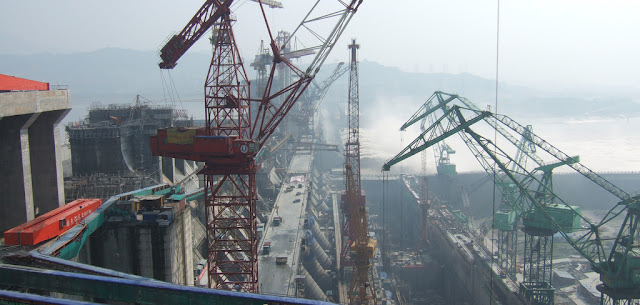
Photo Credit: Adapted from “Construction of the Three Gorges Dam,” courtesy of flickr user Harald Groven.