Showing posts from category Asia.
-
Karen Seto on the Environmental Impact of Expanding Cities [Part Two]
› “A lot of cities are trying to become green cities,” said Karen Seto in part two of an interview with ECSP about her recently published article, “A Meta-Analysis of Global Urban Land Expansion,” co-authored with Michail Fragkias, Burak Güneralp, and Michael K. Reilly. “I think one of the main policy implications of our study is that how a city urbanizes is critical, because one of the things we are finding is that urban land is growing faster than urban population, and in some cases it is growing much faster.”
Seto said that the cities with the best prospects for implementing green growth and expansion strategies “tend to focus on the low-hanging fruit,” such as planting trees or constructing buildings with green roofs. From the public’s perspective, these types of measures are relatively painless because they “don’t require changing people’s behavior.”
More challenging, said Seto, will be getting rapidly expanding cities to anchor future development around public-transit systems, especially given the changing lifestyle preferences of upwardly mobile urban populations across China and India, for whom private car ownership serves as an important status symbol.
Still, Seto said she is tentatively optimistic about city planners’ ability to grow cities in a sustainable fashion. “We’ve experienced this rapid growth of urban population and urban land areas, but we’re also seeing that over the next 20 years, according to the UN, we’re going to see even more people living in urban areas,” she said.
“We have this window of opportunity to really shape the way in which cities get developed, and I think that’s really one of the big messages of the study.”
Part one of Karen Seto’s interview is available here. The “Pop Audio” series is also available as podcasts on iTunes.
Sources: China Daily, USA Today. -
Karen Seto on the Environmental Impact of Expanding Cities [Part One]
›“When we think about the environmental impacts of rapid urbanization, we really need to unpack what we mean by ‘urbanization,’” said Karen Seto, an associate professor in Yale University’s School of Forestry and Environment Studies, in this interview with ECSP. “There is the demographic component, where more people are living in cities; there is economic urbanization, which is where livelihoods and economies are becoming more urban rather than rural; and then there is the land component – the conversion of land from agriculture and other ecosystems to become urban.”
Seto is the lead author of a new article, “A Meta-Analysis of Global Urban Land Expansion” (with Michail Fragkias, Burak Güneralp, and Michael K. Reilly), which uses satellite imagery to help document the physical expansion of urban areas in developed and developing nations between 1970 and 2000.
Over that period, the population of cities in the developing world boomed. In 1970, there were roughly the same number of city dwellers in developed nations as in developing nations. By the mid-1990s, however, urban residents of the developing world outnumbered their developed-world counterparts by a factor of two to one. Since then, the gap has continued to grow.
According to the report, urban growth sprawled to cover nearly 60,000 square kilometers of previously non-urban areas during the last three decades of the twentieth-century. One of their most interesting finds, said Seto, was that “urban expansion has been occurring in low-elevation coastal zones more than it has been elsewhere.”
“Essentially what that means is that cities are growing precisely in areas that are highly vulnerable to the impacts of climate change, like sea level rise and storm surges,” she said.
Demography and the Environment
Seto acknowledged that many of the today’s discussions surrounding urbanization focus on the negative impacts for the environment and human security – among them the “loss of agricultural land, conversion of forests, biodiversity loss, changes in hydrology, and climate effects.” Ultimately though, she said, urbanization and its attendant land-use changes shouldn’t be viewed through a black-or-white lens.
“Certainly we think about the oncoming demographic transition of something like three billion more people living in cities,” Seto said, but “that means there’s a lot of efficiency to be gained, whether it is in education, energy, sanitation, or health – urbanization allows for opportunities for really efficient use of resources.”
The real challenge to achieving environmentally sustainable urban development, said Seto, is thoughtful city planning: “How we configure ourselves has a big impact on the environment, so it is not the issue of just whether we are urbanizing – the form in which we urbanize [also] has a huge impact.”
Part two of Karen Seto’s interview is available here. The “Pop Audio” series is also available as podcasts on iTunes.
Sources: Population Reference Bureau, UNFPA. -
Redrawing the Map of the World’s International River Basins
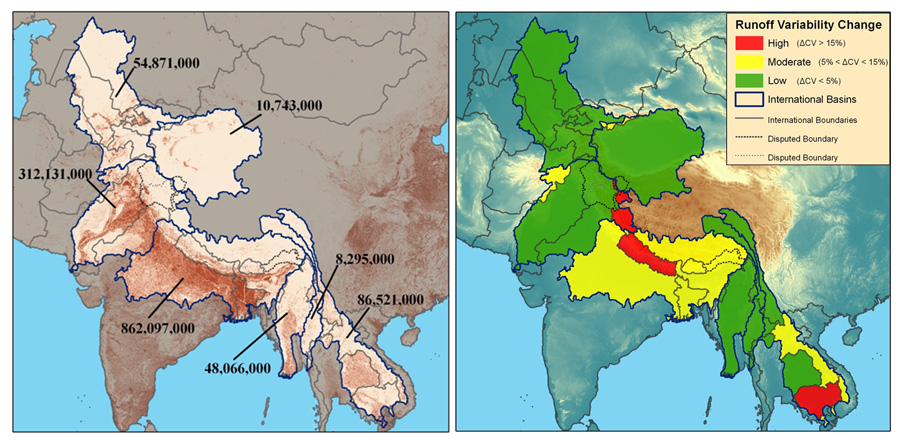
›Understanding why conflict over water resources arises between nations begins with a solid understanding of the geography of international river basins. Where are the basins? How big are they? How many people live there? Who are the riparian nations, and what is the significance of each to the basin?
-
Youth Bulge and Societal Conflicts: Have Peacekeepers Made a Difference?
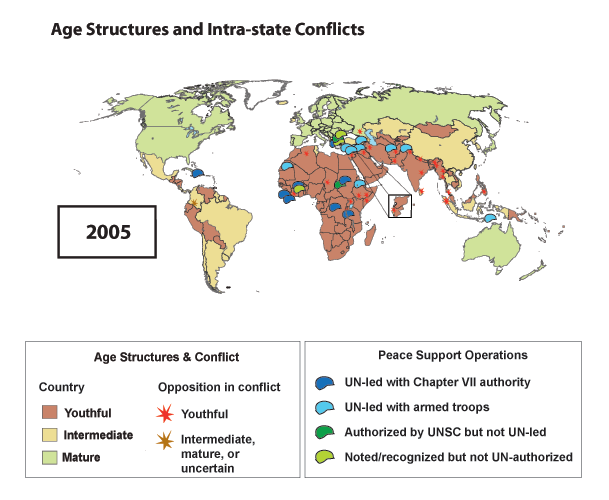
›August 22, 2011 // By Richard CincottaUntil recently, the question of which countries are at the most risk of violent societal conflict could be answered with a terse, two-part response: “the young and the war-torn.” This simple characterization regarding youth and conflict worked well, until the first decade of the 21st century. The proportion of youthful countries experiencing one or more violent intrastate conflicts declined from 25 percent in 1995 to 15 percent in 2005. What’s behind this encouraging slump in political unrest? One hypothesis is that peace support operations (PSOs) – peacekeepers, police units, and specialized observers that are led, authorized, or endorsed by the United Nations – have made a difference.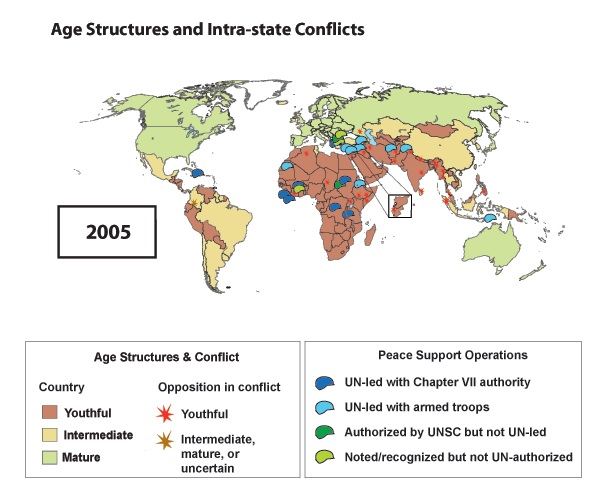
From the 1970s through the 1990s, more than 90 percent of all societal conflicts broke out in countries with a youthful age structure – a population with a median age of 25 years or less. And wherever civil and ethnic wars emerged, they tended to persist. The average societal conflict that began between 1970 and 1999 continued without a one-year break in battle-associated fatalities for about six years. Some – including the Angolan civil war, Northern Ireland’s “Troubles,” Peru’s war against the Shining Path, and the Afghan civil war – endured for decades. In contrast, inter-state conflicts that began between 1970 and 1999 lasted, on average, less than two years (see the UCDP/PRIO Conflict Database).
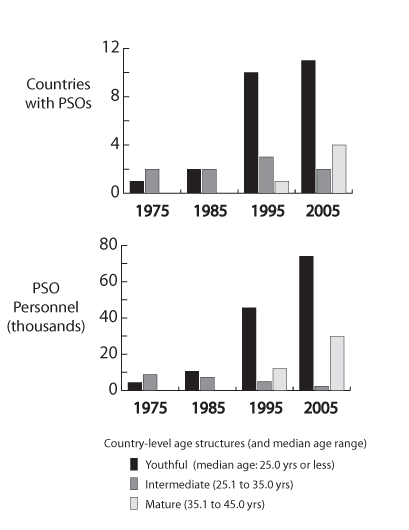
Taking on Intra-State ConflictsBeginning in the early 1990s, however, there was a marked expansion in size and number of PSOs deployed in the aftermath of societal warfare, which appears to have dampened the persistence of some conflicts and prevented the reemergence of others. The annual number of active PSOs deterring the re-emergence of societal conflict jumped from just 2 missions during 1985 to 22 in 2005. In contrast, those led, authorized, or endorsed by the UN to maintain cease-fire agreements between neighboring states during that same period only increased from three active missions to four. By 2009, nearly 100,000 peacekeepers were stationed in countries that had recently experienced a societal conflict. About 70 percent were deployed in countries with a youthful population (see Figures 2A and B). Why the sudden expansion in use of PSOs?
According to William Durch and Tobias Berkman, this upsurge was less a change of heart or modification of a global security strategy and more an outcome of the unraveling web of Cold War international relations. Before the 1990s, the majority of PSOs were United Nations-led operations that were mandated to monitor or help maintain cease-fires along mutual frontiers. Because insurgents were typically aligned with either the Soviets or a Western power, Security Council authorization to mediate a societal conflict was difficult to secure.
This situation changed with the breakup of the Soviet Union and the initiation of PSOs by regional organizations, including operations by the Economic Community of West African States (ECOWAS) in Liberia and Sierra Leone and the NATO-led Kosovo Force in 1998-99.
Demographic Forecasting
What do national demographic trends suggest for the demand for PSOs over the next two decades? For societal conflict, political demographers foresee that the demand for PSOs will continue to decline among states in Latin America and the Caribbean – with the exception of sustained risk in Guatemala, Haiti, Bolivia, and Paraguay. Similarly, demand for peacekeeping is expected to continue to ebb across continental East Asia.
Gauged by age structure alone, the risk of societal warfare is projected to remain high over the coming two decades in the western, central, and eastern portions of sub-Saharan Africa; in parts of the Middle East and South Asia; and in several Asian-Pacific island hotspots – Timor-Leste, Papua New Guinea, the Philippines, and Solomon Islands. But even in some countries that are losing their youthful blush, domestic political relations could turn out less rosy than this simple age-structural model forecasts.
In other words, there are roadblocks to a “demographic peace.” Among them is an increasing propensity for a specific demographic configuration of ethnic conflict: warfare between state forces and organizations that recruit from a minority that is more youthful than the majority ethnic group. Examples of these conflicts include the Kurds in Turkey, the Shiites in Lebanon, the Pattani Muslims in southern Thailand, and the Chechens of southern Russia.
However, this twist on the youth bulge model of the risks of societal conflict is a discussion for another installment on New Security Beat. Suffice it to say that when political demographers look over the UN Population Division’s current demographic projections, they see few signs of either the waning of societal warfare, or the withering of the current level of demand for PSOs.
Richard Cincotta is a consultant on political demography for the Wilson Center’s Environmental Change and Security Program and demographer-in-residence at The Stimson Center.
Sources: PRIO, The Stimson Center, UN Population Division.
Chart Credit: Data courtesy of the UN Population Division 2011, PRIO, and Durch and Berkman (2006). Arranged by Richard Cincotta. -
Russell Sticklor, World Politics Review
The Hungry Planet: Global Food Scarcity in the 21st Century
›August 16, 2011 // By Wilson Center StaffThe original version of this article, by Russell Sticklor, appeared on World Politics Review.
At the dawn of the 20th century, the world population was inching toward a modest two billion. In the 111 years since, notwithstanding the impact of war, genocide, disease, and famine, the global population has soared, reaching three billion around 1960 and now quickly approaching the neighborhood of seven billion. By 2050, the planet will likely be home to two billion more.
We may not be witnessing the detonation of the “population bomb” that Paul Ehrlich warned of in his seminal 1968 book, but such rapid demographic change is clearly pushing the international community into uncharted territory. With a limited amount of arable land and a finite supply of fresh water for irrigation, figuring out how to feed a planet adding upward of 70 million people each year looms as one of the 21st century’s most pressing challenges.
The push to ensure global food security transcends the desire to avoid repeating the famines that devastated the Soviet Union, China, North Korea, Ethiopia, and so many other corners of the world during the past century. Instead, aid and development organizations today rightly view food insecurity problems as deeply intertwined with issues of economic development, public health, and political stability, particularly in the developing world. To maintain order in the international community and prevent the emergence of new failed states in the decades ahead, it will be critical to find innovative means of feeding the rapidly growing populations of sub-Saharan Africa, the Middle East, and South and East Asia.
Continue reading on World Politics Review.
Note: World Politics Review has graciously white-listed all entrances from NSB for this article, so as long as you use the above link, you should be able to read the full article for free.
Russell Sticklor is a consultant for the Environmental Change and Security Program.
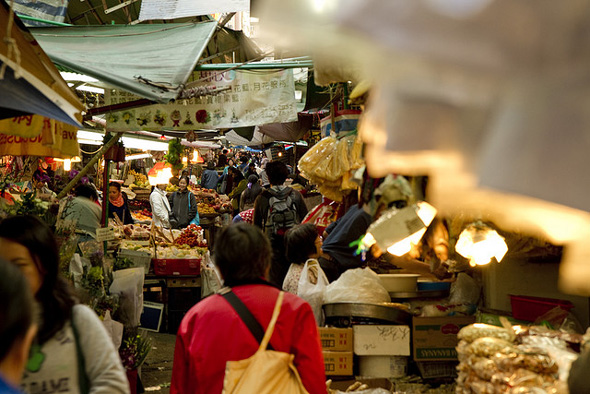
Photo Credit: “Crowded market street,” courtesy of flickr user – yt –. -
International River Basins: Mapping Institutional Resilience to Climate Change
›Institutions that manage river basins must assess their ability to deal with variable water supplies now, said Professor Aaron Wolf of Oregon State University at the July 28 ECSP event, “International River Basins: Mapping Institutional Resilience to Change.” “A lot of the world currently can’t deal with the variability that they have today, and we see climate change as an exacerbation to an already bad situation.”
Wolf and his colleagues, Jim Duncan of the World Bank and Matt Zentner of the U.S. Department of Defense, discussed their efforts to map basins at risk for future tensions over water, as identified in their coauthored World Bank report, “Mapping the Resilience of International River Basins to Future Climate Change-Induced Water Variability.” [Video Below]
Floating Past the Rhetoric of “Water Wars”
Currently, there are 276 transnational water basins that cross the boundaries of two or more countries, said Wolf. “Forty percent of the world’s population lives within these waters, and interestingly, 80 percent of the world’s fresh water originates in basins that go through more than one country,” he said. Some of these boundaries are not particularly friendly – those along the Jordan and Indus Rivers, for example – but “to manage the water efficiently, we need to do it cooperatively,” he said.
Wolf and his colleagues found that most of the rhetoric about “water wars” was merely anecdotal, so they systematically documented how countries sharing river basins actually interact in their Basins at Risk project. The findings were surprising and counterintuitive: “Regularly we see that at any scale, two-thirds of the time we do anything over water, it is cooperative,” and actual violent conflict is extremely rare, said Wolf.
Additionally, the regions where they expected to see the most conflict – such as arid areas – were surprisingly the most cooperative. “Aridity leads to institutions to help manage aridity,” Wolf said. “You don’t need cooperation in a humid climate.”
“It’s not just about change in a basin, it’s about the relationship between change and the institutions that are developed to mitigate the impacts of change,” said Wolf. “The likelihood of conflict goes up when the rate of change in a basin exceeds the institutional capacity to absorb the change.”
Expanding the Database for Risk Assessment
Oregon State University’s Transboundary Freshwater Dispute Database (TFDD) tracks tabular and spatial information on more than 680 freshwater treaties along 276 transboundary river basins, said Jim Duncan. The team expanded the database to include recent findings on variability, as well as the impacts of climate change on the future variability of those basins. “We have a lot more information that we are able to work with now,” Duncan said.
Analyzing the institutional vulnerability of treaties along with hydrological hazards, they found the risk of tension concentrated in African basins: The Niger, Congo, and Lake Chad basins “popped out,” said Duncan. When predicting future challenges, they found that basins in other areas, such as Southeastern Asia and Central Europe, would also be at risk.
Duncan and his colleagues were able to identify very nuanced deficiencies in institutional resilience. “Over half of the treaties that have ever been signed deal with variability only in terms of flood control, and we’re only seeing about 15 percent that deal with dry season control,” said Duncan. “It’s not the actual variability, but the magnitude of departure from what they’re experiencing now that is going to be really critical.”
Beyond Scarcity
“Generally speaking, it’s not really the water so much that people are willing to fight over, but it’s the issues associated with water that cause people to have disagreements,” said Matt Zentner. Water issues are not high on the national security agendas of most governments; they only link water to national security when it actively affects other sectors of society, such as economic growth, food availability, and electric power, he said. Agricultural production – the world’s largest consumer of water – will be a major concern for governments in the future, he said, especially in developing countries economically dependent on farming.
Some experts think that current international treaties are not enough, said Zentner. Peter Gleick of the Pacific Institute has said that “the existing agreements and international principles for sharing water will not adequately handle the strain of future pressures, particularly those caused by climate change.”
How transboundary water treaties fare as the climate and consumption rates change is not as simple as measuring flow; the strength of governing institutions, the parties involved, and other variables all play major roles as well, said Zentner. “When you have flexibility built within [a treaty], it allows it to be a living, breathing, and important part of solving those [water] problems.”
Download the full event transcript here.
Sources: Oregon State University, Pacific Institute.
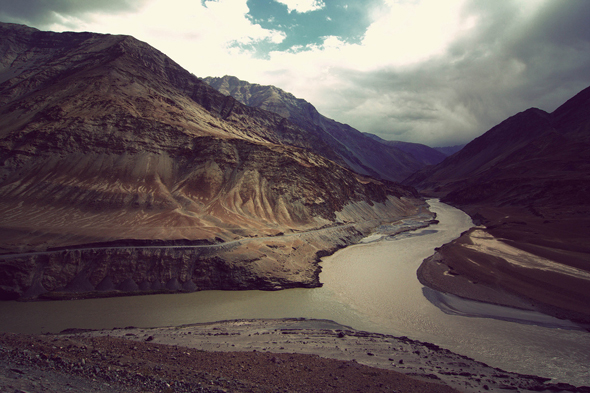
Photo Credit: “Confluence of the Zanskar and Indus,” courtesy of Flickr user Sanish Suresh. -
Watch: Aaron Wolf on the Himalayan and Other Transboundary Water Basins, Climate Change, and Institutional Resilience
›When Aaron Wolf, professor in the Department of Geoscience at Oregon State University, and his colleagues first looked at the dynamics behind water conflict in their Basins at Risk study, they found that a lot of the issues they’d assumed would lead to conflict, like scarcity or economic growth, didn’t necessarily. Instead they found that “there is a relationship between change in a [water] basin and the institutional capacity to absorb that change,” said Wolf in this interview with ECSP. “The change can be hydrologic: you’ve got floods, droughts, agricultural production growing…or institutions also change: countries kind of disintegrate, or there are new nations along basins.”
However, these changes happen independently. “Whether there is going to be conflict or not depends in a large part to what kind of institutions there are to help mitigate for the impacts of that change,” explained Wolf.
“If you have a drought or economic boom within a basin and you have two friendly countries with a long history of treaties and working together, the likelihood of that spiraling into conflict is fairly low. On the other hand, the same droughts or same economic growth between two countries that don’t have treaties, or there is hostility or concern about the motives of the other, that then could lead to settings that are more conflictive.”
Wolf stressed the importance of understanding hydrologic variability in relation to existing treaties around the world. After carefully examining hundreds of treaties, he and his colleagues created a way of measuring their variability to try to find potential hotspots.
“We know how variable basins are around the world; we know how well treaties can deal with variability. You put them together and you have some areas of concern: You may want to look a little closely to see what is happening as people try to mitigate these impacts,” said Wolf.
“We know that one of the overwhelming impacts of climate change is that the world is going to get more variable: Highs are going to be higher, and lows are going to be lower,” Wolf said.
Wolf used the Himalayan basins to illustrate the importance of overseeing the potential effects of climate change and institutional capacity. “There are a billion and half people who rely on the waters that originate in the Himalayas,” he pointed out. Because of climate change, the Himalayas may experience tremendous flooding, and conversely, extreme drought.
Unfortunately, Wolf said, “the Himalayan basins…do not have any treaty coverage to deal with that variability.” Without treaties, it is difficult for countries to cooperate and setup a framework for mitigating the variability that might arise. -
Sajeda Amin on Population Growth, Urbanization, and Gender Rights in Bangladesh
›“One of the reasons why population grows very rapidly in Bangladesh is women get married very early and have children very early,” the Population Council’s Sajeda Amin told ECSP in a recent interview. “So even though they are only having two children, they are having them at an average age of around 20. As demographers would say, women ‘replace’ themselves very rapidly.”
Largely through the promotion of contraceptive use, family planning programs implemented over the past 35 years by the Bangladeshi government and a variety of NGOs have helped lower the country’s total fertility rate to 2.7 from 6.5 in the mid-1970s. To build on this progress, the Population Council has joined a consortium of other organizations – including the Bangladesh Legal Aid and Services Trust, Marie Stopes International, and We Can End All Violence Against Women – to launch the Growing Up Safe and Healthy (SAFE) project in Amin’s native Dhaka and other Bangladeshi cities.
Currently nearing the completion of its first year, the four-year initiative has several aims, among them increasing access to reproductive healthcare services for adolescent girls and young women and bolstering social services to protect those populations from (and offer treatment for) gender-based violence. The project also looks to strengthen laws designed to reduce the prevalence of child marriage – a long-standing Bangladeshi institution that keeps population growth rates high while denying many young women the opportunity to pursue economic and educational advancement.
A Focus on Gender and Climate
Amin says the SAFE project boasts several qualities that collectively set the initiative apart from similar-minded programs in Bangladesh dealing with gender and poverty. These include a strong research component incorporating quantitative and qualitative analysis; the holistic nature of the program, which incorporates educational outreach, livelihood development, and legal empowerment; a commitment to working with both male and female populations; and an emphasis on interventions targeting young people, with the hope that such efforts will allow adolescents to make better-informed decisions about future relationships and reproductive health, thus reducing the likelihood of gender-based violence.
Finally, while many existing gender-based programs focus exclusively on rural communities, Amin points out that the SAFE project also stands apart because of its focus on the country’s rapidly expanding urban areas. To date, the initiative is focusing many of its early interventions in a Dhaka slum that has seen an influx of rural migrants in recent years due to climate-change impacts in the country’s low-lying coastal areas.
“A lot of the big problems in Bangladesh now are climate-driven in the sense of creating mass movements out of areas that are particularly vulnerable or have been hit by a major storm,” Amin said. “Usually these are people who, once they lose their homes and their livelihoods, will have no choice but to move to urban areas, and that’s a process that is kind of a big outstanding issue in Bangladesh now.”
By building programming around girls and young women in such communities, the SAFE project is looking to spark change from the bottom up, prioritizing the unmet health and social needs of some of Bangladesh’s most vulnerable populations.
The “Pop Audio” series is also available as podcasts on iTunes.
Sources: Global Post, Ministry of Health and Family Welfare (Bangladesh), Shaikh and Becker (1985).