-
Much Ado About Conflict? Climate’s Links to Violence Reexamined
›
Violence is on the wane in human affairs, even if slowly and irregularly. Could climate change reverse this trend? Pundits and politicians have raised the specter of havoc caused by rising temperature, erratic patterns of rainfall, and rising sea levels. In this way, so the story goes, climate change will produce famine and mass migration that threatens political stability and provokes violence. However, to date there is little evidence that the meteorological or agricultural conditions associated with climate change are actually a major source of violence.
-
Global Water Security Calls for U.S. Leadership, Says Intelligence Assessment
›March 26, 2012 // By Schuyler NullAlongside and in support of Secretary Clinton’s announcement of a new State Department-led water security initiative last week was the release of a global water security assessment by the National Intelligence Council and Director of National Intelligence. The aim of the report? Answer the question: “How will water problems (shortages, poor water quality, or floods) impact U.S. national security interests over the next 30 years?”
-
Hotspots: Population Growth in Areas of High Biodiversity
›More than one-fifth of the world’s population lives in biodiversity hotspots – “areas that are particularly rich in biodiversity and endemic species,” said John Williams of the University of California, Davis, at the Wilson Center on February 29. And those populations are growing faster than the global average. Add to that the fact that “biodiversity continues to decline globally, despite increasing investments in conservation,” said David Lopez-Carr of the University of California, Santa Barbara, and the need for new approaches to conservation becomes evident. [Video Below]
Williams and Lopez-Carr were joined by Dr. Vik Mohan, director of the sexual and reproductive health program for Blue Ventures, a London-based conservation nongovernment organization that works with communities on the remote western coast of Madagascar.
To respond to the demands of the communities and to better protect biodiversity hotspots, the speakers argued that conservation efforts need to incorporate health and livelihood services directed at the growing populations living nearby.
A Complex Relationship
“The relationship between population and biodiversity loss or conservation is a pretty complex relationship,” said Williams.
He offered Latin America and the Caribbean as an example of the multiple factors that can affect how population and biodiversity interact. Population growth in the region has slowed, and agricultural expansion is driving habitat loss as the population ages and urbanizes and as increasing per capita GDP contributes to higher levels of consumption.
In the Indo-Pacific region, stretching from East Asia to Australia, high population growth coupled with economic growth has coincided with an increase in the exploitation of rare species for illegal trade, according to Williams. And in Africa, where the population is growing quickly but without comparable economic growth and amid high levels of instability, subsistence drives ecological exploitation.
Biodiversity and Family Planning in Madagascar
“People who live in the biodiversity hotspots are typically poorer, typically have poorer access to healthcare than their counterparts in the cities or in the world at large, and typically have poorer health than those counterparts,” said Mohan.
Blue Ventures has been working in Madagascar since 2003. The island is one of the most biodiverse areas in the world; 80 percent of its plant and animal life is endemic, meaning it exists there and nowhere else, said Mohan. At the same time, Madagascar is one of sub-Saharan Africa’s fastest growing countries, with a population growth rate of 2.9 percent and an average total fertility rate of 4.6 children per woman.
Blue Ventures initially came to the country to improve conservation in the island’s coastal villages, where residents survive largely on subsistence fishing. But once there, the group quickly found that the population was “growing so rapidly that in spite of our best conservation efforts, the demand for those finite coastal resources [was] outstripping supply,” said Mohan.
“The number of people who are going out to catch fish to feed their to feed their families is going up exponentially, and those fisherman are having to work harder and harder to catch smaller fish that are farther and farther down the food web.”
Realizing that trend, Mohan said that “just by asking a few very basic questions, we unearthed a huge unmet need for healthcare and a huge unmet need for family planning in particular.”
In response, Mohan and his colleagues opened up a family planning clinic in Andavadoaka, one of the villages Blue Ventures serves. On the clinic’s first day, Mohan said, “20 percent of all women of reproductive age came asking for contraception.” Following that opening, they “rapidly found [that] this unmet need was mirrored in every single village along the coast that we worked in,” he said. Since then, modern contraceptive prevalence, initially about seven percent, has increased four-fold, while birth rates have fallen by about one-third. All in all, Mohan said, the population of the Velondriake region, where Blue Ventures operates, is five percent smaller now than it would have been without the group’s family planning services.
Rural Areas Driving Population Growth
Across the developing world, Lopez-Carr said that unmet need for family planning “remains significantly higher” in biodiversity hotspots. Given that high unmet need, especially in Africa, it is easy to infer that “conservation may be less sustainable…if it does not consider health,” he said.
In his ongoing research on population and biodiversity, Lopez-Carr looks at how fertility rates compare in and out of hotspot areas and between regional and local levels. At the country and province level, “high-value conservation areas do not have unusually high total fertility rates (TFRs),” he said. But at more localized levels, “in the most remote rural areas, TFRs remain high, and in many cases, in the most remote rural areas, the demand for family planning is still very low,” indicating that these areas are still in the early stages of their demographic transitions.
The fact that the sub-state picture can look so different from the state-level picture means that there is more work for researchers to do, said Lopez-Carr. “Where the fertility rates are highest is where we have the least data,” he said, and that has significant implications for understanding future population growth.
Looking at UN population projections, the world’s net population gains will be in its poorest cities, he said, but “virtually all this growth is going to be from migration, fueled by remaining high fertility in rural areas.” And “virtually all of that growth will be predicated upon the timing, magnitude, [and] pace of the fertility transition in rural areas.”
Better understanding the demographic picture in rural areas is therefore critical – not just to improving health and preserving biodiversity in the world’s hotspots, but to honing down more accurate global population projections as well.
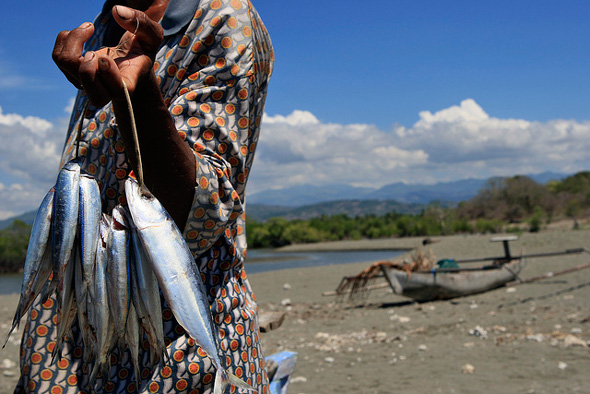
Event ResourcesPhoto Credit: “Fisherman Carries Day’s Catch,” courtesy of United Nations Photo. -
Eelke Kraak, ChinaDialogue
Central Asia’s Dam Debacle
›March 13, 2012 // By Wilson Center StaffThe original version of this article, by Eelke Kraak, appeared on ChinaDialogue.
The Toktogul Dam in Kyrgyzstan is an imposing structure. The dam guards the largest and only multi-annual water reservoir in central Asia. The cascade of five hydroelectric stations downstream produces 90 percent of Kyrgyzstan’s power. Cotton fields thousands of kilometers away in Kazakhstan and Uzbekistan depend on the release of water from this dam.
The Toktogul is literally and figuratively the “valve” of the Syr Darya River. But by relying on large-scale engineering projects to control the river, these countries have ignored the fundamentally political nature of water management.
The significance of the Toktogul dam goes beyond its economic benefits. It was the center piece of the Soviet Union’s efforts to conquer nature in its drive to modernize central Asia. When it became fully operational in the late 1980s, the project to control the region’s rivers seemed complete.
But the costs have been high. The Aral Sea, the terminal lake of the main sources of water in central Asia, the Syr Darya and Amu Darya rivers, has shrunk to almost nothing. Many areas surrounding what is left of the lake are heavily polluted. Moreover, the now independent Syr Darya riparian countries – Kyrgyzstan, Uzbekistan, Tajikistan and Kazakhstan – disagree on how the Toktogul should be operated.
Continue reading on ChinaDialogue.
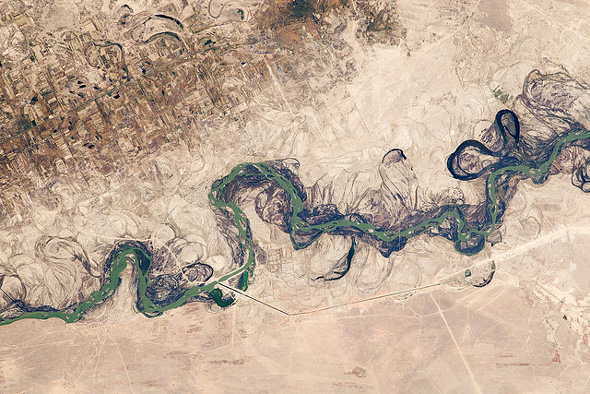
Syr Darya River Floodplain, Kazakhstan, courtesy of NASA and the Center for Philosophy of Sciences of the University of Lisbon. -
P.H. Liotta, Salve Regina University
The Real Population Bomb: Megacities, Global Security, and the Map of the Future (Book Preview)
›February 8, 2012 // By Wilson Center StaffThere was a time when the city was the dominant political identity. Centuries and even millennia ago, the most advanced societies in the Mediterranean, the Near East, and South America revolved around cities that were either states in themselves or were the locus of power for larger empires and kingdoms. The time of the city is coming again, though now in a considerably less benign way.From the introduction to The Real Population Bomb:There was a time when the city was the dominant political identity. Centuries and even millennia ago, the most advanced societies in the Mediterranean, the Near East, and South America revolved around cities that were either states in themselves or were the locus of power for larger empires and kingdoms. The time of the city is coming again, though now in a considerably less benign way.
This book is about where and how geopolitics will play out in the twenty-first century. Cumulatively it represents two decades of work from authors with seemingly dissimilar backgrounds: one is a poet, novelist, and translator; the other is a security analyst and expert in disaster response and management who has worked for two presidential administrations. Both were colleagues at the U.S. Naval War College in the early 2000s.
With the rise of massive urban centers in Africa and Asia, cities that will matter most in the twenty-first century are located in less-developed, struggling states. A number of these huge megalopolises – whether Lagos or Karachi, Dhaka or Kinshasa – reside in states often unable or simply unwilling to manage the challenges that their vast and growing urban populations pose. There are no signs that their governments will prove more capable in the future. These swarming, massive urban monsters will only continue to grow and should be of great concern to the rest of the world.
We have traveled widely and conducted fieldwork in places as disparate as the Altiplano of Bolivia; Caracas, Venezuela; Guayaquil, Ecuador; the autonomous Altai Republic in deep Siberia; and the massive slums of Egypt, India, Kenya, South Africa, and Brazil. What we share from this experience is the recognition that the world has changed before our eyes. Terms such as the “developed” and “developing” world – phrases that were always dangerous and loaded with false value – no longer have the relevance they seem to have had once. Concepts such as “first world” and “third world” are stubborn relics of Cold War thinking – just as our “mental maps” are grounded in the often difficult but known past. We must change our ways of seeing the world.
Traditionally there have been two general approaches to understanding societies and states. One is the humanitarian or ecological perspective in which the focus is on society – how people live and are affected by war, pollution, and economic globalization. The other is a realist perspective in which the focus is on the economic, political, and military relations among major powers such as the European Union, the United States, China, and Russia.
What these traditional approaches underemphasize is the overlap and natural alignment between them. To understand the map of the future, we need to critically appreciate how astonishing population growth in cities – particularly fast-growing megalopolises in weak or failing states in Africa, the Middle East, and Asia – is impacting ecology and ecosystems, human security, and the national security of Western states, as well as allies and trading partners.
For both better and worse, globalization and urban population growth have changed political and economic dynamics in ways that previous conceptions of how the world works cannot do justice. In this book we examine how developments below the nation-state level – at the municipal level – affect how we must see the world of the future. While this work is anything but a travelogue, we do visit some of the most alarming locations on the earth. Often these places have been viewed in impressionistic terms, as distant locations where “others” live – with whom “we” have little interaction. But we are far more connected than we think; whether Nigeria or Pakistan, Bangladesh or Egypt, their future is also ours. The odds seem stacked against those who live there. In the dense, overgrown neighborhoods and shantytowns of Lagos, Kinshasa, Cairo, Karachi, Lahore, or Dhaka, government authorities have failed to provide infrastructure and public services. We need urgent, collective, and innovative actions to help critical megacities weather the gathering storm.
But there is hope and strength. Though time is running short, solutions are still possible. In the end, this book is about the power and resilience of the human spirit.
P. H. Liotta’s latest book is The Real Population Bomb: Megacities, Global Security, and the Map of the Future, with James F. Miskel. As a member of the United Nations Intergovernmental Panel on Climate Change UN’s IPCC, he shared the 2007 Nobel Peace Prize.
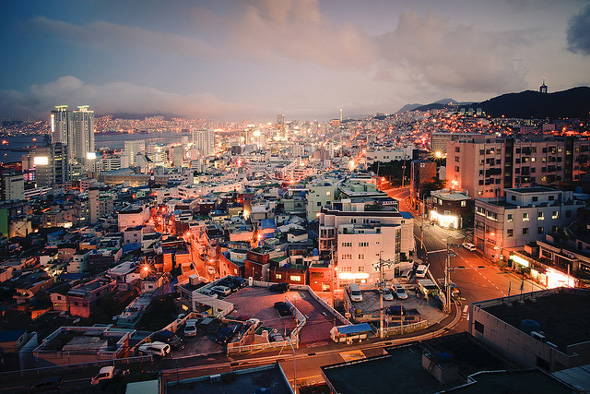
Photo Credit: “Urban View: the Republic of Korea’s Second Largest City,” courtesy of United Nations Photo. -
Water and Population: Limits to Growth?
›February 3, 2012 // By Laurie MazurWater – essential, finite, and increasingly scarce – has been dubbed “the new oil.” Experts debate whether human societies are approaching “peak water,” beyond which lies a bleak future of diminishing supplies and soaring demand. Others observe that, for many, the water crisis has already arrived.
-
Richard Black: Future Climate-Migration Interactions Will Stress Cities, “Trap” Vulnerable Populations
›“In a 50-year time span, climate change, in particular, is likely to have a quite a strong impact on the drivers of migration,” said Richard Black, professor of human geography at University of Sussex and lead author of Migration and Global Environmental Change: Future Challenges and Opportunities. “But in a way that is different to what has been understood until now.”
-
Move Beyond “Water Wars” to Fulfill Water’s Peacebuilding Potential, Says NCSE Panel
›January 26, 2012 // By Schuyler Null
One of the best talks of last week’s NCSE Environment and Security Conference was thewater security plenary on Friday. Moderator Aaron Salzberg, who is the special coordinator for water resources at the Department of State, led with a provocative question: how many in attendance think there will be war over water in the future?
Showing posts from category Asia.