Showing posts from category Asia.
-
The Economist
Afghanistan’s Demography: A Bit Less Exceptional
›The original version of this article appeared in The Economist, and is based on ECSP Report 14, Issue 1.
This is a story from Afghanistan which is not about fighting, bombs, or the Taliban. It even contains a modicum of good news. It is about demography.
Afghanistan has long been seen as a demographic outlier. In 2005-10, according to the United Nations Population Division, its fertility rate was 6.6 – the second-highest in the world after Niger (the fertility rate is the number of children a woman can expect to have during her lifetime). The contrast with the rest of South Asia is extreme: fertility ranged from four (in Pakistan) to below three (in Bangladesh, India, and Sri Lanka). Afghanistan’s sky-high fertility seems consistent with a view of the country as trapped in an exceptional and dysfunctional mode of development, marked by war, religious extremism, tribal honor codes, and the subjugation of women.
But this fertility rate was always a bit of a guess. The last census was taken in 1979, the year of the Soviet invasion. A whole generation has grown up since then, amid pervasive violence and uncertainty. It has been extremely hard to know how fertility has been changing.
Hence the significance of the Afghanistan Mortality Survey. Based on interviews with 48,000 women and girls aged 12 to 49, it is the nearest thing the country has had to a national census for 30 years (there were smaller surveys in 2003 and 2007-08, but their coverage was not national).
Continue reading on The Economist.
Read more about the Afghanistan Mortality Survey here on the blog with Elizabeth Leahy Madsen’s original posts here and here.
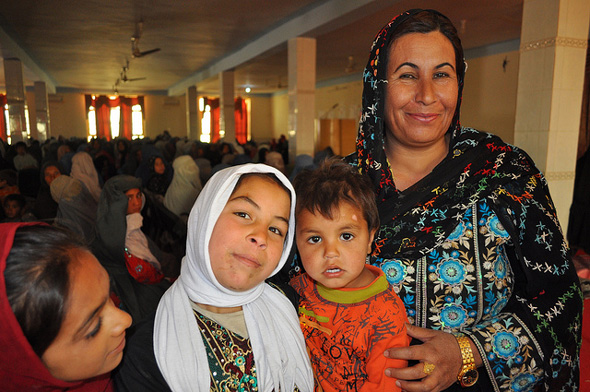
Photo Credit: “Celebrating International Women’s Day in Afghanistan,” courtesy of the U.K. Department for International Development. -
USAID’s New Global Health Framework and Delivering Equity in Health Interventions
›USAID’s new Global Health Strategic Framework, Better Health for Development, lays out the agency’s major health priorities for the next five years. “Core global health priorities” include reducing maternal mortality, ensuring child survival and nutrition, fostering an “AIDS free generation,” and fighting infectious diseases. Family planning and reproductive health is listed as a key area for bilateral engagement. In particular, the strategy hopes to continue to “graduate” countries from the agency’s family planning program, which since the 1980s has transitioned 21 countries into local ownership of family planning support. The strategy also takes stock of the shifting global health environment, noting the rise of the “BRICS” countries as new donors and the need to strengthen public health systems in developing countries. “Already, private payments account for 50-80 percent of total health spending in Africa and Asia, leading to system inefficiencies, inequitable access, and health costs that prove catastrophic to individuals and families,” the report reads. In order to achieve its priorities within this context, the document sets out a number of strategies, including a focus on program sustainability, the empowerment of women, and integrated approaches to development. Health, it says, “cannot be isolated from other development challenges.”Speaking of health interventions, a team of researchers led by Aluisio Barros of the Federal University of Pelotas, Brazil, recently compared coverage data from more than 50 countries against an index of household wealth to estimate the most and least equitable interventions. The study, “Equity in Maternal, Newborn, and Child Health Interventions in Countdown to 2015: A Retrospective Review of Survey Data From 54 Countries,” published in The Lancet, found that “interventions with similar levels of overall coverage often have very different degrees of inequality.” According to the data, “the most inequitable indicator was skilled birth attendant, followed by four or more antenatal care visits, whereas the most equitable was early initiation of breastfeeding.” For example, though the average for attendance by a skilled birth attendant was 53.6 percent across the entire sample, the wealthiest fifth had an 84.4 percent coverage rate and the poorest stood at 32.3 percent. “Interventions that are usually delivered in fixed health facilities…tend to be the most inequitably distributed,” write the authors, with geographical access, financial barriers, and discrimination appearing as likely obstacles for the poor. The authors conclude that, although “concern about inequalities in maternal and child health in poor countries was conspicuously absent from the global agenda in the past,” the availability of new, intervention-specific data provides a means of targeting equity issues in health delivery more successfully. -
Women’s Rights and Voices Belong at Rio+20
›This summer, world leaders will gather in Rio de Janeiro for the 20th anniversary of the first UN Earth Summit to hammer out a new set of agreements on what sustainable development means and, more importantly, how both rich and developing nations can get there before it’s too late. However, for the scores of women who will be attending (and just importantly for those who aren’t), there are glaring omissions: reproductive health, gender equality, and girls education are nowhere to be found on the Rio+20 agenda.
Women offer many of the most promising levers for the transformation to sustainable development. My experience with the Global Fund for Women tells me that women are full of creative and strategic solutions to the problems facing their communities around the world. Their voices must be included in critical decisions affecting our world. And the fact is, sustainable development isn’t sustainable if it doesn’t include empowering women to plan their families, educate themselves, and their children, and have a voice in government at all levels. Rio+20 must have human rights – and women’s rights – at its core. Earth summit planners haven’t yet done that, but women can make it happen.
Women are 51 percent of the world’s population, yet own only one percent of its assets, are two-thirds of the world’s workers but earn a mere 10 percent of wages. Rio+20 must not become another forum in which women’s issues are not heard. Instead, the summit must demonstrate that women’s voices are integral to all development. Environmental sustainability simply can’t happen without women’s inclusion.
For example, in West Africa, women make up 70 percent of workers in agriculture. In Burkina Faso, deforestation, water scarcity, and soil erosion show us that climate change is already impacting women farmers. Women tend to “sacrifice themselves” in order to care for their families – feeding themselves last. And women are most likely to suffer and die in environmental disasters – particularly in the Asian countries most at risk from climate change.
So how do we support women while supporting the environment that sustains us all?
Simply meeting women’s needs for family planning is one inexpensive and powerful development strategy with a host of environmental benefits. Over 200 million women around the world want the ability to choose the spacing and number of children but don’t have access to, or accurate information about, basic contraceptives like condoms, pills, and IUDs. One-hundred and seventy-nine nations already agree that meeting this need is a top priority, and the Millennium Development Goals (MDGs) reflect a goal of universal access to family planning as well.
Satisfying this demand would dramatically reduce maternal and child mortality and enhance human rights. What’s more, two recent studies show that a reduction of 8 to 15 percent of essential carbon emissions can be obtained by meeting women’s needs for family planning. This reduction would be equivalent to stopping all deforestation or increasing the world’s use of wind power fortyfold.
The Earth Summit presents a major opportunity to ensure that women’s needs and rights are given top priority in plans for sustainable development. In a time of multiple, interlinked human and environmental crises and a very tight funding environment, investing in women is a clear winner.
A greater understanding of the impact of environmental degradation, pollution, and climate change on women, coupled with solid public policy that respects and protects women’s reproductive rights, is essential to the “Sustainable Development Goals” that many believe will emerge from Rio+20 to replace the MDGs, which expire in 2015.
As the summit approaches, it’s time to reflect on why women’s full participation and inclusion is so important and call for world leaders to harness the power of women as we launch the era of sustainable development.
Musimbi Kanyoro is president and CEO of the Global Fund for Women, which advances women’s human rights by investing in women-led organizations worldwide.
Sources: Food and Agriculture Organization, Guttmacher Institute, Moreland et al. (2010), O’Neill et al. (2010), Princeton Environmental Institute, UN, UNEP, World Bank, World Health Organization.
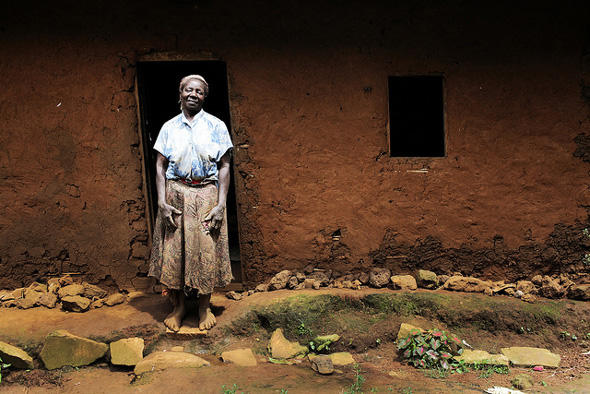
Photo Credit: “Reokadia Nakaweesa Nalongo,” courtesy of Jason Taylor/Friends of Earth International. -
In Building Resilience for a Changing World, Reproductive Health Is Key
›April 20, 2012 // By Laurie MazurChange is a constant in human (and natural) history. But today, we have entered an era in which the pace, scale, and impact of change may surpass anything our species has previously confronted.
-
Megacities, Global Security, and the Map of the Future
›“We’re in an urban century, there is no doubt,” said Peter H. Liotta, visiting scholar at the U.S. Military Academy West Point and co-author of The Real Population Bomb: Megacities, Global Security, and the Map of the Future, during a March 20 event at the Wilson Center. Liotta’s book focuses on the geopolitical impacts of poorly managed urbanization on the most vulnerable as well as the security issues such urbanization might create. He was joined by Jaana Remes of the McKinsey Global Institute, who painted a more promising picture of a globally rising, economically prosperous urban middle class, and Stimson Center visiting fellow Peter Engelke, who grappled with the contradictions between these alternative urban realities. [Video Below]
“Urbanization is key to economic development, but it has been, is now, and will continue to be into the future beset by a very large shadow side, wherein the marginalized face grinding poverty, squalor, and despair,” explained Engelke.
Although Liotta and Remes laid out very different “maps of the future,” Engelke suggested three commonalities. First, they both highlight the “unprecedented scale and speed of global change.” Second, they acknowledge that “a global demographic shift is well underway, and has been for some time.” And third, they accept that we have yet to fully integrate cities into the physical and mental maps by which we navigate the world, he said. Despite the economic dynamism of cities, “we live in a world that, I submit, has not yet grasped this reality even in conceptual terms, much less political and policy ones.”
The City as a Source of Vulnerability
People come to megacities “because there’s a chance,” said Liotta. “It looks like a nightmare to us, but people come because they’re waiting for a future.” This chance, however, is often slim, according to Liotta.
The sheer scale of modern urbanization (approximately 200,000 people move every day from rural to urban areas) produces myriad sources of vulnerability for the poorest and most marginalized, said Liotta. “World population growth will occur in the poorest, youngest, and often heavily Muslim states, which lack education, capital, and employment. And for the first time in history the world will be primarily urbanized, with most megacities in the poor states where you don’t have policing, sanitation, and health care.”
This urban shift concentrates young populations presumed to be unstable, exacerbates the risk of disease and climate change, and increases the threat of declining resource availability and food production, Liotta said. In states where “the lights are out” – that is, where urbanization is not met with sufficient economic development – our new urban century may feature significant security challenges, he argued. “Every single security problem we have today, and in the future – whether it’s human security, environmental security, or national security – is [in] the places where the lights are out.”
In The Real Population Bomb, Liotta links these sorts of security issues to what he terms “entangled vulnerability scenarios,” such as scarcity of water for drinking and irrigation, outbreak and rapid spread of disease, or lack of sufficient warning systems for natural disasters or environmental impacts. These scenarios, he argues, deserve a greater showing next to the traditional focus on hard security “threats.”
Fertility rates are generally declining, which will eventually dissipate the youth bulges being experienced by many countries, but the challenge is how to “manage that glide path,” said Liotta. It is about “doing it well collectively, because we are not thinking collectively well about how to do this and places in the world are in serious trouble.”
The City as a Center of Growth
Jaana Remes presented both a broader scale of analysis and a more positive outlook. Urbanization is “the most powerful positive economic force in today’s environment,” she asserted, drawing on the McKinsey Global Institute report, Urban World: Mapping the Economic Power of Cities.
Compared to the historical experiences of the Western world, change in the most rapidly urbanizing of today’s developing states is occurring at “100 times the scale, in one tenth of the time,” said Remes. This change is fundamentally shifting the economic profiles of states such as India and China, which are projected to account for approximately one third of global GDP by 2050.
This growth in economic prominence can be accounted for by the rise of urban populations of middle class consumers not just in megacities, but also in the rapidly growing “middleweight” cities (from 200,000 to 10 million people) explained Remes. The path that these cities take will be “very significant for…how our world is going to look like in the next few decades,” she said. They are where “the lion’s share of global investment is going to be made.”
Engaging Global Urbanization
“That we are seeing cities rise in their profile is nothing new in history,” said Remes, “in fact you can argue that cities are actually some of the longest-lasting assets in the world.” Today, 600 urban centers generate more than 60 percent of global GDP; 400 of these are in emerging markets. So, “even though the scale of the change we expect to see is very dramatic, from the cities perspective, it is probably going to be more evolution than revolution.”
Taking advantage of this growth will require some significant global re-posturing. In terms of commercial diplomacy for instance, most nations continue to distribute their people more according to the “geopolitical power of the 20th century than the economic opportunity of the 21st,” said Remes. She points out, for example, that the city of Wuhan in China is expected to generate 10 times the GDP growth of Auckland, New Zealand, yet the number of foreign service officials stationed in each city is in the opposite proportion.
Policymakers looking to adapt should also look more closely at opportunities to re-develop existing, or “brownfield,” infrastructure. The challenge of accommodating the tremendous pace of urbanization may be great, she said, but “we have not yet seen one piece of infrastructure where you can’t make substantial improvements.”
Summing up the need to work on what he argued has been a shortfall in policy engagement, Engelke concluded that, “we are indeed quite a ways from acknowledging the enormous challenges, but also the opportunities, that global urbanization presents to us.”
Event ResourcesSources: UN Population Division.
Photo Credit: David Hawxhurst/Wilson Center. -
Impressions of London’s Global Change Conference
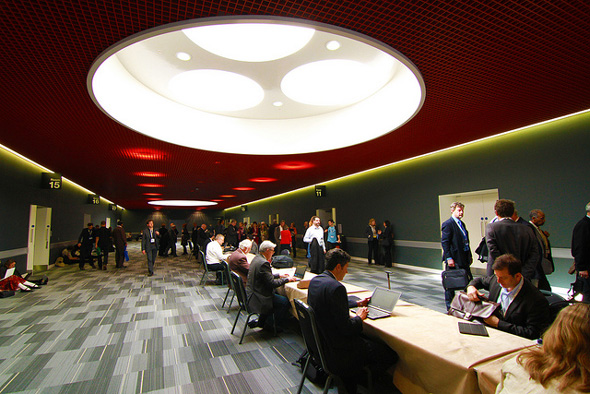
›April 11, 2012 // By Wilson Center StaffThe ECSP delegation to the 2012 Planet Under Pressure conference in London kept a keen eye on discussions of population and demographic dynamics during plenary and breakout sessions. And while the European frame of these topics resembles a much more open discussion of population pressures, presentations repeatedly looked at a broad suite of development challenges, avoiding the urge to elevate one challenge over another.
Out of the hundreds of panels during the week, we counted four that explicitly addressed population (one was hidden in the “Climate Compatible Development” program).
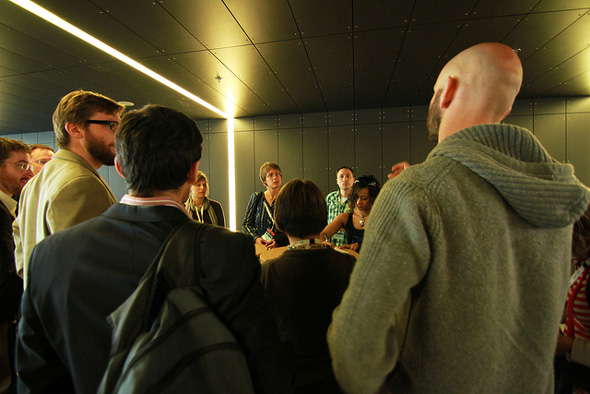
We polled a few participants on their take-aways from the conference, including Bishnu Upretti of the Swiss National Centre of Competence in Research (above). Upretti’s focus is on South Asia, where water and food insecurity, poverty, population, and political tensions – all of which fit under the conference’s broad “global change” heading – are major issues. He came away with an overall positive impression, particularly in the conference’s potential as input for the upcoming Rio+20 UN Conference on Sustainable Development.
But some were not so optimistic about the overall global picture. “It’s all been a bit of a failure really,” said Chris Rapley of University College London on environmental change (below). “Humanity has proved itself incapable either of believing it, or even…getting a grip on the impact that it’s having on the planet.”
Though upbeat about progress in the natural sciences, Rapley argued that without better defining and communicating the consequences, threats, and risks at play, other political and economic concerns will continue to trump the climate and environment concerns.
“We can talk…in very general terms, but to both people and politicians and business people – all three parts of society that have to work together…really coherently to solve this problem – that sort of rather vague ‘gosh it looks a bit gloomy down there but we can’t tell you precisely what’s going to happen’ doesn’t cut the ice,” he lamented.
A Bridge Too Far?
At a conference like this, where topics are wildly diverse and overwhelming, distilling an easy narrative is difficult. Planet Under Pressure was a dizzying collection of natural scientists, inventors, students, journalists, professors, social scientists, and more. Collecting a group like this can shed light on dynamic and innovative work, not to mention foster collaboration on a tangible scale. However, finding grand solutions to the sheer number of challenges, or pressures, placed on the planet isn’t easy.
Yes, the planet is under pressure and this means the international community needs to talk about sustainability, climate change, and overall development in order to ensure a healthy planet for future generations, but nuanced discussion of difficult topics like population dynamics and human health are still a periphery part of the conversation.
The Planet Under Pressure Declaration – the collaborative statement intended to reflect the key messages emerging from the conference – leaves a lot to be desired in this regard. Sarah Fisher, a research and communications officer at the Population and Sustainability Network, suggested text for the declaration that included mention of population dynamics, including growth, urbanization, aging, and migration, in its framing of sustainable development, as well as explicit reference to the importance of human health and wellbeing.
But the final draft of the declaration was largely devoid of these issues, instead focusing more narrowly on environmental degradation and straightforward natural resource management.
For those looking to bridge the gap between the social and natural sciences, then, the focus shifts to the upcoming Rio+20 summit. The specter of the Earth Summit was tangible throughout the conference. From panels to informal discussions, the message was clear: there’s a lot more to be done.
For full population-related coverage from the conference, see our “Planet 2012 tag”. You can also join the conversation on Twitter (#Planet2012). Pictures from the event are available on our Facebook and Flickr pages – enjoy a few below.Photo and Video Credit: Sean Peoples/Wilson Center. -
Youth, Aging, and Governance: A Political Demography Workshop at the Monterey Institute of International Studies
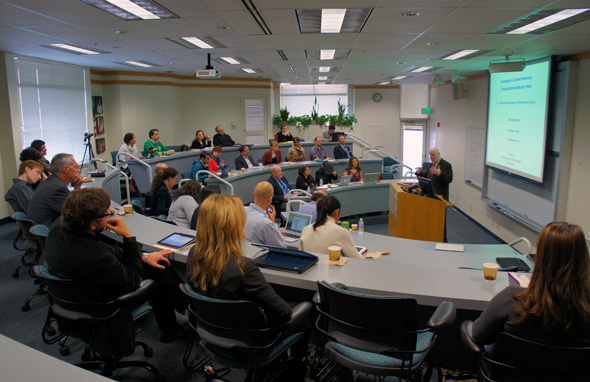
›April 5, 2012 // By Schuyler Null“Demography is sexy – it’s about nothing but sex and death (and migration),” said Rhodes College Professor Jennifer Sciubba at the Monterey Institute of International Studies during a workshop on March 30.
Jack Goldstone of James Madison University, Richard Cincotta of the Stimson Center, and ECSP’s Geoff Dabelko joined Sciubba in a workshop for students and faculty on key developments in political demography. Sciubba and Cincotta were contributors to Goldstone’s recently released edited volume, Demography: How Population Changes Are Reshaping International Security and National Politics.
“Demography is changing the entire economic and strategic divisions of the world,” Goldstone told the room. “We’ve had a 15 year increase in life expectancy just in the last half century,” and today, “90 percent of children under 10 are growing up in developing countries.”
Many countries, said Goldstone, are caught in a difficult race between growth and governance, with governments struggling to provide services and opportunity to their growing populations. This challenge is especially acute in cities, which for the first time in human history are home to the majority of all people.
At the same time, aging is a phenomenon that will affect many developed countries. In the United Sates, the baby boomers are becoming “the grayest generation,” Goldstone said, and similar imbalances between the number of working age people and their dependent elders will soon affect Western Europe, Japan, Korea, Russia, and others.
Re-Examining the Aging Narrative
Some have predicted this “graying of the great powers” will have disastrous consequences for many of the G8, as state pension costs blunt economic growth and innovation, military adventurousness, and global influence, but Jennifer Sciubba presented a case for why fears may be overblown.
When discussing the aging phenomenon in developing countries, many analysts focus too closely on the fiscal environment, argued Sciubba. This creates tunnel vision that ignores the potential coping mechanisms that states have at their disposal. Alliances, for example, are under-accounted for, she said, and closer European Union and even NATO integration could help ameliorate the individual issues faced by aging countries like Germany, France, and Italy.She also pointed to evidence that the developing world’s declining fertility may be have been “artificially depressed” by large proportions of women that delayed pregnancy starting in the 1990s. But now the average age of childbearing has stopped rising. The UN total fertility rate projections for industrialized states for the period 2005 to 2010 was revised upward from 1.35 children per woman in 2006 to 1.64 in 2008 and 1.71 in 2010.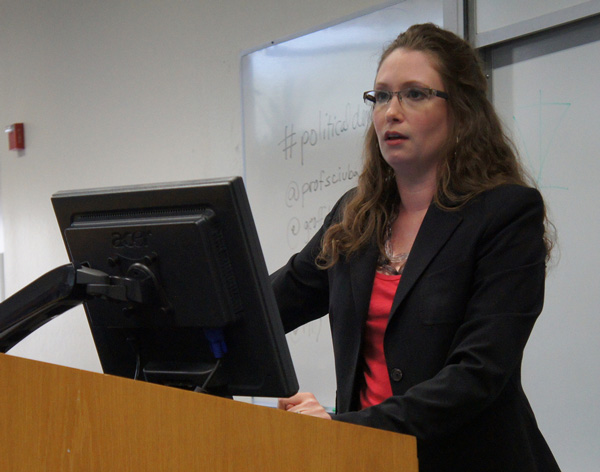
This brings into focus a key leverage point for many developed countries that is not often discussed in traditional conversations about aging: making the workplace friendlier for women. Offering money to couples to have children does not work, said Sciubba – women do not make a simple monetary cost-benefit analysis when they decide to have children. Much more likely is a calculation about the cost to their professional career. Therefore, instituting more liberal leave policies and making it harder for employers to fire both men and women for taking maternity or paternity leave is more likely to have a real impact on fertility rates.
The growing efficiency – and retirement age – of today’s workers can blunt the effect of older workforces on developed economies, said Sciubba. And the stability, strong institutions, and legal protections for innovation are all advantages that will continue to attract the best and the brightest from developing countries.
The competing phenomena of aging in the developed world and continued growth in the developing – which some have dubbed the “demographic divide” – will likely make immigration a very important, possibly friction-inducing issue in the coming decades. Goldstone pointed to the challenges Europe is having today coping with immigrants from North Africa and the Middle East as a possible harbinger of things to come.
Applying Demographic Theory: The Age Structural Maturity Model
While many regions will continue to experience population growth for the next two decades, including sub-Saharan Africa, the Middle East, and parts of East and South Asia and Latin America, the overall global trend is towards older populations. This is good news for democracy, according to Richard Cincotta.
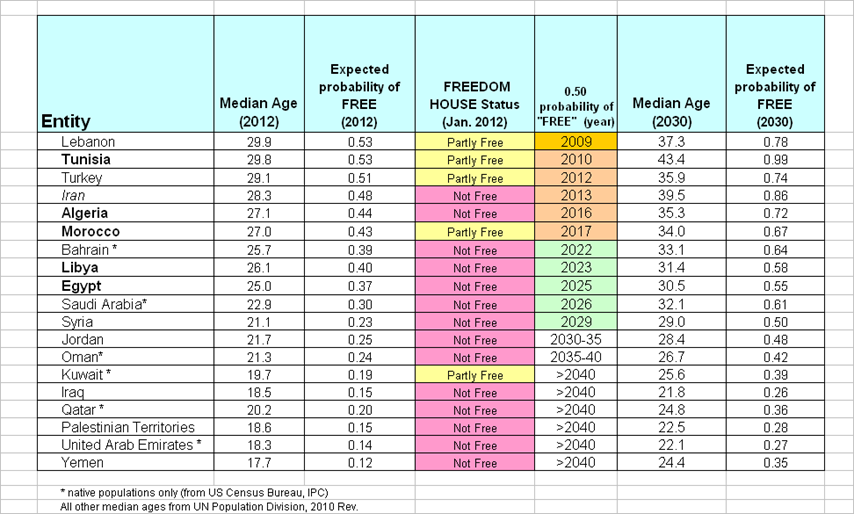
Cincotta, who consults with the National Intelligence Council on demographic issues, explained his “age structural maturity” model, which finds a historical correlation between the median age of countries and their Freedom House scores (an annual global assessments of political rights and civil liberties). Older populations tend to have more liberal regimes, while the opposite is true in younger populations. Combining this model with demographic projections, one can predict when it will become likely for democracy to emerge as a country ages. Before the Arab Spring – to some disbelief at the time – Cincotta used the model to predict that Tunisia would reach a 50/50 chance of achieving liberal democracy in 2011 (see more on this in his posts about Tunisia and the Arab Spring).
For those youthful countries that do achieve some level of liberal democracy, the model predicts they have a high likelihood of falling back towards authoritarianism (Mali is a tragic recent example).
This model, said Cincotta, can be a useful tool for analysts to challenge and add to their assessments. For example, it paints a bleak picture for democracy in Afghanistan (median age 16.6 years old), Iraq (18.5), or Yemen (17.7) and a comparatively rosier one for Tunisia (29.8), Libya (26.1), and Egypt (25.0). Some other observations may useful as well: no monarch has survived without some limits of power being introduced after countries reach a median age of 35, and military rulers too never pass that mark.
The age structural maturity model is, however, not perfect, Cincotta said. The most common outliers are autocracies (Freedom House score of “not free”) and partial democracies (“partly free”) with one-party regimes (China, North Korea), regimes led by charismatic “founder figures” (Cuba, Singapore), or those that where the regime is either supported or intimidated by a nearby autocratic state (Belarus).
Like all analyses, the model has its limitations, said Cincotta, but if used as a tool to generate “alternative hypotheses,” it can help predict dramatic political changes, like the Arab Spring. The research also suggests that the “third wave” of democratization is not over and will in fact continue to expand as countries with younger populations mature.
In conclusion, the panelists recommended the students find ways to include political demography in their work moving forward. “Consider it an alternative tool that may be useful,” said Geoff Dabelko. Policymakers today are overburdened with information and conventional analyses can sometimes become stuck in familiar lines of thought – demography can supplement these or shake them up by providing alternative narratives.
Sources: UN Population Division.
Photo Credit: Schuyler Null/Wilson Center; chart courtesy of Richard Cincotta. -
Responses to JPR Climate and Conflict Special Issue: François Gemenne (Sciences Po)
›If you want a government to address something, make it a defense issue. No need to hold a PhD in political science to know that governments tend to give the highest priority to issues that involve national security interests – one can complain and whine about it, but that’s the way it is.