Showing posts from category Africa.
-
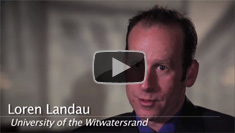
Loren Landau: We Need to Move Beyond Traditional Views of Migration
› Addressing the role of subnational actors, from local governments to mining companies, is increasingly critical to understanding migration, said Loren Landau, director of the African Center for Migration and Society at the University of the Witwatersrand, in an interview with ECSP. These actors frequently exert more influence than national governments over human resources because they control the “space in which people live, the space in which they produce,” Landau said.
Migration is most frequently seen as an aberration or a temporary coping mechanism, but this conception is outdated. According to Landau, “especially as rural livelihoods become less viable, movement will be the norm.”
Local and global actors must recognize that “people are moving, and they are moving to a whole range of new places,” he said. These new places will need attention and resources, but we will need to move beyond traditional views of migration in order to respond to the challenge. -
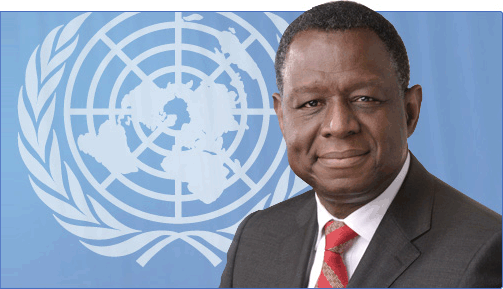
Babatunde Osotimehin Answers Seven Questions on Population
›PSI’s Impact magazine has an interview up with UNFPA Executive Director Babatunde Osotimehin asking him seven questions about population. It’s not likely this will be the last seven-something-themed story as we approach October and the expected seven billion mark for global population, but Karl Hofmann, president and CEO of PSI, asks some good questions, including on the prospect of harnessing the “demographic dividend” and about the barriers facing more integrated development efforts – a critical topic in population, health, and environment (PHE) circles.
On the demographic dividend:Karl Hofmann: Demography can be a key to progress with the right policy environment in place, but it can also be a burden when we don’t have the right framework in place to take advantage of growing populations. Some have described this as the demographic dividend – growing populations as a potent driver of economic growth and development. Give us your perspective on that.
And on integrated development:
Babatunde Osotimehin: I spoke at the 17th African Union Summit this year and one of my messages was that we have the opportunity right now to take advantage of the demographic dividend of young people. It’s important for African governments to understand that they have a youthful population. Most of Africa is under the age of 35. If 85 percent of the African population is under 35, the implication is that you have to have education, social services, housing, all of that, tailored to meet the needs of this population.
Beyond that, given what we’ve seen with the Arab spring uprising and others in many parts of the developing world, young people who are out of work want education and economic opportunities. We want to appeal to member states to provide skills appropriate to development and also ensure that we have continuing conversations with young people about their reproductive health and rights so they can make the choices that will ensure they plan for their families.KH: There are lots of conversations going on in global health circles these days around the synergy of integration. From your perspective, what are the barriers to this integration?
Read the full interview on Impact.
BO: I think it’s bipolar. Some countries are satisfied with vertical programs. Others are resistant to changing their system at the request of a donor. One argument for integration is that you can have the one-stop shop situation where one, two, three trained providers can deliver services at the same time. These include integration of HIV counseling, testing and treatment with family planning, with health education for non-communicable diseases, with immunization for children or with maternity services.
When you look at the components of an integrated system, it is very easy to sell. In terms of investment, it makes sense for the governments to build and put this together. The supervision becomes a lot easier, and the training of health workers would then capture all of the skill sets that would be required. Some countries, like India, Ethiopia and Nigeria have started this kind of integration.
Sources: PSI.
Image Credit: Adapted from UNFPA. -
Rich Thorsten on Water Sanitation, Population, and Urbanization in the Developing World
›“For the first time in human history, more than one half of the world’s population now lives in urban areas, and some of the largest and fastest growing population centers in the world – countries like India, China, parts of sub-Saharan Africa – are in areas where water resources are becoming more and more scarce,” said Water.org’s Rich Thorsten in a recent interview with ECSP.
Thorsten serves as director of international programs for Water.org, which partners with local communities, governments, and NGOs across Central America, South Asia, and Africa to bring improved water sanitation to at-need rural and urban populations. He emphasized that ensuring access to clean water has a number of positive spillover effects, ranging from improved prospects for economic development to greater social stability, since access to non-polluted water supplies removes one potential source of tension within and between communities.
Community Health
The greatest benefit of improved sanitation services, however, comes in the form of enhanced public health outcomes. “I would definitely say there is a strong correlation” between the two, Thorsten asserted. “Water and sanitation-related diseases are related to the deaths of at least 3.5 million people every year in the developing world – not to mention millions of hours and dollars that are lost to treating health problems and coping with health problems as a result of poor [water] access and hygiene practices.”
Thorsten said that community participation has been a key aspect of ensuring the sustainability of Water.org’s projects. To pave the way for continued gains in economic development and public health, he said they work alongside water users, engineers, and government officials in target communities to make those parties stakeholders in the infrastructure development process. Fostering a sense of community ownership of sanitation projects helps reduce the likelihood that infrastructure will fall into disrepair or disuse after the initial programming intervention has been conducted.
Given that improving water-sanitation access for the world’s poor is a key element of the UN Millennium Development Goals, Thorsten said he is pleased the subject seems to be attracting more attention within the policymaking and development communities. Despite the positive momentum, however, he acknowledged the fight to ensure clean-water access for the developing world will remain an uphill battle.
“When one considers that….about 2.6 billion people lack access to basic sanitation, that there’s more people in the world that have access to a cell phone than a pit latrine or a toilet, it’s still a very daunting task that will require a lot more investment, commitment, and attention in order to improve the situation for billions of people,” Thorsten said.
Sources: UN.
The “Pop Audio” series is also available as podcasts on iTunes. -
Karen Seto on the Environmental Impact of Expanding Cities [Part Two]
›“A lot of cities are trying to become green cities,” said Karen Seto in part two of an interview with ECSP about her recently published article, “A Meta-Analysis of Global Urban Land Expansion,” co-authored with Michail Fragkias, Burak Güneralp, and Michael K. Reilly. “I think one of the main policy implications of our study is that how a city urbanizes is critical, because one of the things we are finding is that urban land is growing faster than urban population, and in some cases it is growing much faster.”
Seto said that the cities with the best prospects for implementing green growth and expansion strategies “tend to focus on the low-hanging fruit,” such as planting trees or constructing buildings with green roofs. From the public’s perspective, these types of measures are relatively painless because they “don’t require changing people’s behavior.”
More challenging, said Seto, will be getting rapidly expanding cities to anchor future development around public-transit systems, especially given the changing lifestyle preferences of upwardly mobile urban populations across China and India, for whom private car ownership serves as an important status symbol.
Still, Seto said she is tentatively optimistic about city planners’ ability to grow cities in a sustainable fashion. “We’ve experienced this rapid growth of urban population and urban land areas, but we’re also seeing that over the next 20 years, according to the UN, we’re going to see even more people living in urban areas,” she said.
“We have this window of opportunity to really shape the way in which cities get developed, and I think that’s really one of the big messages of the study.”
Part one of Karen Seto’s interview is available here. The “Pop Audio” series is also available as podcasts on iTunes.
Sources: China Daily, USA Today. -
Karen Seto on the Environmental Impact of Expanding Cities [Part One]
›“When we think about the environmental impacts of rapid urbanization, we really need to unpack what we mean by ‘urbanization,’” said Karen Seto, an associate professor in Yale University’s School of Forestry and Environment Studies, in this interview with ECSP. “There is the demographic component, where more people are living in cities; there is economic urbanization, which is where livelihoods and economies are becoming more urban rather than rural; and then there is the land component – the conversion of land from agriculture and other ecosystems to become urban.”
Seto is the lead author of a new article, “A Meta-Analysis of Global Urban Land Expansion” (with Michail Fragkias, Burak Güneralp, and Michael K. Reilly), which uses satellite imagery to help document the physical expansion of urban areas in developed and developing nations between 1970 and 2000.
Over that period, the population of cities in the developing world boomed. In 1970, there were roughly the same number of city dwellers in developed nations as in developing nations. By the mid-1990s, however, urban residents of the developing world outnumbered their developed-world counterparts by a factor of two to one. Since then, the gap has continued to grow.
According to the report, urban growth sprawled to cover nearly 60,000 square kilometers of previously non-urban areas during the last three decades of the twentieth-century. One of their most interesting finds, said Seto, was that “urban expansion has been occurring in low-elevation coastal zones more than it has been elsewhere.”
“Essentially what that means is that cities are growing precisely in areas that are highly vulnerable to the impacts of climate change, like sea level rise and storm surges,” she said.
Demography and the Environment
Seto acknowledged that many of the today’s discussions surrounding urbanization focus on the negative impacts for the environment and human security – among them the “loss of agricultural land, conversion of forests, biodiversity loss, changes in hydrology, and climate effects.” Ultimately though, she said, urbanization and its attendant land-use changes shouldn’t be viewed through a black-or-white lens.
“Certainly we think about the oncoming demographic transition of something like three billion more people living in cities,” Seto said, but “that means there’s a lot of efficiency to be gained, whether it is in education, energy, sanitation, or health – urbanization allows for opportunities for really efficient use of resources.”
The real challenge to achieving environmentally sustainable urban development, said Seto, is thoughtful city planning: “How we configure ourselves has a big impact on the environment, so it is not the issue of just whether we are urbanizing – the form in which we urbanize [also] has a huge impact.”
Part two of Karen Seto’s interview is available here. The “Pop Audio” series is also available as podcasts on iTunes.
Sources: Population Reference Bureau, UNFPA. -
Certification: The Path to Conflict-Free Minerals from Congo
›This summer, the Wilson Center’s Africa Program, in co-sponsorship with the Enough Project, assembled a panel of experts from American, British, and Congolese governments, private industry, and the NGO community to discuss the deplorable situation in the eastern Democratic Republic of the Congo (DRC) involving conflict minerals and certification as a way forward.
After introductory remarks by Wilson Center President Jane Harman, Africa Program Director Steve McDonald introduced John C. Bradshaw, executive director of the Enough Project, who moderated the panel discussion. [Video Below]
Under Secretary of State Robert D. Hormats began by saying the “extremely traumatic” humanitarian situation in the restive areas of the eastern DRC requires “a bold, resolute, and morally inspired response by the United States and other countries.”
Sasha Lezhnev, policy consultant for the Enough Project, explained how the demand for tin, tantalum, tungsten, and gold – for use in batteries, circuit boards, and screens in computers and cellphones – are, in effect, driving the conflict in the DRC.
However, Ambassador to the United States from the DRC Faida Mitifu pointed out that a significant 70 percent of the economy in the eastern regions of the country depends on mining, thus any initiative would have to take into account the livelihoods of the people. In order to assist those communities while a process is formulated, Lezhnev called for targeted development projects in the most affected regions.
The Kimberley Process: A Potential Model?
“If we want to have a lasting impact, we’re going to need a certification process,” Lezhnev said, and we must learn lessons from the Kimberley Process (KP) in order to implement a suitable framework in the DRC.
Clive Wright, who served as the diplomatic negotiator for the KP and head of the foreign policy team for the British High Commission in Ottawa, described the intricacies of the process and its genesis. Under the provisions of the KP, the trade of rough diamonds is permissible, provided that there is a certificate from the country of origin and complementary legislation is in place in the importing country. This agreement was made through consultations and dialogue between the private sector and civil society.
Though successful in certain respects, Wright listed several shortcomings of the KP: it is not legally binding, therefore there are no levers to pull that compel government action; the process is void of an independent monitoring mechanism; and a consensus clause allows one government to block any action which clears the way for the status quo to prevail.
To implement a policy similar to the KP that guarantees legitimate minerals trade in the DRC, Under Secretary Hormats highlighted four key actors that have critical roles independently and collaboratively: 1) regional governments; 2) industry; 3) civil society; and 4) the U.S. government.
Regional Governments
Governments in the region face considerable challenges, said Hormats, as rebel groups trade across borders and evade efforts to rein in the commerce of precious gems, minerals, and arms. The states surrounding the Great Lakes – including Uganda, Rwanda, Burundi, Zambia, Kenya, and the DRC – have coalesced around these issues and developed a plan that will require effective coordination to ensure credibility. Some countries have already established traceability schemes, which are crucial for states that share borders with the DRC, since smuggling is incessant.
With regard to rebel factions, Kinshasa has occasionally participated in joint operations with the governments of Rwanda and Uganda “to stabilize [and] contain the activities of armed groups,” said Ambassador Mitifu. Progress, though slow, has also been made in demilitarizing the mining areas in the Kivu provinces as well as Maniema and in weakening the Congrès National pour la Défense du Peuple’s (CNDP) parallel administration.
The government in Kinshasa has made significant steps toward a certification framework and taken punitive action against military personnel who have engaged in illicit trade, said Ambassador Mitifu. She outlined the efforts the Kabila administration has made to address the issue, including initiatives to put in place a credible certification system so that clean minerals can be exported. In conjunction with MONUSCO – the UN peacekeeping mission in the DRC – the Congolese government has introduced centers where miners can bring their products and feed them into a legitimate supply chain. Finally, Kinshasa is working closely with the private sector, international organizations, and local NGOs to minimize fraud and enhance cooperation. Nevertheless, governance and corruption represent a formidable roadblock in the implementation of any certification process.
Industry Responsibility
Tim Mohin, the director of corporate responsibility for Advanced Micro Devices – one of the largest semiconductor manufacturers in the world – argued that industry can positively influence the supply chain by creating conflict-free smelter programs and a due diligence bulwark where anyone along the supply chain can trace their resources back to a certified smelter.
Customers, Mohin said, are going to have to insist that businesses comply with this tracking system. Under Secretary Hormats agreed with this sentiment, saying that companies that look into the origin of their minerals send a powerful message to the region and the world. He also expressed hope that “companies [would] work to find ways to adhere to legislation [Dodd-Frank] and honor their obligations to their shareholders without shunning the region’s minerals entirely.”
The most difficult stretches along the supply chain are getting buy-in from the miners and the smelters; overcoming the constraints of socio-economic realities on the ground and geo-politics; and the lack of a sustainable tracing system that spans the spectrum of the supply chain. In addition to shored-up U.S. involvement, Mohin called for increased public-private sector partnerships with incentives reminiscent of the Fair Trade system, development aid to assist displaced people, and enhanced security for artisanal miners and their businesses.
Civil Society and Government
Hormats commended the pivotal role civil society has played and must continue to play in highlighting the humanitarian issues at stake, as governments and companies have been only “dimly aware of the link between human rights abuses and the minerals trade.” Furthermore, Wright encouraged civil society’s participation because it serves as a “great policeman” that monitors the bad behavior of governments, especially when the allure of profiteering seeps into deliberations. Moving forward on boosting security for civil society on the ground in the Congo will be essential.
The U.S. government, Hormats asserted, has to do its part to support initiatives on the table to create conflict-free supply chains. If more revenue is invested in legitimizing supply chains, a substantial portion of the problem would be solved. USAID and the State Department are working with civil society to take action against those responsible for illegitimate trade and exacerbating the conflict. Of course there remains work to be done, but as Under Secretary Hormats indicated “this is the most significant moral issue of our time.”
Derek Langford is a program assistant with the Wilson Center’s Africa Program.
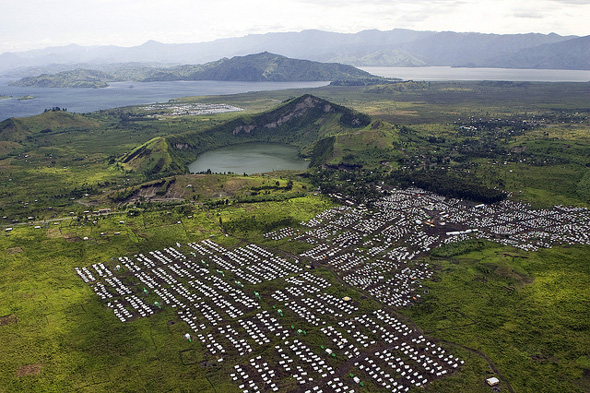
Photo Credit: “Aerial View of Camps for People Displaced by Conflict,” courtesy of flickr user United Nations Photo. -
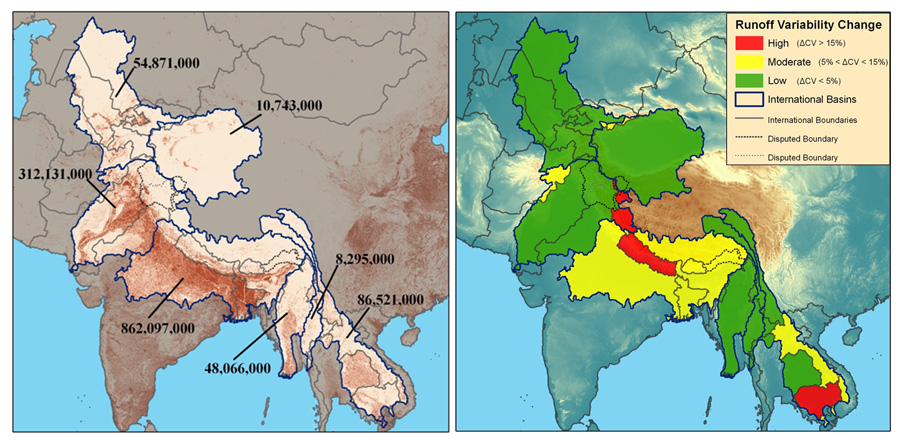
Redrawing the Map of the World’s International River Basins
›Understanding why conflict over water resources arises between nations begins with a solid understanding of the geography of international river basins. Where are the basins? How big are they? How many people live there? Who are the riparian nations, and what is the significance of each to the basin?
-
Youth Bulge and Societal Conflicts: Have Peacekeepers Made a Difference?
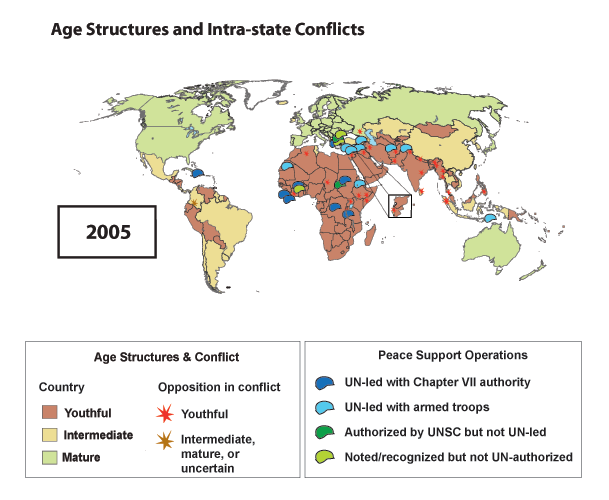
›August 22, 2011 // By Richard CincottaUntil recently, the question of which countries are at the most risk of violent societal conflict could be answered with a terse, two-part response: “the young and the war-torn.” This simple characterization regarding youth and conflict worked well, until the first decade of the 21st century. The proportion of youthful countries experiencing one or more violent intrastate conflicts declined from 25 percent in 1995 to 15 percent in 2005. What’s behind this encouraging slump in political unrest? One hypothesis is that peace support operations (PSOs) – peacekeepers, police units, and specialized observers that are led, authorized, or endorsed by the United Nations – have made a difference.
From the 1970s through the 1990s, more than 90 percent of all societal conflicts broke out in countries with a youthful age structure – a population with a median age of 25 years or less. And wherever civil and ethnic wars emerged, they tended to persist. The average societal conflict that began between 1970 and 1999 continued without a one-year break in battle-associated fatalities for about six years. Some – including the Angolan civil war, Northern Ireland’s “Troubles,” Peru’s war against the Shining Path, and the Afghan civil war – endured for decades. In contrast, inter-state conflicts that began between 1970 and 1999 lasted, on average, less than two years (see the UCDP/PRIO Conflict Database).
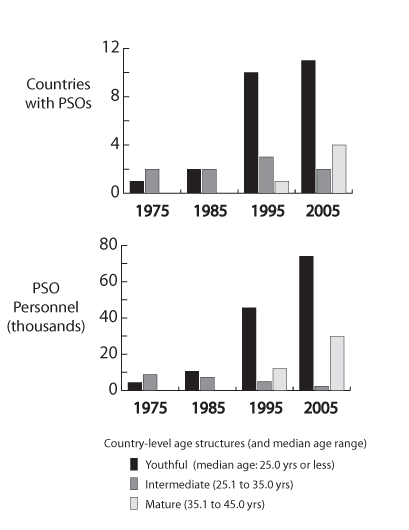
Taking on Intra-State ConflictsBeginning in the early 1990s, however, there was a marked expansion in size and number of PSOs deployed in the aftermath of societal warfare, which appears to have dampened the persistence of some conflicts and prevented the reemergence of others. The annual number of active PSOs deterring the re-emergence of societal conflict jumped from just 2 missions during 1985 to 22 in 2005. In contrast, those led, authorized, or endorsed by the UN to maintain cease-fire agreements between neighboring states during that same period only increased from three active missions to four. By 2009, nearly 100,000 peacekeepers were stationed in countries that had recently experienced a societal conflict. About 70 percent were deployed in countries with a youthful population (see Figures 2A and B). Why the sudden expansion in use of PSOs?
According to William Durch and Tobias Berkman, this upsurge was less a change of heart or modification of a global security strategy and more an outcome of the unraveling web of Cold War international relations. Before the 1990s, the majority of PSOs were United Nations-led operations that were mandated to monitor or help maintain cease-fires along mutual frontiers. Because insurgents were typically aligned with either the Soviets or a Western power, Security Council authorization to mediate a societal conflict was difficult to secure.
This situation changed with the breakup of the Soviet Union and the initiation of PSOs by regional organizations, including operations by the Economic Community of West African States (ECOWAS) in Liberia and Sierra Leone and the NATO-led Kosovo Force in 1998-99.
Demographic Forecasting
What do national demographic trends suggest for the demand for PSOs over the next two decades? For societal conflict, political demographers foresee that the demand for PSOs will continue to decline among states in Latin America and the Caribbean – with the exception of sustained risk in Guatemala, Haiti, Bolivia, and Paraguay. Similarly, demand for peacekeeping is expected to continue to ebb across continental East Asia.
Gauged by age structure alone, the risk of societal warfare is projected to remain high over the coming two decades in the western, central, and eastern portions of sub-Saharan Africa; in parts of the Middle East and South Asia; and in several Asian-Pacific island hotspots – Timor-Leste, Papua New Guinea, the Philippines, and Solomon Islands. But even in some countries that are losing their youthful blush, domestic political relations could turn out less rosy than this simple age-structural model forecasts.
In other words, there are roadblocks to a “demographic peace.” Among them is an increasing propensity for a specific demographic configuration of ethnic conflict: warfare between state forces and organizations that recruit from a minority that is more youthful than the majority ethnic group. Examples of these conflicts include the Kurds in Turkey, the Shiites in Lebanon, the Pattani Muslims in southern Thailand, and the Chechens of southern Russia.
However, this twist on the youth bulge model of the risks of societal conflict is a discussion for another installment on New Security Beat. Suffice it to say that when political demographers look over the UN Population Division’s current demographic projections, they see few signs of either the waning of societal warfare, or the withering of the current level of demand for PSOs.
Richard Cincotta is a consultant on political demography for the Wilson Center’s Environmental Change and Security Program and demographer-in-residence at The Stimson Center.
Sources: PRIO, The Stimson Center, UN Population Division.
Chart Credit: Data courtesy of the UN Population Division 2011, PRIO, and Durch and Berkman (2006). Arranged by Richard Cincotta.