Showing posts from category USAID.
-
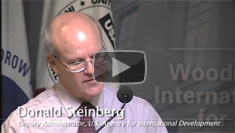
USAID’s Donald Steinberg on Futures Analysis for International Development
›February 28, 2012 // By Stuart Kent Just as the science fiction writer Isaac Asimov explored the idea of predicting the future to influence the world towards a more prosperous, democratic, and peaceful track, so too must USAID try to better understand the challenges of tomorrow, said Donald Steinberg, deputy administrator for the U.S. Agency for International Development, during an address at USAID’s “Future of Development” symposium at the Wilson Center late last year. “Development now is too important to the United States to be left to actions that occur over 1, or 2, or 5, or even 10 years,” he continued. Looking beyond budgetary cycles, Steinberg asserted that “we have to prepare for future development patterns” by analyzing the present.
Why Aid Matters
Drawing on the President’s remarks during the UN’s 2010 Millennium Development Goals Summit in New York, Steinberg outlined three reasons why development aid is central to U.S. foreign policy.
First, we all stand to benefit from living “in a world that’s peaceful, that’s democratic, that’s prosperous, that’s respectful of human rights and respectful of human dignity,” he argued.
Second, “a world that is developing is in our economic interest,” he said. “Developing nations are our fastest growing markets abroad,” providing lucrative outlets for U.S. trade and investment. Eighty-five percent of new U.S. exports over the next two decades will find their way to recipients of U.S. foreign aid, he said.
Third, aid impacts national security. Countries that are developing and prospering “don’t spew out large numbers of refugees across borders or across oceans,” he said, “they don’t transmit pandemic diseases, they don’t harbor terrorists, or now even pirates” – in short, “they don’t require American forces.”
Looking to the Future
According to Steinberg, we can take hold of the future by being prepared to grasp opportunities, even if they come in the midst of challenges.
“We’re seeing demographic shifts that are complicating once steady development patterns,” he said, “and we’re seeing more uneven distribution of wealth within countries and between countries.” But “maternal and infant mortality have plummeted [and] literacy rates are skyrocketing.”
“We still see rampant corruption and we still see crackdowns on civil society all around the world,” however Steinberg pointed out that 17 new democracies have emerged in Africa in the last 15 years alone.
On climate change, he drew from recent events in the Horn of Africa. “A changing rain pattern – from a drought every 10 years to what is now basically a drought every year – has brought together a perfect storm of famine, war, and drought,” he said. Yet across the border from Somalia, the situation is markedly different – in part because “USAID has had the capability to work with eight million Ethiopians over the past decade to strengthen their resiliency.”
Each of these shows the opportunity for positive change amidst difficult challenges, if we are prepared.
“We went through a period where we had eliminated our office of policy and planning,” said Steinberg, but over the last few years the newly established Policy, Planning, and Learning Bureau at USAID has brought back an emphasis on futures analysis. “We are now seeking to become…the thought leader in the development field,” he said.
Overall, the total amount of official government aid is small compared to other sources from the United States, said Steinberg – around $30 billion a year (compared to $36 billion in private giving, $100 billion in remittance flows, and $1 trillion in private capital flows). To make the most of that, USAID should be “a catalyst for development,” he said, working in partnership, encouraging technological innovation, and advancing cross-sectoral understanding.
“We at AID like to think in terms of budget cycles,” said Steinberg. “We’re starting to think about fiscal year [20]14, but I want you to start thinking about fiscal year 25 and fiscal year 30. I won’t challenge you to think 30,000 years ahead like Isaac Asimov did, but I think we do have to consider what the lessons of today are teaching us about the future.”
Sources: The White House. -
What Would It Take To Help People ‘and’ the Planet?
›February 1, 2012 // By Geoffrey D. DabelkoThe original version of this article first appeared in the “Scientist’s Soapbox” column of Momentum magazine’s special issue on “what would it take” to craft solutions to some of the Earth’s toughest challenges.
People living in the most biodiverse areas of the world tend to be poor, isolated, and dependent on natural resources. They often lack reliable access to alternative livelihoods and health services and thus can place stress on these ecologically unique regions.
Conservation efforts will merely slow habitat loss if they don’t fundamentally address the living conditions of the human residents as well as the flora and fauna. But programs to assist these communities have commonly focused on one problem at a time, reflecting the interests of the funders: Environmental groups focus on conservation, while health organizations concentrate on disease. We must ask whether investments to protect biologically rich areas are effective and sustainable if they don’t respond to the many needs of the people who live there.
But the problems faced by people in these remote areas don’t fit our traditional sectors. The way we disburse our funds, divide our bureaucracies, demarcate our disciplines, and measure success ignores the reality of intersecting needs. Such stovepiping can disrespect the communities’ scarce resources, especially their time. It can waste development aid on duplicate supplies and staff. And it can lead us to miss how the solution to one problem (e.g., providing antiretroviral drugs to treat HIV/AIDS) can be undercut by another (e.g., lacking access to safe water with which to take the pills).
So, what would it take to help particularly vulnerable populations while protecting particularly important ecological systems?
We need to strategically target our help by addressing HELP – health, environment, livelihoods, and population – through a truly integrated approach to sustainable development in these areas. Evidence suggests tackling problems concurrently can be more efficient and effective. Key donors such as the U.S. Agency for International Development are increasingly prioritizing integrated responses, providing some funding for sustainable development innovators and supporting evaluation of the results. But we need more evidence that these efforts can achieve results that match or exceed the outcomes of single-sector projects. To rigorously test this approach, more projects must be funded, implemented and analyzed, over longer periods of time and at bigger scales.
To date, some promising projects and research in diverse locations – Ethiopia, Nepal, Madagascar, Rwanda, the Philippines, and Uganda – suggest that the HELP approach offers greater benefits than traditional programs.
In the Philippines, for example, the PATH Foundation Philippines’ Integrated Population and Coastal Resource Management (IPOPCORM) program addresses pressing needs for both family planning services and sustainable environmental stewardship in densely populated coastal communities, where local fisheries have been depleted because of increased demand for food. IPOPCORM helps create marine protected areas and promotes alternative economic livelihoods such as seaweed harvesting, thus allowing critical local fish stocks to recover. Concurrently, the initiative mitigates human-induced pressures on the environment and lowers the vulnerability of this underserved population by providing voluntary family planning services. Since its launch in 2001, the IPOPCORM program’s approach has yielded measurable benefits, simultaneously reducing program costs and improving health and environmental outcomes – and outperforming compartmentalized, side-by-side sector interventions.
How can we bring HELP to biodiversity-rich communities? First, we can encourage scholars, practitioners, and policy-makers to step outside their stovepipes by producing and distributing manuals, for example, based on lessons learned from existing cross-disciplinary projects. Second, we must bridge the gap between analysis and field-based programs by developing new metrics that better assess the impact of integrated programs. Third, we must open up bureaucratic funding structures by demonstrating not only the short-term savings but also the synergies that bolster long-term sustainability.
The challenges are significant, but I see promising new opportunities for overcoming them. For example, the new Pathfinder International-led projects around Lake Victoria in Uganda and Kenya mark the entry of a respected health organization into the environmental arena and the return of a leading private funder – the MacArthur Foundation – to HELP programs. With some of Africa’s highest population densities, poverty, ethnic diversity, and biodiversity, the Great Lakes region is one of the most volatile intersections of human development and environmental change.
Through these and other community-based, integrated projects, we can truly help people and the planet at the same time.
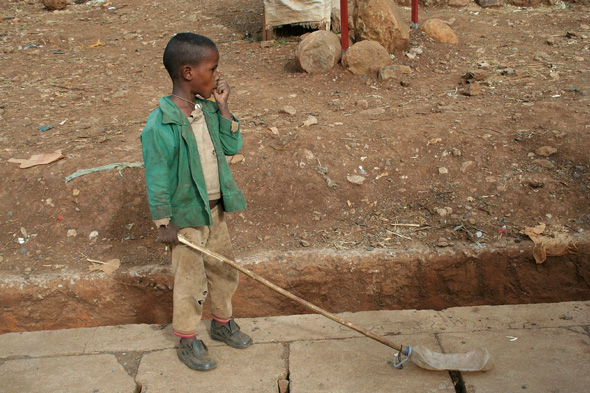
Photo Credit: “Boy on road east of Addis,” courtesy of Geoff Dabelko/Wilson Center. -
Is Foreign Aid Worth the Cost?
›“Is foreign aid worth the cost? That’s not really the question unless you’re Ron Paul,” quipped Carol J. Lancaster, dean of the School of Foreign Service at Georgetown University, at the Wilson Center on January 23. “The real questions are: What do we want to accomplish with our foreign aid? Where should it go? And in what form?” [Video Below]
Lancaster noted that following World War II, foreign aid became “a two-pronged instrument – one as an instrument of the Cold War and the other as an extension of American values.” It has been a very “intense marriage” between the two, he said, “with one side up and the other side down at different times, as any marriage tends to be.” Truman convinced Congress to provide aid to Greece and Turkey in 1948 to combat communism, and he was able to gain approval for the Marshall Plan by “scaring the wits out of Congress” about the communist threat.
Aid Under Fire
Congressman Donald Payne (N.J.), who is the ranking Democrat on the House Foreign Affairs Committee’s Subcommittee on Africa, agreed that the Cold War was the principal reason for our foreign aid programs after World War II, as we provided hundreds of billions of dollars in aid to our supporters around the world. But, “It’s different today,” he added. “Since the end of the Cold War, more funds are going for humanitarian and development assistance, but it is still directly linked to our national interests. One in five American jobs are tied to U.S. trade, and the growth of our trading partners is our growth as well.”
Payne cautioned that there is “a new group in the House of Representatives who think we should step out of the world. They’ve told their constituents they are going to cut the budget, and foreign aid is an easy target.” Payne noted that polls show the American people think one-quarter or more of the federal budget goes to foreign aid when it is little more than one percent.
Nevertheless, there has been bipartisan support for former President Bush’s HIV/AIDS initiative in Africa which is showing remarkable results in reducing deaths from the disease. Payne added that aid to Africa is showing results in the number of economies that are doing well despite the global economic downturn.
Payne expressed frustration with the inability to enact a foreign aid authorization bill in the last several Congresses because the measures became weighted down with all manner of policy riders that were both partisan and controversial. Consequently, our foreign relations operations are solely dependent on the annual appropriations bills which tend to become encumbered as well with troublesome riders.
The Dangers of “Nation Building”
Charles O. Flickner, Jr., a 28-year Republican staff member on the Senate Budget Committee and then the Foreign Operations Appropriations Subcommittee in the House, presented a more skeptical view, saying foreign aid is not worth the $35 billion it is costing us each year, even though some of the programs have been successful and should be continued. The biggest problem in recent years, he said, has been the amount of money wasted on projects in Iraq and Afghanistan without adequate planning or execution. Money was being virtually shoveled out the door in amounts the host countries did not have the capacity to absorb, said Flickner, and as a consequence we have witnessed a lot of failed projects and corruption.
Smaller projects, which the U.S. government and private aid donors are better at, have a greater chance for success because they do not overwhelm the capacities of host countries. He cited some of the scholarships and technical training programs available for foreign nationals as being among the most worthwhile in building internal leadership capacity for the future in developing countries.
Rajiv Chandrasekaran agreed on the amount of wasted aid dollars being spent in Iraq and Afghanistan, which he has covered as a foreign correspondent for The Washington Post. He told the story of a small, dirt-poor town in Afghanistan he visited in where the bazaar was bustling with new shops and goods, and people were freely spending money on modern electronics, motor bikes, and clothes. The town was the beneficiary of a massive U.S. aid program that provided seed money for farmers to grow crops and created day labor jobs for the residents of the area. A contractor was authorized to spend $30 million on the economic development of the town during the U.S. counterinsurgency surge and that came to roughly $300 per person. It was clear to the USAID official on the ground and to the reporter that the experiment would not be sustainable over the long-term, even though there was a temporary sense of economic activity and prosperity.
Future Vulnerabilities
The panel seemed to agree that it was unfair to blame USAID for these failures since they were thrown into situations overnight they were not prepared to manage in countries that were not capable of absorbing the assistance being directed at them – all in the midst of ongoing conflict. The real test of whether the new directions being charted by the Obama Administration will work will be on the smaller, more manageable projects in which the host countries have a greater role in shaping and implementing.
Lancaster listed four vulnerabilities in the future course of U.S. foreign aid that should be avoided, including trying to merge our various interests through the State and Defense Departments with our aid programs in countries like Pakistan, where the institutions are weak and corrupt; the danger of creating an entitlement dependency through funding of HIV/AIDS drugs, where we will be guilty of causing deaths if we reduce funding; the danger of attempting to undertake too many initiatives at once, such as food aid, global health, climate change, and science and technology innovations, while simultaneously trying to reform the infrastructure of USAID; and trying too hard to demonstrate results from aid given the difficulty of disentangling causes and effects and gauging success over too short a time frame.
Event Resources:
Don Wolfensberger is director of the Congress Project at the Wilson Center. -
Call for Papers: Reducing Urban Poverty
›The Woodrow Wilson Center’s Comparative Urban Studies Project, USAID, the International Housing Coalition, the World Bank, and Cities Alliance are teaming up a third time to co-sponsor an academic paper competition for graduate- and PhD-level students focused on challenges facing urban centers in the developing world.
The themes of this year’s competition are land markets, global climate change, and youth.
Land Markets: The absence of efficient land and housing markets and lack of secure tenure for both renters and owners are impediments to urban and economic development in developing cities. Papers on this topic should explore strategies and approaches that would enable property markets to function better and would provide increased security of tenure and strengthened property ownership rights.
Global Climate Change: Papers should examine how urban populations, especially the poor, are coping with the impacts of climate change, and provide strategic policy analysis to better understand how cities can become more resilient to climate change impacts.
Youth: Most of the youth of the developing world are now or will soon be living in urban areas. Unfortunately, they are often growing up in the poorest urban areas – informal settlements and slum communities where their opportunities for advancement are limited by a variety of negative factors. Papers focused on youth should explore ways to build capacity so that you can develop knowledge and skills, find gainful employment, and participate more fully in society to advance economic growth and social development.
Winning papers from each category will be published and the authors invited to Washington, D.C. in the fall of 2012 for a policy workshop with subject matter experts. Additionally, one grand prize winner will be asked to present his or her work at the World Urban Forum (WUF). WUF was established by the United Nations to examine rapid urbanization and its impact on communities, cities, economies, climate change, and policies. The sixth WUF will be held from September 1-7, 2012 in Naples, Italy and will be focused on “The Urban Future.” In addition to the Washington conference and publication of his or her paper, the grand-prize winner will be invited to present his or her winning paper on a panel at the World Urban Youth Assembly at WUF on September 1st and 2nd.
The deadline for the submission of abstracts is February 20, 2012.
For detailed competition guidelines and requirements, and further information on the sub-topics, please see the full call for papers.
Image Credit: “Split by yelowcap,” courtesy of flickr user yelowcap (Vladimir Kaštier). -
New Research on Climate and Conflict Links Shows Challenges for the Field
›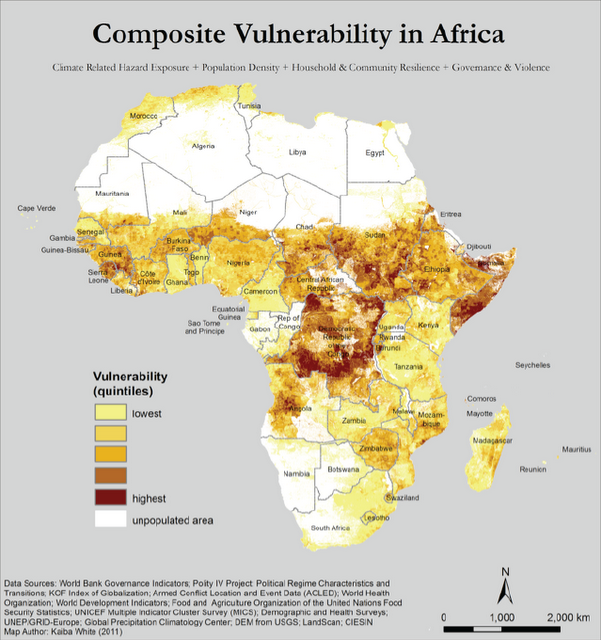
“We know that there will be more conflicts in the future as a result of climate change than there would have been in a hypothetic world without climate change,” said Marc Levy, deputy director of the Center for International Earth Science Information Network (CIESIN) at Columbia University’s Earth Institute, although existing data and methodologies cannot predict how many additional conflicts there will be, or which causal factors will matter most. [Video Below]
-
Ambassador Melanne Verveer, U.S. Department of State
Ambassador-at-Large for Global Women’s Issues on Durban and the Role of Women in Combating Climate Change
›December 23, 2011 // By Wilson Center StaffThe original version of this article, by Ambassador Melanne Verveer, appeared on the White House Council on Environmental Quality blog.
Last week I traveled to Durban, South Africa to participate in the Conference of the Parties to the United Nations Framework Convention on Climate Change to highlight the critical and largely untapped potential of women to combat climate change. Studies have shown that it is often women who are on the frontlines of, and suffer disproportionately from, the impacts of climate change. This is certainly important. But we must remember that women are also a powerful force for finding solutions to climate change across the board, including in areas such as agriculture, sustainable forest management, and energy access.
Agriculture, which accounts for approximately 14 percent of global greenhouse gas emissions and is a sector that can be particularly sensitive to climate variability and change, is one key area where women can play a major role. A recent FAO report shows that women, in many places, are the main producers of the world’s staple crops, particularly in developing countries and regions likely to be adversely affected by climate change impacts. However, globally, only a small minority of women farmers have access to land tenure. This is a problem for many reasons – including that it limits women’s potential to combat climate change. Studies have shown that women with the right to property are significantly more capable of investing in climate-smart agricultural productivity; we have a lot of work to do to unlock women’s potential in this area.
Women also have untapped potential for increasing energy access, which directly relates to climate change. For example, nearly three billion people globally still rely on traditional cookstoves and open fires to prepare food for their families. In most instances, women are responsible for cooking – not to mention also spending many hours per week collecting fuel, which often puts women at risk of gender based violence. The resulting smoke exposure causes an estimated two million premature deaths annually, with women and young children the most affected. Cookstoves also impact the climate through emissions of greenhouse gases and short-lived particles such as black carbon. Engaging women is critical to tackling this problem. As we work to build a global market for clean cookstoves, integrating women into the cookstoves supply chain will help increase clean cookstove adoption rates while also creating new economic development opportunities. And as Secretary Clinton has noted, women create a multiplier effect in local communities because they disproportionately spend more of their earned income on food, healthcare, home improvement, and schooling.
The United States recognizes the power of women’s potential in these areas and many others, and is investing in major initiatives including Feed the Future and the Global Alliance for Clean Cookstoves, where women’s role in generating transformative change is front and center.
I went to Durban to highlight the critical role of women in combating climate change. While there, I worked with U.S. negotiators on the Durban texts and participated in public engagement events. Our efforts to build on the gender equality and women’s empowerment language in the Cancun agreements are reflected in several crucial institutional developments, including language on gender balance related to the composition of the board of the new Green Climate Fund, the Standing Committee, and the Adaptation Committee. We also worked to reflect gender considerations in the mission of the Climate Technology Center and Network. USAID Assistant Administrator Eric Postel and I solicited input during a meeting with leading non-governmental organizations working on gender and climate issues, and I hosted a high-level side event at the U.S. Center focused on unlocking women’s potential to combat climate change. The level of enthusiasm among my fellow panelists and the audience at the event was inspirational.
We made progress in Durban, but we can’t stop here. To achieve the future we all seek, we must do more. As the late Wangari Maathai, founder of the Green Belt Movement and ground-breaking advocate on women and the environment said, “We must not tire, we must not give up, we must persist.” The future of not only women, but our planet, depends on it.
Ambassador Melanne Verveer is U.S. Ambassador-at-Large for Global Women’s Issues.
Sources: Food and Agriculture Organization, Intergovernmental Panel on Climate Change, The White House.
Photo Credit: “Melanne S. Verveer,” courtesy of the U.S. Embassy, Kabul. -
In Somalia, Beyond the Immediate Crises, Demography Reveals a Long-Term Challenge
›December 21, 2011 // By Elizabeth Leahy MadsenIn the nearly 20 years since the infamous intervention that resulted in the deaths of dozens of American and UN peacekeeping soldiers on the streets of Mogadishu, Somalia has become the epitome of a “failed state.” Neighboring countries, global bodies, and aid agencies are rushing to respond to the country’s rapidly evolving political, security and humanitarian crises.
Diplomatic attention has focused on decentralized, weak governance that is divided among the Al Shabab insurgency, clan warlords, and a hamstrung and largely ineffective Transitional Federal Government, whose control does not extend beyond the capital. Foreign militaries have had to devote naval resources to curtailing daring and far-reaching acts of piracy against civilian and military vessels from networks based in Somalia. Aid groups have been stymied in their efforts to stem famine as access to populations in the hardest-hit areas has been cut off by Al Shabab and food aid has been stolen. Most recently, Kenyan and, reportedly, Ethiopian forces have crossed the border, extending the reach of the country’s political crisis. Hundreds of thousands of have fled conditions of hunger, illness, and violence into neighboring countries.
Perhaps the deepest woe of a “failed state” is that its problems are deep-seated and cannot be solved during the brief span of a UN meeting or the news cycle following the latest terrorist attack. Amid the extraordinary efforts to battle the country’s crises, one of the most important underlying structural factors is often overlooked: the country’s unusual demographic picture.
A Demographic Outlier
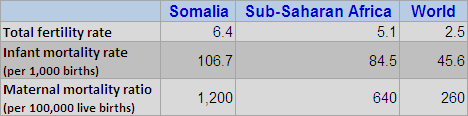
Somalia is a global outlier in demographic terms, with rates of fertility (6.4 children per woman), infant mortality (107 deaths per 1,000 births), and maternal mortality (1,200 deaths per 100,000 live births) all above the already-high averages for sub-Saharan Africa. These demographic indicators are both a reflection of the abysmal state of health care in the country and a warning that its economic and security challenges are unlikely to be easily resolved.Research shows that where at least 60 percent of the population is younger than 30 years old, countries are more prone to outbreaks of civil conflict, and the risk increases as the proportional size of the “youth bulge” grows. In Somalia, 70 percent of the population is younger than 30, a level comparable to Iraq and the Palestinian Territories. With little to no improvements in health care, Somalia’s age structure has remained unchanged over the past 40 years. Unlike dozens of other countries where fertility has declined significantly in recent decades, Somali women have nearly as many children on average today as they did in the 1970s. The current total fertility rate of 6.4 children per woman is only a 12 percent decline from the 1970 rate.
Despite high infant mortality – more than 10 percent of children die before turning one – this sustained high fertility rate has generated rapid population growth, with each successive generation larger than the next. Somalia’s population has almost tripled since 1970, from 3.6 to 9.3 million, although population density remains low (one-third the world average). If the fertility rate remains constant at the current level – not an unreasonable projection considering how stagnant it has been over past decades – Somalia would be home to 33 million people by 2050. Even if the fertility rate drops to near four children per woman, as projected in the UN’s medium variant, the population would still triple to 28 million by mid-century given the demographic momentum of decades of high fertility.The fertility decline built into the UN’s medium variant projection – which would still place Somalia among the highest total fertility rates in the world by 2050 – is unlikely without steady and major improvements in the country’s health system, particularly women’s health. But with decades of conflict, weak governance and little investment, the environment for reproductive health services is dire.
A recent World Health Organization assessment described “unacceptable levels of unmet need, extreme inequities in access…slow progress…[and] underinvestment and poorly coordinated actions.” Pregnancy and childbirth are major risks to women’s well-being. Somali women have a one in 14 chance of dying from maternal causes over their lifetimes, the second-highest risk in the world. Funding to improve reproductive and maternal health care remains too low to meet demand. The United Nations Population Fund reports that donors spent about $6 million on population and reproductive health programs in 2008, about one-third as much as was spent in Benin and Burundi, which have smaller populations.
The Future for Youth
Instability and violence have become entrenched in Somalia; according to the Armed Conflict Dataset, civil conflict occurred in 12 of the past 20 years. The direct causes of the conflict are typically recorded as struggles for power and resources among competing clans. But in considering the underlying causes of conflict, demographic security scholars have suggested that very young age structures such as Somalia’s can create both motive and opportunity for recruitment into a violent uprising. As ever-growing numbers of young people face adulthood with few prospects for employment, hopelessness or desperation can make them vulnerable to the promise of well-being and identity offered by a political faction or rebel group.
There are 1.7 million people between the ages of 15 and 24 in Somalia today, with another 2.5 million following in the next ten-year age cohort. With opportunities for education, jobs, and equitable participation in society, these youth would represent a promising future for their country. Unfortunately, such opportunities are not afforded to most of them. A United Nations survey found that the secondary school enrollment rate is just six percent, with poverty and early marriage keeping many young people out of school. World Bank data from 2002 show that two-thirds of urban working-age adults and 41 percent of those in rural areas were unemployed. Nearly half of the population lives on less than $1 per day.
Youth Education, Economic Opportunities Could Increase Stability
While global attention centers on the government’s commitment to a new roadmap for peace and the efforts of the African Union’s peacekeeping forces to drive Al Shabab out of Mogadishu, development agencies have recognized demographic security as an important component of Somalia’s future.
The United Nations Children’s Fund is supporting schools for displaced children in Mogadishu, saying in a press release that “providing them with learning opportunities in a safe environment is critical for the country’s long-term stability and growth.”
The U.S. Agency for International Development (USAID) has announced plans for a new program called the Somali Youth Leaders Initiative, which aims to improve young people’s access to secondary education and economic opportunities and to increase their civic participation. In designing the program, USAID noted “the recruitment of boys and men by extremist organizations and piracy networks” and “the common perception that an increasing youth population is a potentially destabilizing force.”
As the October 4 bombing at the Education Ministry in Mogadishu showed, young people are often the victims of the country’s instability. Programs such as those of UNICEF and USAID that empower young people to capitalize on their potential should be a greater focus among initiatives to address Somalia’s long-term future as well as its immediate crises.
Elizabeth Leahy Madsen is a consultant on political demography for the Wilson Center’s Environmental Change and Security Program and former senior research associate at Population Action International.
Sources: BBC, Population Action International, The New York Times, UCDP/PRIO, UNICEF, UNESCO, UN Population Division, UN Population Fund, Urdal (2006), USAID, World Bank, World Health Organization.
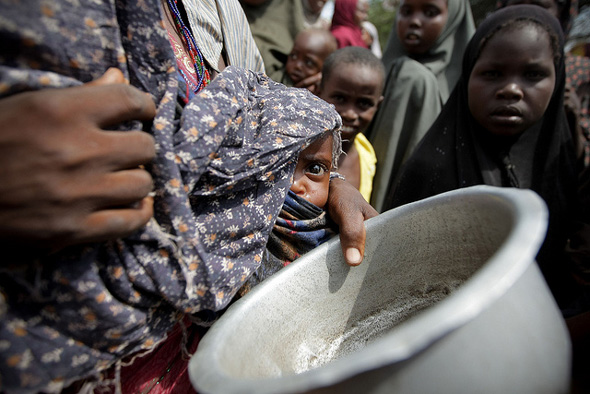
Image Credit: “Somalia Suffers from Worst Drought in Century,” courtesy of flickr user United Nations Photo/Stuart Price; charts arranged by Elizabeth Leahy Madsen, data from the UN Population Division and World Health Organization. -
The Legacy of Little America: Aid and Reconstruction in Afghanistan
›In 2007, the United States built a $305 million diesel power plant in Afghanistan – the world’s most expensive power plant of its kind. Yet the facility is rarely used, because the impoverished country cannot afford to operate it.
This ill-fated power plant does not represent the only time America has lavished tremendous amounts of money on development projects in Afghanistan that have failed to meet objectives. At a December 7 presentation organized by the Wilson Center’s Asia Program and co-sponsored with the Middle East Program and International Security Studies, Rajiv Chandrasekaran discussed Washington’s expensive attempts to modernize southern Afghanistan’s Helmand River Valley from the 1940s to 1970s – and the troubling implications for U.S. development projects in that country today.
From Morrison Knudsen to USAID
According to Chandrasekaran, a Wilson Center Public Policy Scholar and Washington Post journalist, the story begins after World War II, when Afghanistan’s development-minded king, Zahir Shah, vowed to modernize his country. He hired Morrison Knudsen – an American firm that had built the Hoover Dam and the San Francisco Bay Bridge – to construct irrigation canals and a large dam on the Helmand River. Shah’s view was that by making use of the Hindu Kush’s great waters, prosperity would emerge and turn a dry valley into fertile ground.
Unfortunately, problems arose from the start. The region’s soil was not only shallow, but also situated on a thick layer of subsoil that prevented sufficient drainage. When the soil was irrigated, water pooled at the surface and salt accumulated heavily. Yet despite these challenges, King Shah was determined to continue the massive enterprise. And so, increasingly, was the U.S. government – particularly when Washington began to fear that if it did not support this project, the Soviets would.
In 1949, the United States provided the first installment of what would amount to more than $80 million over a 15-year period. With this aid in hand, Morrison Knudsen not only completed the canals and dam but also constructed a new modern community. Americans called the town Lashkar Gah, but Afghans christened it “Little America.” It boasted a movie theater, a co-ed swimming pool, and a tennis court. Children listened to Elvis Presley records, drank lemonade, and learned English at Afghanistan’s only co-ed school.
However, problems continued to proliferate. Afghans in Lashkar Gah – many of whom had been lured away from their ancestral homelands on the promises of better harvests – did not experience greater farm yields. In the 1960s, the Afghans severed their contract with Morrison Knudsen, and began working directly with U.S. government agencies, including the new U.S. Agency for International Development (USAID). The result was some fairly productive farms, but, due in great part to waterlogging and soil salinity, the objective of transforming the region into Afghanistan’s breadbasket was not attained. U.S. funding slowed in the 1970s, and the grand experiment officially ended in 1978, when all Americans pulled out of Lashkar Gah following a coup staged by Afghanistan’s Communist Party.
“We Need To Find a Middle Ground”
What implications does all this have for U.S. reconstruction efforts in Afghanistan today? Chandrasekaran offered several lessons for American policymakers. One is “beware the suit-wearing modern Afghan” who claims to speak for his less-development-inclined countrymen. Another is to be aware that “there is only so much money that the land can absorb.” Finally, it is unrealistic to expect patterns of behavior to change quickly; he noted how Afghans in Lashkar Gah continued to flood their fields even when advised not to do so.
These lessons are not being heeded today, according to Chandrasekaran. He cited a USAID agricultural project, launched in late 2009, that allocated a whopping $300 million to just two provinces annually, with $30 million spent over only a few months. He said that while this effort may have generated some employment, the immense amounts of money at play fueled tensions among Afghans. Furthermore, contended Chandrasekaran, the program “focused too much on instant gratification and not on building an agricultural economy.”
In conclusion, Chandrasekaran insisted that foreign aid is essential in Afghanistan (and at the recently concluded Bonn Conference, Afghan President Hamid Karzai agreed, calling for financial assistance to continue until 2030). He described past aid efforts as either “starving the patient” or “pumping food into him.” We need to find a middle ground, he argued, and said that working on more modest projects with small Afghan nongovernment organizations is one possibility. The problem, he acknowledged, is that Washington is under pressure to spend ample quantities of money, and therefore depends on large implementing partners – no matter the unsatisfactory results.
Michael Kugelman is program associate with the Asia Program at the Wilson Center.