-
Ruth Greenspan Bell and Barry Blechman for Foreign Affairs
How Much Did the Climate Talks in Durban Accomplish?
›December 16, 2011 // By Wilson Center StaffThe original version of this article, by Ruth Greenspan Bell and Barry Blechman, appeared on Foreign Affairs.
The outcome of the recent Durban climate conference represents a victory, of sorts, for a particular vision of how the community of nations might eventually gain control over greenhouse gases. But that vision is flawed, perpetuating an approach that, after more than 20 years of negotiations, has not reversed warming trends. Of particular concern is the continued insistence on a comprehensive deal negotiated by all nations through a UN process. The degree to which the meme of a “legally-binding” agreement has dominated thinking is likewise troubling.
Our October article, “Beyond the Durban Climate Talks,” examined an alternative negotiating pathway – one based on the effective model of nuclear arms control. There, specific issues were opportunistically segmented for resolution. And, in some cases, negotiators achieved progress by working in alternative fora that were not wedded to the UN ground rules, especially the ones that give every country, no matter how small, a potential veto on the results. Unfortunately, the Durban result continues the well-trod UN pathway.
The meetings saw protracted debate about how precisely to characterize the “legal” and “binding” nature of a future agreement that might emerge in 2015 from yet another “new” round of negotiations. Indeed, the supposed distinction between “political” or “voluntary” and “legally binding” agreements has dominated United Nations Framework Convention on Climate Change negotiations for years. Yet such distinctions break down upon closer examination.
Continue reading on Foreign Affairs.
Ruth Greenspan Bell is public policy scholar at the Wilson Center.
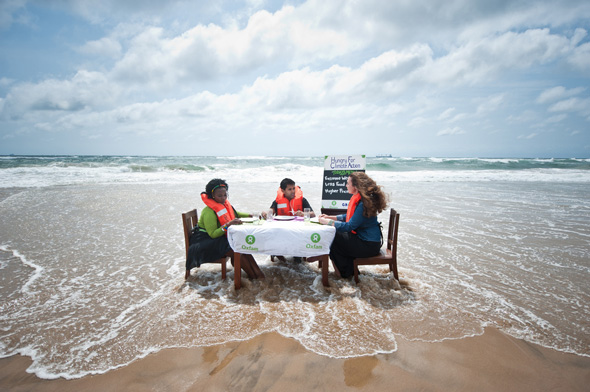
Photo Credit: “Oxfam hungry for climate action at Durban Climate Conference,” courtesy of Oxfam International and Ainhoa Goma. -
Famine and Food Insecurity in the Horn of Africa: A Man-Made Disaster?
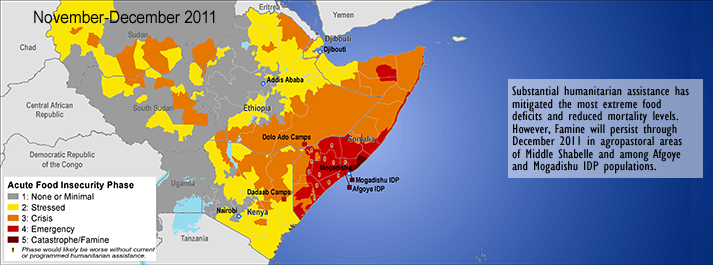
›This year’s drought in the Horn of Africa has been the region’s worst in decades and has exploded into a humanitarian catastrophe affecting millions. In Somalia, where the drought is layered on top of two decades of conflict and an extremely weak state, the impact of the drought has been most damaging. Somalia is the only country in the region where the UN has declared famine zones. And, even though the UN recently upgraded three of Somalia’s six famine areas to “lesser emergencies,” four million Somalis – more than half the country’s population – remain in urgent need of food and general humanitarian aid.
The drought may have been what sparked the current crisis, but other, longer-term factors, like a sustained lack of agricultural development, extreme rural poverty, and changing weather patterns, not to mention Somalia’s lack of functioning government, set the stage.
A Long-Term Crisis in the Making
“Lack of rainfall over several seasons is the most immediate and most visible cause of the current humanitarian crisis in the Horn of Africa,” said Jim Hansen of the Consultative Group on International Agricultural Research (CGIAR) in a brief video produced this summer by the International Research Institute for Climate and Society at Columbia University (watch above). Much of the Horn’s population “depends on rain-fed agriculture and pastoralism for their livelihoods and sustenance,” said Hansen. Already “quite poor and…locked in poverty for quite a long time,” environmental and resource degradation, paired with rapid population growth, have compounded their vulnerability to extreme events, he said.
Throughout the region, resilience to crises like the current drought has been weakened by decades of poor agricultural planning, “driven more by shifts in ideology than any real evidence among some of the key international development organizations,” said Hansen. That poor planning has made communities more dependent on humanitarian aid when poor weather hits, which in turn forces aid groups to redirect resources away from longer-term development and towards short-term disaster relief instead, Hansen said.
While these problems exist across the Horn of Africa, Hansen points out that the crisis has been most damaging in Somalia, which he attributes to the country’s weak governance and to international aid groups’ limited ability to operate in the country.
“Northern Kenya, southern Ethiopia, and Somalia have similar severity of drought, but the humanitarian crisis is much more severe – the loss of livelihood and life is greater in Somalia largely because the government is weaker,” he said.
The Government’s Role
Owen Barder, a senior fellow at the Center for Global Development, draws a more direct line between governance and famine in the Horn. “In Somalia…there’s a complete breakdown of government, and the consequence is the famine that we’re seeing,” said Barder during a Center for Global Development podcast. The country has been without a functioning government since 1991, when civil war broke out. It has since become “the most food-insecure nation in the world” and, as described by Foreign Policy, “the international community’s longest-running failure.”
Barder raised two points about the government’s role in famine. One, that access to information – in this case an early warning system monitoring drought conditions – can minimize the humanitarian impact of any given natural disaster; and two, that a country’s government must be able to translate that information into action in order for it to actually make a difference.
Barder is not alone in emphasizing the state’s role as a driver of the famine. Edward Carr, a AAAS science fellow with USAID, wrote in July, when the UN first declared famine in Somalia, that attributing the famine solely to drought is “a horrible abdication of responsibility for the human causes of this tragedy.”
Charles Kenny, also a senior fellow at the Center for Global Development, went even further on Foreign Policy, arguing that famine, or “mass starvation as an intentional act of governance,” should be categorized as a crime and prosecutable at the International Criminal Court.
Al Shabab and the Months AheadAs of late November, the United Nations estimated that tens of thousands had died in Somalia alone since drought began this spring. Though USAID’s Famine Early Warning Systems Network (FEWSNET) reports that famine has now subsided in three of the six southern regions it initially struck, a quarter of a million Somalis remain at risk of “imminent starvation,” according to the UN.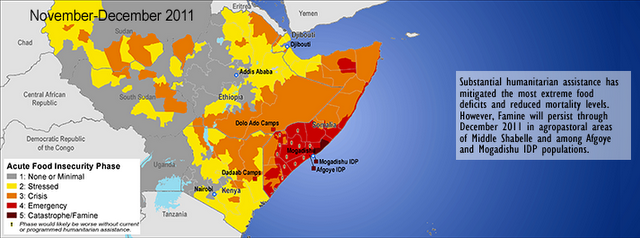
According to FEWSNET, famine should not reappear in the foreseeable future, assuming aid groups can maintain current distribution levels – a key caveat. Ten days after FEWSNET issued its analysis, however, Al Shabab, the Al Qaeda-linked militant organization that controls much of southern Somalia, banned 16 aid groups, including UNICEF and the World Health Organization, from operating in the areas under its control. UNICEF spokesman Jaya Murthy told the BBC that the move would put “about 160,000 severely malnourished children…at imminent risk of death.”
Fighting in southern Somalia between Al Shabab and Kenyan and Ethiopian forces is adding another layer to the country’s humanitarian crisis. The UN Office of the High Commissioner for Refugees reported that, as of late November, the fighting had become the primary driver of internal displacement, replacing drought and famine as the key drivers during the first three quarters of the year. The UNHCR estimated that, between the drought and the conflict, 1.46 million Somalis have been displaced.
Meanwhile, the rainy season is picking up, and although that’s good news for farmers and pastoralists, it also means that Somalis will be vulnerable to diseases like measles, typhoid, and cholera, which can spread quickly through overcrowded, under-supplied IDP camps. Somalis still living under Al Shabab’s control are prohibited from getting vaccinations, amplifying their vulnerability to disease in the coming months.
These latest developments offer strong evidence that policy decisions can exacerbate the human toll of natural disasters. From Barder’s perspective, that is reason for optimism. “We have the information, we have the capacity to prevent it from happening,” he said.
For more on Somalia’s underlying demographic issues, see Elizabeth Leahy Madsen’s post “In Somalia, Beyond the Immediate Crises, Demography Reveals a Long-Term Challenge.”
Sources: AlertNet, Associated Press, BBC, Famine Early Warning Systems Network, Foreign Policy, Huffington Post, The New York Times, UNHCR, UN News Centre, Voice of America.
Video Credit: “Jim Hansen on Food Security in East Africa,” courtesy of the International Research Institute for Climate and Society on vimeo; image credit: FEWSNET/USAID. -
Can “Climate-Smart Agriculture” Help Feed Africa’s Growing Population?
›December 13, 2011 // By Brenda ZuluFood production needs to increase 70 percent by 2050 to meet the demands of a growing world population, said former UN Secretary-General Kofi Annan in a keynote address on “climate-smart agriculture” at a COP-17 event hosted by the World Bank and African Union. Annan, who is now chairman of the Alliance for a Green Revolution in Africa (AGRA), said this was a particular concern in Africa, where four out of five citizens are dependent on agriculture for their livelihoods.
One in seven people in the world do not have enough food to eat, Annan said, and climate change is expected to make this challenge more difficult to overcome. Climate-smart agriculture includes a wide variety of techniques that help increase the resilience of communities and protect them from extreme weather events, such as terracing to prevent soil erosion, improving weather forecasting, managing water runoff, and developing irrigation systems.
“Climate change affects us by undermining our resource base through water and soil degradation,” said Prime Minister of Ethiopia Meles Zenawi at the event. “There is need to protect the resources and to rehabilitate green areas of our land.” He said that since 70 percent of Africans are small-scale farmers and that most of the poor in Africa were farmers, there is no better way to fight poverty on the continent than through agriculture.
South African President Jacob Zuma said at the event that given that the UN projects a population of more than nine billion people in the world by 2050, agriculture should be a priority as it is more vulnerable to climate change than any other sector.
“Climate-smart agriculture includes proven practical techniques such as mulching, intercropping, conservation agriculture, integrated crop management and agro forestry, improved grazing, and innovative better weather management,” he said, all of which have the potential to help increase crop yields.
Mary Robinson, chair of the Global Leaders Council for Reproductive Health, said there could be no smart agriculture without integrating women’s issues, because climate change affects women disproportionately. “Women make the connection between climate-smart agriculture, food security, and gender,” she said.
“Our ability to feed the growing population under climate variability and change will require new expertise and harmonized efforts,” said Robinson.
Annan agreed, saying African women should be fully involved in early action that can support technical assistance, such as screening agriculture plans to ensure they are “climate smart” as well as integrating climate resilience and mitigation into ongoing poverty-reduction programs and testing new approaches.
But according to Brylyne Chitsunge, a farmer from Pretoria speaking on the panel, things will need to change considerably from the status quo. “The small-scale farmer remains very much marginalized in institutions,” she said. “They exist on paper but they really don’t exist.”
Brenda Zulu is a member of Women’s Edition for Population Reference Bureau and a freelance writer based in Zambia. Her reporting from the COP-17 meeting in Durban (see the “From Durban” series on New Security Beat) is part of a joint effort by the Aspen Institute, Population Action International, and the Wilson Center.
Sources: World Bank, World Food Programme.
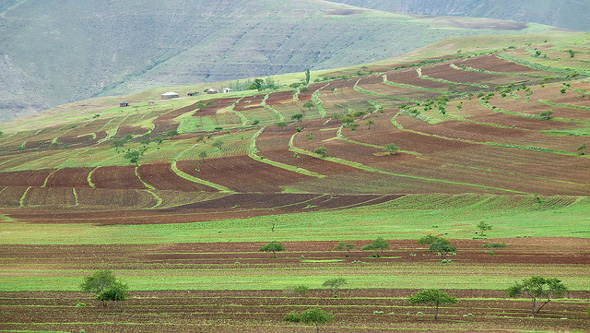
Photo Credit: “Cultivated hillsides,” courtesy of flickr user coda (Damien du Toit). -
New UNEP Climate Report Says Women Face “Disproportionately High Risks”
›December 8, 2011 // By Brenda ZuluA new United Nations Environment Programme (UNEP) report, Women at the Frontline of Climate Change: Gender Risks and Hopes, released at COP-17, says that women, particularly those living in mountainous regions in developing countries, “face disproportionately high risks to their livelihoods and health from climate change, as well as associated risks such as human trafficking.”
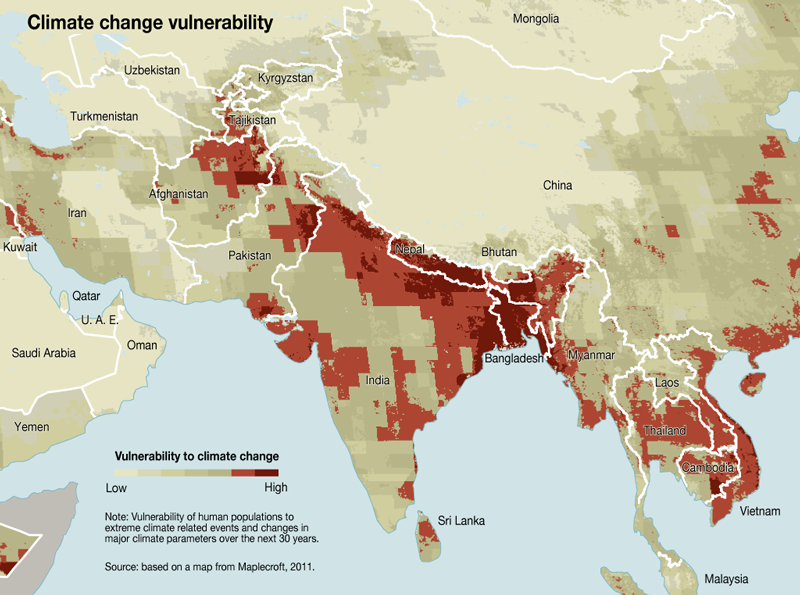
Droughts, floods, and mudslides are affecting a growing number of people worldwide, in part because of climate change, but also because population growth is highest in some of the most vulnerable areas of the world. For example, in the 10 years from 1998-2008, floods affected one billion people in Asia, but only four million people in Europe.
According to UNEP, women often bear the brunt of such disasters: “In parts of Asia and Africa, where the majority of the agricultural workforce are female, the impacts of such disasters have a major impact on women’s income, food security, and health,” as they are responsible for about 65 percent of household food production in Asia and 75 percent in Africa. In addition, they are often more likely than men to lose their lives during natural disasters.
UNEP Executive Director Achim Steiner said in a press release that “women often play a stronger role than men in the management of ecosystem services and food security. Hence, sustainable adaptation must focus on gender and the role of women if it is to become successful.”
“Women’s voices, responsibilities, and knowledge on the environment and the challenges they face will need to be made a central part of governments’ adaptive responses to a rapidly changing climate,” he added.
Investing in low-carbon, resource-efficient green technologies, water harvesting, and alternatives to firewood could strengthen climate change adaptation and improve women’s livelihoods, says UNEP.
“If Insufficient, Family Planning Funds Should Be Scaled Up”
UNEP spokesperson Nick Nuttall said in an interview that there are wide differences between how people consume natural resources, with North Americans and Europeans consuming far more than someone in a developing country. We should move toward more efficient use of natural resources, make the transition to a low-carbon economy, and scale up renewable energies, which can reduce demand for fossil fuels to meet economic growth and population increases, he said.
Asked whether climate change funds should therefore support family planning, Nuttall said the UN supports the right of couples and women to choose the size of their families and that many UN agencies and NGOs provide that support already.
But, he said, “there are funds available for family planning and, if insufficient, they should be scaled up to meet the demands and requests of developing countries. Given that this is an issue far wider than climate change, these existing funding streams should be where the financial support comes, rather than from a climate fund.”
Brenda Zulu is a member of Women’s Edition for Population Reference Bureau and a freelance writer based in Zambia. Her reporting from the COP-17 meeting in Durban (see the “From Durban” series on New Security Beat) is part of a joint effort by the Aspen Institute, Population Action International, and the Wilson Center.
Sources: UNEP.
Image Credit: “Climate change vulnerability,” courtesy of Riccardo Pravettoni, UNEP/GRID-Arendal. -
The Yasuní-ITT Initiative Is a Practical Climate Solution That Must Be Embraced at Durban
›As the world turns to Durban, South Africa, for this year’s UN climate summit, new findings are turning up the heat on the urgency to address climate change. The reality though is that we no longer have the luxury of resting our hopes solely on an internationally binding climate agreement; we must begin to look more closely at supporting immediate and tangible solutions. By complementing a global top-down effort of continued international negotiations with bottom-up approaches, we increase our chances at mitigating the most damaging effects of climate change. One of the most innovative models of such a bottom-up approach is the Yasuní-ITT Initiative being undertaken by the Government of Ecuador and supported by the UN Development Programme’s Multi-Partner Trust Fund Office (MPTF Office).
-
UNiTE To End Violence Against Women
›November 25, 2011 // By Schuyler NullToday is the International Day to End Violence Against Women, an awareness and advocacy campaign organized by a host of UN agencies and offices “to galvanize action across the UN system to prevent and punish violence against women.”
Gender equity and inequity play a role in a myriad of international development, health, security, and even environmental issues, from rape as a weapon of war; demography’s effects on political stability; maternal health and its impact on child development; women’s rights as a social stability issue; and the disproportionate effect of climate change on rural women.
The numbers around gender-based violence are staggering. According to the UN:
Here are some of New Security Beat’s posts on gender-based violence and inequity and their intersection with development, the environment, and security:- 70 percent of women experience physical or sexual violence from men in their lifetime.
- Approximately 250,000 to 500,000 women and girls were raped in the 1994 Rwandan genocide, and in the eastern Democratic Republic of Congo (DRC), at least 200,000 cases of sexual violence, mostly involving women and girls, have been documented since 1996, though the actual numbers are considered to be much higher.
- In the United States, one-third of women murdered each year are killed by intimate partners; in South Africa, a woman is killed every six hours by an intimate partner; in India, 22 women were killed each day in dowry-related murders in 2007; and in Guatemala, two women are murdered, on average, each day.
- Over 60 million girls worldwide are child brides, married before the age of 18, primarily in South Asia (31.1 million) and sub-Saharan Africa (14.1 million).
Gender-Based Violence in the DRC: Research Findings and Programmatic Implications:
Dr. Lynn Lawry, senior health stability and humanitarian assistance specialist at the U.S. Department of Defense, presented findings from the first cross-sectional, randomized cluster study on gender-based violence in the DRC at the Wilson Center this year. The first of its kind in the region, the population-based, quantitative study covered three districts in the DRC and a total of 5.2 million adults, comprehensively assessing gender-based violence, including its prevalence, circumstances, perpetrators, and physical and mental health impacts.
Pop Audio: Judith Bruce on Empowering Adolescent Girls in Post-Earthquake Haiti: “The most striking thing about post-conflict and post-disaster environments is that what lurks there is also this extraordinary opportunity,” said Judith Bruce, a senior associate and policy analyst with the Population Council. Bruce spent time last year working with the Haiti Adolescent Girls Network, a coalition of humanitarian groups conducting workshops focused on the educational, health, and security needs of the country’s vulnerable female youth population.
The Walk to Water in Conflict-Affected Areas: Constituting a majority of the world’s poor and at the same time bearing responsibility for half the world’s food production and most family health and nutrition needs, women and girls regularly bear the burden of procuring water for multiple household and agricultural uses. When water is not readily accessible, they become a highly vulnerable group. Where access to water is limited, the walk to water is too often accompanied by the threat of attack and violence.
Weathering Change: New Film Links Climate Adaptation and Family Planning: “Our planet is changing. Our population is growing. Each one of us is impacting the environment…but not equally. Each one of us will be affected…but not equally,” asserts the new documentary, Weathering Change, launched at the Wilson Center in September. The film, produced by Population Action International, explores the devastating impacts of climate change on the lives of women in developing countries through personal stories from Ethiopia, Nepal, and Peru.
Sajeda Amin on Population Growth, Urbanization, and Gender Rights in Bangladesh:
The Population Council’s Sajeda Amin describes the Growing Up Safe and Healthy (SAFE) project, launched in Dhaka and other Bangladeshi cities last. The initiative aims, to increase access to reproductive healthcare services for adolescent girls and young women, bolstering social services to protect those populations from (and offer treatment for) gender-based violence, and strengthen laws designed to reduce the prevalence of child marriage – a long-standing Bangladeshi institution that keeps population growth rates high while denying many young women the opportunity to pursue economic and educational advancement.
No Peace Without Women: On October 31, 2000, the UN Security Council adopted Resolution 1325, which called for women’s equal participation in all efforts to maintain and promote peace and security; however, little progress has been made over these last 10 years and women remain on the periphery when it comes to post-conflict reconstruction and development. A report from the humanitarian organization CARE concedes that “much of the action remains declarative rather than operational.”
Addressing Gender-Based Violence to Curb HIV: At last year’s International AIDS Conference in Vienna an astonishing development in the campaign to stem the spread of HIV/AIDS was unveiled – a microbicide with the ability to reduce the risk of transmission of HIV. This welcome development coincides with an intensified focus on women’s health and security needs among donors, especially the United States.
The Future of Women in the MENA Region: A Tunisian and Egyptian Perspective: Lilia Labidi, minister of women’s affairs for the Republic of Tunisia and former Wilson Center fellow, joined Moushira Khattab, former minister of family and population for Egypt, this summer at the Wilson Center to discuss the role and expectations of women in the Egyptian and Tunisian revolutions, as well as issues to consider as these two countries move forward.
Sources: UN Secretary-General’s Office. -
Watch: Geoff Dabelko on Climate Adaptation and Peacebuilding at SXSW
›November 16, 2011 // By Wilson Center StaffThe problems of climate adaptation, poverty alleviation, and peacebuilding are common to many parts of the world. Yet the efforts to address them are often pursued separately or with little coordination. Capturing the co-benefits of building institutional capacity critical to all three areas is an idea that will likely receive little attention at next year’s Rio+20 Earth Summit in Brazil, says ECSP Director Geoff Dabelko.
-
How Did We Arrive at 7 Billion – and Where Do We Go From Here? [Part One]
›October 26, 2011 // By Elizabeth Leahy MadsenThe United Nations Population Division has estimated world population will reach seven billion on Monday. Which changes in demographic trends led us to this milestone? What do the past and present tell us about how human numbers will change in the future?
The “Day of Seven Billion” was announced this spring following the release of the latest revision of UN population projections. Although the seven billionth person will not be precisely identified, this estimate is based on careful demographic modeling. Every two years, the UN revises its projections to incorporate the latest trend data and modify its assumptions, as seemingly small changes can make a huge difference demographically.The UN estimates that the seven billionth person alive today will be born on October 31. Demographer Elizabeth Leahy Madsen explains how we got to that number, its significance, and where our demographic path might take us from here. Read part two here.
The United Nations Population Division has estimated world population will reach seven billion on Monday. Which changes in demographic trends led us to this milestone? What do the past and present tell us about how human numbers will change in the future?
The “Day of Seven Billion” was announced this spring following the release of the latest revision of UN population projections. Although the seven billionth person will not be precisely identified, this estimate is based on careful demographic modeling. Every two years, the UN revises its projections to incorporate the latest trend data and modify its assumptions, as seemingly small changes can make a huge difference demographically.
Demography Is Driven by Fertility and Population Momentum
Since world population reached three billion in 1959, the rate of growth has increased, peaked, and begun to slow. Each succeeding milestone was reached more quickly than the last: It took 15 years to reach four billion, 13 years to hit five billion, and only 11 years to get to six billion at the end of 1998. The interval leading to seven billion was slightly longer, at 13 years, as the global rate of population growth has slowed.
Although mortality and migration also affect population trends, the factor with the greatest influence by far is fertility – the average number of children born to each woman. The decline in the global fertility rate from an average of nearly 5 children per woman in the early 1960s to 2.5 children today has in turn slowed the pace of world population growth. However, demographic momentum from previous generations of high fertility can drive population growth for decades to come. Even if Nigeria reached replacement-level fertility today, its population would still grow by one-third by 2050 as the number of births continued to exceed the number of deaths.
Assumptions Matter
Population projections consider: 1) current data about fertility and 2) assumptions about the ways fertility will change in the future. These assumptions vary depending on the source, so how much of a difference do they make? As it turns out, quite a lot.
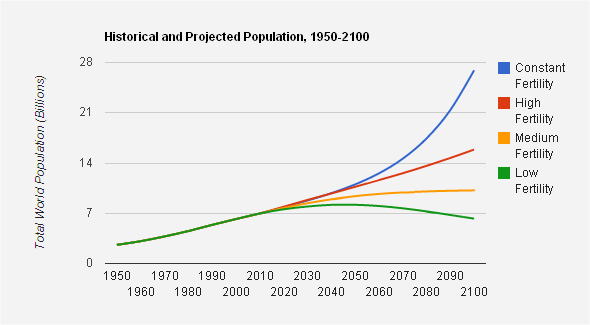
Projections of world population in 2050 range from 8.1 billion (if fertility rates fall to a global average of 1.7 children per woman) to 10.9 billion (if they remain unchanged). The gap of nearly three billion between those possibilities is greater than the combined populations of China and India today.
Estimates vary even more widely for the end of the century, with the UN projecting that by 2100 world population could total anywhere between 6 billion (if total fertility falls to an average of 1.55 children per woman) and 27 billion (if every country’s fertility rates remain constant at today’s levels).
While demographers parse the details of the projections, policymakers would like to know which of these scenarios is more likely. After all, the economic, environmental, and political consequences of a population of 8 or 11 billion two generations hence are not the same, and a world of 27 billion is difficult for anyone to fathom.
If we simply projected past trends into the future at a steady rate, the population estimates on the low end of the fertility spectrum seem more likely. The global fertility rate has fallen from 4.5 children per woman in the early 1970s to 2.5 today, a decline of 43 percent, so the 14 percent decline projected in the medium-fertility variant between now and 2050 seems reasonable at first glance, perhaps even conservative. The medium-fertility variant assumes that all countries’ fertility rates will begin moving towards replacement level, around 2.1 children per woman, regardless of whether they are currently above or below that number.
However, even a 14 percent decline in fertility assumes that areas where fertility rates remain stalled at high levels will soon begin rapid declines, paralleling the past experience of other regions. As Population Reference Bureau demographer Carl Haub writes, “the assumption that the developing world will necessarily follow the path of the industrialized world…is far from a sure bet.”
In the last 40 years, fertility rates in the Caribbean, northern and southern Africa, Latin America, and all of Asia declined by 50 percent or more. The pace of decline in sub-Saharan Africa, while still notable, was much slower, at 23 percent. In order to meet the UN medium-variant projections, the region’s fertility rate would need to fall by nearly 40 percent by mid-century.
Some of the largest, fastest-growing populations in the developing world would need to experience a major acceleration from recent trends. In Nigeria, fertility edged down by 15 percent between 1970 and 2010, but the medium variant projection depends on a decline of 37 percent over the next four decades; Ethiopia’s fertility rate will need to fall by half.
Gender Matters, Too
The great irony of fertility trends is that gender inequities play an important role at both ends of the scale. In countries with the highest fertility rates, women tend to have less education than men and less autonomy. Their fertility choices may be greatly affected by the preferences of their husbands or other family members. In Niger, which has the highest fertility rate in the world, married men would, on average, like three more children than married women. In Uganda, where women average more than six children each, 60 percent of men report that domestic violence is justified.
By contrast, in countries with the lowest fertility rates, women have achieved equal access to education and the labor market, with more autonomy about how to earn income and what to do with it. Yet cultural expectations that place the burden for child and elder care and housework almost entirely on women can make marriage an unappealing option. In Japan, which is among the 10 lowest fertility countries in the world, more women are choosing to stay single: The marriage rate has fallen by almost half since the 1970s. Japanese women who do marry are waiting until their late 20s and tend not to give birth until they are 30, both of which result in lower average family size.
Even at this end of the demographic spectrum, the assumptions embedded within population projections seem optimistic. Japan’s fertility rate was last above replacement level in the early 1970s; it has fallen steadily to 1.3 children per woman today. The UN projections assume that fertility will immediately reverse track and begin rising to over 1.8 children per woman in 2050, rebounding above two children per woman before the end of the century.
The stalled high fertility rates in much of sub-Saharan Africa and parts of the Middle East, together with unprecedented low fertility in Eastern Europe and parts of East Asia, indicate that we are currently in an era of remarkable demographic diversity, despite the UN’s projection of future convergence.
Continue reading part two here.
Elizabeth Leahy Madsen is a consultant on political demography for the Wilson Center’s Environmental Change and Security Program and former senior research associate at Population Action International.
Sources: Boling (2008), Haub (2011), Japan Statistics Bureau, Measure DHS, UN Population Division, UN Population Fund, Washington Post.
Image Credit: Chart data from UN Population Division, arranged by Elizabeth Leahy Madsen.
Showing posts from category UN.