

Showing posts from category zz Organizations.
-
Projecting Population: A Risky Business
›May 6, 2009 // By Sean Peoples Assumptions about human behavior drive our knowledge of future global population trends. Demographers analyze population and other survey data in order to forecast trends, but uncertainty colors these projections.
In the 2008 Revision of World Population Prospects, the UN Population Division projects that our planet will grow to 9.15 billion people by 2050. Yet this medium-variant projection is just one of several possible scenarios released in this latest round of number crunching. The low- and high-variant projections—7.96 billion and 10.5 billion, respectively—could instead become reality, given slight shifts in fertility rates in developing countries, where growth rates remain higher than in more developed nations. Although both developing and developed nations are susceptible to shifts in fertility rates, uncertainties are greater in the developing world due to factors such as inconsistent data collection, weak health system infrastructure, and low government capacity.
Elizabeth Leahy and I investigate the underlying assumptions behind population projections in an article in the May/June edition of World Watch magazine. By comparing three of the leading population-forecasting institutions, we find that small variations in assumptions can lead to significant differences in projections.
Uganda’s demographic outlook is a prime example. Between 1960 and 2005, Uganda’s population grew by 22 million people, while the country’s fertility rate fell by less than 3 percent. The UN medium-variant population projection assumes the country will buck precedent and experience a 61 percent fertility rate decline between 2005 and 2050, resulting in a population of 91 million people. The U.S. Census Bureau, on the other hand, assumes a less drastic fertility decline and projects a population of 128 million people by 2050. The International Institute for Applied Systems Analysis (IIASA), an Austrian institution that projects population on a regional basis, recently revised its population projections to reflect greater growth in sub-Saharan Africa due to stalling fertility decline and stagnant educational-attainment rates.
Fertility rates rarely decline when governments have not made the proper investments in health and education. The UN medium-variant projection is commonly cited as an inevitable scenario; few people know that one of its underlying assumptions is that access to modern contraception will continue to expand. Without real-world development investments to match these assumptions, a very different scenario could easily materialize. By empowering women, bolstering access to education, and providing comprehensive family-planning services to citizens, governments and policymakers can translate these assumptions into reality.
-
Former USAID Population Directors Argue for Major Boost in Family Planning Funding
›April 7, 2009 // By Gib Clarke“We know how to do family planning, we know what it costs, and we know that it works,” said Joseph Speidel of the University of California, San Francisco, at the launch event for Making the Case for U.S. International Family Planning Assistance sponsored by the Wilson Center’s Environmental Change and Security Program on March 17, 2009. The key missing element, he said, is political will.
Speidel and his co-authors—all former directors of the U.S. Agency for International Development’s (USAID) Office of Population and Reproductive Health—argued that Congress should more than double spending on international family planning in the coming years for health, economic, and environmental reasons.
The Big Ask
Making the Case recommends that the USAID population budget be increased from $457 million in FY2008 to $1.2 billion in FY2010, growing further to $1.5 billion in FY2014. According to the speakers, this increase is necessary to:- Meet the “enormous pent-up and growing unmet need for family planning”;
- Stabilize population growth rates, especially in Africa; and
- Achieve the Millennium Development Goal of universal access to reproductive health services.
Duff Gillespie of the Johns Hopkins Bloomberg School of Public Health showed that U.S. funding for family planning has been stagnant in real dollars since the late 1960s, despite the fact that there are 200 million women with an unmet need for family planning. Without champions within USAID and the Obama administration, he said, the dollar amounts appropriated for family planning are unlikely to increase.
Speidel explained that growing populations, combined with stable or increasing rates of consumption, contribute to climate change. The current rate of population growth is unsustainable, given Earth’s finite natural resources. Changes in behavior and technology—such as eating less meat or using clean energy—could improve environmental outcomes.
Absolute numbers still matter, however: Although population growth rates have declined, the global population continues to grow. Addressing the nearly one-half of all pregnancies that are unplanned would bring great health and environmental benefits, said Speidel.According to Steven Sinding of the Guttmacher Institute, although most economists and demographers agree that economic growth leads to lower fertility, whether lower fertility reduces poverty is still a matter of much debate. But the “demographic dividend” generated by slowing population growth is a reality, he argued, and countries can benefit from it if their institutions are prepared to take advantage of it. For example, a USAID study found that one dollar invested in family planning in Zambia saved four dollars in other development areas.
A Broader Base of SupportRuth Levine of the Center for Global Development urged the authors to avoid “preaching to the choir.” One way to engage other constituencies interested in demographic issues is to broaden the scope of “population” to include not only family planning, but also migration, urbanization, and other key demographic issues.
In addition, convincing World Bank economists, especially the Bank’s next president, of the connections between declining fertility and poverty reduction should be a priority, said Levine, because developing countries put a lot of stock in the Bank’s advice.
By Gib Clarke
Edited by Rachel Weisshaar
Photos: From top to bottom, Joseph Speidel, Duff Gillespie, Steven Sinding, and Ruth Levine. Courtesy of Dave Hawxhurst and the Wilson Center.

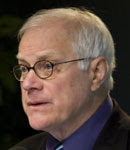 Duff Gillespie of the Johns Hopkins Bloomberg School of Public Health showed that U.S. funding for family planning has been stagnant in real dollars since the late 1960s, despite the fact that there are 200 million women with an unmet need for family planning. Without champions within USAID and the Obama administration, he said, the dollar amounts appropriated for family planning are unlikely to increase.
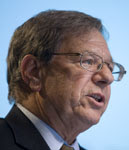 According to Steven Sinding of the Guttmacher Institute, although most economists and demographers agree that economic growth leads to lower fertility,
 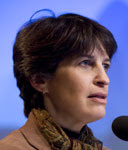 Ruth Levine of the Center for Global Development urged the authors to avoid “preaching to the choir.” One way to engage other constituencies interested in demographic issues is to broaden the scope of “population” to include not only family planning, but also

