

Showing posts from category zz Organizations.
-
Alex Evans, Global Dashboard
Is it Time for Sustainable Development Goals?
›September 8, 2011 // By Wilson Center StaffThe original version of this article, by Alex Evans, appeared on Global Dashboard.
From MDGs to…SDGs? That’s one of the ideas swirling around in discussions ahead of the Rio 2012 sustainable development summit next year, anyway.
You can see the attraction. With less than a year to go, there are precious few concrete ideas on the table for what the summit might produce, especially in the area of “institutional framework for sustainable development,” one of two key themes for the event (sure, there’s much talk of a new World Environment Organization, but color me very unconvinced of the case for that). So might SDGs help to fill the gap?
Well, that would depend on what they cover. The government of Colombia has set out a proposal for SDGs that would cover various sectors – atmosphere, climate resilience, land degradation, sustainable agriculture, biotech, waste and so forth. This would mainly be about ‘reaffirming’ (that awful word – who, other than diplomats, ever ‘reaffirms’ anything?) commitments made at Rio 1992. But you have to wonder: important though delivery of existing commitments undoubtedly is, is ‘reaffirmation’ of stuff agreed 20 years ago really going to set any pulses racing outside the sustainable development priesthood?
Continue reading on Global Dashboard.
Sources: UN.
Image Credit: Adapted from UNSCD 2012 official logo. -
‘Dialogue’ TV: Revisiting Mr. Y and “A National Strategic Narrative”
›“We are, what I would call, very non-linear thinkers,” said U.S. Navy Captain Wayne Porter about the white paper he co-authored with U.S. Marine Colonel Mark Mykelby, “A National Security Narrative,” launched by Woodrow Wilson Center President Jane Harman at the Center in April. “We’re almost incapable of restricting ourselves to defense and security in isolation from a much larger perspective,” he told Dialogue TV.
“I think maybe that’s why Admiral Mullen has kept me around – I can offer a perspective that maybe he wouldn’t get from conventional strategists or from conventional planners,” said Porter, who served three out of four tours with the current chairman of the Joint Chiefs of Staff as a special assistant for strategy.
Dialogue host John Milewski sat down with Captain Porter and Robert Litwak, director of International Security Studies and vice president for programs at the Wilson Center, for a discussion about the white paper – published under the pseudonym “Mr. Y” (echoing George Kennan’s seminal “X” article) – and its contention that the United States should move away from an outmoded Cold War-era model of containment, deterrence, and control towards a “strategy of sustainability.”
The narrative has been well received, Porter said: “I think there is an appreciation that it’s a very complex strategic environment that we live in now and that maybe we need to re-look at all of the tools that we could use as a nation to pursue our enduring national interest.”
Inflection Points in History
“The timing of such conversations is cyclical,” said Litwak. “The original ‘X’ article emerged from the end of the Second World War and the advent of the Soviet threat, which required a new conception of international relations that Kennan articulated, as well as the National Security Act of 1947 to line up the U.S. government with this new environment.”
There have also been periods of concern about American decline. “I think what one sees in the current era are both of those trends coming together,” Litwak said:The system is changing – it’s a debatable proposition that the United States is in decline – but we see in the international system rising powers, notably China, as well as transnational trends that are beyond the sovereign control of any single state, which have called into question the nature of the international system…as well as a sense that…there’s something qualitatively different about this recession than the typical economic, cyclical recession and that has to do with the domestic sources of American strength.
These conditions, as well as the source of argument – coming from the military – combined to give particular resonance to the piece, Litwak said.
The Information/Globalization Age
“I think the thing that has changed materially to us is that the information age has brought about an awareness that our environment is completely interconnected,” Porter said. “There’s a complexity to this that can’t be analyzed linearly, that has to have new tools applied.”
“I’d honestly characterize it as significant as the Enlightenment in the 1600s,” he said.
“Certainly we’ve thought in silos and debates have been too often compartmentalized,” Litwak said. “One of the strengths of this piece is that it is truly synthetic – working across the continuum of instruments of power – and talks in a really powerful way about how hard power…has its place, but that the non-military dimensions of American power have been neglected.”
But, Porter said, it’s important to focus on being proactive, rather than reactive:The thing that bothered us most about the strategies that we see every day in our jobs on our side of the river and across the river is that they are almost universally based on anticipating and countering known risk and threat, and our sense is that we have entered an age in which we need to overcome that sense of fear and seize the opportunity to shape the environment of the future as opposed to simply being resilient to it.
As Litwak points out, Secretaries Gates (now former) and Clinton – in the form of the Quadrennial Defense Review, Quadrennial Diplomacy and Development Review, and numerous speaking engagements – have both called for closer integration between State and Defense, more resources for non-military levers of power, and more holistic concepts of security. But unfortunately the greater integration called for in these documents remains unrealized.
Dialogue is an award-winning co-production of the Woodrow Wilson International Center for Scholars and MHz Networks that explores the world of ideas through conversations with renowned public figures, scholars, journalists, and authors. The show is also available throughout the United States on MHz Networks, via broadcast and cable affiliates, as well as via DirecTV and WorldTV (G19) satellite.
Find out where to watch Dialogue where you live via MHz Networks. You can send questions or comments on the program to dialogue@wilsoncenter.org. -
What’s in a Name? Watch Don Lauro on PHE, HELP, and HELPS
›Population, health, and environment (PHE) expert Don Lauro has worked on integrated projects for decades as a scholar, an implementer, a donor, and an evaluator. He recently visited the USAID-funded BALANCED Project in Tanzania as part of a wider look at this integrated approach. In an interview with ECSP, Lauro said the effort “made me think more broadly…about this area that we call population, health, and environment and what’s really in a name like that.”
“We commonly say PHE, and we all know what we’re talking about,” Lauro said of the population and development community, “but when you look deeply into these projects – or even not so deeply – you see that there’s other things going on as well.”
For example, Lauro pointed to the focus on livelihoods that many PHE programs have: “In the project I saw in Tanzania, there were many microcredit groups on the ground – mostly women – taking small loans for developing little enterprises that they had, like baking bread, raising bees, buying a cow…little enterprises to make their lives a little bit better.”
“Some people don’t use the term ‘PHE’…maybe it’s a ‘HELP’ project; that is health, environment, livelihoods, and population,” Lauro said. “Other people would say it’s maybe something even longer, ‘HELPS’ – health environment, livelihoods, population, and sustainability (or ‘security’ – Ed.).” When he was at the Wilson Center, Gib Clarke coined the “HELP” term in ECSP’s FOCUS Issue 20, arguing that livelihoods is such a critical component that it ought to be more formally recognized.
But, said Lauro, “on the ground they don’t use these terms – they say things like, ‘this is a healthy community program’ or ‘this is a green community program.’”
“I think it’s very important for us to realize what happens on the ground is lot different, and maybe more real, than how we talk about it.” -
Youth Bulge and Societal Conflicts: Have Peacekeepers Made a Difference?
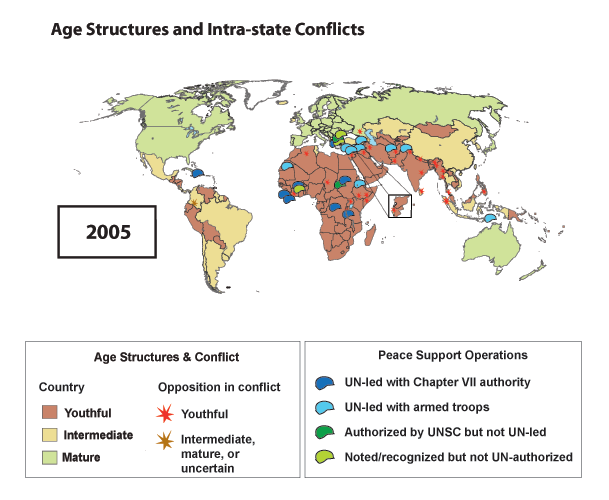
›August 22, 2011 // By Richard CincottaUntil recently, the question of which countries are at the most risk of violent societal conflict could be answered with a terse, two-part response: “the young and the war-torn.” This simple characterization regarding youth and conflict worked well, until the first decade of the 21st century. The proportion of youthful countries experiencing one or more violent intrastate conflicts declined from 25 percent in 1995 to 15 percent in 2005. What’s behind this encouraging slump in political unrest? One hypothesis is that peace support operations (PSOs) – peacekeepers, police units, and specialized observers that are led, authorized, or endorsed by the United Nations – have made a difference.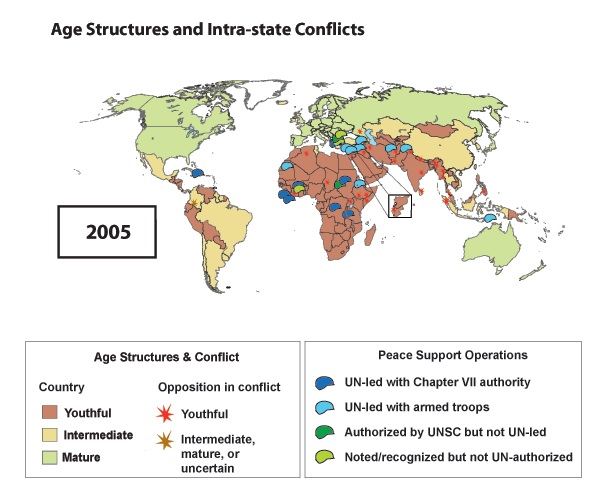
From the 1970s through the 1990s, more than 90 percent of all societal conflicts broke out in countries with a youthful age structure – a population with a median age of 25 years or less. And wherever civil and ethnic wars emerged, they tended to persist. The average societal conflict that began between 1970 and 1999 continued without a one-year break in battle-associated fatalities for about six years. Some – including the Angolan civil war, Northern Ireland’s “Troubles,” Peru’s war against the Shining Path, and the Afghan civil war – endured for decades. In contrast, inter-state conflicts that began between 1970 and 1999 lasted, on average, less than two years (see the UCDP/PRIO Conflict Database).
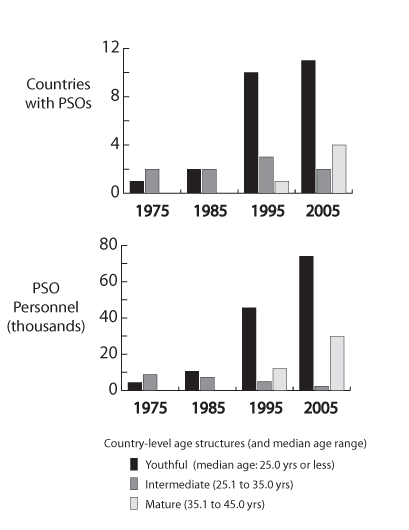
Taking on Intra-State ConflictsBeginning in the early 1990s, however, there was a marked expansion in size and number of PSOs deployed in the aftermath of societal warfare, which appears to have dampened the persistence of some conflicts and prevented the reemergence of others. The annual number of active PSOs deterring the re-emergence of societal conflict jumped from just 2 missions during 1985 to 22 in 2005. In contrast, those led, authorized, or endorsed by the UN to maintain cease-fire agreements between neighboring states during that same period only increased from three active missions to four. By 2009, nearly 100,000 peacekeepers were stationed in countries that had recently experienced a societal conflict. About 70 percent were deployed in countries with a youthful population (see Figures 2A and B). Why the sudden expansion in use of PSOs?
According to William Durch and Tobias Berkman, this upsurge was less a change of heart or modification of a global security strategy and more an outcome of the unraveling web of Cold War international relations. Before the 1990s, the majority of PSOs were United Nations-led operations that were mandated to monitor or help maintain cease-fires along mutual frontiers. Because insurgents were typically aligned with either the Soviets or a Western power, Security Council authorization to mediate a societal conflict was difficult to secure.
This situation changed with the breakup of the Soviet Union and the initiation of PSOs by regional organizations, including operations by the Economic Community of West African States (ECOWAS) in Liberia and Sierra Leone and the NATO-led Kosovo Force in 1998-99.
Demographic Forecasting
What do national demographic trends suggest for the demand for PSOs over the next two decades? For societal conflict, political demographers foresee that the demand for PSOs will continue to decline among states in Latin America and the Caribbean – with the exception of sustained risk in Guatemala, Haiti, Bolivia, and Paraguay. Similarly, demand for peacekeeping is expected to continue to ebb across continental East Asia.
Gauged by age structure alone, the risk of societal warfare is projected to remain high over the coming two decades in the western, central, and eastern portions of sub-Saharan Africa; in parts of the Middle East and South Asia; and in several Asian-Pacific island hotspots – Timor-Leste, Papua New Guinea, the Philippines, and Solomon Islands. But even in some countries that are losing their youthful blush, domestic political relations could turn out less rosy than this simple age-structural model forecasts.
In other words, there are roadblocks to a “demographic peace.” Among them is an increasing propensity for a specific demographic configuration of ethnic conflict: warfare between state forces and organizations that recruit from a minority that is more youthful than the majority ethnic group. Examples of these conflicts include the Kurds in Turkey, the Shiites in Lebanon, the Pattani Muslims in southern Thailand, and the Chechens of southern Russia.
However, this twist on the youth bulge model of the risks of societal conflict is a discussion for another installment on New Security Beat. Suffice it to say that when political demographers look over the UN Population Division’s current demographic projections, they see few signs of either the waning of societal warfare, or the withering of the current level of demand for PSOs.
Richard Cincotta is a consultant on political demography for the Wilson Center’s Environmental Change and Security Program and demographer-in-residence at The Stimson Center.
Sources: PRIO, The Stimson Center, UN Population Division.
Chart Credit: Data courtesy of the UN Population Division 2011, PRIO, and Durch and Berkman (2006). Arranged by Richard Cincotta. -
Zo Zatovonirina, PHE Champion
Improving Human Health and Conservation in Madagascar’s Forest Communities
›This PHE Champion profile was produced by the BALANCED Project.
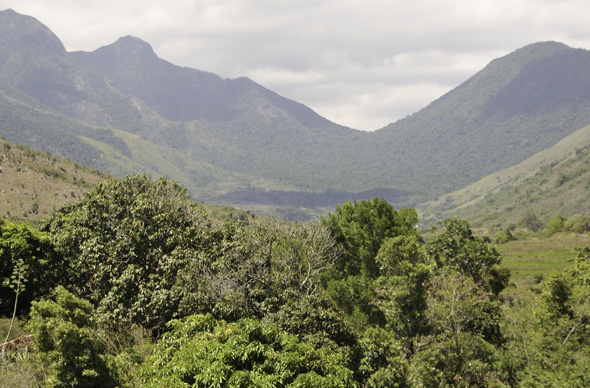
Madagascar is one of the world’s most unique ecosystems, with a total of eight plant families, five bird families, and five primate families that live nowhere else on Earth. Madagascar’s tropical forests and marine environments are home to endemic species of flora and fauna, although tragically 15 species are now extinct. At the same time, Madagascar is rich in freshwater resources, yet more than 60 percent of the island’s 19.7 million people do not have access to safe drinking water.Since 2003, Zo Zatovonirina has worked for Conservation International (CI) in Madagascar, and he has seen up-close the challenges of reaching remote forest communities, often requiring one- or two-day hikes over treacherous roads. As coordinator for USAID’s Healthy Families, Healthy Forests Program, Zo worked with two Malagasy nongovernmental organizations (NGOs), MATEZA, and the Association for Health Action and Security, to implement integrated population, health, and environment (PHE) approaches in response to community needs in the Ankeniheny Zahamena forest corridor in eastern Madagascar.
From 2003-2008, CI and partners reached more than 25,000 village residents with PHE messages; increased contraceptive prevalence in target zones from 17 percent in 2005 to 30 percent in 2008; constructed 3,000 latrines; and improved environmental health in all priority sites.
Today, biodiversity in Madagascar is under increased pressure, in light of political instability since 2009 and continued population pressures. Recognizing CI and partner experience and investments in conservation efforts to improve human well-being, USAID Madagascar and World Learning recently awarded a new 15-month grant to CI Madagascar and two Malagasy NGO partners – Voahary Salama and Ny Tanintsika – to implement an integrated PHE project in the southeastern Ambositra Vondrozo forest corridor. All three organizations have implemented PHE projects in Madagascar, and they have established trusting relationships with the people living in these fragile ecosystems.
Madagascar has a rich history of implementing successful PHE projects, and this project represents a new PHE pilot phase in the midst of political uncertainty. According to Zo, PHE approaches remain constant – simultaneously addressing several complex and linked problems such as poverty, child survival, and unsustainable dependency on natural resources. In Zo’s experience, CI’s PHE approach touches on all these aspects and delivers a pragmatic, integrated package of interventions designed to increase community capacity to better manage their health and environment. Utilizing PHE approaches, CI, Voahary Salama, and Ny Tanintsika will strive to reach communities for the first time ever with family planning, water, sanitation, and hygiene services while helping them conserve their biological heritage.
This PHE Champion profile was produced by the BALANCED Project. A PDF version can be downloaded from the PHE Toolkit. PHE Champion profiles highlight people working on the ground to improve health and conservation in areas where biodiversity is critically endangered.
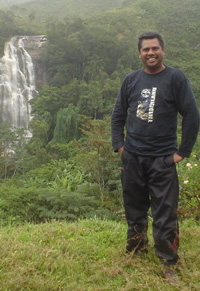
Photo Credit: The forests of Madagascar, courtesy of Conservation International/Russ Mittermeier, and Zo Zatovonirina, courtesy of Conservation International. -
Deirdre LaPin, Niger Delta Working Group
Next Step, Clean Up the Niger Delta: The UNEP Ogoni Environmental Report
›August 12, 2011 // By Wilson Center StaffThe original version of this article, by Deirdre LaPin, appeared on the Niger Delta Working Group and AllAfrica.
The long-awaited report from the United National Environmental Program (UNEP) on oil damage in the Ogoni area was presented to President Goodluck Jonathan on August 4 in Abuja. This important study, the first of its kind in the Niger Delta, was conceived well before 2006 by the Federal Government as part of the Ogoni reconciliation and peace process led by Father Matthew Kukah (recently named Bishop of Sokoto). Intended as a major assessment of the impacts of oil production in the Ogoni region, UNEP in an early statement described the aim as to “clarify and de-mystify concerns expressed by local communities.” [Audio Below]
Shell Petroleum Development Company (SPDC) suspended active production in Ogoniland in late 1993 as a response to growing resistance to industry presence led by the martyred freedom fighter and writer Ken Saro-Wiwa. However, the company remained responsible during its withdrawal for monitoring and maintaining its installations, and especially the critical Trans-Niger pipeline serving Bonny Terminal. It also left behind a number of spill sites.
Deirdre LaPin on the History of Inequality in the Niger Delta [Excerpted Version] by ECSP WWC
Over the years the company had mixed success in negotiating with local communities access to spills sites or achieving their complete remediation. The impoverished local population also pursued informal oil production that centered on bunkering (oil pipeline tapping) and bush refining – increasing opportunities for further spills and pollution. In keeping with the “polluter pays” principle, the operator SPDC joint venture funded the U.S. $9.5 million UNEP study.
Last week the press had a field day with the freshly unveiled report.
Journalists whisked together highlights and added spice from the region’s contested history. Some articles cooked in the press kitchen missed key ingredients or simply got them mixed up. The best among them focused on the findings from the study’s careful scientific analysis, which led UNEP to the conclusion that “pollution has perhaps gone further and penetrated deeper than many may have previously supposed.”
This forceful opinion stated in the foreword by UNEP’s executive director Achim Steiner represents a long step beyond the study’s original technical terms of reference or the limited policy aims supporting reconciliation and “de-mystification.”
Now in 2011, UNEP’s thoughtful recommendations, while not assigning blame, point clearly to the need for a genuine shift in the priorities and practices of the oil industry and governmental regulatory agencies operating throughout the Niger Delta. The muscular sub-text rippling throughout the report makes clear that nothing less than ending pollution and full remediation of Ogoniland (and indeed the whole Niger Delta region) should be accepted as an end point.
Continue reading on the Niger Delta Working Group.
For more on the Niger Delta, be sure to also read “Nigeria’s Future Clouded by Oil, Climate Change, and Scarcity,” which includes the full audio interview with Deidre LaPin (excerpted above) on the history of the Niger Delta.
Sources: UNEP.
Photo Credit: NASA Space Shuttle Overflight photo of the Niger Delta, courtesy of NASA. -
Cynthia Brady, USAID
The Specter of “Climate Wars”
›July 29, 2011 // By Wilson Center StaffThe original version of this article, by Cynthia Brady, appeared in the June/July 2011 edition of USAID’s Frontlines.
In 2007, many in the advocacy community rushed to categorize the conflict in the Darfur region of Sudan as a “climate war” in the wake of a compelling United Nations report that emphasized the ways climate change and environmental degradation can drive conflict.
In 2009, international media focused significant attention on an academic study that analyzed historical linkages between civil war and temperatures in sub-Saharan Africa and suggested there would be a 54-percent increase in armed conflicts by 2030. [Video Below]
In both cases, subsequent research and analyses conducted by prominent scholars countered those original claims of such direct climate and conflict connections, at least based on existing evidence. Those studies are two examples of the recent spate of analyses on the subject and serve as cautionary tales against alarmism and overly simplistic assumptions about specific connections between climate change and stability.
The reality is far more complicated.
The science and practice of analyzing the interaction of climate change risk and conflict risk is new and still evolving. As a result, there is little certainty over exactly how climatic change will manifest in specific locations and what the consequences will be for economic development, political stability, and peace and security.
Around the world, climate change likely will create both risks and opportunities, making it critical that development and relief organizations like USAID consider climate change not as a monolithic threat but rather as an important influence within a complex web of environmental and social factors.
Responding to climate change effectively means taking action to reduce the threats. It also means harnessing opportunities by helping people and institutions to effectively cope with and adapt to change – environmental or otherwise. Climate-focused interventions, if conducted strategically and with sensitivity to local context, can produce outcomes for conflict prevention and sustainable development as well.
For example, recent USAID-funded research in the conflict-prone Karamoja region of northeastern Uganda found that engaging local communities in the design and implementation of climate change adaptation activities – for example, promoting shared grazing areas and creating small-scale irrigation systems – holds considerable potential to reduce conflict by building social cohesion and addressing feelings of marginalization and disempowerment among local community members.
Since 2008, USAID has invested in research to better understand how specific climate factors contribute to the risk of conflict and affect the resilience of social structures and institutions. The goal is to build a deeper understanding that will enable the agency and its partners to respond most effectively to climate-related stress, reduce the risk of violent outcomes, and maximize the potential for U.S. foreign assistance to prevent conflict and promote stability.
This knowledge also will help USAID make wise investments as part of meeting U.S. Government commitments under the Global Climate Change Initiative as described in President Barack Obama’s September 2010 Presidential Policy Directive on Global Development.
Climate Change and Conflict Prevention
The research thus far points to climate change as an exacerbating factor in situations where political, economic, and social stresses already exist. The risk of conflict is greatest where there is poor governance and low institutional capacity.
The agency, through its Office of Conflict Management and Mitigation (CMM), has identified two basic scenarios under which climate change could combine with other variables and potentially lead to conflict.
First, climate change could intensify existing environmental or resource problems. For example, a series of droughts could reduce the available local water supply, aggravating competition between farmers and pastoralists in already arid regions. Second, climate change could create new environmental or resource problems that contribute to instability. Changing rainfall patterns, for instance, could damage agricultural production in formerly fertile areas, decimating local livelihoods and causing food insecurity.
There is a third area of potential risk for USAID and other donors as well: namely, that climate-related financing, policies, and programs which have not adequately considered local conflict dynamics and context could produce serious unintended negative consequences.
Climate change-related interventions such as incentive payments to stop deforestation – particularly in fragile states and conflict-affected areas – must recognize that both the money and the power to allocate benefits may inadvertently reinforce the social status quo, shift local power balances, or expose governance failures.
In her field work in Nepal, Janani Vivekananda, a researcher with USAID partner International Alert, recently illustrated how certain types of assistance might inadvertently do harm. She explained how a now-defunct village water tap installed in an effort to mitigate the effects of climate variability, did not appropriately consider the local social, political, and conflict context or even basic environmental parameters. In the end, it contributed to local grievance.
The community had requested the tap to be installed during a period of water stress and three consecutive years of drought. The Government of Nepal sponsored the project just before the elections.
Vivekananda explained: “These people are hand-to-mouth farmers. They didn’t know and they wouldn’t know that ground water levels were falling. They wouldn’t know the negative impacts of uncontrolled surface water extraction and so they chased about this tap, and within three months it ran dry. That was the only cash that was injected into the community for development purposes, and it had no impact whatsoever apart from being a stark reminder that the government itself isn’t doing what it ought to.”
This story highlights the reality that local context will define the outcome of peace or conflict and, thus, as CMM’s discussion paper “Climate Change, Adaptation, and Conflict: A Preliminary Review of the Issues” noted, there remains a pressing need for a more robust, fine-grained understanding of the interaction between climate change and the political, social, and economic realities of conflict-prone areas.
To help fill this information gap, USAID is supporting field-based climate change and conflict research in Peru, Uganda, Ethiopia, and the Niger River Basin in West Africa. At the global level, the agency is improving its ability to integrate climate change considerations into conflict early warning models. It is also establishing academic and practitioner partnerships that explore a wide range of environment and security issues.
Today, close to 60 percent of the State Department’s and USAID’s foreign assistance goes to 50 countries that are in the midst of, recovering from, or trying to prevent conflict or state failure. A significant amount of that assistance is slated for Global Climate Change mitigation and adaptation programming. Yet, as CMM’s conflict early warning specialist, Kirby Reiling, observed, “much of that money could be a lost investment if those countries fall into armed conflict.”
With conflict-sensitive development assistance and with smart climate change policies and programs, vulnerable countries will have enhanced opportunities to build stronger societies and more resilient institutions for sustainable development, peace, and security.
Cynthia Brady is a senior conflict advisor in USAID’s Office of Conflict Management and Mitigation.
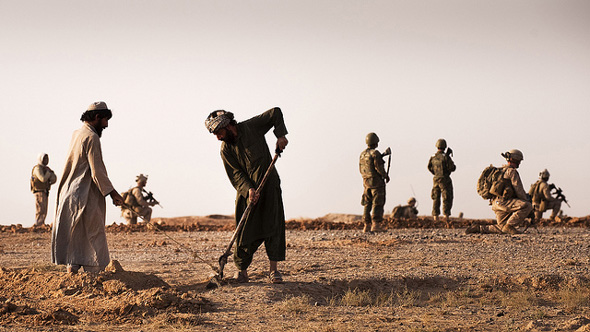
Photo Credit: Afghan farmers plow a field guarded by U.S. Marines, courtesy of flickr user isafmedia. -
UN Security Council Debates Climate Change
›Today the UN Security Council is debating climate change and its links to peace and international security. In this short video, ECSP Director Geoff Dabelko outlines his hopes for today’s session and its follow-on activities. He suggests it is time to move from problem identification to problem solving by developing practical steps to respond to climate-security links.
This Security Council debate was held at the instigation of the German government, chair of the Security Council this month. But it is not the first time this body has debated climate and security. In 2007, the United Kingdom used its prerogative as chair to introduce the topic in the security forum. Opinions from member states diverged on whether the Security Council was the appropriate venue for climate change.
Largely at the instigation of the Alliance of Small Island States, the UN General Assembly tackled climate and security links in 2009. The resulting resolution also spurred the UN Secretary-General to produce a summary report on the range of climate and security links.
Sources: Reuters, UN.






.jpg)