-
Nabeela Ali on How PAIMAN Is Improving Maternal Health in Pakistan
›“Maternal mortality is a very complex thing – it’s not just patient-doctor relationships, it has so much to do with behaviors, with communities, with the household, with family members,” said Nabeela Ali, chief of party for the Pakistan Initiative for Mothers and Newborns (PAIMAN), which received USAID maternal and child health funding from 2004 to 2010.
Pakistan is the world’s sixth most populous country, yet has long held one of the world’s highest maternal mortality rates. Ali spoke at the Wilson Center last fall about strategies to better engage faith-based organizations on maternal and child health issues. In this interview with ECSP, she stressed that despite Pakistan’s very religious society, these interventions are possible with the right messaging.
PAIMAN aims to reach vulnerable and isolated groups, including poor, rural, or conservative women. “The areas where no one can reach [are] where we targeted,” Ali said.
In these areas, ulama – influential religious leaders and scholars – are highly trusted. “It was not a one-size-fits-all strategy,” Ali emphasized. “Religious leaders are not technical people, but they are experts in their own field. You have to approach them with trust and respect.”
“The first step is establishing rapport with them; then they listen to you,” said Ali. This is best done through another alim, not a technical person. Those ulama that were approachable proved to be valuable allies in the promotion of maternal health. PAIMAN has reached over 35 million people in Pakistan over its now eight-year run.
Projects like PAIMAN are necessary in areas of the world where religious leaders are the most respected community authorities. In Pakistan, Ali believes that now that this strategy has been demonstrated to be viable, the government should help bring it to scale. An NGO-funded project ends, but a government-funded program has much more continuity, which in turn helps build trust with local leaders, she said.
Sources: UN Population Division. -
Women’s Rights and Voices Belong at Rio+20
›This summer, world leaders will gather in Rio de Janeiro for the 20th anniversary of the first UN Earth Summit to hammer out a new set of agreements on what sustainable development means and, more importantly, how both rich and developing nations can get there before it’s too late. However, for the scores of women who will be attending (and just importantly for those who aren’t), there are glaring omissions: reproductive health, gender equality, and girls education are nowhere to be found on the Rio+20 agenda.
Women offer many of the most promising levers for the transformation to sustainable development. My experience with the Global Fund for Women tells me that women are full of creative and strategic solutions to the problems facing their communities around the world. Their voices must be included in critical decisions affecting our world. And the fact is, sustainable development isn’t sustainable if it doesn’t include empowering women to plan their families, educate themselves, and their children, and have a voice in government at all levels. Rio+20 must have human rights – and women’s rights – at its core. Earth summit planners haven’t yet done that, but women can make it happen.
Women are 51 percent of the world’s population, yet own only one percent of its assets, are two-thirds of the world’s workers but earn a mere 10 percent of wages. Rio+20 must not become another forum in which women’s issues are not heard. Instead, the summit must demonstrate that women’s voices are integral to all development. Environmental sustainability simply can’t happen without women’s inclusion.
For example, in West Africa, women make up 70 percent of workers in agriculture. In Burkina Faso, deforestation, water scarcity, and soil erosion show us that climate change is already impacting women farmers. Women tend to “sacrifice themselves” in order to care for their families – feeding themselves last. And women are most likely to suffer and die in environmental disasters – particularly in the Asian countries most at risk from climate change.
So how do we support women while supporting the environment that sustains us all?
Simply meeting women’s needs for family planning is one inexpensive and powerful development strategy with a host of environmental benefits. Over 200 million women around the world want the ability to choose the spacing and number of children but don’t have access to, or accurate information about, basic contraceptives like condoms, pills, and IUDs. One-hundred and seventy-nine nations already agree that meeting this need is a top priority, and the Millennium Development Goals (MDGs) reflect a goal of universal access to family planning as well.
Satisfying this demand would dramatically reduce maternal and child mortality and enhance human rights. What’s more, two recent studies show that a reduction of 8 to 15 percent of essential carbon emissions can be obtained by meeting women’s needs for family planning. This reduction would be equivalent to stopping all deforestation or increasing the world’s use of wind power fortyfold.
The Earth Summit presents a major opportunity to ensure that women’s needs and rights are given top priority in plans for sustainable development. In a time of multiple, interlinked human and environmental crises and a very tight funding environment, investing in women is a clear winner.
A greater understanding of the impact of environmental degradation, pollution, and climate change on women, coupled with solid public policy that respects and protects women’s reproductive rights, is essential to the “Sustainable Development Goals” that many believe will emerge from Rio+20 to replace the MDGs, which expire in 2015.
As the summit approaches, it’s time to reflect on why women’s full participation and inclusion is so important and call for world leaders to harness the power of women as we launch the era of sustainable development.
Musimbi Kanyoro is president and CEO of the Global Fund for Women, which advances women’s human rights by investing in women-led organizations worldwide.
Sources: Food and Agriculture Organization, Guttmacher Institute, Moreland et al. (2010), O’Neill et al. (2010), Princeton Environmental Institute, UN, UNEP, World Bank, World Health Organization.
Photo Credit: “Reokadia Nakaweesa Nalongo,” courtesy of Jason Taylor/Friends of Earth International. -
Uganda’s Demographic and Health Challenges Put Into Perspective With Newfound Oil Discoveries [Part One]
›April 26, 2012 // By Kate DiamondUganda’s population is the second youngest in the world, with half of the country younger than 15.7 years old (just older than Niger’s median age of 15.5 years). In the past 10 years, the country – about half the size of France in land area – has added 10 million people, growing from 24 to 34 million. That growth, paired with other factors like poor governance and long-standing insecurity, has made providing basic services a difficult task for a government that is one of Africa’s most aid-dependent.
-
Karen Newman: Rio+20 Should Re-Identify Family Planning As a Core Development Priority
›April 25, 2012 // By Kate DiamondEnergizing people around family planning can be difficult, “because donors, like everyone else, like something that’s new,” said Karen Newman, coordinator for the UK-based Population and Sustainability Network. “There’s nothing new about family planning. The technology is safe, effective, it’s acceptable, and it works. We just need a lot more of it out there to be accessible to a lot more people.”
Newman spoke to ECSP at the 2012 Planet Under Pressure conference about her hopes for the upcoming Rio+20 sustainable development conference, which marks the 20-year anniversary of the UN Earth Summit.
“What we want is increased investment in voluntary family planning services that respect and protect rights,” Newman said, “and I think that Rio represents a fabulous opportunity for us to re-identify family planning as a core development priority.”
Newman also hopes the Rio conference will lead to “an integrated look at sustainable development, so that… it isn’t just about the green economy and institutional framework, it’s looking at sustainable development in the round.”
Government development programs and policymakers need to adapt their bureaucratic processes to the kinds of integrated programming being carried out on the ground, she said. In Madagascar, for example, conservation group Blue Ventures leads an integrated PHE program that cuts across marine conservation, family planning, and healthcare sectors. “Now I defy you to find an EU budget line that would be broad enough to embrace marine conservation and family planning in the same project line,” said Newman.
“The first thing we need is that level of integrated thinking – not just in Rio, but also in the way that we conceptualize the work that needs to be done and we facilitate the availability of funding streams that can fund that kind of integrated program.”
Lastly, Newman hopes that the summit in and of itself is successful because of its implications for future development work. As the world gears up to create the next big framework for global development to follow the Millennium Development Goals, Rio is uniquely positioned to set a baseline for what matters and for what the development community is capable of accomplishing.
“What I want to see is a really sophisticated look at sustainable development, coming up with sustainable development goals in a world that makes sense of seven billion, where there are still millions of women without access to the family planning services that we take for granted,” said Newman, “and taking that concept to the job of developing the post-MDG framework that will frame development for the next 20 years.” -
A New Land Security Agenda to Enable Sustainable, Equitable Development
›The recent news that overseas investors have acquired over 10 percent of Australia’s farmland and 9 percent of water entitlements in its agriculture sector has struck a political chord in the country. Large grain-producing nations like Brazil and Argentina have passed laws to restrict the foreign ownership of land. In other global grain hubs, like Ukraine and Russia, compromised harvests due to droughts could result in export restrictions. In a globalized economy, the combination of scarcity, market and population pressures, and weather volatility will make fertile land an increasingly precious resource.
A shift is underway in global financial markets, where global investors perceive that owning what grows on the land – or better still, owning the land itself – may be a hedge against the risks of more volatile financial markets. A surge in farmland investments is expected to grow over the next decade is due to a number of combined pressures: a growing global demand for commodities, rising commodity prices, ecological limits, and the fact that farmland is a “real asset” that offers diversification to the portfolios of investors at a time of market volatility.
The need to increase food production against the backdrop of resource limits, social vulnerability, and population growth, puts the question of land at the center of a new security agenda.
In sub-Saharan Africa large-scale acquisitions of land that neglect local livelihoods and resource scarcity, commonly referred to as “land grabs,” put the region’s future in the balance. Not all land investments have negative consequences, but given the lower levels of land tenure by communities and the fragility of human security in sub-Saharan Africa, regulating land investments with foresight is an urgent issue. Population growth and climate change underpin this agenda. A worse-than-average drought, exacerbated by climate change, may be all that is needed in certain places to realize the political, humanitarian, and ecological risks that are slowly building momentum.
From Land Grabs to Land Stewardship
Progress now depends on moving from a land grabs debate to land stewardship solutions. This shift, which the Earth Security Initiative summarized in a report published this month, The Land Security Agenda: How Investor Risks in Farmland Create Opportunities for Sustainability, requires an improved understanding by investors and political leaders of three priorities: managing land degradation, protecting human rights by focusing on food security and land ownership, and keeping economies within ecological – especially water – limits.
The agenda we have developed discusses why these issues form part of a new risk management agenda for investors as well as for countries seeking to attract foreign capital, whose economic competitiveness and political stability may be compromised by these trends. But managing these risks, we argue, will require making human rights and ecological limits a central feature of a new investment paradigm.
A range of international investors is already searching for solutions to engage practically with this debate. Among those with whom we have engaged throughout the study are individual investment funds, people seeking change within the financial sector, and investor networks such as the UN-backed Principles of Responsible Investment. Recently, governments, international organizations and civil society groups have also agreed on a set of voluntary guidelines for land governance under the auspices of the Committee on World Food Security. These developments are positive steps, but their voluntary nature remains problematic. The focus must now be placed on operationalizing their recommendations to ensure real accountability and creating political incentives in host countries to regulate their land to ensure long-term and equitable prosperity.
A Call to Action
In The Land Security Agenda we call on investors to turn their attention to their land and commodities portfolios, as well as the investments currently under due diligence, and begin to ask how soil resilience, the prosperity of local people, and freshwater limits are being considered. We recommend beginning to assess the risks of countries according to how well their governments are managing these issues.
We similarly call on heads of state in countries seeking to attract large investments in land to become more aware that these risks may undermine their country’s wealth, their stability, and economic competitiveness. Political leadership is needed to champion and enforce regulations that will encourage investments and modernization while protecting a country’s social and natural capital.
Some of the recommendations we have developed, which would help set the tone for investors and governments to move from voluntary principles to action, include:- Define land security parameters: Establish a set of verifiable measures that allows stakeholders to distinguish those land investments that advance equitable and sustainable prosperity from those that do not. Based on these criteria, which we suggest must consider people, water, and soil, it is possible to advance their integration into three important areas of the investment cycle: the identification of investment opportunities that build positive value, the due diligence process, and the performance reviews of fund managers.
- Build better country risk profiles: If the population of a given country is dependent on agriculture for livelihoods, shouldn’t issues like soil erosion, water availability and lack of recognition for people’s land rights increase that country’s sovereign risk? We think so and now seek to develop a “land security index” to help investors and host country governments assimilate these trends into their decisions as well as increase the advocacy capacity of local civil society.
- Advance the formal recognition of land rights on a large scale: The universal call for the prior and informed consent of communities must be supported, but will be of little practical value if communities do not hold the legal rights to their land or are not well informed about their rights and the commercial opportunities available to them. Civil society groups working to advance good governance, land titling, and capacity building – many of whom we have spoken to during this study – are in a position to help create a “land security partnership” that builds technical and political momentum for the formal recognition of land rights on a large scale, as well as the resourcing and oversight that government agencies will require to implement them.
Alejandro Litovsky is the founder and director of the Earth Security Initiative and lead author of the report. The Land Security Agenda can be downloaded here.
Sources: DGC Asset Management, Land Commodities Asset Management, Telegraph.
Image Credit: Cover of the The Land Security Agenda. -
Global Water Security Calls for U.S. Leadership, Says Intelligence Assessment
›March 26, 2012 // By Schuyler NullAlongside and in support of Secretary Clinton’s announcement of a new State Department-led water security initiative last week was the release of a global water security assessment by the National Intelligence Council and Director of National Intelligence. The aim of the report? Answer the question: “How will water problems (shortages, poor water quality, or floods) impact U.S. national security interests over the next 30 years?”
-
Fourth World Water Development Report Released by UN
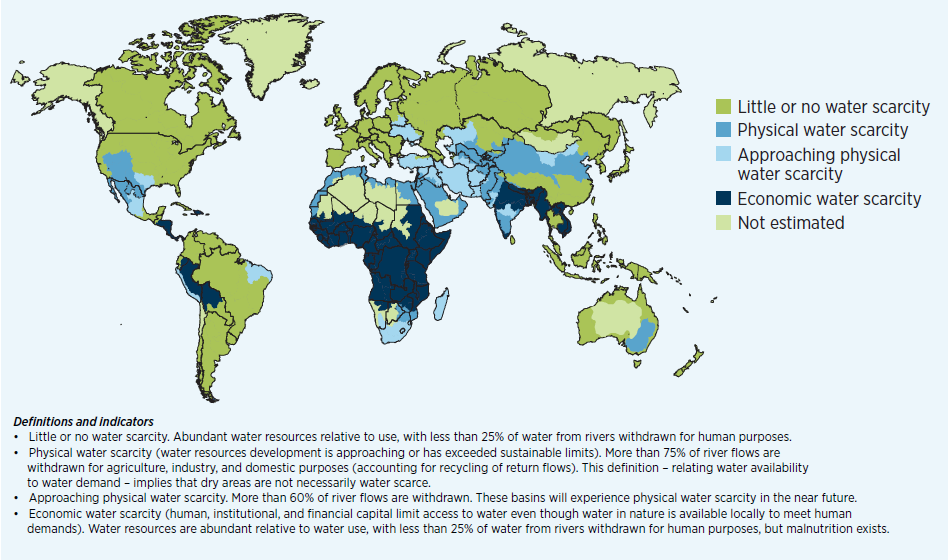
›The beginning of last week’s World Water Forum in Marseille also marked the release of UNESCO’s fourth edition of the World Water Development Report. Chief amongst the challenges outlined in the new report are meeting demand from growing population and consumption. Agriculture accounts for 70 percent of water usage, according to the report, and globally we will require 70 percent more food over the next 40 years, introducing the possibility of overtaxing already-stressed water resources – all while adapting to climate change. There are substantial gains to be had in increasing farm-to-table efficiency, especially in developing countries, the authors sagely point out, but the supply challenge remains a huge one.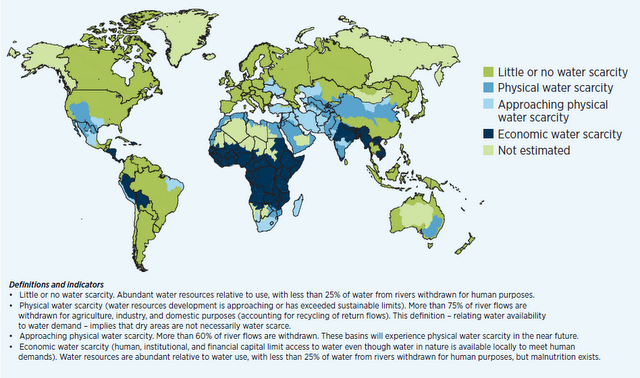
This year’s edition also adds several new sections, including on women and water. “The crisis of scarcity, deteriorating water quality, the linkages between water and food security, and the need for improved governance are the most significant in the context of gender differences in access to and control over water resources,” write the authors. “These challenges are expected to become more intense in the future.”
The integrated nature of today’s water issues is a highlight throughout the report. “Accelerated change” will create new threats and “interconnected forces” create uncertainty and risk, but UNESCO emphasizes that if policymakers are made aware of these issues, ultimately “these forces can be managed effectively and can even generate vital opportunities and benefits through innovative approaches to allocation, use, and management of water.”
Image Credit: Water Management Institute, via figure 15.5 from UNESCO World Water Development Report. -
Food Security in a Climate-Altered Future, Part One: “Hotspots” Suggest Food Insecurity More Than a Supply Problem
›March 20, 2012 // By Kathleen MogelgaardSmall talk about the weather with my Malawian taxi driver became serious very quickly. “We no longer know when the rains are coming,” he said as we bumped along the road toward the Lilongwe airport last November. “It is very difficult, because we don’t know when to plant.”
These days, he is grateful for his job driving a taxi. His extended family and friends are among the 85 percent of Malawians employed in agriculture, much of which is small-holder, rain-fed subsistence farming. Weather-related farming challenges contribute to ongoing food insecurity in Malawi, where one in five children is undernourished.
His observations of the recent changes in climate match forecasts for the region: In East Africa, climate change is expected to reduce the productivity of maize – Malawi’s main subsistence crop – by more than 20 percent by 2030, according to a recent analysis by Oxfam International.
I looked out the window at dusty fields and tried to imagine what Malawi might look like in 2030. For one thing, it will be more crowded. A lot more crowded. According to UN population projections, by 2030, Malawi’s population will have grown from about 15 million today to somewhere between 26.9 and 28.4 million. With climate change dampening agricultural productivity and population growth increasing food demand, how will Malawians – many of whom don’t have enough to eat now – have enough to eat in the future?
It gets quiet in the taxi as the driver and I both ponder this question. Malawi is not alone in being a climate-vulnerable country with a rapidly growing population dependent on rain-fed agriculture. Population Action International’s Mapping Population and Climate Change tool shows us that many “hotspot” countries – scattered across Latin America, Africa, and Asia – face the triple challenge of low climate change resilience, projected decline in agricultural productivity, and rapid population growth.
Agricultural trade, government safety net programs, and foreign assistance will no doubt continue to play an important role in the quest for food security in Malawi and other “hotspot” countries in the future. And climate change adaptation projects will, hopefully, reshape agricultural practices and technologies in ways that can boost yields and enable crops to better withstand temperature and precipitation fluctuations.
These interventions will be critical in addressing the supply side of future food security challenges. But what about growing demand?
Malthus Revisited?
Juxtaposing population growth with food production does, of course, bring us back to Thomas Robert Malthus’ original (and by now somewhat infamous) dire warning: that population growth would eventually outrun food supply. But seeing the scale of the challenges in Malawi firsthand, I must admit that my inner Malthus sat up and took notice.
It is true that technological advances have enabled astounding growth in agricultural yields that have enabled us to feed the world in ways the doom-filled Malthus could never have imagined in the early 19th century. But it is also true that the agricultural productivity gains that helped us keep pace with population growth for so long are beginning to slow: According to the U.S. Department of Agriculture, aggregate agricultural yields averaged 2.0 percent growth annually between 1970 and 1990, but that growth in yields declined to 1.1 percent between 1990 and 2007, and is projected to decline to less than 1.0 percent in the years to come.
This comes at a time when the Food and Agriculture Organization reports that food production will need to increase by 70 percent by 2050 in order to adequately feed a larger, wealthier, and more urbanized population.
To dismiss any talk of population growth as outmoded Malthusian hand-wringing misses an opportunity to embrace interventions that can contribute significantly to prospects for future food security – namely, empowering women with information and services that enable them to determine the timing and spacing of their children.
In Malawi and many of the “hotspot” countries around the world, high proportions of women remain disempowered in this regard. Meaningful access to family planning and reproductive health services results in smaller, healthier families that will be better equipped to cope with the food security challenges that are headed their way.
Not only does a smaller family mean that limited household resources go further, but access to family planning and reproductive health services is connected to other important education and economic outcomes.
A new Population Reference Bureau policy brief, for example, highlights how improving women’s reproductive health will not only lead to declining fertility and slower population growth in sub-Saharan Africa, but can also contribute to balancing a woman’s many roles (agricultural producer, worker, mother, caregiver, etc.) in ways that support greater food security for her family. And research by the International Food Policy Research Institute shows that in developing countries, women’s education and per capita food availability are the most important underlying determinants of child malnutrition – with women’s education having the strongest beneficial impact. Access to family planning paves the way for these outcomes – and by slowing population growth, can help to slow the growth in food demand.
Women’s Needs and Future Food Demand
The scale of potential benefits of meeting women’s family planning needs is significant when thinking about future food demand, both globally and especially in food insecure, climate-vulnerable countries. As we have seen in Malawi, there is a range of possible future population sizes and that range grows even wider when the projections are extended to 2050: According to the UN, Malawi’s 15 million today will grow to somewhere between 45 million and 55 million by 2050.
That span of 10 million people embodies assumptions about declining fertility in Malawi. To reach 55 million, the average number of children per woman would need to drop from 5.7 today to 4.5 by 2050. If fertility drops further, to 3.5 children per woman, Malawi’s population would grow to (only) 45 million. Where Malawi ends up in that 10-million-person population spread will have deep implications for per capita food availability, not to mention other important development outcomes.
Fertility declines of this kind do not require coercion or “population control.” As we have seen time and again, when women are empowered with information and services that enable them to determine the timing and spacing of their children, smaller, healthier families are the inevitable result.
Meeting women’s needs for reproductive health and family planning services is not – and never should be – about reducing population size. Universal access to reproductive health is recognized as a basic human right and central development goal (embodied in Millennium Development Goal 5) because of its vital connections to women’s and children’s health, education and employment opportunities, and poverty alleviation. And yet, too many women remain without the ability to effectively plan their families. In Malawi, one in four married women would like to delay their next birth or end child-bearing all together but aren’t using contraception; globally, 215 million have this unmet need.
As global efforts ramp up to address interlinked challenges of food security and climate change adaptation, assessing the role of population growth is more important than ever. And in designing strategies to address these challenges – strategies like the U.S. Government’s Feed the Future Initiative and UN-supported National Adaptation Plans – we should not pass over opportunities to incorporate interventions to close the remaining gap in universal access to family planning, especially in places like Malawi and other “hotspot” countries (such as Haiti, Nigeria, and Nepal), where women’s unmet family planning needs are high and population growth is rapid.
Continue reading with part two on the often under-examined role of population projections in food security assessments here.
Sources: Food and Agriculture Organization, Guttmacher Institute, International Food Policy Research Institute, International Institute for Environment and Development, MEASURE DHS, Oxfam International, Population Action International, Population Reference Bureau, The Lancet, U.S. Department of Agriculture, UN Population Division.
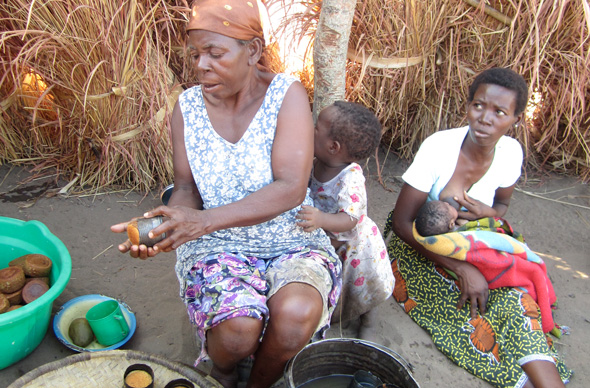
Photo Credit: Women in a village near Lake Malawi make cornbread while caring for small children, used with permission courtesy of Jessica Brunacini.
Showing posts from category zz Organizations.