-
Three UN Millennium Development Targets Reached and a Review of the Human Drivers of Climate Change
›“It is plausible that key transitions in human evolutionary history have been driven in large part by climate change,” write Eugene A. Rosa and Thomas Dietz in “Human Drivers of National Greenhouse-Gas Emissions,” a literature review published by Nature Climate Change. “Changes in climate will doubtless be a key force in the future evolution of social systems, including all aspects of social, economic, and political life, while impinging on the health and well-being of the individuals who populate them.” Rosa and Dietz cite numerous studies to argue that nearly every facet of society will be affected by climate change. “The critical point,” they write, “is that population, affluence, technology, and all other drivers act not alone or additively but in a multiplicative fashion.” For example, rapid population growth can lead to an increase in urbanization, which generates “substantial demand for goods and services that can induce emissions in distant places.” They conclude that huge changes must be made in technology and consumption in order to combat the effects of climate change that are being caused by a growing population and an increasingly affluent world. The United Nations’ 2012 Millennium Development Goals Report, released last month in New York City, announces that three of the eight major human development goals have been reached ahead of their 2015 targets. The Millennium Development Goals, set at a conference in 2000, were established to “uphold the principles of human dignity, equality, and equity at a global level.” The 2012 report indicates that the number of people living in extreme poverty has been halved since 1990; the proportion of people in the world without sustainable access to safe drinking water has also been halved; and more than 200 million slum dwellers have “gained access to either improved water sources, improved sanitation facilities, or durable or less crowded housing.” At the report launch, UN Secretary-General Ban Ki-moon noted that “these results represent a tremendous reduction in human suffering and are a clear validation of the approach embodied in the MDGs, but they are not a reason to relax.” Goals that have yet to be achieved include universal primary education; gender equality; reduced child mortality and improved maternal health; reducing rates of diseases such as HIV and malaria; and creating a global partnership for development.
Keenan Dillard is a cadet at the United States Military Academy at West Point and an intern with the Woodrow Wilson Center’s Environmental Change and Security Program. -
A Roundup of the ‘Global Trends 2030’ Series on Population Aging
›
The National Intelligence Council is trying something new for this year’s Global Trends report: keeping a blog. So far, there have been postings from analysts and contributors on everything from migration and urbanization to international banking and precision strike capabilities, but over the past week, one of the most extensive series yet went up on demography. Though youth bulge theories have often dominated population-related security discussions, 11 posts highlight the newest and least understood of all demographic conditions: advanced population aging.
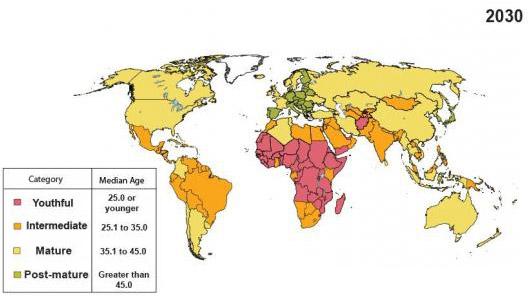
In parts of the world, mainly Europe and several countries in East Asia, populations are set to become “extremely mature” because of sustained declines in average fertility to very low levels and steady increases in lifespan. Demographers measure maturity by a population’s median age – the age of the person for whom precisely half of the population is younger and half older. Japan and Germany currently have the most mature populations; both are reported to have a median age slightly over 45 years. By 2030, UN Population Division and U.S. Census Bureau projections suggest that there may be between 19 and 29 countries that pass this benchmark. In Japan, the median age is projected to be 51.
If 5 out of 10 people in a country over 50 years old sounds unprecedented, that’s because it is. In this series, titled “Population Aging to 2030,” a group of political demographers, economic demographers, political scientists, and historians discuss the implications of this never-before-experienced set of age structures.
In his introductory essay, “Population Aging: A Demographic and Geographic Overview” (cross-posted here on New Security Beat), Richard Cincotta outlines the upcoming demographic trend, identifying the particulars of these novel age structures and indicating the regions that are expected to mature into economically and politically advantageous and disadvantageous demographic profiles.
In “Population Aging – More Security or Less?,” Jack Goldstone examines the effects on the U.S. military of a maturing developed world. With the United States and their traditional allies having proportionally fewer young people, will this impact limit their ability to put “boots on the ground?” Can new partnerships be developed in order to make up for this shortfall in man power?
In “China: the Problem of Premature Aging,” Richard Jackson focuses on China’s unique set of aging issues. Due to strict immigration laws and the one-child policy, China is experiencing the most rapid aging of the major powers. The favorable age structure which has enabled huge economic growth will soon shift to being a major burden on a relatively smaller working-age population, having potential political and societal consequences beyond that.
“The Sun Has Yet to Set on China” provides a different interpretation of the challenges China faces. Jennifer Dabbs Sciubba argues that although there will be changes in age structure, the problems may be overstated and the United States may still face a challenge to its status as sole global superpower.
In “Population Aging and the Welfare State in Europe,” Ronald Lee and Andrew Mason emphasize the stresses aging will exert on the extensive social welfare programs of many European states. The combination of longer life expectancy and declining fertility rates has led to a large and increasing funding gap in the welfare system, leaving questions as to the future viability of these programs.
In “Population Aging and the Future of NATO,” Mark Haas foresees that the welfare funding gap could have far-reaching international security consequences. With European governments diverting more and more resources away from military spending to fund welfare programs, the current U.S. irritation with NATO is likely to continue, as European allies “free ride” on the back of U.S. military supremacy in order to cut their defense budgets.
In “The Beginning of History: Advanced Aging and the Liberalness of Democracies,” Richard Cincotta examines the future of the liberal democratic political systems across aging countries. With increasing pressure on resources and a large disparity likely between the native born and migrant populations, it may become challenging for these states to remain liberal and democratic.
For Toshi Yoshihara, author of “The Strategic Implications of Japan’s Demographic Decline,” the aging process will pose a question of priorities for the leaders of Japan. The decreasing number of personnel available to the military, the effects of which were highlighted by the recent tsunami, will force a strategic decision between a defense force that is prepared primarily to address immediate and local security threats or one that is trained primarily for broader humanitarian interests.
“A Demographic Sketch of a Reunified Korea” provides interesting insights into the hypothetical demography of a single, unified Korea. Putting aside the two very distinct social paths that evolved during the past 60 year, Elizabeth Hervey Stephen uses demographic projections to envisage the challenges and opportunities that could arise from reunification.
David Coleman points to immigration as a possibly-mitigating force to aging in the developed world. In “The Impact of Immigration on the Populations of the Developed World and Their Ethnic Composition,” Coleman concludes that the developed world is likely to become “super diverse” by 2030. But this trend can be volatile. International migration is subject to many political and economic factors, bringing into question whether the developed world can rely on migration to supplement their native growth rates.
In “The Ethnic Future of Western Europe to 2030,” which wraps up the series, Eric Kaufmann examines the ethnic make-up of Western Europe in the coming decades. While the size of ethnic minority populations may be smaller than in the United States, the speed of growth in these minorities is likely to be much more rapid in Western Europe. This unprecedented increase in migrant populations could exacerbate ethnic social tensions, particularly in urban areas.
The broad nature of these essays suggests that advanced population aging will emerge within the context of many types of policy debates in the coming decades. While these 11 brief essays only scratch the surface of their respective areas of research, they provide a broad introduction to the politics of advanced population aging.
Jonathan Potton is a student at the University of Aberdeen and currently interning at the Stimson Center for demographer Richard Cincotta.
Sources: UN Population Division, U.S. Census Bureau.
Image Credit: Courtesy of Richard Cincotta. Data from U.S. Census Bureau’s international database. -
Michael Kugelman, Sustainable Security
The Global Land Rush: Catalyst for Resource-Driven Conflict?
›July 31, 2012 // By Wilson Center StaffThe original version of this article, by Michael Kugelman, appeared on SustainableSecurity.org.
On May 11, the UN approved new international rules to govern how land is acquired abroad. These Voluntary Guidelines (VGs), the outcome of several years of protracted negotiations, are a response to growing global concern that nations and private investors are seizing large swaths of overseas agricultural land owned or used by small farmers and local communities for food, medicinal, or livelihood purposes. FAO head Jose Graziano da Silva describes the VGs as “a starting point that will help improve the often dire situation of the hungry and poor.”
It’s hard to quibble with the intent of the guidelines. They call for, among other things, protecting the land rights of local communities; promoting gender equality in land title acquisition; and offering legal assistance during land disputes.
Unfortunately, however, any utility deriving from the VGs will be strictly normative. As their name states explicitly, they are purely optional. A toothless set of non-obligatory rules will prove no match for a strategy that is striking both for its scale and for the tremendous power of its executioners.
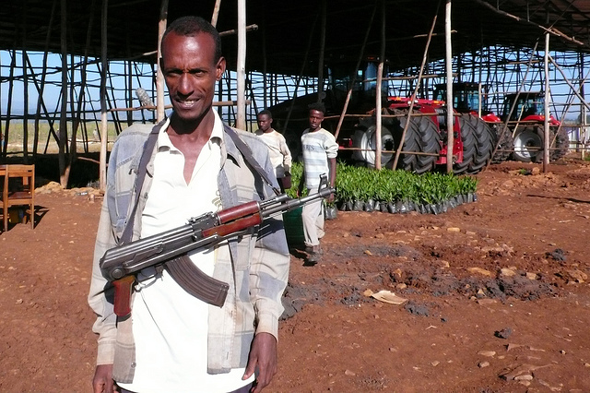
Oxfam estimates that nearly 230 million hectares of land (an area equivalent to the size of Western Europe) have been sold or leased since 2001 (with most of these transactions occurring since 2008). According to GRAIN, a global land rights NGO, more than two million hectares were subjected to transactions during the first four months of 2012 alone. One of the largest proposed deals – an attempt by South Korea’s Daewoo corporation to acquire 1.3 million hectares of farmland in Madagascar – failed back in 2009. Still, even larger investments are being planned today, including a Brazilian effort to acquire a whopping six million hectares of land in Mozambique to produce corn and soy (Mozambique offered a concession last year).
Continue reading on SustainableSecurity.org.
Sources: BBC, Food and Agriculture Organization, GRAIN, MercoPress, Oxfam, Reuters.
Photo Credit: “Garde armé,” courtesy of flickr user Planète à vendre. -
Open Data Initiatives at USAID Reflect Move Towards Collaboration, Enabling Efforts
›Over the past year and a half, USAID has been busy reinventing itself. The announcement of its USAID FORWARD initiative and the release (jointly, with the State Department) of the first Quadrennial Diplomacy and Development Review in late 2010 signaled significant changes for the organization, including several reforms designed to modernize operations and improve transparency. Part of that effort is making data collection and dissemination more open.
Thus far, the results have been encouraging.
September of last year saw the launch of an awareness campaign focused on the Horn of Africa, co-sponsored by the Ad Council and called, somewhat confusingly, USAID FWD (famine, war, drought). As part of the program, USAID published a collection of regional maps, aggregating the organization’s substantial data pool and showing everything from food and water security to the movement of refugees and IDPs (internally displaced persons).
Using data from its own FEWS.NET site, USAID created the maps with open-source tools, allowing other organizations and concerned individuals to leverage the data for additional aid and outreach activities. Many, including the ONE Campaign and InterAction, were quick to incorporate the maps and underlying data into their own activities.
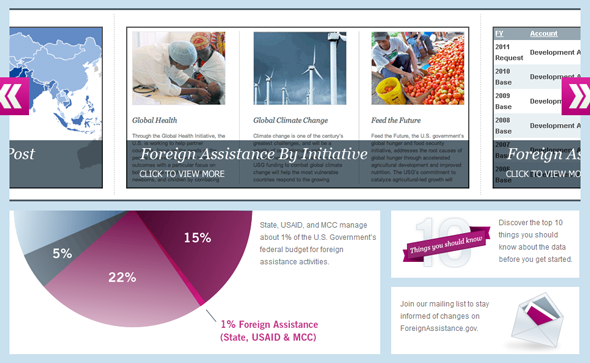
In order to promote greater data access and transparency, USAID also collaborated with the Department of State to create the Foreign Assistance Dashboard, a website that provides sortable aid budget allocation data to the general public. Launched in late 2010 with frequent updates since, the site allows users to see easily how aid is apportioned by region, sector, initiative, or other categories.
For instance, visitors can see that USAID more than quadrupled its humanitarian assistance to Pakistan in 2010 as a result of that country’s devastating flooding. Aid then fell back to near 2009 levels the following year.
Recently, USAID has also taken its open data efforts to the Web. Faced with 117,000 records of development loans provided by its own Development Credit Authority and lacking proper geographic coding, the organization undertook a pioneering experiment in crowdsourcing this June. Civilian volunteers from the online technical communities GISCorps and the Standby Task Force pitched in to help code the data, as did unaffiliated citizens attracted by social media campaigns.
The end results were outstanding: the volunteers finished the job in just 16 hours, although USAID had initially expected the operation to take 60.
Representatives from USAID recently published an illuminating case study about the crowdsourcing experiment and launched it at the Wilson Center. “By leveraging partnerships, volunteers, other federal agencies, and the private sector, the entire project was completed at no cost,” the report noted, adding that USAID hoped to have “blaze[d] a trail to help make crowdsourcing a more accessible approach for others.” One of the case study authors, Shadrock Roberts, noted that “we need to be working as hard to release relevant data we already have as we are to create it.”
USAID’s recent experiments with transparency and greater civilian participation appear to be part of a larger organizational shift toward greater openness and collaboration. Administrator Rajiv Shah seemed to confirm this in a March interview with Foreign Policy, when he spoke at length about the benefits of partnering with the private sector as well as other NGOs.
The recently reported demise, or at least great diminishing, of President Obama’s Global Health Initiative (GHI), which closed its doors amid a heated turf battle between USAID, the State Department, and PEPFAR, lends credence to this theory as well. The official GHI blog stated last week that it would “shift focus from leadership within the U.S. Government to global leadership by the U.S. Government.” This appears to indicate greater future emphasis on collaboration, with an eye toward enabling non-USAID actors to play a greater role in the development process.
It remains to be seen how USAID’s role and strategy will change over the next few years. However, results from the organization’s initial attempts at open data and open government policies have been positive in many respects, and there is reason to hope they will continue to push the boundaries in these areas.
Sources: Center for Global Development, Foreign Assistance Dashboard, Foreign Policy, Global Health Initiative, USAID.
Image Credit: Foreign Assistance Dashboard. -
Visualizing Complex Vulnerability in Africa: The CCAPS Climate-Conflict Mapping Tool
›“Every crisis is complex, and the Sahel is no exception,” wrote USAID Assistant Administrator Nancy Lindborg in a recent Huffington Post article that called for “smarter programming and a coordivenated response” to chronic crises. “A regional drought has been overlaid with instability stemming from the coup in Mali and conflict in the northern part of that country where armed militant groups have forced the suspension of critical relief operations” and led to refugee movement into neighboring countries simultaneously challenged by drought and crop infestation. Understanding the complexity of this type of crisis, let alone visualizing the multiple factors that come into play, is a growing challenge for policymakers and analysts.
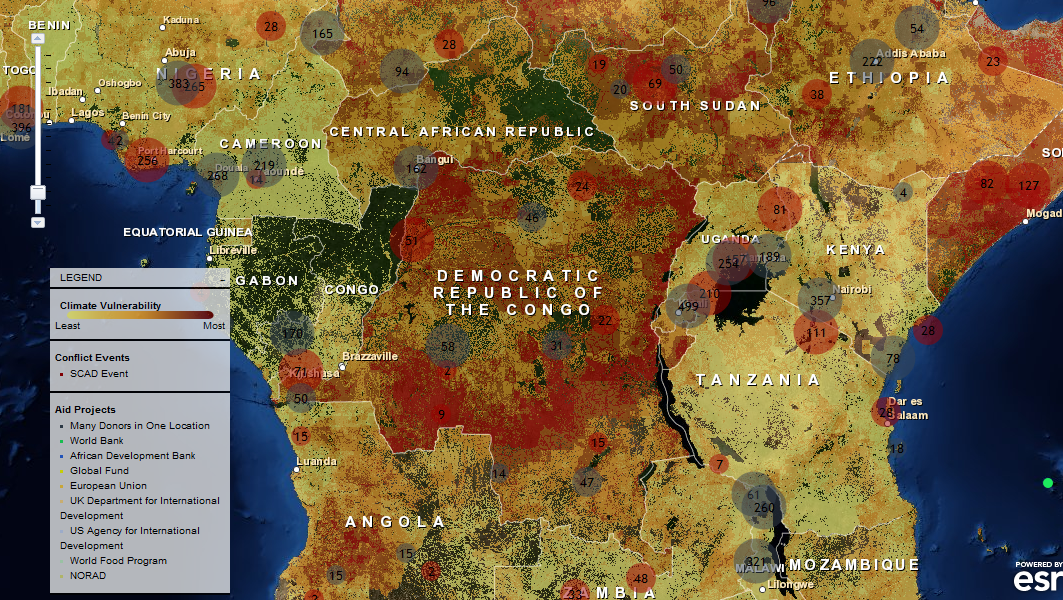
Enter version 2.0 of a mapping tool created by the Climate Change and African Political Stability Program (CCAPS) housed in the Robert S. Strauss Center for International Security and Law, based at the University of Texas, Austin.
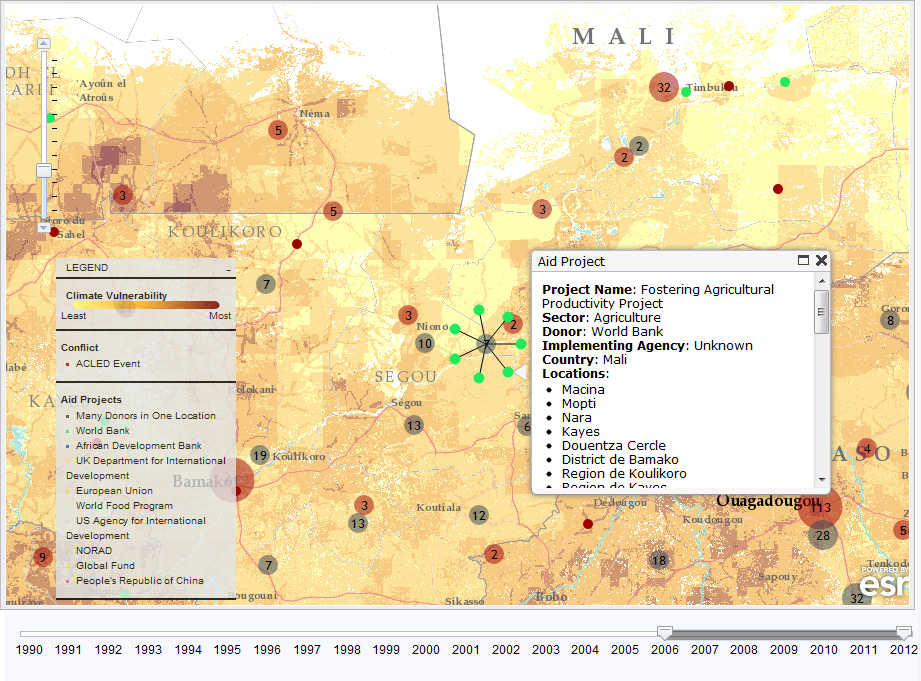
In collaboration with the College of William and Mary, Trinity College, and the University of North Texas, and with funding by the U.S. Department of Defense’s Minerva Initiative, CCAPS originally launched the mapping tool in March of this year. The map is powered by mapping and data tools from Esri and allows users to view any combination of datasets on international development projects, national governance indicators, incidences of conflict, and climate vulnerability data.
With an intuitive interface and compelling visuals, the mapping tool is a valuable resource for policy analysts and researchers to assess the complex interactions that take place among these environmental, political, and social factors. Advanced filters allow the user to identify a subset of conflicts and aid projects and there are nine base map styles from which to choose.The mapping tool is anything but static. The team is constantly working to refine and enhance it through the inclusion of additional indicators and improvement of the interface. The updated version now includes CCAP’s new Social Conflict in Africa Database, which tracks a broad range of social and political unrest, and their partners’ real-time conflict dataset, the Armed Conflict Location and Event Dataset (ACLED), which tracks real-time conflict data. Impressively, the ACLED data will be updated weekly.
I asked CCAPS program manager Ashley Moran to clarify how the governance indicators work in the model. She explained:The national governance indicators are included in one of four baskets that make up the climate vulnerability model…and represent four potential sources of vulnerability: physical exposure to climate-related hazards, population density, household and community resilience, and governance and political violence. They used the term “basket” since most include several indicators that reflect the full dimensions of that source of vulnerability. The fourth basket includes five national governance indicators and one indicator of political violence.
Moran also shared plans to add more detailed national governance data to the map:We are developing a mapping tool specifically for the climate vulnerability model, which will allow users to see the component parts of the model. It will allow users to re-weight the baskets (e.g. if a user thought governance should have more weight within the model since the government response to climate hazards is key), and it will also allow users to examine an area’s vulnerability to just one or two baskets of the user’s particular interest (instead of all four baskets combined as the tool does now). When we launch this, a user will essentially be able to see the vulnerability model disaggregated into its component parts, so they’ll be able to map just the governance data in the model, if they want.
In the coming months, the CCAPS team will add more detailed historical and projected data on climate vulnerability, data on disaster response capacity, as well as international aid projects coded for climate relevance.
Each of these datasets on their own are a wealth of vital information, but understanding how they intersect and the potential impact of their interactions is crucial to improving our understanding of them individually and collectively and creating responses that are timely and long-lasting.
If you’re in the San Diego area next week, check out Ashley Moran’s presentation of the mapping tool at the Esri International User Conference and the Worldwide Human Geography Data Working Group.
Sources: The Climate Change and African Political Stability Program, The Huffington Post.
Image Credit: CCAPS -
Urban Resilience: What Is It and How Can We Promote It?
›A new study on the intersection of violence and economic development in cities breaks new ground by examining how communities respond to and cope with extant violence, rather than focusing on the root causes of violence in a given area. Authors Diane Davis, Harvard professor of urbanism and development, and John Tirman, executive director of MIT’s Center for International Studies, spoke at length about the origins, methodology, and findings of the report, Urban Resilience in Situations of Chronic Conflict, at the Wilson Center on July 12. The report was supported by USAID’s Office of Conflict Management and Mitigation.
“We made the decision that we weren’t going to produce yet another research project or study on the root causes of violence, because there is a lot of incredibly good work on that [already],” said Davis. “We wanted to take a totally different angle…to try to think about taking a more pragmatic approach that builds on how everyday people, who live with violence, respond.”
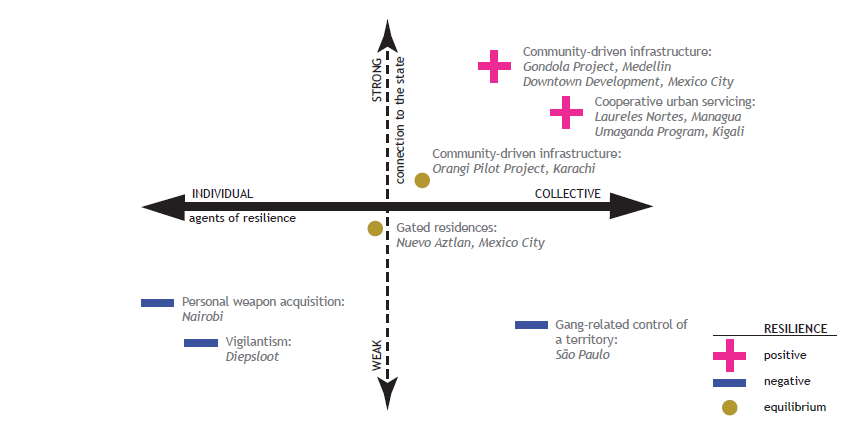
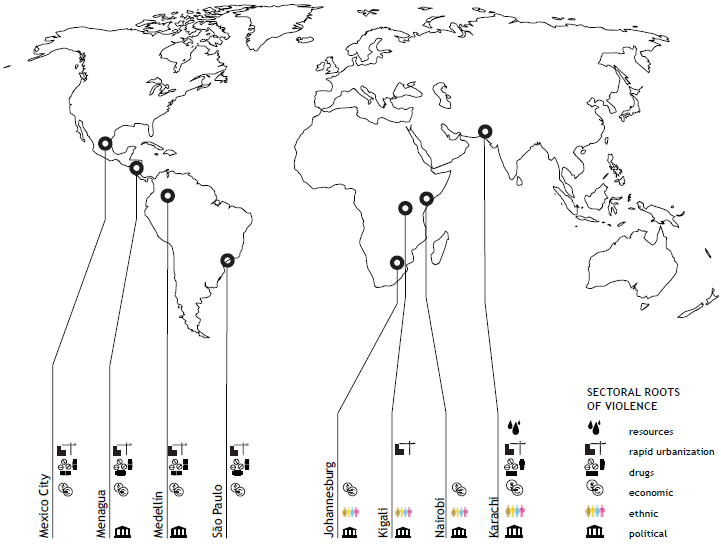
To do this, Davis and Tirman focused their research on seven cities around the world with histories of chronic violence, creating a case study for each and then comparing results. (An eighth city, Karachi, was jettisoned because it was deemed too unsafe for research.) The comparative process allowed Davis and Tirman to develop a basic theoretical framework for how different factors increase or decrease a community’s resilience to violence.
Defining Resilience
The term “resilience” lies at the heart of the new study. “The idea of ‘bouncing back,’ or returning to normalcy, is [generally] the measurement standard for looking at resilience,” Davis said.
However, she was quick to point out the problems with such a simplistic definition. “[In] cities of the developing world…things are in flux. So it’s really hard to know what a ‘bouncing back’ is if things are constantly changing.”“Also,” she added, “in many of the environments we were looking at, violence is a consequence of the way things were under normal conditions. So you don’t necessarily want to bounce back to those conditions that were producing the violence in the first place.”
Davis and Tirman sidestepped these problems by letting their research define successful resilience, rather than trying to fit their results to a prefabricated definition of the word. In doing so, they were able to identify several important commonalities in the cities and communities that displayed the most positive resilience to violence.
“Our findings suggest that resilience appears at the interface of civilian and state action,” Davis writes in the report. She underscored the significance of civilians as facilitators in both developing and implementing better security policies: “People who live in violence know more than academics or policymakers about what they can and can’t do to deal with the problem of violence,” she said.
Focus on Community
Davis and Tirman pointed out that the most successfully resilient cities they studied – Mexico City, Managua, and especially Medellín – seemed to have a number of civilian/state relationships defined “from below,” rather than the more problematic “top down” approach. This means that civilians and communities were participating on their own terms, collaborating with city planners and with law enforcement agencies to get their needs met rather than simply being what Davis called “yes men” to higher authorities.
Physical space – what Davis referred to as “the weight of the spatial” – also played a very significant role in Urban Resilience. She and Tirman made the conscious decision to incorporate physical planning and design into their research, eschewing the more typical sectoral approach to violence and security.
This methodological break from the existing literature was particularly useful in demonstrating that violence-plagued communities are often themselves the most important agents of resilience. “Citizens have to be able to make real decisions on their own,” Davis stressed in the Q&A; session that followed her and Tirman’s presentation. “[They] have to feel that ownership, that autonomy of the decisions in their neighborhood, even if they’re bad [decisions], because that’s what ties them to each other.”
“We think the starting point for generating resilience is really supporting and enabling communities to make dense horizontal relationships with others in their neighborhood, across sectors, that allow them to push back against perpetrators of violence.”
In other words, while the state can play a significant role in helping communities to mitigate violence, successful resilience ultimately requires the commitment and participation of the communities in question.
“The state might have a security program, it might have a planning program, but every decision has to be made with an understanding of what’s good for that particular neighborhood,” Davis said.
Places People Want to Protect
Davis was very succinct in offering recommendations based on the study. For policymakers and urban planners, she said resilience is formed by “a combination of good governance, security reform, and…inclusive urban planning.” Citing examples from Mexico City, Medellín, and elsewhere, Davis pointed to planning policies like mixed land use, greater pedestrian accessibility, and more parks and public spaces as ways that authorities could engender the kind of community pride so crucial to the development of positive urban resilience.
“[Focus on] generating vibrant public areas where people feel invested in protecting [them] and making them better,” she advised.
While many scholars have tended to look either at the state or local communities in isolation when considering violence and resilience, Davis argued that reducing violence was “a shared objective.” She thus stressed the importance of “co-production of security,” reiterating the overall notion that state and community actors need to work side-by-side in a form of what Davis and Tirman called “cooperative autonomy.”
In addition to Urban Resilience in Situations of Chronic Violence, Davis also authored the supplementary Toolkit for Urban Resilience in Situations of Chronic Violence. Both documents can be found on the MIT’s website. Davis and Tirman hope to add the seven individual case studies to the site soon.
Event Resources:Photo Credit: “Bogota at night,” courtesy of flickr user WanderingtheWorld (Christopher Schoenbohm); charts courtesy of Davis and Tirman. -
‘Motherland Afghanistan’ Shows Maternal Mortality Not Just A Health Issue
›Afghanistan has one of the highest rates of maternal mortality in the world: 327 out of every 100,000 women who give birth die during childbirth. Despite some recent improvements, political, social, cultural, and economic factors present enormous challenges. Last month, the Center for Population and Development Activities hosted an online viewing and dialogue discussion of the PBS Independent Lens film Motherland Afghanistan, which follows Afghan-American filmmaker Sedika Mojadidi and her father, Dr. Qudrat Mojadid, as they return to their home country and visit the Laura Bush Maternity Ward in Kabul. The conditions they find are devastating and underscore not only the need for greater commitment to reproductive health services, but also the advancement of women’s and girl’s access to education, security, and political participation.
-
Pop at Rio+20: Despite Failure Narrative, Progress Made at Rio on Gender, Health, Environment Links
›July 13, 2012 // By Sandeep BathalaA month ago this weekend I boarded a plane to Rio de Janeiro for the UN Conference on Sustainable Development. Over the past few weeks, I have had some time to reflect on the amazing (and exhausting) experience afforded to me. Unfortunately, the final Rio+20 outcome document (considered by some to be misnamed as “The Future We Want”) failed to recognize the connections between reproductive rights and sustainability. However, since I returned I’ve also found myself in conversations with colleagues eager to celebrate the successes of the conference.
Jason Bremner, program director at Population Reference Bureau, reminds me that the initial “zero draft document” that was circulated prior to Rio had absolutely no mention of reproductive health, family planning, or population. “Though the ultimate conference document wasn’t a success by many measures, I commend the efforts of the many advocacy organizations that resulted in the inclusion of reproductive health and family planning as a key aspect of sustainable development,” he said.
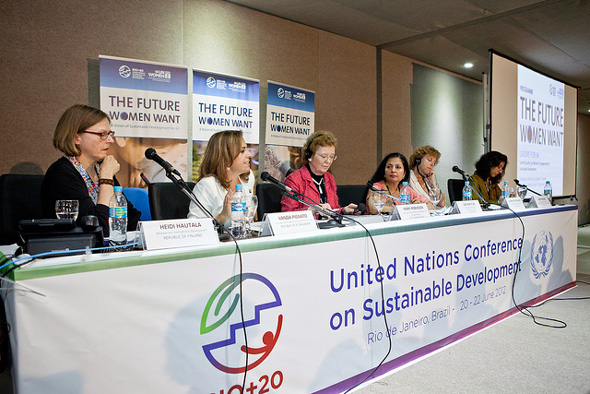
Other wins were recognized at Rio as well. On a panel organized by the International Planned Parenthood Federation, Brazilian Minister of Policies for Women Eleonora Menicucci de Oliveira pointed out that the presence of women this year was much stronger than at the 1992 conference. And she stressed that the overall importance placed on the reduction of poverty will have a big impact for women.
Though the official language was weakened in the final outcome document, there was much more support expressed at side events and off the record conversations. Speaking at the same event as Oliveira, Christian Friis Bach, Minister for Development Cooperation in Denmark, said that “one leader after another has stood up for reproductive rights, and we’ve started a campaign which will go on until ICPD+20.”
In fact, as the Wilson Center’s Brazil Institute Director Paulo Sotero points out, there was a great deal of progress made by non-government representatives alongside the main conference:I left Rio more hopeful about the future than the official part of Rio+20 would allow. As governments clearly fumbled in the face of the complex challenges of imagining and building a more equitable and sustainable economic growth model in the decades ahead, I saw senior business executives and leaders of civil society engaged in intelligent and productive dialogue about difficult issues at hundreds of thematic panels held at the Corporate Sustainability Forum and other sessions held in Rio.
I felt the same energy. And many groups there seemed to already be planning for next steps.
On the first day of side events I attended, members of the Population and Climate Change Alliance discussed strategies to ensure that in the post-2015 (i.e. post-Millennium Development Goals) international development agenda sexual and reproductive health and rights are explicitly recognized as core to sustainable development. The panel included Mialy Andriamahefazafy of Blue Ventures Madagascar, Joan Castro of PATH Foundation Philippines, Inc., and Negash Teklu of PHE Ethiopia Consortium, who all shared examples of efforts in their countries to integrate reproductive health with other sustainable development programs.Joan Castro on PATH Foundation’s work in the Philippines
The Rio+20 conference was, at the very least, a re-affirmation of the tenets set down by the ‘92 Earth Summit – that is, that there is middle ground between full-tilt economic development and uncompromising environmentalism, called “sustainable development,” and we ought to be moving towards it. It was also a fantastic gathering place for disparate groups of people to come together on to similar issues and to build momentum and networks on their issues.
For those hoping to see a stronger link recognized between reproductive rights, population, and the environment, the good news is that elsewhere, awareness and momentum seems to be growing. Just this week, The Bill and Melinda Gates Foundation joined the United Kingdom, United States, France, Germany, the Netherlands, South Korea, Norway, Sweden, and Australia to pledge more than $2.6 billion towards meeting global unmet for contraceptives. And the connection to development was explicit: “Contraceptives are one of the best investments a country can make in its future,” reads the summit website.
Coincidence to have followed so closely behind a “disappointing” Rio outcome? Perhaps not.
Sources: The Bill and Melinda Gates Foundation, Estado, UN Conference on Sustainable Development.
Photo Credit: “UN Women Leaders Forum at Rio+20,” courtesy of UN Women.
Showing posts from category zz Organizations.